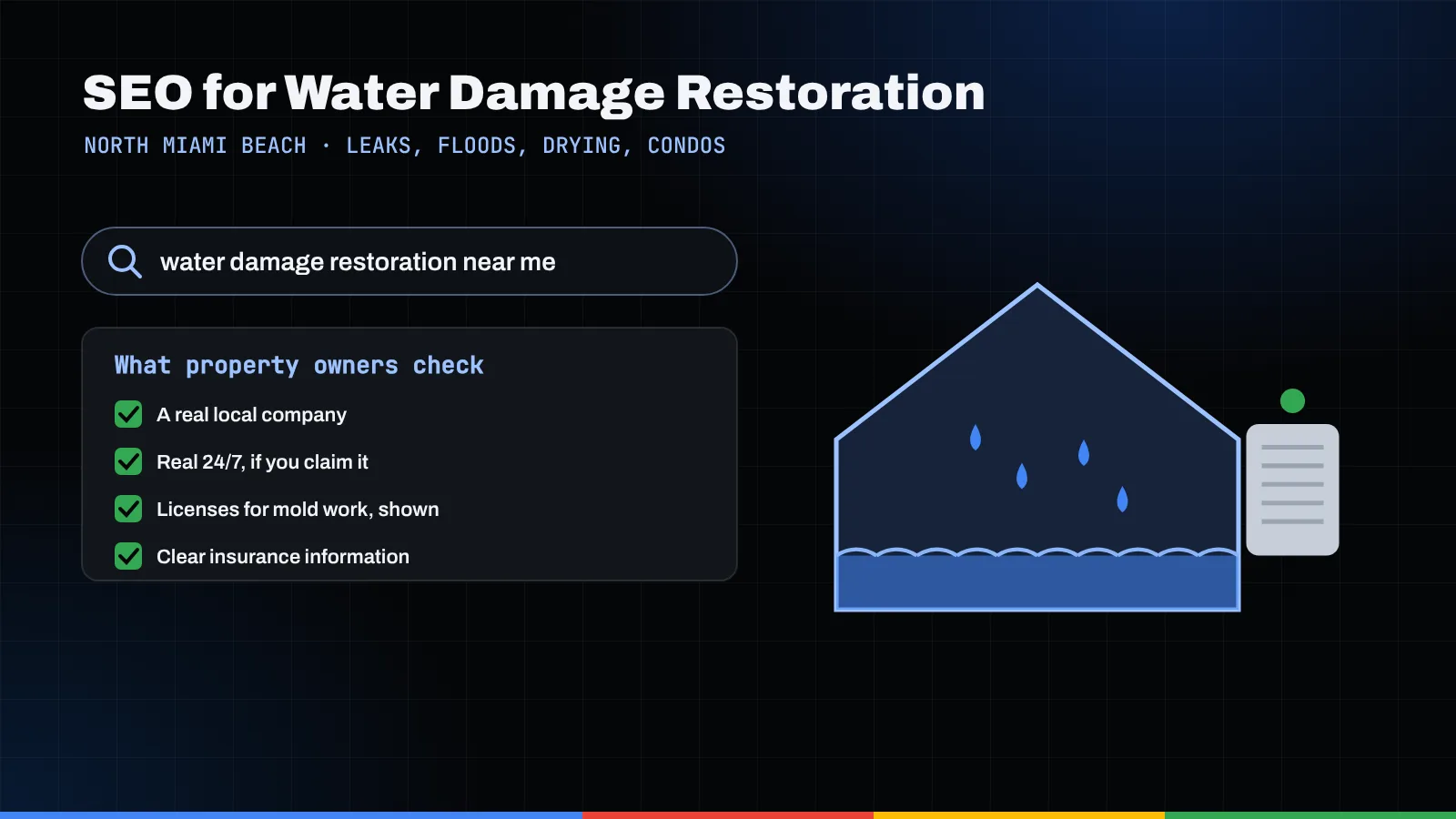
Water damage customers search in a hurry, so your marketing has to work like a good crew: show up fast, assess honestly and document everything. That means a rule-following Google Business Profile, a separate page for each kind of loss, a site that loads and dials quickly on a phone, and trust signals you can back up, from IICRC training to the mold licenses your people actually hold. Skip insurance-claim promises that Florida law has narrowed.
Key takeaways
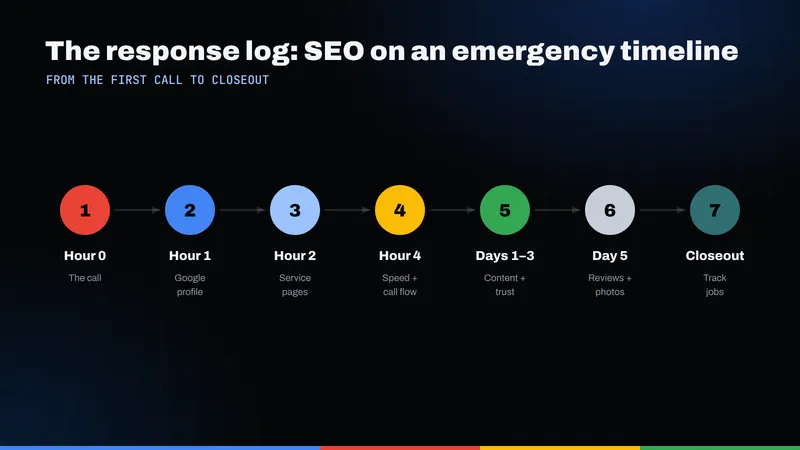
- Treat SEO like a job log: the call, arrival, assessment, extraction, drying, documentation and closeout each map to one piece of your marketing.
- Service-area businesses should hide a home address on Google, keep a realistic service area and use their real name. Claim 24-hour response only if someone truly answers and dispatches at 3 a.m.
- Water damage attracts lead-gen listings. Google's Business Redressal Complaint Form handles misleading names, phone numbers and websites on Maps.
- Florida licenses mold assessors and mold remediators individually through DBPR and bars one person or company from assessing and remediating the same structure within 12 months, with a narrow contractor exemption.
- Florida voids attempts to assign post-loss benefits under property policies issued on or after January 1, 2023, so old AOB language deserves an attorney's review.
Hour 0: the call (who's searching and how urgent)
Every water job starts the same way. Somebody is standing in an inch of water, or watching a stain spread across the ceiling, with a phone in one hand. They aren't comparing ten companies over coffee. They want someone who looks real, looks close and picks up.
That's why SEO for water damage restoration differs from SEO for most home services. The gap between "I have a problem" and "I called someone" is short, and the decision usually happens on one screen: the map results, a profile, maybe one page of your site. If that screen looks vague, the caller moves to the next listing.
To keep this concrete, picture a hypothetical mitigation company we'll call Tidecrest Restoration, a three-van crew serving North Miami Beach and nearby cities from the owner's home office. Tidecrest is invented for this article. It has no reviews, rankings or results, and it isn't a client. It's a job file we can walk through.
Tidecrest's callers fall into a few groups:
- The active emergency: a burst supply line, failed water heater or overflowing AC drain pan. They call the first credible number.
- The condo neighbor: water coming through the ceiling from the unit above, or their leak reaching the unit below.
- The storm aftermath: wind-driven rain or flooding. These calls arrive in clusters, so capacity matters as much as rankings.
- The slow discovery: a musty smell, soft baseboards, a stain under the sink. More research, often a mold question.
- The property manager: someone responsible for many units who wants a dependable vendor.
Project manager's note: before touching the website, write down which of these jobs you want more of and which ones you can staff at 2 a.m. Filling the phone with calls you can't run is worse than no marketing.
Hour 1: arrival (your Google Business Profile)
Your Google Business Profile is the van pulling into the driveway. For urgent local searches it often matters more than your website, which is why our Google Maps SEO work starts here.
Google's Business Profile guidelines say a service-area business should hide its address and generally keep its service area within about two hours of driving time. A storefront-less business gets one service-area profile, a virtual office doesn't qualify unless it's staffed during business hours, and the phone number must be under the business's direct control, preferably a local number.
The name is where restoration companies get into trouble. Google doesn't allow marketing taglines or hours information in the business name and warns that extra information can lead to suspension. "Tidecrest Restoration" is fine. "Tidecrest 24/7 Water Damage Flood Mold Removal North Miami Beach" is not.
Can you call yourself 24 hours?
Only if it's true. Google asks for your regular customer-facing hours, and its examples treat "Open 24 hours" as a valid hours setting for a business that really is open around the clock. The test is simple: if a real person answers at 3 a.m. and can send a crew, say so. If nights go to a voicemail checked at 7 a.m., list the hours you staff and describe your after-hours process on your site.
Dealing with fake and lead-gen listings
You'll run into listings that don't look like real local companies: keyword-stuffed names, no photos, phone numbers that route who knows where. Google's Business Redressal Complaint Form is for reporting misleading or fraudulent names, phone numbers or URLs on Maps. It asks for the Maps URL and a factual explanation, and Google says it can't guarantee action or send status updates. File calmly, then keep making your own listing obviously real.
Local Services Ads
Google lists "Water damage services" as an eligible category in its Local Services Ads documentation, and businesses that pass its screening can earn the Google Verified badge. LSAs can help during busy weeks, but they don't replace a profile and site that hold up on their own.
Hour 2: assessment (service pages for each kind of loss)
A good tech walks the whole loss before setting a single fan. Your website should separate problems the same way. A "Services" page listing fifteen things in a row gives Google little to rank and gives a panicked caller little to trust. Most restoration company SEO problems we see start right here.
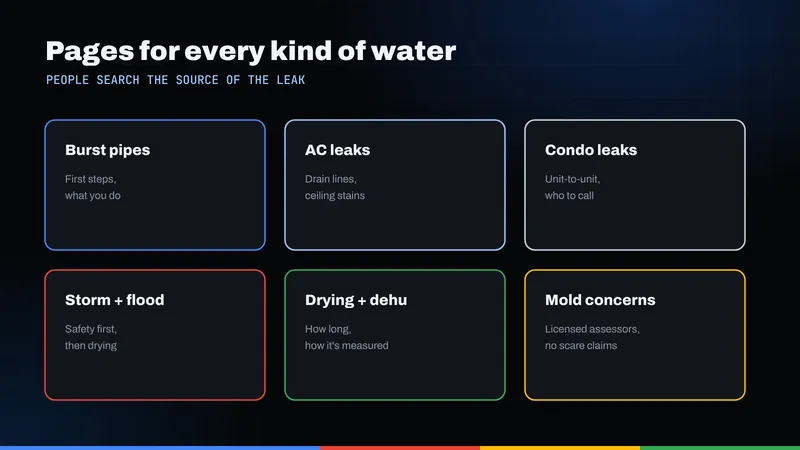
Here's how Tidecrest might map situations to pages. The phrases illustrate how people describe these problems; they aren't measured search volumes.
| Situation | What customers tend to search | Page to build |
|---|---|---|
| Burst pipe or failed supply line | "burst pipe water cleanup," "water extraction near me" | Emergency water extraction |
| AC drain line or air handler leak | "AC leaking water through ceiling" | AC leak water damage |
| Leak from the unit above or into the unit below | "water coming through ceiling condo" | Condo and unit-to-unit leaks |
| Flooding or storm water intrusion | "flood cleanup," "storm water damage" | Flood and storm water cleanup |
| Wet walls, floors or cabinets | "structural drying," "dehumidification water damage" | Structural drying and dehumidification |
| Musty smell or visible growth | "mold inspection," "mold removal" | Mold services (licensed) or a mold referral page |
| Building or portfolio needing a vendor | "water damage company for property managers" | Commercial and property management |
Each page should answer the same questions plainly: what happens when you arrive, how you measure moisture, what decides how long drying takes, what the customer should do while waiting, and how to reach you. Use real photos of your own crew and equipment.
Project manager's note: on the condo page, explain that you document the source and affected areas for the owner, the neighbor and the association, but don't decide who's responsible. That belongs to the condo documents, the insurers and, if contested, attorneys.
If you also handle the leak itself, or refer it, our plumber SEO guide covers that side. Building a page system like this is the core of our local SEO work.
Hour 4: extraction (site speed and call flow)
Extraction is where speed stops being optional, and the same is true of your site. A caller with water on the floor won't wait for a homepage video to load on one bar of signal. We've written about how website speed affects revenue, and restoration is one of the clearest cases.
Test the call flow on a phone, outside, on cellular data:
- Tap-to-call above the fold on every page, with the number as real text.
- One clear next step: call now for active water, a short form for slow leaks and property managers.
- Honest response language. Never promise an arrival time you can't keep across your whole service area.
- A short safety checklist: shut off the water if it's safe, stay away from wet outlets and devices, photograph the damage.
- Answer the phone. Track missed calls by hour and fix staffing before buying more traffic.
If you use call tracking, make sure the number on your profile still reaches your business directly, in line with Google's phone rules.
Day 1–3: drying (content and trust)
Drying takes days of steady attention, and so does content. A few accurate articles published over time build more trust than a burst of thin posts. Good topics come straight from the job: what moisture readings mean, why equipment keeps running after the floor feels dry, how AC leaks show up before anyone notices, and what a condo owner should document after a neighbor's leak. Don't publish timelines or costs you can't stand behind.
Credentials that mean something
The IICRC publishes the ANSI/IICRC S500 Standard for Professional Water Damage Restoration, currently the 2021 fifth edition. It describes procedures and precautions for restoration in residential, commercial and institutional buildings, and notes that correcting the water source is the property owner's responsibility, not the restorer's. If your team works to S500 and holds IICRC training, name the certifications and who holds them. "Certified" with no detail reads as filler.
A careful line on mold
Mold content is where restoration sites most often overreach. Don't make health claims, diagnose symptoms or sell with fear. Describe the service, the license that covers it and the process. If a reader has health concerns, point them to a medical professional.
Day 3: moisture readings (licensing and insurance rules)
Around day three, a good crew checks readings and adjusts. It's also the moment to check your site against the rules. This is general information about what we verified, not legal advice.
Mold assessor and mold remediator licensing
Florida licenses mold assessors and mold remediators under chapter 468, Part XVI. DBPR's mold-related services FAQ says the department licenses individuals, not businesses, and that holding both titles takes two licenses. Section 468.8419 adds prohibitions that shape your marketing:
- Using a title like "mold assessor" or "mold remediator" without complying with the licensing part is prohibited.
- The same person or company may not assess and then remediate (or remediate and then assess) the same structure within 12 months, with an exemption for certain certified Division I contractors.
- Assessors and remediators may not exchange referral payments, inducements or rewards.
So your mold page should name the licensed individuals and license types, and never imply one company will test and then remediate the same home. If Tidecrest only does water mitigation, its referral page shouldn't rest on a fee-for-referral deal.
What about water mitigation itself?
In the statutes and DBPR pages we reviewed, we didn't find a separate state license for water extraction and drying, and we won't claim one isn't required. Follow-on repairs like drywall, plumbing or electrical can fall under contractor licensing. Confirm your scope with DBPR and the local building department, and list only licenses you hold.
Assignment of benefits
Plenty of restoration sites still say "just sign an AOB and we'll deal with your insurance." Florida's section 627.7152, amended by 2022 legislation, now says in subsection (13) that a policyholder may not assign post-loss benefits under a residential or commercial property policy issued on or after January 1, 2023, and that any attempt is void, invalid and unenforceable. The section's assignment requirements cover agreements under policies issued from July 1, 2019, up to January 1, 2023.
Audit every page, ad and form for AOB wording and have a Florida attorney review what's left. Florida also restricts certain claim-related solicitation by contractors, which we covered in our roofing SEO guide. Our insurance agent SEO post shows how agents talk to the same homeowners. Don't interpret policies or promise coverage on your pages.
Day 5: documentation (reviews and photos)
Restoration runs on documentation: moisture maps, photos, equipment logs. Document your reputation just as carefully.
Ask every customer for a review at the same point, usually after final readings, with the same simple message. Google's contribution policies prohibit review incentives, asking only happy customers, discouraging negative reviews and conflict-of-interest reviews from employees or family. The FTC's final rule on fake reviews, announced August 14, 2024, bans fake and AI-generated reviews, sentiment-conditioned incentives, undisclosed insider reviews and suppression through threats or intimidation.
Post your own job photos: equipment in a real room, meters in use, the crew and vans. Get permission first, and keep addresses, faces, unit numbers and belongings out of frame. On condo jobs, avoid anything that identifies the building or the neighbor.
Project manager's note: reply to every review, including angry ones, with facts and no customer details. A calm reply to a hard review can reassure the next caller more than another five stars.
Closeout (tracking and schema)
A job isn't closed until the paperwork is done. At month's end, Tidecrest would review:
- Calls by source: profile, organic pages, LSAs and referrals, answered versus missed.
- Calls by job type: burst pipe, AC leak, condo, storm, mold question.
- Booked jobs, not just leads. Ten real extraction jobs beat a hundred tire-kickers.
- Profile health: Google edits, new photos, review replies and suspicious listings worth reporting.
Structured data is the last bit of paperwork. Schema.org has no restoration-specific type. HomeAndConstructionBusiness, a LocalBusiness subtype, is a reasonable fit, while EmergencyService is described as being for places like fire stations and emergency rooms, so it's the wrong label. Keep markup consistent with the visible page: real name, phone, service area and hours. Our post on how schema helps search engines covers the mechanics.
Restoration companies that do well with local SEO in Miami and nearby cities treat it like equipment maintenance: checked often, fixed before it fails. Start with our North Miami Beach SEO page or our broader approach to SEO in Miami, and when you're ready, request a free audit of your profile and site.
Frequently asked questions
What matters most in SEO for water damage restoration companies?
A Google Business Profile that follows Google's rules, backed by a fast mobile site with a separate page for each type of loss you handle. Hide a home address, keep a realistic service area, use your real name and list hours you actually staff.
Can a restoration company list itself as open 24 hours on Google?
Only if it's true. Google asks for regular customer-facing hours and doesn't allow hours or taglines in the business name. If a real person answers and can dispatch around the clock, say so; if not, list your staffed hours.
Do I need a license to advertise mold remediation in Florida?
Florida licenses mold assessors and mold remediators as individuals through DBPR, and section 468.8419 prohibits using those titles without complying. It also bars assessing and remediating the same structure within 12 months, with an exemption for certain certified Division I contractors. Confirm your situation with DBPR or an attorney.
Can I still advertise assignment of benefits in Florida?
Section 627.7152(13) says post-loss benefits under residential or commercial property policies issued on or after January 1, 2023 may not be assigned, and attempts are void. Remove outdated AOB language and have a Florida attorney review insurance wording. This is general information, not legal advice.
Can water damage companies use Google Local Services Ads?
Yes. Google lists water damage services as an eligible Local Services Ads category, and businesses that pass screening can earn the Google Verified badge. LSAs work best alongside a strong profile and website.