SEO for plumbers comes down to being the right answer for the specific call a homeowner is about to make. Set up a service-area Google Business Profile with true hours, build one page per job (burst pipes, drains, water heaters, repipes, leak detection), put your Florida license number everywhere you advertise, and earn reviews honestly. Do that and the person with water on the floor can call you without second-guessing.
Key takeaways
- Organize your site and profile around the calls you actually take: emergencies, drains, water heaters, repipes and leaks each need their own page.
- Most plumbers are service-area businesses. Google says to hide your address and keep the service area within roughly two hours of driving from your base.
- Only claim 24-hour service if a person or an on-call tech really answers at 2 a.m., and set your Google hours to match.
- Florida law requires a contractor's certification or registration number in every advertisement, regardless of medium.
- Ask every customer for a review the same way. Paying for reviews, gating them or posting fake ones breaks Google policy and the FTC's 2024 rule.
What does SEO for plumbers actually need to do?
Call type: any inbound call / Urgency: varies / What they need to see: proof you do this job, here, now.
Picture the dispatch board on a busy Monday: a slab leak, a sink that won't drain, a landlord asking for a repipe quote. Different callers, different speeds.
Search works the same way. The person typing "emergency plumber near me" at night won't read your About page. The person comparing repipe quotes will read every word. Good plumber SEO gives each caller the page that answers them.
So the job breaks into four parts:
- Get found: a clean Google Business Profile and a site Google can understand.
- Match the call: one page per job type, written for the person making that call.
- Prove you're legit: license number, permits, insurance, real reviews.
- Make it easy to call: tap-to-call phone number, true hours, a short form for non-urgent work.
If you've read our SEO guide for contractors in North Miami Beach, the foundation is similar. This post stays on plumbing: the calls, the urgency and what each caller needs before they pick up the phone.
How should a plumber set up Google Business Profile?
Call type: "plumber near me" from a phone / Urgency: high / What they need to see: a nearby name, real hours, reviews, a call button.
For a lot of calls, your Business Profile is the only thing a customer sees before dialing.
Most plumbers drive to the customer instead of running a storefront. Google calls that a service-area business, and its Business Profile guidelines are specific about it:
- Hide the address. Google says service-area businesses should hide their business address from customers. If you run the company from your house, the address stays private.
- Keep the service area honest. The guidelines say a service area shouldn't extend farther than about two hours of driving time from where the business is based, though larger areas may be appropriate for some businesses.
- No virtual offices. A service-area business can't list a "virtual" office unless it's staffed during business hours.
- Name only. Use your real business name. Google doesn't allow service info, location info or taglines stuffed into the name, and says it can lead to suspension. "Smith Plumbing" is fine. "Smith Plumbing 24/7 Emergency Drain Cleaning NMB" isn't.
Profile checklist
- Primary category set to plumber; add secondary categories only for work you actually do.
- Services list filled in with each job type (drain cleaning, water heater repair, repiping, leak detection).
- Phone number that matches your website and rings a person or a real answering setup.
- Photos of your trucks, your techs on the job and finished work, not stock images.
- A link to the matching page on your website.
For the profile basics in more depth, see our Google Business Profile guide for North Miami Beach businesses, or our Google Maps SEO service if you'd rather hand it off.
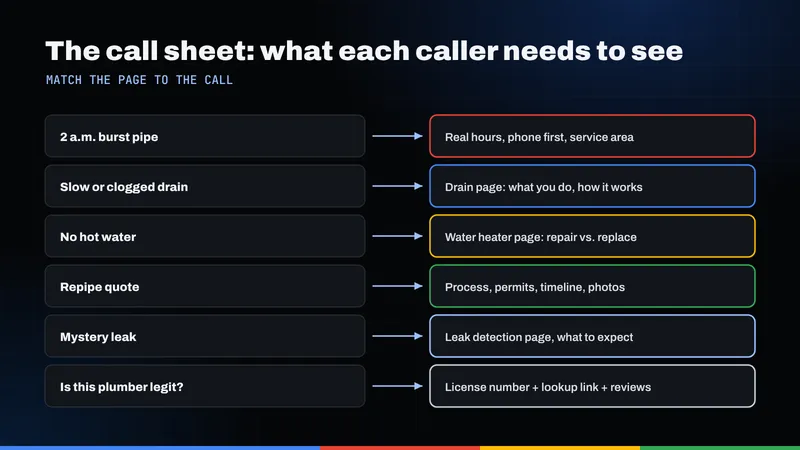
2 a.m. burst pipe: when can you say "24/7"?
Call type: 2 a.m. burst pipe / Urgency: right now / What they need to see: a number that answers and hours that are true.
This is the call where false claims hurt most. The homeowner has water running and calls the first listing that says emergency. If nobody answers, they call the next plumber.
Rule one: only say 24-hour if it's true. That means a person or an on-call tech actually picks up at 2 a.m., and someone can actually roll a truck. "We return calls in the morning" isn't 24-hour service.
Rule two: make your Google hours match. Google's guidelines ask for your regular customer-facing hours, and its own example of a 24-hour business sets the hours to "Open 24 hours." Business hours also can't go in your business name. If your site says 24/7 but your profile says 8 to 5, you're sending mixed signals to customers and to Google.
Emergency page checklist
- Phone number at the top, tap-to-call on mobile, repeated after each section.
- What to do right now: how to find and shut off the main water valve, and when to cut power near the leak.
- What you'll do when you arrive: find the source, stop the water, explain repair options.
- Which neighborhoods you can reach at night, if your after-hours area is smaller than your daytime one.
- How after-hours pricing works, described honestly. Don't post numbers you won't honor.
If you don't run nights, say so. "Same-day service during business hours" still sells.
Slow drain: what goes on a drain cleaning page?
Call type: slow or clogged drain / Urgency: today or this week / What they need to see: you handle this exact problem, and how.
A slow drain isn't a crisis, so this customer shops a little. They search the symptom ("kitchen sink draining slow," "toilet keeps backing up") as often as the service. A line on a services list can't answer that. A dedicated drain cleaning page can.
- Name the symptoms people actually describe: gurgling, slow tubs, backups in more than one fixture, smells.
- Explain the methods you use, such as snaking, hydro jetting or camera inspection, in plain words, and when each one makes sense.
- Say when it's bigger than a clog. Multiple fixtures backing up can point to a main line problem. Saying so builds trust.
- Split residential and commercial if you serve both.
If a question comes up on every call, answer it on the page.
Water heater out: why does every job need its own page?
Call type: no hot water / Urgency: today / What they need to see: you repair and replace their type of unit.
Nobody's house is flooding, but nobody wants a cold shower tomorrow. These callers want to know: can you fix it, and if not, can you replace it soon?
A strong water heater page covers:
- The unit types you service: tank, tankless, electric, gas. Only list what you actually work on.
- Repair vs. replace: what you check, and how you help the customer decide.
- What happens on install day, including haul-away of the old unit if you do it.
- Brands you service, if you're comfortable naming them. Don't imply a manufacturer partnership you don't have.
- Permits: if the job in that jurisdiction needs one, say you pull it.
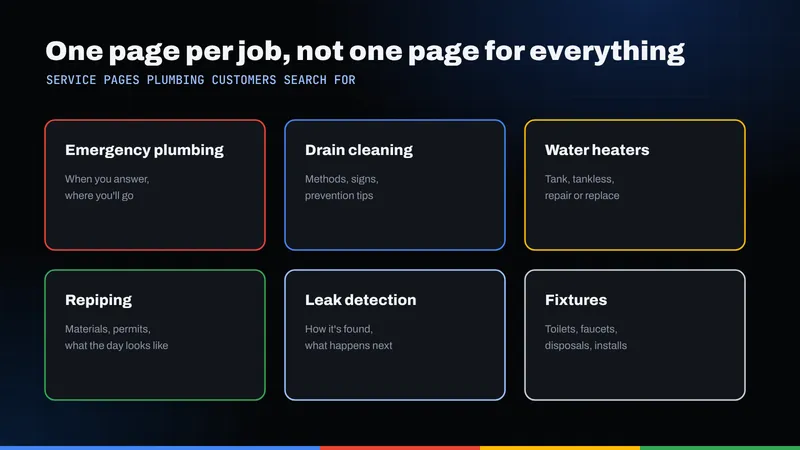
Every distinct job gets its own page: emergencies, drains, water heaters, repiping, leak detection, sewer lines. Each targets a different search. Whether you call it plumber SEO or local SEO in Miami, the structure is the same. Our local SEO service builds pages this way for each service and the areas you cover.
Leak detection, quickly
Leak detection deserves its own page. The caller has a symptom (a high water bill, a damp wall, a meter that keeps spinning) and wants the source found without tearing up the house. Explain your equipment and process, and whether you also make the repair.
Repipe quote: how do license numbers and permits build trust?
Call type: repipe quote / Urgency: low, high dollar / What they need to see: you're licensed, you pull permits, you explain the job.
Repipe customers take their time and compare several companies. They want proof you're licensed and won't leave walls open and permits unpulled.
Florida plumbing licensing basics
Plumbing contractors in Florida are licensed under Chapter 489 of the Florida Statutes. The Department of Business and Professional Regulation's Construction Industry Licensing Board page explains the two tracks:
- Certified contractors hold a state certificate of competency and can contract in any jurisdiction in Florida. License numbers start with "C" (plumbing is CF).
- Registered contractors met a local jurisdiction's competency requirements and can contract only in those jurisdictions. License numbers start with "R" (plumbing is RF).
That matters for SEO. If you're registered, your service area pages should only target places where you're allowed to work.
Your license number in every ad
Section 489.119(5)(b) of the Florida Statutes says the registration or certification number of each contractor "shall appear in each offer of services, business proposal, bid, contract, or advertisement, regardless of medium." The same subsection says that if a vehicle bears your business name, the number must be displayed with it, and that the board issues a notice of noncompliance for a first offense.
In practice:
- Put the license number in your site footer so it's on every page.
- Add it near quote forms and on every service page.
- Include it in your Google Business Profile description and any paid ads where it fits.
- Point customers to DBPR's online license search so they can verify it themselves.
Permits
Local building departments handle trade permits. In North Miami Beach, the city's Building Department issues building and trade permits, and its plumbing officials inspect structures for code compliance. A repipe page that says you pull the permit and schedule the inspections answers the question careful buyers are already asking.
Which page should you build for each call type?
Call type: all of them / Urgency: n/a / What they need to see: the page that matches their call.
Here's the dispatch board turned into a build list.
| Call type | What customers search | Page or asset to build |
|---|---|---|
| 2 a.m. burst pipe | "emergency plumber near me," "burst pipe repair" | Emergency plumbing page with shutoff steps, plus Google hours that match your real availability |
| Slow or clogged drain | "drain cleaning," "kitchen sink clogged," "main line backup" | Drain cleaning page organized by symptom and method |
| Water heater out | "water heater repair," "tankless water heater installation" | Water heater page covering repair, replacement and unit types you service |
| Repipe quote | "repipe house," "repiping cost," "replace galvanized pipes" | Repiping page with process, permits, license number and a quote form |
| Hidden leak | "leak detection," "slab leak," "high water bill leak" | Leak detection page explaining equipment, process and next steps |
| Sewer problem | "sewer line repair," "sewer camera inspection" | Sewer line page, with camera inspection explained |
| "Is this plumber local?" | "plumber North Miami Beach," "plumber near me" | Service area pages for places you actually serve, plus your Business Profile |
| "Are they legit?" | Business name plus "reviews" or "license" | Reviews on your profile, license number in the footer, an About page with real photos |
Build the rows in order of what earns you the most work.
Should plumbers use Local Services Ads?
Call type: high-intent searcher who trusts the badge / Urgency: high / What they need to see: Google Verified next to your name.
Local Services Ads sit at the top of some search results and charge per lead rather than per click. Google's Local Services Ads eligibility page lists plumbers among the eligible categories.
Ads that pass screening show the Google Verified badge, which Google says signals that your business passed its screening process. The requirements Google lists include a license or business registration and an acknowledgment that you hold all appropriate business licenses.
LSAs don't replace organic SEO. Stop paying and they go away. But the same license, reviews and accurate business info help both. If you want them run alongside regular search campaigns, that's part of our Google Ads management.
How should plumbers get reviews without breaking the rules?
Call type: customer reading reviews before calling / Urgency: decides the call / What they need to see: recent, specific, real reviews.
Reviews do a lot of the selling in this trade: did you show up on time, clean up and charge what you quoted?
The rules are clear. Google's policy on fake engagement says businesses may not:
- Pay for reviews, directly or in kind.
- Offer incentives in exchange for a review, or for changing or removing a negative one.
- Discourage negative reviews or selectively ask only happy customers.
- Post reviews with a conflict of interest, such as from employees or family.
On top of that, the FTC announced a final rule banning fake reviews and testimonials in August 2024. It covers fake reviews (including AI-generated ones), incentives tied to positive or negative sentiment, undisclosed insider reviews and review suppression through threats or intimidation.
A review routine that works
- Finish the job and walk the customer through what you did.
- Send a text with your review link the same day, to every customer, not just the happy ones.
- Keep the ask simple: "If you have a minute, we'd appreciate a review about today's job."
- Reply to every review, good or bad, briefly and professionally.
- Never offer a discount or gift card for a review.
Does Plumber schema markup help?
Call type: none directly / Urgency: background work / What they need to see: nothing, but Google does.
Schema markup tells search engines what your business is in a structured way. Schema.org has a dedicated Plumber type, described as "a plumbing service," under LocalBusiness and HomeAndConstructionBusiness.
Use it on your homepage or contact page with your:
- Business name, exactly as it appears on your Business Profile.
- Phone number and website URL.
- Service area, if you don't serve customers at an address.
- Opening hours, matching your Google hours.
- Links to your official profiles.
Schema won't move rankings on its own, but it helps Google and AI search tools confirm who you are and what you do. Our post on how schema helps search engines goes deeper. If you're a plumbing company looking into SEO in North Miami Beach or broader SEO in Miami, we'll check your schema, profile and pages as part of a free SEO audit.
Frequently asked questions
Can a plumber without a shop rank in Google Maps?
Yes. Google lets service-area businesses keep a Business Profile with the address hidden. Set your service area to places you actually serve, generally within about two hours of driving from your base, and don't list a virtual office unless it's staffed during business hours.
Can I advertise 24/7 emergency plumbing?
Only if it's true. Someone needs to answer and dispatch at any hour. Google asks for your real customer-facing hours, and a business open around the clock should set its hours to "Open 24 hours." Make your website, profile and ads say the same thing.
Does my plumbing license number have to appear on my website?
Section 489.119(5)(b) of the Florida Statutes says a contractor's registration or certification number must appear in each offer of services, business proposal, bid, contract or advertisement, regardless of medium. Putting it in your site footer and on every service page is the simplest way to cover your website.
Are plumbers eligible for Local Services Ads?
Google's Local Services Ads eligibility page lists plumbers as an eligible category. Businesses that pass Google's screening show the Google Verified badge, and the requirements include a license or business registration.
Should I post prices for repipes or water heaters?
Only if you'll honor them every time. Repipes and water heater installs vary with the home, the materials and permit requirements. It's usually more honest to explain how you quote, what affects the price and what the customer gets in writing before work starts.