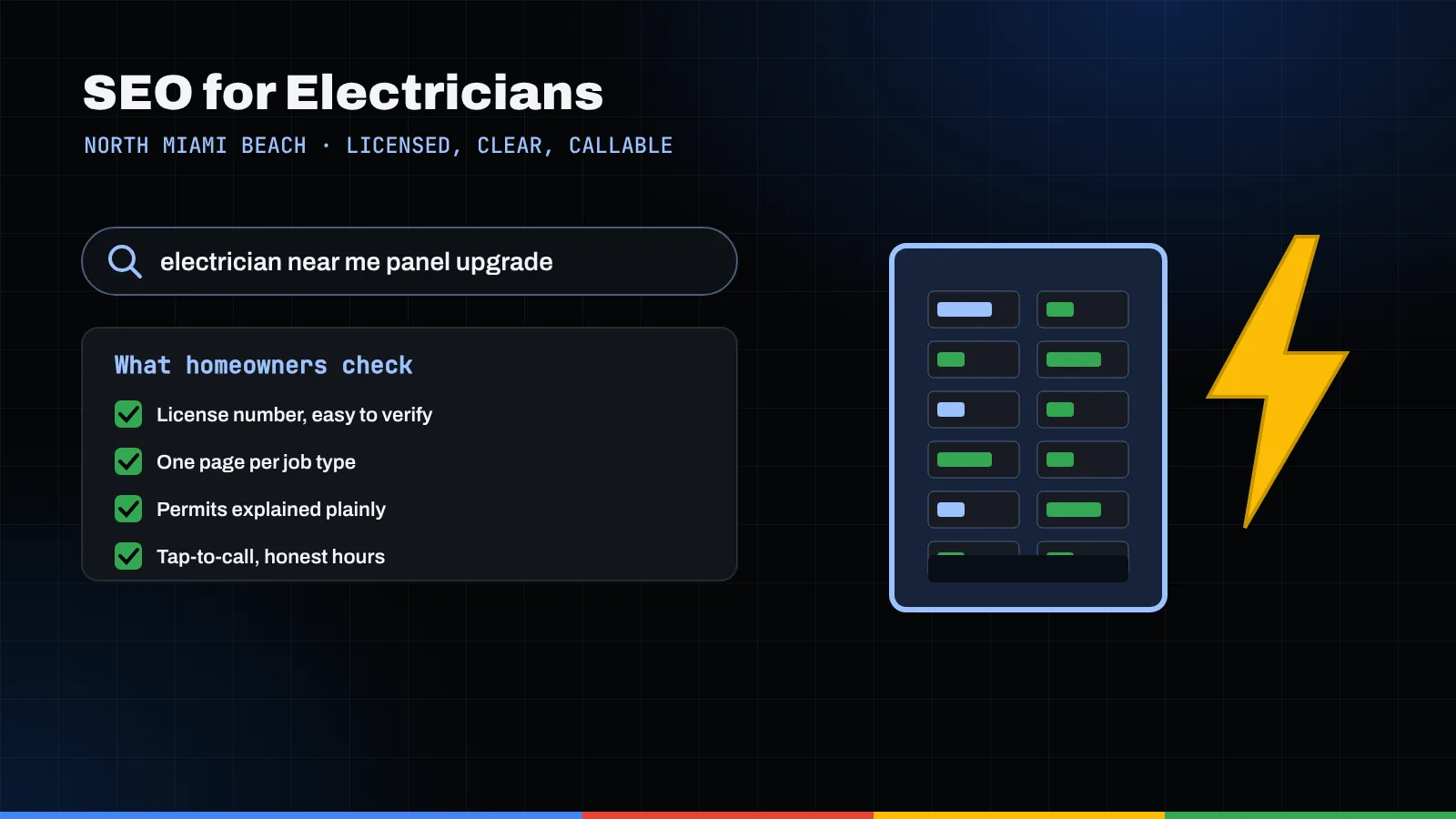
SEO for electricians works like a well-planned circuit: clean inputs (an accurate Google Business Profile), properly sized loads (one page for each job you actually do), and breakers that prevent trouble (your license number in every ad, honest reviews, permit-aware copy). Wire those in order and a homeowner on a phone can confirm you're licensed, local and available before they tap call. That is the same evidence Google uses to decide who shows up.
Key takeaways
- Treat your online presence as a circuit: profile and site are the inputs, service pages are the loads, compliance and reviews are the breakers.
- Most electricians are service-area businesses. Hide the home address on Google Business Profile and keep the service area realistic.
- Build a separate page for each job type (panel upgrades, generators, EV chargers, surge protection, lighting, inspections, commercial work) with the details a customer needs to decide.
- Florida law requires your certification or registration number in every advertisement, in any medium. That includes your website, your profile and your ads.
- Ask every customer for a review the same way, never pay for one, and say plainly on your pages that permitted work gets permitted.
How should an electrician think about SEO?
Think about it the way you'd think about a service. Before anything gets energized, you want to know three things: what's feeding the system, what's drawing on it, and what protects it when something goes wrong.
- Inputs. Your Google Business Profile, your website and the information other sites hold about you. If the input is noisy (a wrong phone number, a stale address, a business name stuffed with keywords), everything downstream gets less reliable.
- Loads. The searches you want to serve: "panel upgrade," "generator installer," "EV charger installation," "electrician near me." Each one needs its own properly sized page, the same way each appliance gets its own circuit instead of everything hanging off one overloaded run.
- Breakers. The things that keep you out of trouble: your license number displayed where the law requires it, permit-honest copy, reviews earned without shortcuts. Skip them and the system may work for a while, until it trips.
Our post on SEO for contractors in North Miami Beach covers the trades broadly. This one stays inside the panel: what an electrical contractor specifically needs, in the order we'd wire it. If you want the market-level view first, our North Miami Beach SEO page explains how we approach the city.
How do you set up a Google Business Profile as a service-area electrician?
Most electricians drive to the job. Customers don't come to you. Google treats that as a service-area business, and its Business Profile guidelines have specific rules for it. Follow this procedure in order:
- Confirm the business name. Use your real-world name exactly as it appears on your truck, invoices and signage. Google says adding unnecessary information to the name isn't permitted, so "Smith Electric" stays "Smith Electric," not "Smith Electric 24/7 Panel Upgrades North Miami Beach."
- Hide the address if you work from home or a yard customers don't visit. Google's guidance is that service-area businesses should hide their street address from customers.
- Set a realistic service area. Google says the overall area generally shouldn't extend farther than about two hours of driving from where you're based. List the cities and neighborhoods you'd actually dispatch a truck to.
- Use a phone number you control. Google asks for a number that connects directly to the business, and prefers a local number over a central call center.
- Keep one profile. Google says there should be only one profile per business. Duplicates split your reviews and confuse the listing.
- Don't list a virtual office. A rented mailbox doesn't qualify. Google says service-area businesses can't list a virtual office unless it's staffed during business hours.
- Choose categories carefully. Pick the primary category that best describes the core business, then add secondary categories only for services you actually offer.
- Fill in services, hours and photos. Real photos of your trucks, crew and finished panels do more than stock images ever will.
For the full walk-through, including posts and Q&A, see our Google Business Profile guide for North Miami Beach. If you'd like us to handle the map side, that's what our Google Maps SEO service does.
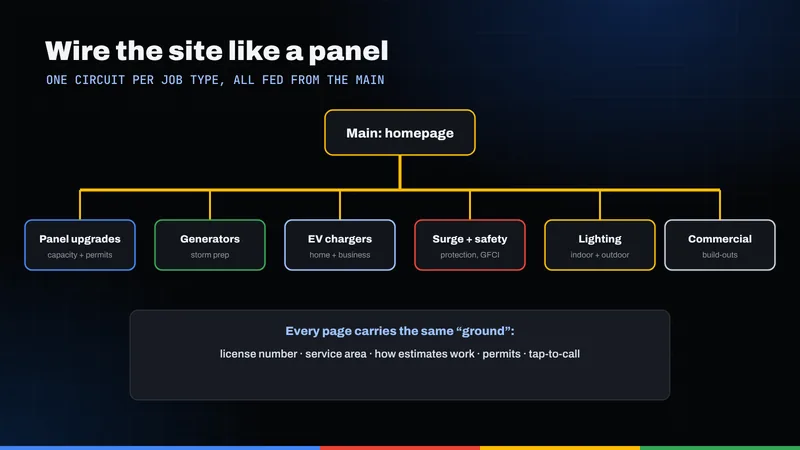
Why does each electrical job need its own page?
One "Services" page listing fifteen things is a single circuit carrying every load in the house. It technically works. Nothing on it is sized right.
Someone researching a whole-home generator has different questions than someone whose breaker keeps tripping, and both differ from a property manager who needs a commercial tenant buildout. A dedicated page lets you answer the questions each of those people actually has, and gives Google a clear match between the search and the page.
Here's the layout we'd start with. Treat it as a load schedule: adjust it to the work you really do, and don't build pages for services you don't offer.
| Job type | Page | Must-have details |
|---|---|---|
| Panel upgrades and replacements | /panel-upgrades/ | Signs a panel may need attention, what the visit involves, that permitted work is permitted and inspected, how you quote (site visit vs. phone) |
| Whole-home generators | /generator-installation/ | Standby vs. portable explained, transfer switch basics, fuel type questions you'll ask, maintenance options, service area |
| EV charger installation | /ev-charger-installation/ | What you check first (panel capacity, location, run length), charger brands you install, permit note, condo/HOA considerations |
| Surge protection | /surge-protection/ | Whole-home vs. point-of-use, what it does and doesn't protect, pairing with panel work |
| Lighting (interior, exterior, landscape) | /lighting-installation/ | Project examples with your own photos, fixture sourcing policy, dimmers and controls |
| Inspections and troubleshooting | /electrical-inspections/ | What a diagnostic visit covers, when to call right away, how findings are reported |
| Emergency service | /emergency-electrician/ | Exact hours you answer, what counts as an emergency, safety steps while they wait |
| Commercial electrical | /commercial-electrician/ | Building types served, tenant buildouts, maintenance agreements, how to request a bid |
Two rules for every page. First, write about the job, not about how great you are; explain the process, the decisions the customer will face and what affects the scope. Second, don't publish prices or statistics you can't stand behind. If pricing depends on the panel, the run and the permit, say that, and explain how you quote. A good on-page structure for each one is in our on-page SEO guide.
Should generator pages mention hurricane season?
Yes, accurately. The National Hurricane Center states that the Atlantic hurricane season runs from June 1 to November 30. For a South Florida generator or surge-protection page, that's honest, relevant context: homeowners plan these projects around the season, and your page should help them do it.
What to include:
- A plain note that installations involve planning, permitting and inspection, so starting well before the season is sensible.
- What happens during your site visit and what you'll need from the homeowner.
- How you handle maintenance and service after installation.
- Basic safety reminders, framed as reminders, such as never connecting a portable generator to house wiring without a proper transfer switch installed by a licensed electrician.
What to leave out: fear-based copy, invented outage figures and promises about delivery dates you don't control. A calm, factual page builds more trust than a countdown timer, and it ages better too.
What does Florida require about license numbers in electrician ads?
This is the main breaker in the panel. Florida's Electrical Contractors' Licensing Board licenses and regulates electrical and alarm contractors, and its FAQ draws a distinction that matters for your marketing:
- Certified licensees passed the state exam (with some exceptions) and can work anywhere in Florida.
- Registered licensees hold a local county or municipal certificate of competency registered with the board, and can only work in the jurisdictions where they hold that local license.
Why it matters for SEO: your service area on Google and your city pages should match where your license lets you work. A registered contractor whose site targets areas outside their licensed jurisdictions is building a load the circuit can't legally carry.
Then there's the number itself. Section 489.521(7)(b) of the Florida Statutes says the registration or certification number "shall be stated in each offer of services, business proposal, or advertisement, regardless of medium." The same section directs the board to fine or cite contractors who leave it out. The board's FAQ adds that the number belongs on vehicle signs and advertisements in any medium.
Practical checklist:
- Put your license number in the site footer so it appears on every page.
- Repeat it on the contact page and each service page near the call button.
- Add it to your Google Business Profile description.
- Include it in every paid ad, social post promoting your services and printed piece.
- Make sure the name on the license matches the business name on your site and profile.
We're not lawyers, and this isn't legal advice. Read the statute and the board's guidance yourself, and ask counsel if your situation has wrinkles.
How should electricians talk about permits on their website?
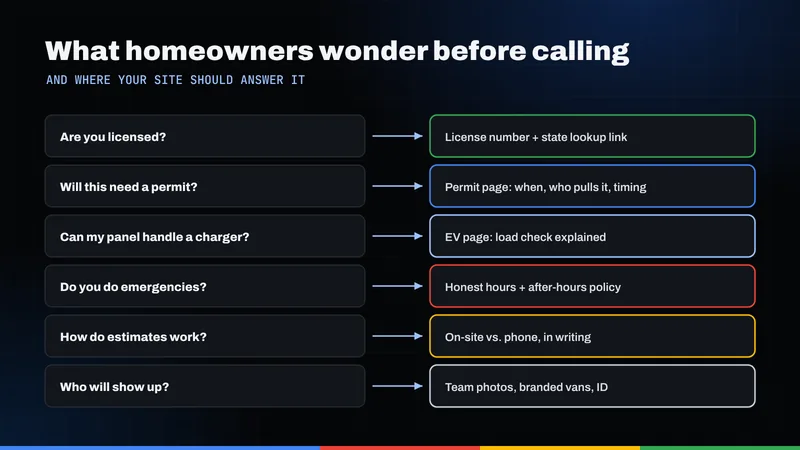
Homeowners should expect that many electrical jobs, especially panel changes, new circuits, generators and EV chargers, will need a permit and an inspection. The exact requirements depend on the job and the jurisdiction, which is why the clearest move is to say, on every relevant page, that you pull the permits the work requires.
That one sentence does a lot. It separates you from the unlicensed handyman, it answers a question customers often don't know to ask, and it sets expectations about timelines.
If you serve North Miami Beach, the city has a Building Department at 17011 NE 19th Avenue that handles building and trade permit applications, and its page notes that building, plumbing, electrical and mechanical officials inspect structures for code compliance. Linking to the correct building department from your service-area pages is a small, genuinely useful detail. Just make sure the link matches the city you're writing about; neighboring cities run their own departments.
Wording that works, as an example: "Panel replacements in North Miami Beach require a permit and inspection through the city's Building Department. We handle the application and schedule the inspection, and we'll tell you up front how that affects your timeline." Before publishing anything like it, confirm the specifics with the department for the job in question.
Are Local Services Ads worth it for electricians?
They're worth evaluating. Google's Local Services Ads help page lists electricians among the eligible service categories in the U.S. These ads sit at the top of many local searches, and businesses that pass Google's screening carry the Google Verified badge.
A few points from Google's documentation to know before you start:
- Availability depends on category and location, so check eligibility for your area first.
- Google's onboarding includes license or business registration checks and an acknowledgment that you hold the appropriate business licenses. Another reason your licensing should be squared away before you market.
- Google offers pre-badge ads that let some businesses receive leads after passing preliminary checks while they finish onboarding. The categories Google excludes from pre-badge ads are garage door services, health care verticals and locksmiths; electricians aren't on that list as of this writing.
Local Services Ads run alongside SEO; they don't replace it. The badge and reviews that help LSA performance also help your organic listing. If you want help weighing paid placements against organic work, our Google Ads team handles both, and our local SEO service covers the organic side.
Is there schema markup specifically for electricians?
Yes. Schema.org defines an Electrician type, which sits under LocalBusiness and HomeAndConstructionBusiness. Using it on your homepage or contact page tells search engines, in structured form, what kind of business you are.
A sensible wiring order:
- Mark up the business as
Electricianwith your name, phone, URL and logo exactly as they appear on the page and on your Google Business Profile. - Add
areaServedfor the cities you actually cover. If you hide your address on Google, don't publish it in schema either. - Add
openingHoursthat match your real availability, including any after-hours service you genuinely provide. - Validate the markup and re-check it whenever your phone, hours or service area change.
Schema won't rank a thin page. It labels the wires so the inspector can read them. Our post on how schema helps search engines explains what it can and can't do.
What makes an electrician's site work on a phone?
A homeowner smelling something hot near the panel isn't going to read three paragraphs. Design for that person first:
- Tap-to-call in the header on every page, sticky on mobile, with the number written out.
- Emergency clarity. State exactly when you answer the phone. "24/7" only if someone really picks up at 3 a.m.; otherwise give real hours and say what to do outside them.
- Safety first, then sales. On the emergency page, a short list like: if you smell burning or see sparks, keep away from the panel and call your utility or 911 if there's immediate danger. Then the call button.
- License number near the button. It answers "are these people legitimate?" at the moment of decision.
- Fast pages. Heavy sliders and auto-playing video slow the load on a weak signal.
- Short forms for non-urgent jobs: name, phone, job type, a photo upload for the panel or the spot where the charger goes.
If your current site looks good but the phone isn't ringing, our website design work is built around exactly this kind of conversion path.
How should electricians get reviews without breaking the rules?
Reviews are the most visible breaker of all, and two rulebooks apply.
Google's policy on fake engagement prohibits offering incentives such as payments, discounts or free services for reviews, and prohibits discouraging negative reviews or selectively soliciting positive ones. Reviews from people with a conflict of interest, including current or former employees, aren't allowed either.
The FTC's final rule on fake reviews, announced in August 2024, bans fake reviews and testimonials, incentives conditioned on a positive or negative sentiment, undisclosed insider reviews, and suppressing negative reviews through threats or intimidation.
A clean review procedure:
- Close the job: work complete, inspection passed if one was required, invoice settled.
- Send every customer the same short request with a direct link to your Google review form.
- Attach nothing to it. No discount, no raffle entry.
- Don't filter. Don't send happy customers to Google and unhappy ones to a private form.
- Reply to every review, calmly and specifically. On a negative one, state the facts and offer to talk offline.
Over time, reviews that mention specific jobs ("replaced our panel," "installed the EV charger in our garage") do more for you than generic praise, and they come naturally when you ask after real work.
Want a second set of eyes on your profile, pages and license display? Request a free SEO audit and we'll trace the circuit end to end.
Frequently asked questions
Can an electrician without a storefront rank in Google Maps?
Yes. Google lets service-area businesses keep a Business Profile with the street address hidden. Set your service area to the places you actually serve, generally within about two hours of driving from your base, and don't list a virtual office that isn't staffed.
Do I have to show my license number on my website?
Section 489.521 of the Florida Statutes says an electrical contractor's registration or certification number must be stated in each offer of services, business proposal or advertisement, regardless of medium. Putting it in your site footer and near every call button is the simplest way to cover your pages.
What's the difference between a certified and a registered electrical contractor in Florida?
According to the Electrical Contractors' Licensing Board, certified licensees can work anywhere in Florida, while registered licensees hold a local certificate of competency and can only work in the counties or municipalities where they hold that local license. Your marketing should match where you're licensed to work.
Can electricians use Local Services Ads?
Google's Local Services Ads help page lists electricians as an eligible category in the U.S., though availability depends on location. Businesses that pass Google's screening show the Google Verified badge, and onboarding includes license or business registration checks.
Should I list prices for panel upgrades or EV chargers?
Only if you'll honor them every time. Most electrical jobs depend on the panel, the wire run and permit requirements, so it's usually more honest to explain how you quote, what affects the scope and what the customer gets in writing before work starts.