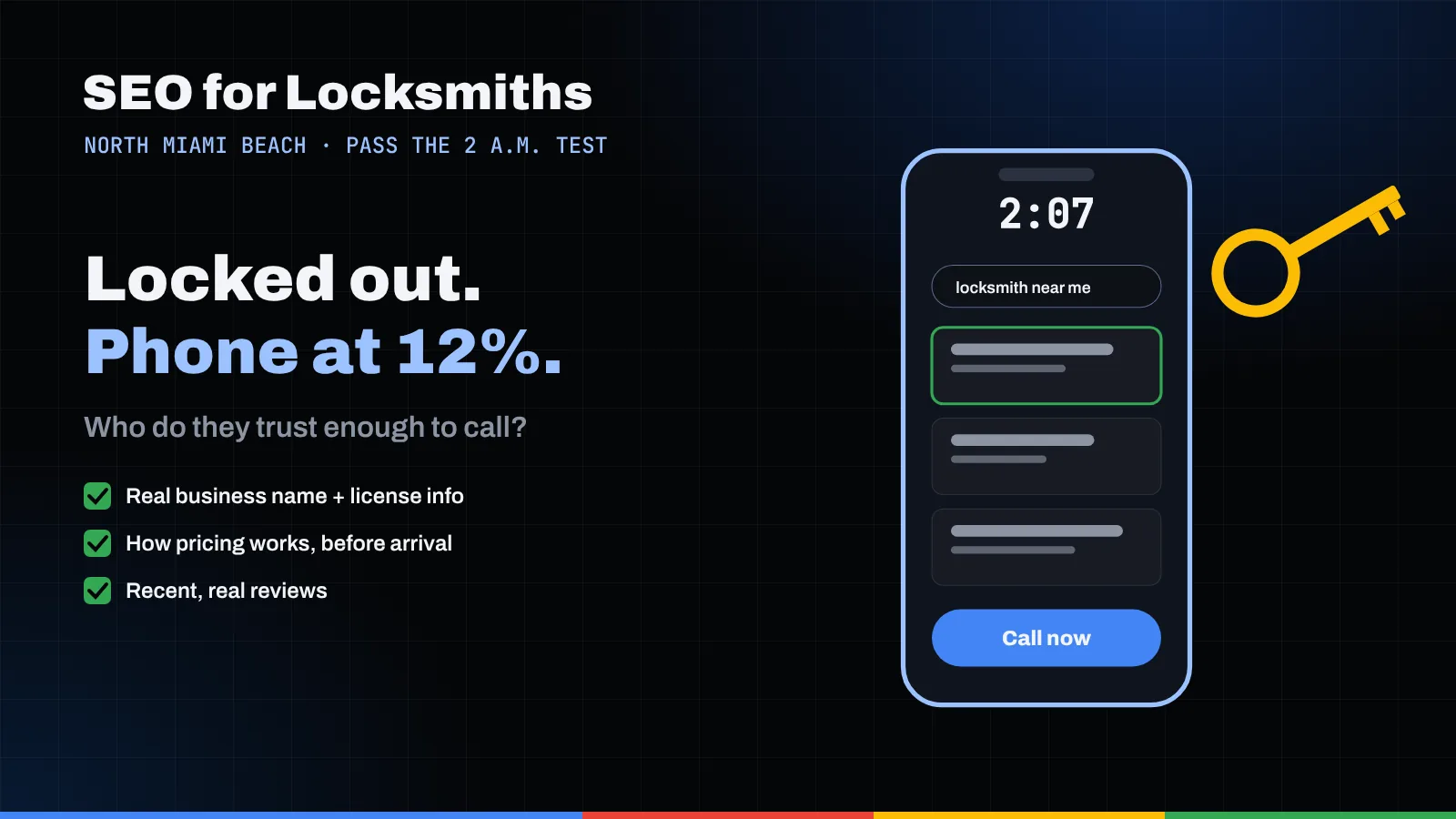
SEO for locksmiths comes down to passing one test: a stranger locked out at 2 a.m. looks at your listing and your website on a phone and decides, in seconds, whether you're a real local shop or a call center. Run a clean, verified Google Business Profile, a fast mobile site with a tap-to-call button, honest reviews and a plain explanation of how you price jobs. That's what earns the call, and it's the same information Google needs to trust you.
Key takeaways
- Judge every page by the 2 a.m. test: would a tired, stressed person on a phone trust it enough to call?
- Locksmith search has a long-running fake-listing problem. Google requires Advanced Verification for locksmith advertisers in the U.S., and your organic presence should read just as verifiable.
- Service-area locksmiths should hide their address on Google Business Profile, keep their service area within roughly two hours of driving, and use their real business name.
- Miami-Dade County says it stopped issuing locksmith licenses on July 1, 2025. Don't advertise a credential you can't back up.
- Explain how you price (service call, labor, parts, after-hours) without publishing numbers you won't honor, and never buy or gate reviews.
What does the 2 a.m. test look like?
Picture the call you want. Someone is standing outside an apartment off N.E. 163rd Street with a dead phone battery warning and no keys. Or a car is locked in a grocery store lot with the engine running. They type "locksmith near me" with one thumb. They don't read. They scan.
In about the time it takes to scroll once, they're asking three questions:
- Is this a real business near me? A name that sounds like a company, not a string of keywords. A local area code. Reviews that mention actual jobs.
- Will they come now? Hours that say so, and a phone number they can tap.
- Am I about to get ripped off? Some sign of how pricing works before a stranger shows up with a drill.
Everything in this playbook serves those three questions. If you also want the broader picture of how we approach the city's market, our North Miami Beach SEO page lays it out. Here, we stay on the job at hand: getting a locksmith chosen over the listing that looks just like yours but isn't.
Why is locksmith search full of fake listings?
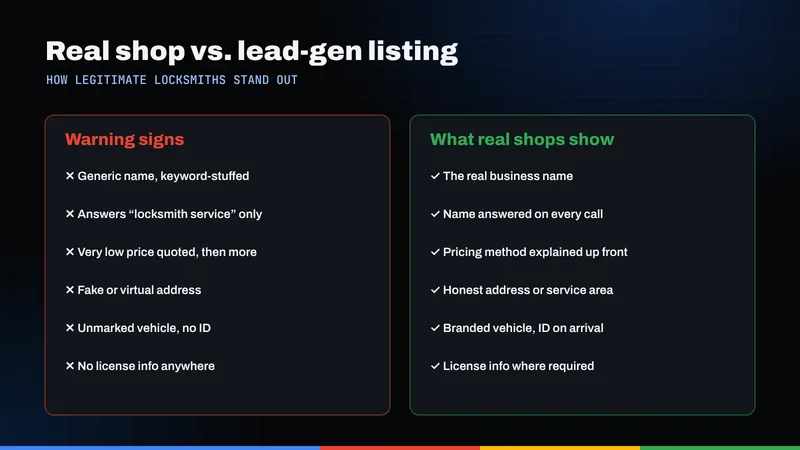
Let's be candid, because your customers already are. Locksmith searches have a reputation problem, and it isn't your fault. Some "local locksmiths" are lead-generation operations: a generic name, an address that isn't really theirs, and a call routed to whichever subcontractor is free. The customer finds out when the quote on arrival doesn't match the one on the phone.
Google treats the category as high risk. Its Advanced Verification policy lists locksmith services in the United States and Canada as a category where Google Ads and Local Services advertisers must pass extra checks, including agreeing to a recorded video interview. That's the paid side, but it tells you how Google sees the whole category.
On the organic side, the Google Business Profile guidelines close several doors that fake operators rely on:
- Lead generation agents aren't eligible for a Business Profile.
- There should be only one profile per business, not one per neighborhood.
- Service-area businesses can't list a "virtual" office unless it's staffed during business hours.
- The phone number must be under the business's direct control, and Google prefers a local number over a central call-center line.
Here's how a legitimate shop stands out: be specific where the fakes are vague. A real owner's name. A real business name that matches the van, the invoice and the website. Photos of your actual crew and vehicles. Reviews that name the street, the car model or the lock you replaced. A fake listing can copy a keyword. It has a much harder time copying a verifiable life.
You can't control what other listings do. You can make your own profile undeniable, which is the next section.
The Google Business Profile playbook for a service-area locksmith
Most mobile locksmiths are service-area businesses: you go to the customer, not the other way around. Run these steps in order.
- Use your real-world name. Google says your name should reflect your business's real-world name and that adding unnecessary information isn't permitted. A plain name like "Northside Lock & Key" (an example) is a name. "24/7 Cheap Locksmith North Miami Beach Car Keys" is a suspension waiting to happen.
- Hide your address if customers don't visit. The guidelines say service-area businesses should hide their address. If you run a storefront where people walk in, show it and staff it.
- Set a realistic service area. Google says the area generally shouldn't extend farther than about two hours of driving from your base. For a locksmith promising fast arrival, your honest radius is probably much tighter. List the places you'll truly reach quickly.
- Pick the right primary category, then add only the secondary categories that match services you perform: residential, automotive, commercial, safes. Don't add categories for work you subcontract out.
- Set hours you'll answer. If you take emergency calls overnight, say so. If you don't, don't claim 24 hours. A missed 2 a.m. call costs more than a closed sign.
- Use a phone line you control. Not a shared dispatch number that also rings for other "brands."
- Expect verification to take effort. Google determines which verification methods you get. Have proof of your business, your tools and your vehicle ready in case video verification is offered.
- Fill in services and photos. Real photos of your van, your tools and finished jobs. No stock images of smiling models holding keys.
For a deeper walk through profile setup in this city, see our Google Business Profile guide for North Miami Beach. Our Google Maps SEO service handles this work end to end.
What licensing can a North Miami Beach locksmith show?
This is where we slow down, because it changed recently and it's easy to get wrong.
Miami-Dade County used to license locksmiths and locksmith businesses. Its locksmith licensing page now says that, effective July 1, 2025, the county is no longer issuing licenses for locksmiths and locksmith services businesses. The county cites Section 163.211 of the Florida Statutes, which expressly preempts occupational licensing to the state and ended older local licensing programs on that date.
We couldn't confirm a statewide Florida locksmith license from a primary state source, so we won't tell you one exists or doesn't. Before you publish anything about credentials, check with the state and the county directly.
What this means for your marketing:
- Don't advertise a license number you can't verify today. An expired county number on your van or footer invites exactly the doubt you're trying to remove.
- Show what you can prove. Your registered business name, insurance, years operating, the owner's name and photo, and any manufacturer or trade training you've actually completed.
- Carry identification. The county's consumer tips for locksmith services tell residents to make sure the locksmith has identification, to get estimates in writing and to ask for an invoice listing services performed. Say on your site that you do all three.
Should a locksmith run Local Services Ads?
Possibly, and if you do, the verification is part of the value. Google's Local Services Ads getting-started page for the U.S. lists locksmiths as an eligible category. Some older articles describe "Google Guaranteed" or "Google Screened" badges; the current help page talks about a Google Verified badge for providers who pass Google's screening process.
Two details matter for locksmiths specifically:
- Google offers "pre-badge" ads that let some businesses get leads before finishing onboarding, but the page says pre-badge ads aren't available for locksmiths. You have to complete verification first.
- Locksmith advertisers also fall under the Advanced Verification policy mentioned above, which includes a recorded video interview.
That friction is a filter. It's harder for a fly-by-night operator to get through, which is good for you if you're legitimate. Our Google Ads management team can tell you whether Local Services Ads, search ads or neither make sense for your budget, and set up tracking so you know which calls were real jobs.
How should a locksmith website pass the 2 a.m. test?
Your website is the second place a cautious customer checks, usually right after tapping your listing. It has to load fast on a weak signal and get them to a phone call without thinking. Run this checklist on your own phone, outdoors, on cellular data:
- Phone number at the top, tappable. Use a proper tel: link so one tap starts the call. Keep it visible as they scroll.
- Business name and owner in the first screen. Not just a logo. Words a person can match to the van that pulls up.
- One sentence on what you do right now. "Home, car and business lockouts in North Miami Beach and nearby. We answer overnight." Then the button.
- Fast on mobile. Compress images, drop heavy sliders and chat widgets that block the page, and watch Google's Core Web Vitals in Search Console. Our post on how website speed affects revenue covers the fixes.
- Separate pages for separate jobs. Residential lockouts and rekeys, automotive lockouts and key replacement, commercial locks and access control. Each page should describe the work you actually do and what the customer should have ready, like proof of ownership for a car.
- A real "About" page. Who owns the shop, how long you've been working, photos of the team.
A gorgeous site that hides the phone number fails this test every time. If your current site looks good but doesn't ring, our website design work starts from the call button and builds outward.
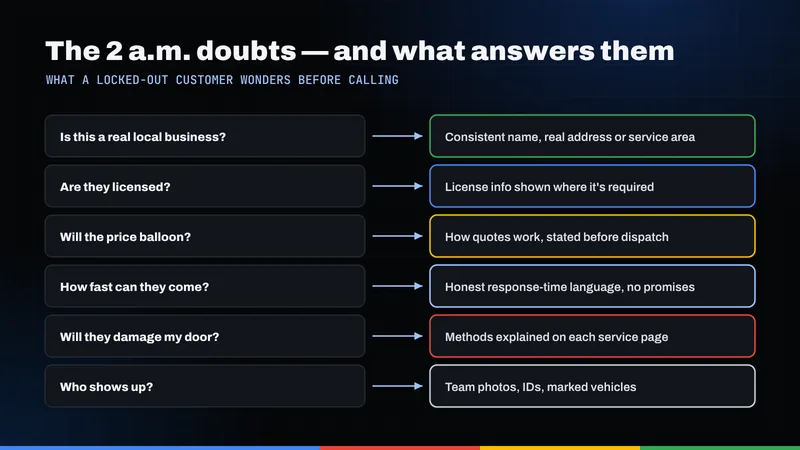
The 2 a.m. doubt table: what to show for each fear
Use this as a punch list. Each row is a doubt that kills calls, and the thing on your listing or site that answers it.
| Customer's 2 a.m. doubt | What to show | Where |
|---|---|---|
| "Is this even a local company?" | Real business name, owner's name and photo, local phone number, list of areas you serve | Profile, homepage header, About page |
| "Will someone actually come tonight?" | Honest hours, a clear note on overnight availability, tap-to-call button | Profile hours, top of every page |
| "Is the price going to triple when they show up?" | How you price: service call, labor, parts, after-hours, and that you confirm the total before work starts | Pricing section, service pages |
| "Will they just drill my lock?" | A note that you try non-destructive entry first where possible, and explain when replacement is needed | Lockout service pages |
| "Who's going to show up at my door?" | Team photos, marked vehicles, a promise of identification on arrival | About page, profile photos |
| "Are these reviews real?" | Reviews that mention specific jobs, with owner replies that sound human | Profile, testimonial section |
| "Can I prove what I paid?" | A statement that every job gets a written invoice listing services and parts | Pricing section, FAQ |
How can a locksmith be transparent about price without publishing a price list?
Locksmith pricing genuinely varies. A simple house lockout isn't a high-security deadbolt, and a 2010 sedan isn't a late-model push-to-start car. So you don't need to post exact numbers, and you shouldn't post numbers you won't honor. "From $19" bait is exactly what scammers use, and customers know it.
What you can publish is the structure:
- Name the parts of a bill. Service call, labor, parts, and any after-hours or distance charges. If you have a minimum, say so.
- Commit to a total before work starts. Say on the page that you give the full estimate on the phone or on arrival, and that nothing starts until the customer agrees.
- Put it in writing. The county's consumer tips tell residents to get estimates in writing and an itemized invoice. Tell them you already do this.
- Explain what changes a price. Lock type, key type, time of day, proof-of-ownership checks. Plain language beats a table of made-up numbers.
- Name the payment methods you accept. Cards, cash, whatever is true.
This section is often the page that converts. Our conversion optimization work tests where pricing information sits, because putting reassurance next to the call button usually beats burying it in a footer.
How should locksmiths get reviews without breaking the rules?
Reviews are where the fake-listing problem shows up most, so honest reviews are where you win. Two sets of rules apply.
Google's prohibited and restricted content policy bans reviews paid for directly or in kind, incentives such as discounts or free services, content that isn't based on a real experience, conflict-of-interest reviews from current or former employees, and selectively soliciting positive reviews while discouraging negative ones.
The FTC's 2024 final rule on fake reviews and testimonials prohibits creating, selling or buying fake reviews, offering rewards conditioned on a particular sentiment, undisclosed insider reviews, and using groundless legal threats or intimidation to suppress negative ones.
A clean review routine for a locksmith:
- Ask every customer the same way. A text with your review link after the job is closed and paid. No pre-screening for happy customers.
- Nothing attached. No "10% off your next rekey" for a review.
- Ask them to be specific. "If you mention what we helped with, it helps the next person decide." Specific reviews read as real because they are.
- Reply to all of them, including the rough ones. A calm, factual reply to a complaint shows the next 2 a.m. reader how you handle problems.
- Never post reviews from staff or family, and never pay a service that "boosts" ratings.
Should a locksmith use Locksmith schema markup?
Yes, as a supporting step. Schema.org has a dedicated Locksmith type, which sits under LocalBusiness and HomeAndConstructionBusiness. Marking up your homepage with it tells search engines in a structured way that you're a locksmith, and connects your name, phone, website and service area.
Keep the markup honest and boring:
- Use the Locksmith type with your real business name, matching your profile exactly.
- Include your telephone, URL and opening hours as they appear on the page.
- Use areaServed for the places you actually cover.
- Only mark up information a visitor can see on the page. Don't put a hidden street address in schema if you've hidden it on Google for privacy.
Schema won't fix a weak profile, but it removes ambiguity. Our explainer on how schema helps search engines covers the mechanics, and our local SEO service includes it as standard. When you're ready for an honest look at where your listing and site stand, request a free audit.
Frequently asked questions
Can a locksmith with no storefront rank in Google Maps?
Yes. Google lets service-area businesses keep a Business Profile with the address hidden. Set your service area to the places you actually cover, generally within about two hours of driving from your base, and never list a virtual office that isn't staffed.
Can I put "North Miami Beach" or "24/7" in my Google business name?
Only if it's part of your real-world business name as it appears on your signage and branding. Google says the name should reflect your real-world name and that adding unnecessary information isn't permitted.
Do locksmiths need a Miami-Dade County license?
Miami-Dade's licensing page says that as of July 1, 2025, the county no longer issues licenses for locksmiths and locksmith businesses, citing state preemption under Section 163.211 of the Florida Statutes. Check with the state and county for current requirements before advertising any credential.
Are Local Services Ads available for locksmiths?
Google's U.S. Local Services Ads help page lists locksmiths as an eligible category, but pre-badge ads aren't available for locksmiths, so you must complete verification first. Locksmith advertisers also fall under Google's Advanced Verification policy, which includes a recorded video interview.
Should a locksmith post exact prices online?
Not unless you'll honor them every time. Explain how you price instead: service call, labor, parts and after-hours charges, a total agreed before work starts, and a written itemized invoice afterward.