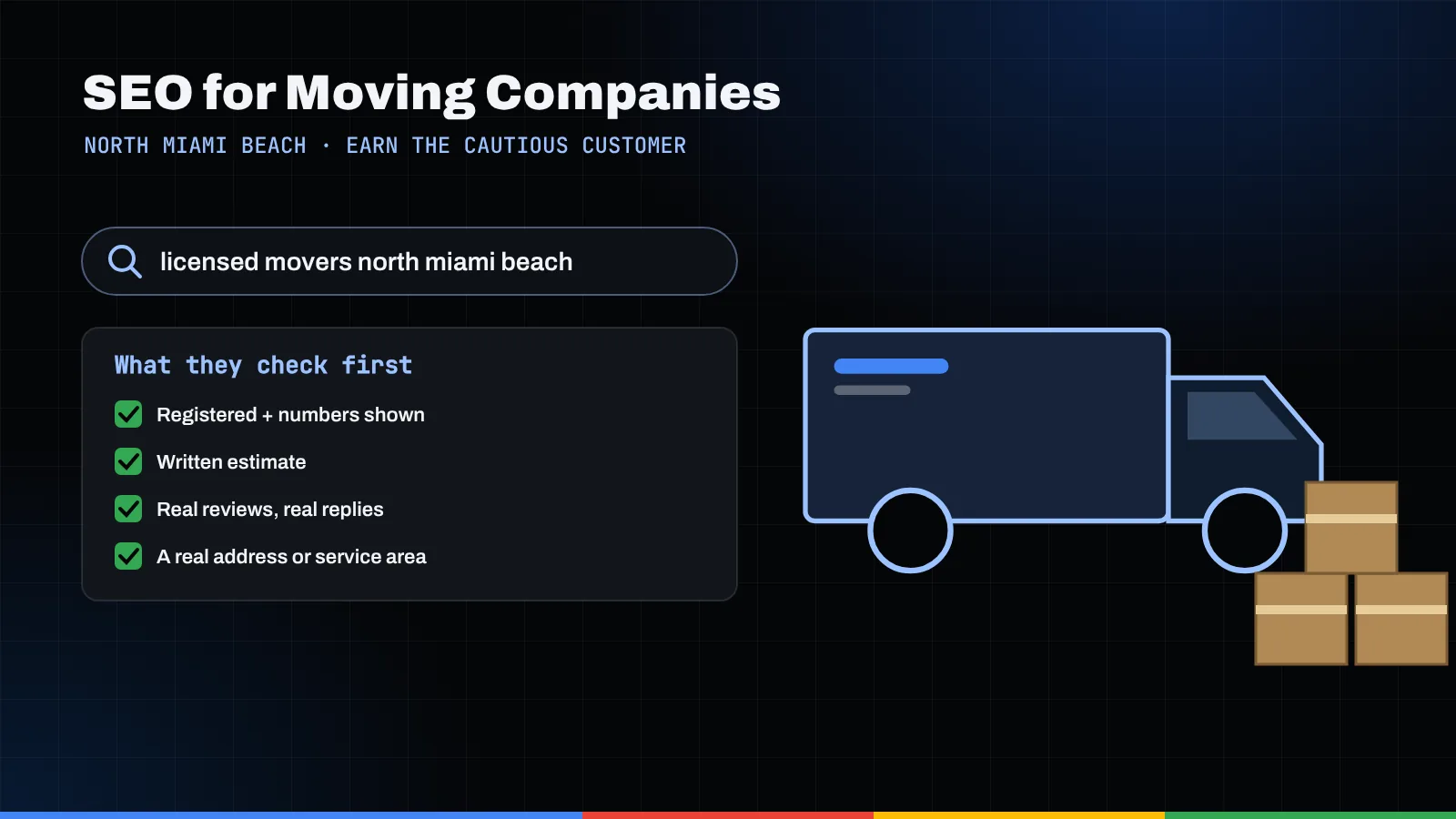
Good SEO for moving companies starts from the customer's side of the table: a careful shopper checks your Florida registration, your federal number if you cross state lines, your address, your estimate process and your reviews before calling. Publish every one of those things plainly on your site and your Google Business Profile, and you pass the vetting and give Google the clearest picture of who you are. Shortcuts like fake addresses and bought reviews fail both tests.
Key takeaways
- Cautious customers vet movers before requesting a quote. Answer their checklist on your site.
- Florida requires intrastate movers to register with FDACS and to show a registration phrase such as "Fla. Mover Reg. No." in their ads. Put it in your footer and on your quote page.
- If you run interstate moves, federal rules require your U.S. DOT number in your advertising. Make it easy to look up.
- A Google Business Profile for a mover usually means a service-area setup: hide the address if customers don't visit, list real cities, and never use a virtual office.
- Google's policies and the FTC's 2024 rule both prohibit fake, incentivized and gated reviews.
Why should a mover think like a skeptical customer?
Picture the person on the other end of your phone. They're about to hand strangers everything they own, often on a lease or closing deadline. Many have heard the horror story: a low phone quote, a loaded truck, then a much bigger bill. So they do homework. They search your name, check your reviews, look for a registration number and read your quote page closely for anything that sounds slippery.
That homework is your SEO brief. Google's Business Profile help center says local results are based mainly on relevance, distance and how well known a business is. Complete business details, real reviews and pages that clearly describe your services feed those signals, and they're exactly what a skeptical customer looks for. Write for the investigator and you usually write well for the search engine too.
Most sections below follow one pattern: the myth, the reality, then what to publish. If you serve North Miami Beach and the surrounding corridor, our North Miami Beach SEO page explains how we approach the local market more broadly.
Myth: "Nobody reads the registration number." Reality: the careful ones look for it first
Myth
Your Florida registration is paperwork. You keep the certificate on the wall, and that's the end of it.
Reality
Florida's household moving law, Chapter 507 of the Florida Statutes, applies to moves that start and end inside the state. Under section 507.03 of Chapter 507, each mover and moving broker must register with the Florida Department of Agriculture and Consumer Services (FDACS), renew every two years, and display the certificate at the main place of business. The same section requires mover advertisements to include a registration phrase such as "Fla. Mover Reg. No." or "Fla. IM No." followed by the number.
Florida's Attorney General tells consumers to look movers up on FDACS's business search before signing anything. If they can't find your number on your site, you've failed step one.
What to publish
- Your registration phrase and number in the site footer, on your quote and contact pages, and in your Google Business Profile description.
- A short "Licensing and insurance" page that states your registration, explains what it means in plain English, and tells customers they can verify it with FDACS themselves.
- The business name exactly as registered, matching your trucks.
Miami-Dade County runs its own moving business registration as well, and its application says the county registration number must appear in all advertisements. If you hold one, publish it next to the state number.
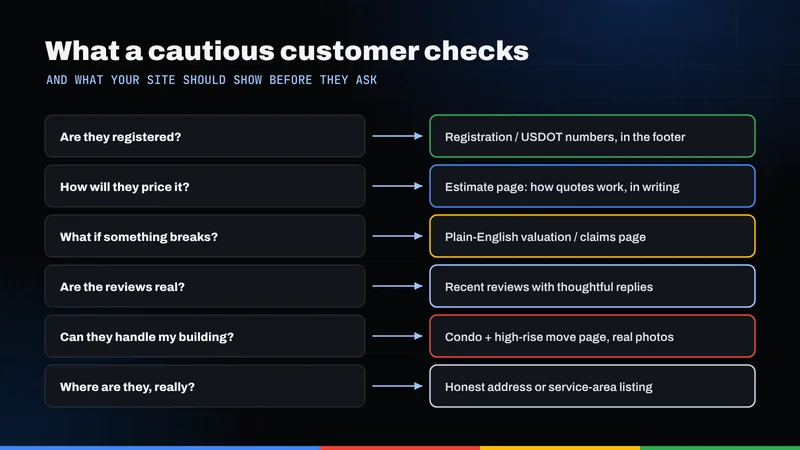
Myth: "Long-distance customers just want a price." Reality: they want a number they can check
Myth
If you run moves from North Miami Beach to New York or Atlanta, a flashy price calculator will do the selling.
Reality
Interstate household moves fall under federal rules, not Florida's chapter. Federal regulations at 49 CFR 375.207 require an interstate household goods carrier's advertisements to include its name as it appears on its USDOT assignment and its number, written as "U.S. DOT No." followed by the number. The Federal Motor Carrier Safety Administration (FMCSA) runs a Protect Your Move program with a registered mover search.
FMCSA also publishes of red flags of moving fraud. Read as a mover, it's a website audit. Among the warning signs: estimates given without seeing the goods, no written estimate, large cash deposits, blank documents, a website with no local address and no registration or insurance information, and phones answered with a generic "Movers" instead of a company name. The same program says interstate movers must give customers the booklet Your Rights and Responsibilities When You Move and the Ready to Move brochure.
What to publish
- Your U.S. DOT number (and MC number if you have one) beside the Florida registration in the footer.
- A long-distance page explaining your interstate estimates and the documents customers receive, with links to the federal booklets.
- A clear statement of whether you are the carrier or a broker who arranges the move with another company. Blurring it is a classic warning sign.
Myth: "We need an office address in every city we serve." Reality: that's how profiles get suspended
Myth
To show up in the map pack for Aventura, Sunny Isles Beach and Fort Lauderdale, you need a profile with an address in each.
Reality
Most movers are what Google calls service-area businesses: you go to the customer, the customer doesn't come to you. Google's service-area business help page says that if you don't serve customers at your business address, you should remove the address from your profile. You can then set up to 20 service areas by city, postal code or other area, and the overall area generally shouldn't extend beyond about two hours of driving time from where your business is based.
Google's guidelines for representing your business are blunt about the shortcuts. Your profile must reflect your actual, real-world location. P.O. boxes and mailboxes at remote locations aren't acceptable. A rented mailing address you don't operate from isn't eligible. There should be only one profile per business, and the name should be your real-world business name, without extra marketing text.
What to publish
- One profile for your real base of operations, with the address hidden if customers don't visit it.
- Service areas that match where you genuinely send crews.
- Accurate categories, services, hours and photos of your real trucks and crew.
- Your registration numbers in the description, matching the website.
Our guide to the Google Business Profile in North Miami Beach covers setup in more detail, and our Google Maps SEO service handles it for you if you'd rather not.
Which service pages should a moving company build?
A cautious customer doesn't search for "movers" and stop. They search for their situation: a two-bedroom condo in a high-rise, a piano, a move into storage while a renovation runs long, a parent downsizing. One catch-all "Services" page can't answer those well. Separate pages can.
A sensible starting set for a North Miami Beach mover:
- Local moves. How you price them, what a crew and truck look like, what's included.
- Long-distance and interstate moves. Estimate process, timelines, documents, your U.S. DOT number.
- Packing and unpacking. Full pack, partial pack, fragile items, materials you supply.
- Storage. Where goods are held, how access works, and what's itemized on the estimate. Florida's estimate rules require the location of any place goods will be held.
- Condo and high-rise moves. More on this below.
- Specialty items. Pianos, safes, art, only if you actually do them.
Condo and high-rise moves, kept honest
Building moves are where a mover can show real expertise without making anything up. Many condo and apartment buildings set their own rules for moves: reserved elevator times, padded elevators, certificates of insurance naming the association, loading dock windows and deposits. Details differ by building, so don't make claims about specific towers. Explain your process instead: you'll ask for the building's move rules, request any certificate of insurance the management office needs, and schedule around the reserved elevator time.
If you're a contractor-style business juggling many service pages, the structure in our contractor SEO guide for North Miami Beach applies almost one for one.
Myth: "Hide the price details so they call." Reality: vague quotes look like the scam
Myth
The less you say about pricing, the more people will pick up the phone.
Reality
The red-flag lists from both FMCSA and Florida's Attorney General warn about movers who quote without assessing the goods, won't put estimates in writing, or say the final price will be set on loading day. A page that says only "Call for a free estimate!" echoes that pattern.
Florida law gives you something better to say. Under section 507.05, before providing any moving or accessorial services, a mover must prepare a written estimate and a contract, and both parties must sign or electronically acknowledge them. The estimate must include, among other items, contact information, the move dates, the pickup and delivery addresses, any place the goods will be held, an itemized breakdown and total of all costs and services, and the accepted forms of payment. Movers must accept at least two of three payment types: cash-type payments, a personal check, or a valid credit card.
What to publish
- A step-by-step explanation of how your estimate works: virtual or in-home survey, written itemized estimate, signed contract, then move day.
- A list of what the estimate covers (labor, truck, materials, stairs or elevator time, storage) so customers can compare quotes line by line.
- A short form that asks the questions you actually need (origin, destination, home size, building type, move date) and a visible phone number answered with your company name.
For more on turning traffic into booked surveys, see our conversion optimization work.
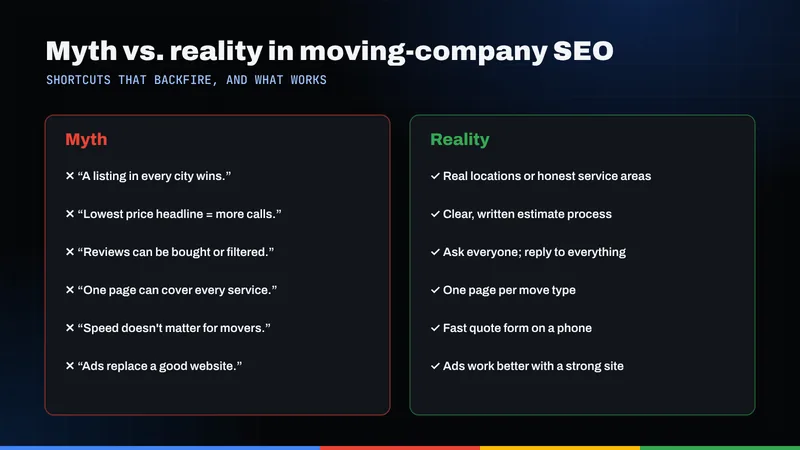
What does a cautious customer check, and what should you publish?
The left column comes from published consumer warnings. The right column is your homework.
| What a cautious customer checks | What the mover should publish |
|---|---|
| Is this mover registered in Florida? | "Fla. Mover Reg. No." and number in the footer, quote page and profile |
| For a move out of state, is the carrier federally registered? | "U.S. DOT No." (and MC number if applicable) on the long-distance page and footer |
| Is this the actual mover or a broker? | A clear statement of which you are, and who performs the move |
| Will I get a written, itemized estimate? | A quote page that walks through the written estimate and contract process |
| Do they want a big cash deposit? | Accepted payment methods and deposit policy, in writing |
| Is there a real local business behind the site? | Real business name, real phone answered with that name, real photos of trucks and crew |
| Are the reviews believable? | Reviews from actual customers, with owner responses to good and bad ones |
| What happens with my building's rules? | A condo and high-rise page explaining how you handle elevator reservations and insurance certificates |
| Is my stuff insured? | A plain explanation of valuation options and liability limits, without claiming "everything is covered" |
On that last row: Section 507.04 of the same Florida chapter sets insurance requirements for registered movers and says a mover may not limit its liability below 60 cents per pound per article, and must disclose any limit in writing. FMCSA lists "the mover claims all your goods are covered by its insurance" as a red flag. Explaining valuation honestly is more persuasive than overpromising.
Does MovingCompany schema help?
Structured data won't fix a thin site, but it does help search engines read the facts you've already published. Schema.org has a dedicated MovingCompany type, which sits under HomeAndConstructionBusiness and LocalBusiness. It's a natural home for your name, phone, hours, service area and profile links.
- Mark up only what's visible on the page, and think twice before publishing an address you've hidden on Google.
- Use
areaServedfor the cities you really cover, matching your profile. - Don't add review markup for reviews you've copied from somewhere else.
We explain why this matters in how schema helps search engines.
Myth: "Everybody games their reviews." Reality: the rules caught up
Myth
A few friendly five-star reviews from staff and a small discount for happy customers is how the industry works.
Reality
Google's prohibited and restricted content policy bans reviews that are paid for, directly or in kind, and content posted because a business offered an incentive. Merchants may not selectively solicit positive reviews, discourage negative ones, or pressure staff into review quotas. Reviews from people with a conflict of interest, including current or former employees, aren't allowed.
Federal law now backs that up. In August 2024 the FTC announced a final rule banning fake reviews and testimonials. It prohibits fake reviews (including AI-generated ones), compensation conditioned on a positive or negative review, undisclosed insider reviews, and suppressing negative reviews through threats or intimidation, and it lets the FTC seek civil penalties against knowing violators.
What to do instead
- Ask every customer for a review the same way, a day or two after delivery, with nothing attached.
- Reply to every review. A calm, specific reply to a complaint about a scratched dresser tells the next skeptic a lot.
- On your site, show real reviews with names as the customers posted them, and link to your profile so readers can see the full list.
What lead-gen and spam tactics should movers avoid?
Some tactics make a mover look bigger than it is. Each tends to backfire twice: it breaks platform rules, and it's what cautious customers are warned about.
- Fake or virtual addresses. Renting a mailbox in a city you want to rank in breaks Google's guidelines and can cost you the profile.
- Keyword-stuffed business names. Google says the name should match your real-world name. "Best Cheap Movers North Miami Beach" on the profile when the trucks say something else invites a suspension.
- Faceless lead-gen sites. Sites that collect a request and sell it to whoever pays, with no company name or registration number, are the "generic greeting" problem FMCSA warns about.
- Hundreds of near-identical city pages. A page per city with nothing but the name swapped out doesn't help customers. Build city pages only where you have something real to say.
Strip away the jargon and moving company SEO, like any strong local SEO, is mostly the discipline of publishing true, checkable facts in the same form everywhere. If you only have a week, start here. Add your Florida registration phrase and number (and U.S. DOT number if you go interstate) to your footer and profile. Fix your Google Business Profile so it matches how you actually operate. Rewrite your quote page around the written estimate process. Then start asking every customer for a review. Service pages, schema and condo content come next. Covering the wider county? Our SEO Miami page covers local SEO in Miami.
Want a second pair of eyes? We'll run a free audit of your site and profile through the same skeptical-customer lens used in this guide.
Frequently asked questions
Do Florida movers have to show their registration number on their website?
Section 507.03 of the Florida Statutes requires mover advertisements to include a registration phrase such as "Fla. Mover Reg. No." or "Fla. IM No." with the number. A footer placement puts it on every page.
What's the difference between FDACS registration and a USDOT number?
FDACS registration covers household moves that start and end inside Florida. Interstate moves fall under federal rules, and an interstate household goods carrier's ads must show its number as "U.S. DOT No." followed by the number. A mover doing both should publish both.
Should a moving company hide its address on Google?
If customers don't come to your address, Google says to remove it and set service areas instead, up to 20 cities or postal codes, generally within about two hours of driving from your base. Never list a P.O. box, virtual office or mailbox you don't operate from.
Can I offer a discount on the next move for a five-star review?
No. Google prohibits reviews posted because of an incentive, and the FTC's 2024 rule bans compensation conditioned on a particular sentiment. Ask every customer the same way, with nothing attached.
What should a mover's quote page include?
Explain your estimate process, what the written itemized estimate covers, accepted payment methods and your deposit policy. Florida law requires a written estimate and contract before any moving services begin, so describing that process openly builds trust with cautious customers.