To choose an SEO company, ask direct questions about what they will actually do, how they build links, who owns the accounts, and how they report, then listen for specifics instead of promises. Walk away from anyone who guarantees rankings, won't explain their methods, or wants to own your domain, Google Business Profile, Analytics or Search Console. A fair contract spells out deliverables, access, ownership and a reasonable exit, in writing.
Key takeaways
- Google itself says no one can guarantee a #1 ranking. Treat any guarantee as the end of the conversation.
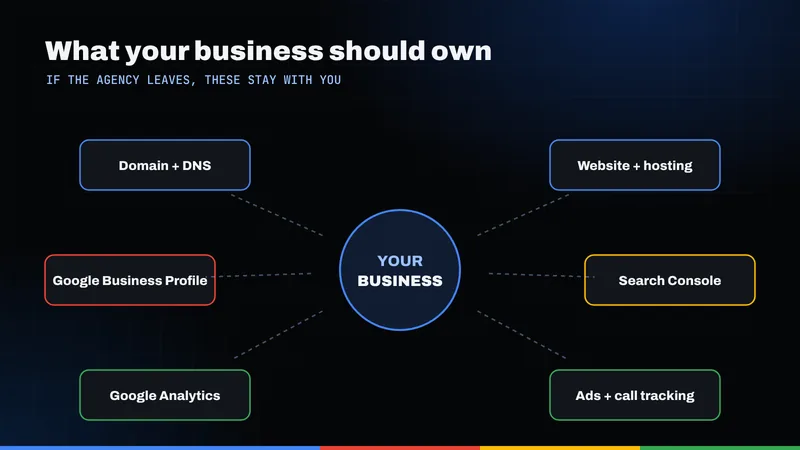
- You, not the agency, should be the owner of your domain, Google Business Profile, Google Analytics and Search Console. Agencies get user access.
- The best interview questions force specifics: what gets done in month one, how links are earned, and what happens to your stuff if you leave.
- Fake reviews and paid reviews aren't a gray area. The FTC and Google both prohibit them, and you're the one exposed.
- A good contract lists deliverables, reporting cadence, access rules and exit terms. If the scope fits on a napkin, so will the results.
Why should you take advice on hiring an SEO from an SEO agency?
Fair question. We're an SEO agency headquartered in North Miami Beach, so take this with that in mind. We'd obviously like you to hire us.
But here's the thing. The fastest way for us to lose a good client is for them to have been burned by someone else first. Owners who got stuck with a mystery contract, a "proprietary" link network and a Google Business Profile they can't log into show up on our calls suspicious of everyone. Honestly? They should be.
So this is the guide we wish every business owner read before they hire an SEO company and sign anything with anyone, us included. It's the questions to ask, the answers that should make you relax, the answers that should make you reach for your car keys, and what belongs in the contract.
If you want the basics first, our plain-English explainer on what SEO actually is is a good ten-minute primer.
What does Google say about hiring an SEO?
Google publishes its own guidance on this, and most owners never see it. The Google Search Central page "Do you need an SEO?" is short, readable and surprisingly blunt. A few points worth knowing before your first sales call:
- "No one can guarantee a #1 ranking on Google." That's Google's wording, not ours.
- Be careful with any company that is secretive or won't clearly explain what it intends to do.
- Be wary of SEO firms that email you out of the blue, and of anyone claiming a "special relationship" with Google.
- You should never have to link to an SEO from your site as a condition of working with them.
- Ultimately, you are responsible for the actions of any company you hire. If they break the rules on your site, your site pays for it.
That last one is the part people skip. If an agency builds spammy links or mass-produces junk pages, Google doesn't send the agency a penalty notice. It demotes your website. Google's spam policies list the practices that can get a site demoted or removed, including link spam (like buying or selling links for ranking purposes) and scaled content abuse, which is generating lots of pages primarily to manipulate rankings rather than help people.
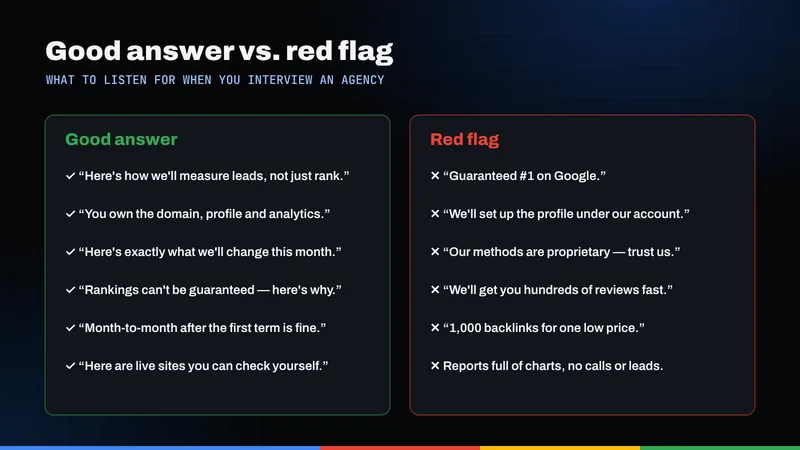
The questions to ask an SEO company (and what the answers mean)
Print this. Bring it to the call. You don't need to ask all of them, but the more an agency squirms, the more you've learned.
What exactly will you do in the first 30 to 90 days?
Good answer: A concrete list. An audit, specific technical fixes, which pages get rewritten or created, Google Business Profile cleanup, tracking setup.
Red flag: "We'll optimize everything." Optimize what, how, and when?Can you guarantee first-page or #1 rankings?
Good answer: "No, and anyone who does is guessing." They'll talk about what they control instead: the work, the timeline, the measurement.
Red flag: Any guarantee. Google says outright that no one can make one.How do you get links to my site?
Good answer: Earned links: local partnerships, sponsorships, PR, genuinely useful content, industry associations. They can show you examples.
Red flag: "Our private network," "guaranteed DA 50+ links," or a monthly link quota with no explanation of where they come from. Our post on what actually works with backlinks goes deeper.Who will be the owner of my Google Business Profile, Analytics and Search Console?
Good answer: "You will. We'll request user access."
Red flag: "We set it up under our account, it's easier." Easier for whom?Will you tell me every change you make to my website?
Good answer: Yes, with a change log. Google's own guidance suggests asking this.
Red flag: "Our methods are proprietary." Methods can be private. Changes to your own website shouldn't be.Who actually does the work?
Good answer: Names and roles, and an honest answer about whether any work is subcontracted or offshored.
Red flag: The person who sold you disappears after signing and you never learn who's touching your site.How do you measure success, and what will my reports show?
Good answer: Leads, calls, form fills, bookings and organic traffic to pages that matter, alongside rankings for keywords tied to revenue.
Red flag: Reports that are only rankings for obscure phrases nobody searches, or "impressions are up" with no connection to the phone ringing.What results do you expect, and in what timeframe?
Good answer: A range with caveats, tied to your competition and your site's starting point. See our honest take on how long SEO takes.
Red flag: "You'll be on page one in two weeks."How do you handle reviews?
Good answer: They help you ask real customers for honest reviews and respond to them well.
Red flag: Offering to "seed" reviews, write them for you, or set up a system that only asks happy customers. More on why below.Is content written by people, AI, or both, and who checks it?
Good answer: A clear process with human review, fact-checking and your approval on anything that makes claims about your business.
Red flag: Hundreds of near-identical city pages pumped out monthly. That's exactly the pattern Google's scaled content abuse policy describes.What's the contract length, and how do I leave?
Good answer: A clear term, a clear notice period, and a written handoff process.
Red flag: Long lock-ins with no performance exit, or cancellation fees that aren't explained until you try to cancel.If we part ways, what do I keep?
Good answer: Everything you paid for: content, the website, the data, the accounts.
Red flag: "The pages we built are hosted on our platform." Some agencies rent you your own website. Ask before, not after.Do you also cover AI search, like Google's AI features and ChatGPT?
Good answer: An honest explanation of what's knowable and what isn't, and how it fits with traditional SEO. Our piece on SEO vs. GEO lays out the overlap.
Red flag: A guaranteed "ChatGPT ranking." No such thing exists to guarantee.
The red flags that should end the conversation
Some warning signs are subtle. These aren't. Add Google's own warnings about cold emails and claimed "special relationships" with Google, and you can politely hang up.
Guarantees
Rankings, traffic, "page one in 30 days." Google's own hiring guidance tells you to find someone else when you hear this. We'd add: a guarantee usually means either the keywords are meaningless or the methods are risky.
Secrecy dressed up as "proprietary"
There's nothing magic in SEO. The work is technical fixes, good pages, a solid local presence and earned links. An agency that won't tell you what it's doing to your site is either doing very little or doing something you wouldn't approve of.
Fake or paid reviews
This one can cost real money. In August 2024 the FTC announced a final rule banning fake reviews and testimonials. It covers reviews from people who don't exist (including AI-generated ones) or who have no real experience with the business, offering incentives conditioned on a positive or negative sentiment, undisclosed insider reviews, and buying fake social media indicators like bot followers. The FTC says the rule lets it seek civil penalties against knowing violators.
Google is just as clear. Its Maps user-generated content policy prohibits paying for reviews directly or in kind, offering discounts or free goods for reviews, and selectively soliciting positive reviews while discouraging negative ones. That last one, often called review gating, is a feature some "reputation" tools still sell. Don't buy it.
Who should own your domain, Google Business Profile, Analytics and Search Console?
You. Every time. This is the single most important thing in this article.
Agencies come and go. Your business's digital identity shouldn't go with them. Here's how each account works, and what to insist on.
- Your domain name. Register it in your business's name, with your email, on an account you control. Give the agency or developer access to DNS if they need it, but keep the registrar login yourself.
- Google Business Profile. Google's help page on managing Business Profile owners and managers explains that a profile can have multiple owners but only one primary owner, and that managers can do nearly everything except add or remove users or delete the profile. Keep primary ownership. Add your agency as a manager. Google's guidelines for representing your business also note that third parties managing profiles for clients need the owner's consent for certain actions, and that taking over a profile starts with the previous owner adding you. That's a headache you can avoid entirely by being the owner from day one.
- Google Analytics. Keep the Administrator role on the account yourself. Google's Analytics user management help shows that Administrators can add and remove users, and you can give an agency Editor or Viewer access at the property level instead.
- Google Search Console. Be the verified owner. Search Console's owners, users and permissions page distinguishes owners from full and restricted users. Google's hiring guidance even suggests that during the vetting stage you give a prospective SEO read access only, not write access.
Each person should use their own Google Account. Google's Business Profile help says as much. No shared passwords, no "just log in as us." When an agency relationship ends, you remove their user and you're done.
If you don't currently know who owns your profile, start there. Our Google Business Profile guide for North Miami Beach businesses walks through checking it.
What should a fair SEO contract include?
A good contract protects both sides. It's not a trust exercise. Here's what we'd want to see if we were the client, and what to push back on.
| Contract term | What fair looks like | Push back if you see |
|---|---|---|
| Scope of work | Specific deliverables by month or quarter: audits, fixes, pages, GBP work, outreach | "Ongoing optimization" with nothing listed |
| Account ownership | You own the domain, GBP, Analytics, Search Console, ad accounts; agency gets user access | Agency-owned accounts "for convenience" |
| Content and website ownership | Work you paid for belongs to you, transferable on exit | Pages hosted on the agency's platform and removed when you cancel |
| Methods | Commitment to follow Google's Search Essentials and spam policies; no paid links or fake reviews | Silence on methods, or "proprietary" with no disclosure |
| Reporting | Set cadence, named metrics, access to raw data, a change log | Reports only in a portal you lose when you leave |
| Term and exit | Clear term, notice period, handoff checklist | Auto-renewals buried in fine print, undefined termination fees |
| Approvals | Your sign-off on content making claims about your business | Agency publishes anything under your name without review |
One more clause we like: a handoff checklist. When the engagement ends, the agency removes itself from your accounts, hands over files, logins it created for you, and any documentation. Agreeing on that up front is far less awkward than negotiating it on the way out.
What does good SEO reporting look like?
A good report answers three questions: what did you do, what changed, and what's next. That's it.
- Work completed. A plain list, linked to the actual pages or changes.
- Business outcomes. Calls, form fills, bookings, direction requests from your Google Business Profile, organic traffic to service pages. These come from your own Analytics and Search Console, which is one more reason you should own them.
- Rankings with context. For terms tied to revenue, not a hundred vanity phrases.
- Next period's plan. So you can hold them to it.
If you want to know which numbers deserve your attention, our companion post on the SEO KPIs North Miami Beach owners should track covers it in detail.
Should you hire a local SEO company, a Miami agency, or a national firm?
People shopping for SEO services in Miami search "SEO company Miami" or "SEO agency Miami" and assume bigger city, better agency. Sometimes. Not always.
What matters more than the zip code on the invoice:
- Do they understand local search? Ranking in the Google Maps results for your neighborhood is a different job from ranking a national blog. Ask how they approach local SEO specifically.
- Do they know your market? North Miami Beach is its own city, separate from North Miami and from Miami Beach, and a surprising number of outsiders mix them up. If an agency gets that wrong on the sales call, it may get it wrong on your pages.
- Is the work visible? Real sites you can look at beat any slide deck.
We're biased, obviously, but we think the best fit is a team that does the work in-house, shows you everything, and lets you leave cleanly if it's not working. You can see what we do on our SEO services page, look at live sites in our portfolio, or read about how we approach SEO in North Miami Beach specifically.
A simple way to start
Before you call anyone, spend fifteen minutes on this:
- Confirm you can log into your domain registrar.
- Check that you're the primary owner of your Google Business Profile.
- Confirm you're an Administrator in Google Analytics and an owner in Search Console.
- Write down the three outcomes you actually want: more calls, more bookings, a specific service growing.
Then bring the question list. If you'd like a second opinion on where your site stands before you interview anyone, you can request an SEO audit from our team. Use it however you like, including to grill other agencies.
Frequently asked questions
Can any SEO company guarantee a #1 ranking on Google?
No. Google's own guidance on hiring an SEO states that no one can guarantee a #1 ranking on Google. A company that promises one is either targeting meaningless keywords or misunderstanding how search works.
What questions should I ask an SEO company before hiring them?
Ask what they'll do in the first 90 days, how they earn links, who will own your Google Business Profile, Analytics and Search Console, whether they'll share every change to your site, how they report results, and what you keep if you leave.
Should my SEO agency own my Google Business Profile?
No. Keep primary ownership yourself and add the agency as a manager. Google lets a profile have multiple owners and managers but only one primary owner, and managers can do nearly everything except add or remove users or delete the profile.
Is it okay for an SEO company to get reviews for my business?
Only by helping you ask real customers for honest reviews. The FTC's rule on consumer reviews bans fake reviews and incentives tied to positive or negative sentiment, and Google's Maps content policy prohibits paid reviews and selectively soliciting only positive ones.
What should an SEO contract include?
A specific scope of work, confirmation that you own your domain and Google accounts, ownership of content you paid for, a commitment to follow Google's spam policies, a reporting schedule, approval rights on content, and clear term, notice and handoff terms.