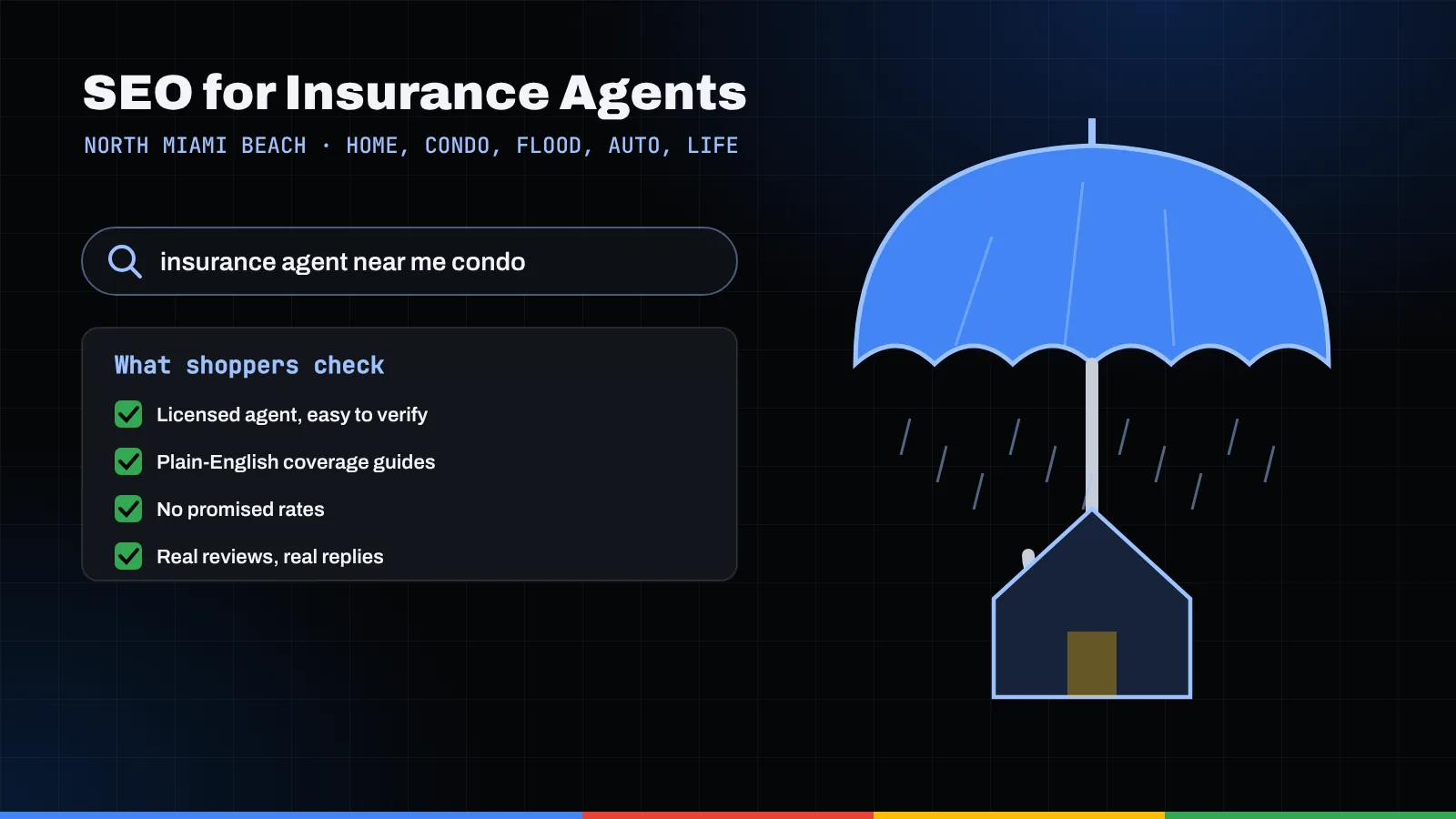
SEO for insurance agents comes down to proving, in writing, that a real licensed person stands behind every page. Google gives extra weight to trust on topics that affect people's financial stability, and Florida law prohibits insurance advertising that is untrue, deceptive or misleading. An agency in North Miami Beach that shows its licenses, explains coverage accurately, avoids promising rates and earns reviews honestly is underwriting its own search visibility.
Key takeaways
- Insurance content falls under "Your Money or Your Life," where Google says trust matters most of all.
- Florida's licensee search lets any shopper look up an agent's license, so put your name and license number where they can find it.
- Section 626.9541 of the Florida Statutes bars misrepresenting a policy's benefits, terms or conditions, and that covers web copy too.
- Quote pages should collect information and explain what drives price, not advertise a rate nobody has rated yet.
- Google allows individual profiles for insurance agents under specific rules, and both Google and the FTC ban fake or incentivized reviews.
How would an underwriter read your agency's website?
Hand most agency websites to an experienced underwriter and the file comes back with notes: stock photos, a "best rates in Miami" headline, flood advice by nobody in particular, no license number. The verdict would be polite and short: unverifiable risk, decline or rate up.
Google reads the same file with similar instincts. It cannot call your office or check your E&O policy, so it relies on what the page shows. This guide treats your online presence the way you would treat a new commercial account: list the exposures, then write the coverage. It applies whether you are an independent agency placing home, condo, auto, flood, life and commercial business with several carriers, or a captive agent working under one brand.
One standard disclaimer, since we are in the business of fine print: what follows on Florida rules is general information, not legal advice. Your compliance contact, your carriers and your attorney have the final word on your advertising.
Myth: "Insurance is a commodity, so SEO is just keywords"
The exposure. Plenty of agencies treat search like a price comparison. Pick a phrase, repeat it in a title, publish a thin page per product, wait. That approach misreads how Google treats this category.
The reality. Google's guidance on creating helpful, reliable, people-first content describes "Your Money or Your Life" topics as those that could significantly affect people's health, financial stability or safety, and it says its systems give more weight to strong experience, expertise, authoritativeness and trustworthiness (E-E-A-T) on those topics. Insurance sits squarely in that group. A wrong answer about a flood deductible or a lapsed auto policy costs someone real money.
Google also says E-E-A-T is not a specific ranking factor. It is a description of what a mix of signals tries to recognize, and Google names trust as the most important part. The same page frames three questions worth answering on every page:
- Who wrote it? A byline with the agent's name, license type and a link to a real bio.
- How was it made? If AI helped draft it, say so, and say a licensed person reviewed it.
- Why does it exist? Google calls this perhaps the most important question. A page that exists to answer a policyholder's question ages well. A page that exists to hold a keyword does not.
The coverage. Fewer pages, written by identifiable people, that each answer a real question a client asked you this year. That is the base policy of good SEO for insurance agents, and every endorsement below builds on it.
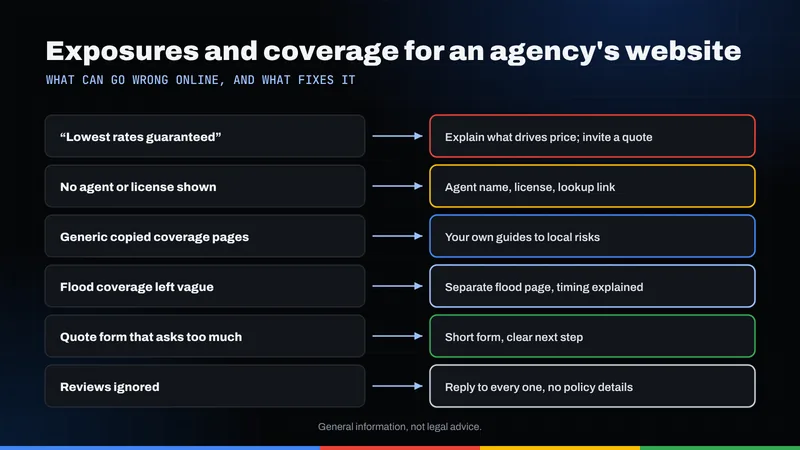
Exposure: an agent nobody can verify
Insurance is one of the few industries where a shopper can confirm your credentials in about a minute. The Florida Department of Financial Services runs a public licensee search where anyone can look up an individual or agency by name, Florida license number or National Producer Number, and see details such as license category (for example life and annuity, or property and casualty), status and appointments. It also links to enforcement actions.
That is a free trust signal most agencies leave on the table. If a careful condo owner can verify you on a state website, your own website should make that easy rather than leaving them to guess your legal name.
The coverage
- Put the agency name and agency license information in the footer of every page.
- Give each licensed agent a bio page with full name, license number, lines of authority and the kinds of clients they actually work with.
- Link to the state licensee search from your About page and invite visitors to check you.
- Byline every guide with the licensed agent who reviewed it, and add a "last reviewed" date when the content touches rules or coverage terms.
A note on the rules: in the advertising provisions we reviewed for this article, we did not find a blanket requirement to print a license number in every ad. Your carriers may have their own standards, and other documents, such as applications, have their own requirements, so check with them and with counsel. Either way, showing it is cheap insurance against looking anonymous.
Exposure: copy that promises more than the policy
Here is where marketing and the law meet. Section 626.9541 of the Florida Statutes, the unfair insurance trade practices section, prohibits knowingly making or circulating any statement or sales presentation that misrepresents the benefits, advantages, conditions or terms of any insurance policy. It also prohibits knowingly placing before the public an advertisement or statement about the business of insurance that is untrue, deceptive or misleading. The section says "by any means," so assume a web page, a blog post and a Google Business Profile post all count.
The same section also addresses unlawful rebates and inducements, advertising "free insurance" as an inducement to buy property, and using a financial institution's name or logo in a way that implies endorsement without written consent.
Phrases an underwriter would circle
- "Fully covered" or "complete protection," when every policy has exclusions, limits and deductibles.
- "Hurricane coverage included," when windstorm terms, deductibles and flood are separate questions.
- "Guaranteed approval" or "everyone qualifies."
- "Cheapest in Florida," which you cannot prove and which will age badly the first time a client compares.
The coverage. Describe what a type of policy generally does, then say plainly that terms vary by carrier and policy form and that the policy itself controls. Have compliance review any page that names a carrier or describes a specific product.
Myth: "A quote page needs a price on it to rank"
The exposure. Agencies see aggregator sites showing numbers and assume they need to do the same. So a page goes up with "auto insurance from $X a month" or a "starting at" figure for condo coverage. Then the first real quote comes back higher, and the page has created exactly the gap between ad and outcome that the statute warns about.
The reality. A quote page ranks and converts when it answers the questions people have before they hand over their information. What will you ask me? How long will it take? What changes the price? Do you write my kind of property? That content is evergreen, accurate and yours.
What a good quote page carries
- A plain statement that quotes depend on underwriting and carrier approval.
- The documents or details to have ready (for a condo, for example, the association's master policy information and any inspection reports you normally request).
- The factors that commonly affect pricing for that line, explained without numbers.
- Who will call back, by name, and when.
- A short form. Every extra field is a question your agent can ask on the phone instead.
If the form itself is the problem, our notes on why attractive websites fail to convert apply here with full force.
Exposure: flood content that gets the basics wrong
For a coastal South Florida agency, flood content is both your best search opportunity and your most expensive way to be wrong. Two basics are worth getting exactly right.
First, flood is generally its own policy, so never imply that a homeowners or condo policy handles it unless a specific policy says so. Second, FEMA's FAQ on the waiting period for a new flood policy says there is typically a 30-day waiting period from the date of purchase before the policy goes into effect, and that there are exceptions. Note the word "typically." Write it that way, and point readers to the exceptions rather than listing them from memory.
The coverage. A flood page that explains the waiting period, separates flood from wind, and tells people to call before storm season rather than during a forecast cone is genuinely useful. Keep any rule-based statement dated and sourced, and re-check it when FEMA updates its guidance. Private flood options vary by carrier; describe them generally and let the quote do the specifics.
Exposure: the wrong Google Business Profile setup
Map results are where much of local insurance shopping starts, and they are where agency setups most often go sideways. Google's guidelines for representing your business name insurance agents specifically as individual practitioners: public-facing professionals, typically with their own customer base.
What the guidelines allow
- An agency office with several agents. The agency creates a profile for the location. Each public-facing agent can have their own profile, and that profile's title should include only the agent's name.
- A solo agent under a brand. This is the common captive setup. If you are the only public-facing practitioner at the location, Google recommends sharing one profile with the format "[brand]: [practitioner name]."
- Support staff and lead generation agents. Not eligible. Google states plainly that lead generation agents for corporations are not individual practitioners.
- One profile per person. An agent should not have multiple profiles for different specialties, so no separate "flood" and "life" listings.
Names must reflect the real-world name, with no marketing taglines and no unnecessary information. "Cheap Auto Insurance North Miami Beach" is not a business name, and a suspension is an expensive way to learn that.
The coverage. Pick the setup that matches how you really operate, keep hours and phone numbers consistent everywhere, and choose categories carefully. Our Google Business Profile guide for North Miami Beach covers the profile itself, and our local SEO and Google Maps SEO pages explain how we handle it for clients.
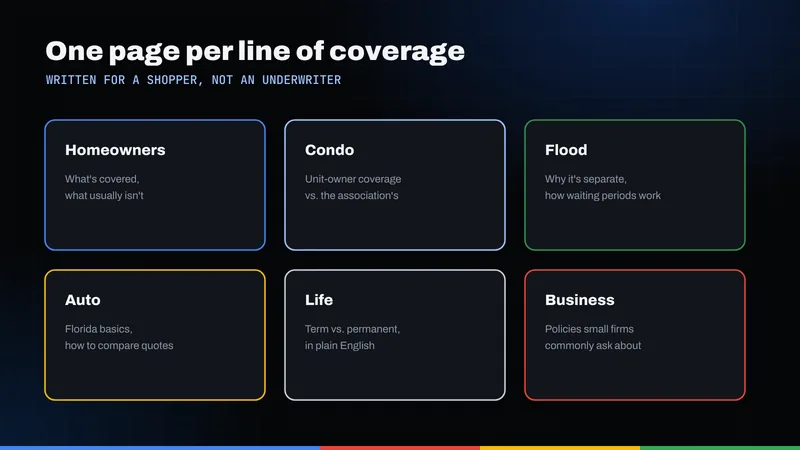
Exposure: structured data that doesn't match the page
Schema markup helps search engines read who you are without guessing. Schema.org has a specific type for this industry: InsuranceAgency, which sits under FinancialService and LocalBusiness. That gives you the usual local business properties, such as name, address, phone, hours and area served, in a type that says exactly what you are.
The common failure is not missing markup. It is markup that claims things the page does not show: an aggregate rating pulled from somewhere else, a service area the agency does not really cover, a phone number that differs from the footer. Markup is a statement of facts. Treat it with the same care as a declarations page.
The coverage. Use InsuranceAgency on the location page, Person markup on agent bios, and keep both consistent with the visible content and your Business Profile. Our explainer on how schema helps search engines goes deeper.
Exposure: reviews you can't defend
Reviews carry extra weight in a trust-driven category, which is why the temptation to shortcut them is so strong. Two sets of rules now make shortcuts a bad bet.
Google's policy on prohibited and restricted content removes fake engagement, bans reviews that were paid for directly or in kind, and bars content posted because of an incentive offered by a business. Businesses may not selectively ask only happy customers for reviews or discourage negative ones. Asking for reviews is fine, as long as you ask without incentives and without trying to steer the rating.
Separately, the Federal Trade Commission announced a final rule banning fake reviews and testimonials on August 14, 2024. It covers fake or AI-generated reviews, rewards conditioned on positive or negative sentiment, undisclosed reviews from officers or managers, company-controlled "independent" review sites, and suppressing negative reviews through threats or false accusations.
Insurance adds its own wrinkle: Florida's rebate and inducement provisions mentioned above. A gift card for a review is already a Google problem. Ask your compliance contact whether it could also look like an inducement.
The coverage. Ask every client the same way at the same moments: after a policy is bound, after a renewal review, and after a claim is handled well. Reply to every review, including the critical ones, without disclosing anything about the client's policy or claim.
The exposure schedule: common gaps and their fixes
| Exposure | What can go wrong | Coverage |
|---|---|---|
| Anonymous content | Weak trust signals on a YMYL topic | Bylines from licensed agents, real bios, review dates |
| No license info on the site | Shoppers can't connect you to the state record | License details in footer and bios, link to the DFS licensee search |
| "Fully covered" style copy | Misrepresentation risk under s. 626.9541 | Describe coverage generally; the policy controls; compliance review |
| "From $X a month" quote pages | Advertised price no client actually gets | Explain the process and pricing factors, no numbers |
| Flood pages written from memory | Wrong waiting period or coverage facts | Cite FEMA, date the page, re-check yearly |
| Keyword-stuffed profile name | Profile edits or suspension | Real-world name; practitioner profiles per Google's rules |
| Markup that oversells | Structured data that conflicts with the page | InsuranceAgency and Person markup matching visible facts |
| Incentivized or filtered reviews | Google removals, FTC exposure, possible inducement questions | Ask everyone, no rewards, reply to all reviews |
None of this requires a large content budget. It requires deciding what your agency will say in public, saying it accurately, and making the people behind it visible.
If your agency writes business across Miami-Dade, the same approach is how we handle local SEO in Miami more broadly through our Miami SEO work, and our North Miami Beach SEO page explains how we approach local search here at home. Our compliance-first guide for mortgage brokers covers a neighboring regulated industry with many of the same exposures. When you want a second set of eyes on your file, request an audit and we will review your site, profile and reviews the way an underwriter would, without promising a rate we haven't calculated.
Frequently asked questions
Is insurance agency SEO different from SEO for other local businesses?
Yes, in degree. Google treats insurance as a "Your Money or Your Life" topic and gives more weight to trust, and Florida law prohibits insurance advertising that is untrue, deceptive or misleading. The basics are the same, but accuracy, authorship and licensing carry more weight.
Should we show our Florida license number on our website?
We recommend it, in the footer and on each agent's bio. Anyone can look up agents and agencies on the Florida Department of Financial Services licensee search, so a visible license number connects your site to the state record. Ask counsel and your carriers about any other requirements that apply to you.
Can we advertise rates or a starting price on our quote pages?
We advise against it. A price shown before underwriting can differ from what a client is actually offered, and section 626.9541 prohibits misrepresenting a policy's terms or advertising that is misleading. Explain the quote process and the factors that affect price instead.
Can each agent in our office have a Google Business Profile?
Google lists insurance agents as individual practitioners. A public-facing agent who can be contacted at the verified location during stated hours can have one profile titled with just their name. A solo agent under a brand should share one profile named "[brand]: [practitioner name]." Support staff and lead generation agents aren't eligible.
Can we give clients a small gift for leaving a review?
No. Google bans reviews posted because of a business incentive, and the FTC's 2024 rule bans rewards conditioned on positive or negative reviews. Florida's rules on rebates and inducements are another reason to check with compliance. Ask every client the same way, with no reward attached.