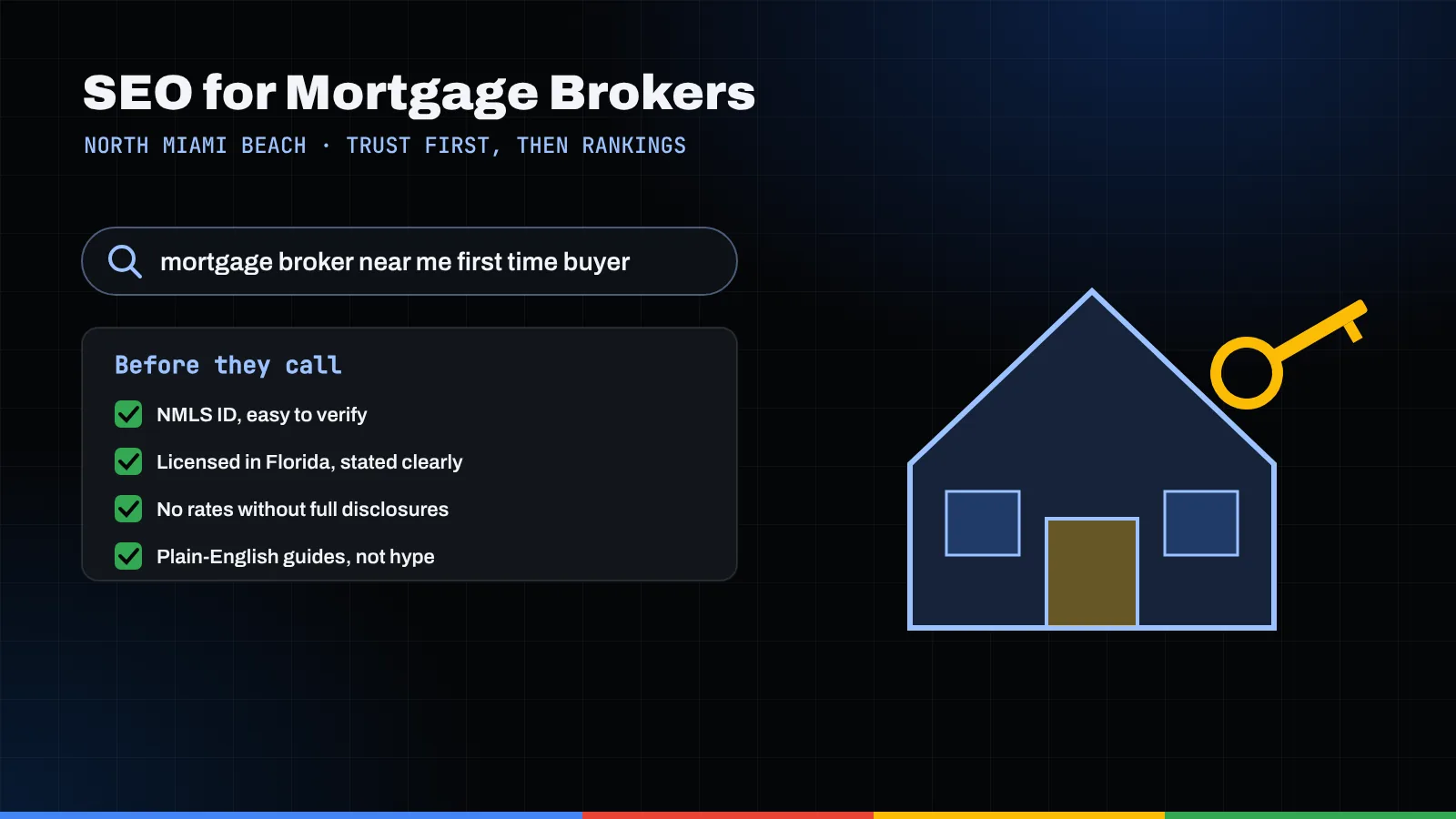
SEO for mortgage brokers works when every page could pass a compliance review before it ever meets a search engine. Google gives extra weight to trust on financial topics, and mortgage advertising is governed by federal and Florida rules, so the site that wins shows who is licensed, explains how lending works, and never advertises a rate or term it can't support. In North Miami Beach, pair that with an accurate Google Business Profile and honest reviews.
Key takeaways
- Mortgage content is a "Your Money or Your Life" topic, and Google says trust is the most important part of E-E-A-T.
- Show company and loan officer NMLS IDs, and tell readers they can check them on NMLS Consumer Access.
- Stating a payment, down payment, number of payments or finance charge can trigger Regulation Z disclosures, including the APR.
- Florida's chapter 494 bars advertising an interest rate without saying it could change or be unavailable at commitment or closing.
- Rate explainers, calculators and glossaries can rank without promising terms. Ask every borrower for a review the same way.
Why is mortgage SEO held to a higher bar?
Two readers review every mortgage website. One is Google. The other is a regulator, an investor's compliance team or a plaintiff's lawyer. A careful broker writes for the second reader first, because content that satisfies a regulator tends to be the content Google is asking for.
Google's guidance on creating helpful, reliable, people-first content describes E-E-A-T (experience, expertise, authoritativeness and trustworthiness) and says that, of these, trust is most important. It also says Google's systems give extra weight to strong E-E-A-T on topics that could significantly affect people's financial stability, which it calls "Your Money or Your Life" topics. A loan secured by someone's home sits squarely there.
Google is careful to add that E-E-A-T isn't a specific ranking factor. There's no badge to collect. What you can do is answer the questions the guidance raises about any page:
- Who made it? Google strongly encourages accurate bylines that lead to the author's background. On a mortgage site, that background includes a license.
- How was it made? If automation helped draft it, say so, and have someone qualified review it.
- Why does it exist? A page that helps a borrower understand escrow is defensible. A page built only to rank for "lowest rates" isn't.
Everything below is general information about marketing, not legal advice. Mortgage advertising law is detailed and changes, so have your compliance officer or counsel review what you publish.
How should a broker show licensing and NMLS IDs?
In Florida, licensing runs through the Office of Financial Regulation. Its loan originator page explains that an individual who solicits mortgage loans, takes applications or negotiates loan terms needs a loan originator license under chapter 494, Florida Statutes, and that applications and renewals are filed through the Nationwide Multistate Licensing System and Registry (NMLS). Chapter 494 separately requires a mortgage broker license for firms acting as brokers.
NMLS assigns each company and individual a unique identifier. The Conference of State Bank Supervisors describes NMLS Consumer Access as a free service for consumers to confirm that a company or professional is authorized to do business in their state. That makes your NMLS ID the most checkable trust signal on your site.
- Company name and NMLS ID in the footer of every page.
- Each loan officer's NMLS ID on their bio, next to their name and photo.
- One plain line explaining that the number can be looked up on NMLS Consumer Access.
- The same details on your Google Business Profile, so search results and your site agree.
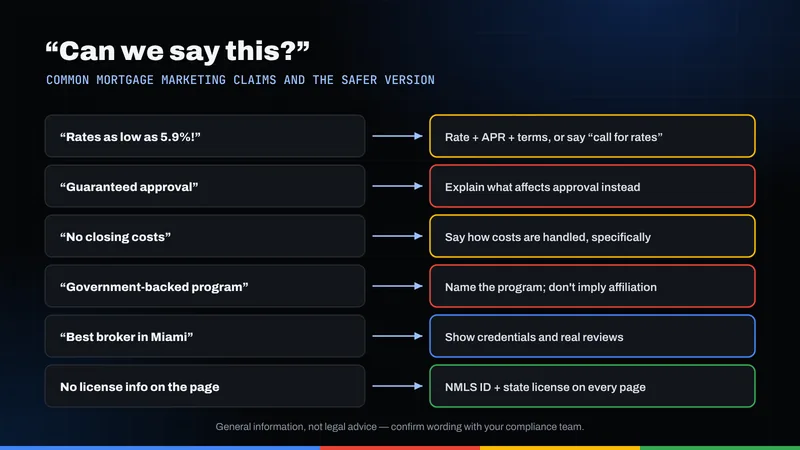
Can we say this? "Licensed in Florida" is a factual claim, only as good as today's license status. When a loan officer leaves or stops originating, update or remove their page that week, not at the next redesign.
A point we checked carefully: section 494.00165, the chapter's advertising section, doesn't itself say "put your license number in every ad." Other obligations may still apply, from rules under Florida Administrative Code chapter 69V-40 to federal and investor requirements. Displaying the IDs is cheap and builds trust. Confirm the specifics with counsel.
Which advertising rules touch ordinary SEO copy?
It's risky to assume ad rules cover paid ads and not web pages. Title tags, meta descriptions, blog posts, profile posts and social captions are all commercial communications about mortgage credit. Three sets of rules come up most.
Regulation Z trigger terms and the APR
Under 12 CFR 1026.24, an ad that states a rate of finance charge must state it as an "annual percentage rate," using that term, and say if it may increase after consummation. The triggering terms are the amount or percentage of any down payment, the number of payments or period of repayment, the amount of any payment, and the amount of any finance charge. Use one, and the ad must also clearly and conspicuously disclose the down payment, the repayment terms over the full term (including any balloon payment) and the APR.
For dwelling-secured credit, the section also prohibits misleading use of the word "fixed," implying a product is a government program or government-endorsed when it isn't, calling a for-profit broker or creditor a "counselor," and giving some trigger terms or disclosures only in a foreign language while giving others only in English.
Regulation N, the MAP Rule
The Mortgage Acts and Practices Advertising Rule, Regulation N at 12 CFR part 1014, prohibits material misrepresentations, express or implied, in commercial communications about mortgage credit products. Its list includes rates, fees and costs (including "no fees" claims), whether payments can vary, government affiliation, who the message is from, the consumer's ability to get a loan (including preapproval or guarantee claims), and the availability of counseling or expert advice. It applies to persons within the FTC's jurisdiction and requires keeping copies of communications for 24 months. Ask counsel whether it covers your firm.
Florida's chapter 494
Section 494.00165 makes it a violation to advertise unqualified access to credit without disclosing material limitations, to advertise an expressed interest rate unless the ad states the rate could change or not be available at commitment or closing, to advertise terms you can't make available to a reasonable number of qualified applicants, to misuse names indicating a federal agency, or to advertise in an unfair, deceptive or misleading way. Licensees must keep samples of each ad for two years.
Here's how those rules map onto claims we see in draft mortgage copy:
| Common marketing claim | What rule it touches | Safer approach |
|---|---|---|
| "Rates as low as X%" in a title tag | Reg Z APR rule; Fla. Stat. 494.00165(1)(b); Reg N rate claims | Keep rates out of titles and snippets. Any stated rate needs the APR, the Florida rate-change statement and a real ability to offer it. |
| "Just $X a month!" | Reg Z trigger term (payment amount) | Use a calculator that shows its assumptions, or describe what drives the payment without a figure. |
| "Guaranteed approval" | Fla. Stat. 494.00165(1)(a); Reg N ability-to-obtain claims | "See what you may qualify for. Approval depends on credit, income, assets and the property." |
| "No closing costs" | Reg N fees and costs | Explain how closing costs can be paid, including through a higher rate, and claim "no costs" only when true for that product. |
| "Our mortgage counselors" | Reg Z "counselor" prohibition; Reg N counseling claims | "Loan officers" or "licensed mortgage loan originators." |
| Spanish headline, English-only disclosures | Reg Z foreign-language rule | Translate the whole ad, disclosures included, or keep it in one language. |
Can we say this? If a sentence would need disclosures in a print ad, assume it needs them on the web. Usually the cleanest fix is to remove the triggering number rather than bolt fine print onto a friendly article.
How do you build a rate page without advertising rates?
Borrowers search for rates constantly, so the intent is worth targeting. The worst version is a static "today's rates" table copied from last month's sheet: stale on arrival, probably not available to most readers, and carrying every risk in the table above.
A defensible rate page explains what moves a quote: credit profile, loan-to-value and down payment; program and term; occupancy; points and lender credits; and lock periods, including why a quote isn't a commitment until it's locked. Then it tells the reader how to get a real quote and what to bring. That answers the question behind the search, "what would I get, and why?", without stating a term.
Can we say this? If you publish a live rate anyway, it needs an owner, a timestamp, stated assumptions, the APR, Florida's rate-change statement and an archived copy. If nobody can own that, don't publish the number.
Are calculators and glossaries worth building?
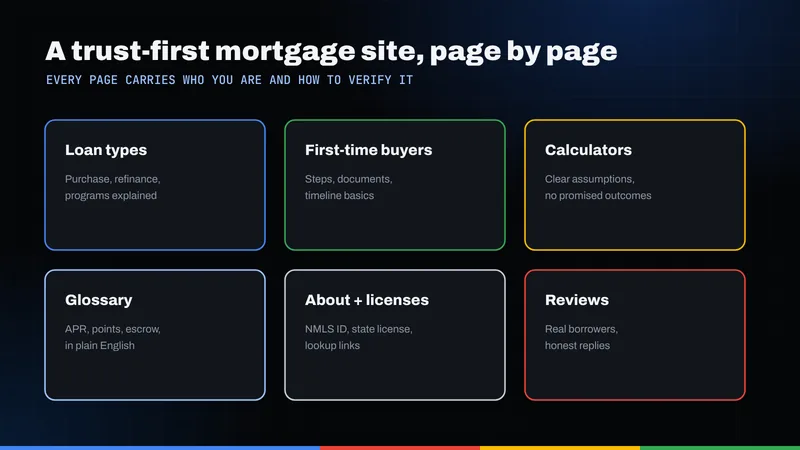
Yes. They answer real questions, earn links over time and rarely require stating a term you'd have to honor.
Calculators let the borrower supply the inputs. Keep them honest:
- Show every assumption: rate, term, taxes, insurance, HOA dues.
- Don't prefill a rate that reads like a current offer.
- Label the output as an illustration, not a quote or a Loan Estimate.
- Include tax and insurance fields, since leaving them out understates the monthly cost.
A glossary should define the words borrowers stumble over: APR versus interest rate, points, escrow, PMI, rate lock, loan-to-value and debt-to-income. Have a licensed loan officer review it and say so on the page. That's the "who" and "how" Google asks about, in practice.
North Miami Beach is a multilingual market, so translated pages are a real opportunity. Translate disclosures with everything else. Our guide to multilingual SEO in North Miami Beach covers the technical setup.
Can individual loan officers have their own Google Business Profile?
Sometimes. Google's guidelines for representing your business let an individual practitioner have a dedicated profile if they're public-facing and can be contacted directly at the verified location during stated hours. Support staff shouldn't have profiles, one practitioner shouldn't have several, and lead generation agents aren't eligible. A solo loan officer working under a brand should share one profile named "[brand]: [practitioner name]."
The name must match your real-world name, and marketing taglines aren't permitted. "Best Rate Mortgage North Miami Beach" in the name field is both a suspension risk and a rate claim. Our walkthrough of Google Business Profile in North Miami Beach covers categories, photos and posts, and our local SEO service is where we manage it for clients.
Can we say this? Profile posts are ads. "Lock today at X%!" raises the same APR and rate-change issues as a billboard. Post about process, documents and local market education instead.
Which schema types fit a mortgage brokerage?
Structured data must match the visible page, and this is a common place for guesswork:
- Schema.org has FinancialService, a subtype of LocalBusiness. It fits the brokerage's office.
- There's no "MortgageBroker" type. Don't invent one.
- MortgageLoan exists as a financial product type and can describe a loan you offer. Be careful with rate-related properties, since markup can carry the same claims as copy.
- Loan officer bios can use Person markup tied to the organization, with the NMLS ID visible on the page.
More in how schema helps search engines.
How should a broker ask for reviews?
Google's review policies prohibit incentives for reviews, conflict-of-interest reviews (which can include current or former employees) and selectively soliciting positive reviews, often called review gating. The FTC's final rule on fake reviews and testimonials, announced August 14, 2024, bans fake reviews (including AI-generated ones), incentives conditioned on positive or negative sentiment, undisclosed insider reviews and suppressing negative reviews through baseless threats or intimidation.
- Ask every closed borrower, with the same message, at the same point.
- Offer nothing in exchange.
- Don't ask staff, family or referral partners to post without disclosing the relationship.
- Reply to every review without confirming that someone was a borrower or discussing loan details.
Can we say this? A review quoted on your site is a testimonial. If it mentions a rate or payment, it can raise the same issues as your own copy. Choose testimonials about service and communication.
What does a compliant SEO workflow look like?
Mortgage broker SEO uses the same fundamentals as any SEO in Miami: relevant pages, a fast site, accurate listings and earned links. Local SEO in Miami for a lender adds one thing, a review step, and it has to be a routine:
- Inventory every page, profile and post, flagging rates, payments, fees and program names.
- Fix high-risk items first: titles and snippets with rates, guarantees or "counselor."
- Build the trust layer: NMLS IDs, real bios and bylines.
- Add an approval gate: compliance signs off before anything goes live, and a dated copy is saved, which supports Florida's two-year ad-sample rule.
- Publish reviewed education on a schedule: first-time buyer guides, condo financing, refinance basics.
- Review quarterly, because old posts are where stale claims hide.
Referring agents face related questions, covered in our real estate agent SEO guide, and debt relief and credit repair SEO covers another regulated finance niche. For our approach to the city overall, see North Miami Beach SEO.
We'll review your site and profiles through both lenses, search visibility and advertising risk, and tell you what to fix first. Request a free audit, and bring your compliance contact into the conversation.
Frequently asked questions
Do mortgage advertising rules apply to blog posts and web pages?
Often, yes. Regulation N covers commercial communications about mortgage credit products, and Florida's section 494.00165 addresses advertising about mortgage loans and brokering services. Treat titles, blog posts and profile posts as advertising, and have counsel confirm what applies to your firm.
Should we put our NMLS ID on our website?
We recommend it: the company ID in the footer and each loan officer's ID on their bio. Consumers can confirm licensees for free on NMLS Consumer Access, so a visible ID is a strong trust signal. Ask counsel about any display requirements that apply to you.
Can we publish today's mortgage rates on our site?
Only with a process behind it. Regulation Z requires a stated rate of finance charge to appear as an APR, and Florida law requires an advertised interest rate to carry a statement that it could change or not be available at commitment or closing. Many brokers do better explaining what affects rates.
Is there a MortgageBroker schema type?
No. Schema.org has FinancialService, a subtype of LocalBusiness, which fits a brokerage office, and MortgageLoan for describing a loan product. Markup should match what's visible on the page.
Can a loan officer have a separate Google Business Profile from the brokerage?
Google allows a dedicated profile for a public-facing practitioner who can be contacted directly at the verified location during stated hours. A solo loan officer under a brand should share one profile named "[brand]: [practitioner name]." Lead generation agents aren't eligible.