SEO for accountants works like a well-kept ledger: every claim on your website should tie back to something a client or Google can verify. For a CPA firm, bookkeeper or tax preparer in North Miami Beach, that means a correctly categorized Google Business Profile, one page per type of client you serve, credentials people can look up themselves, honest reviews, and a content calendar that follows the tax year instead of fighting it.
Key takeaways
- Accounting is a "Your Money or Your Life" topic, so Google weighs trust heavily. Show who wrote your pages and why they're qualified.
- Build separate pages for individuals, small businesses, bookkeeping, payroll and IRS notices. Each one answers a different client's questions.
- Point visitors to the public records that back your credentials: the Florida DBPR license search and the IRS directory of credentialed preparers.
- Plan content by season: deadline and document pages before tax season, planning and cleanup content in the off-season.
- Ask every client for a review the same way, with no incentive. Google's policy and the FTC's 2024 rule both say so.
Why is SEO for accountants different from other local SEO?
A plumber's work is visible. An accountant sells judgment, and the client usually can't audit it. The whole sale rests on trust, and Google's systems treat it the same way.
Google's guide to creating helpful, reliable content describes a category of topics it calls "Your Money or Your Life" (YMYL), meaning subjects that can significantly affect a person's health, financial stability or safety. For those topics, Google says its systems give even more weight to content that shows strong experience, expertise, authoritativeness and trustworthiness (E-E-A-T). The same page is careful to say E-E-A-T is not itself a specific ranking factor, and that of the four, trust is the most important.
Translated into accounting terms: Google is not going to count your credits. It's going to look at whether the books balance. A penalty abatement page with no named author is an unsupported entry. The same page reviewed by a named CPA, linked to a bio showing the license, is a reconciled one.
The rest of SEO for accountants follows the same principles as any local practice, which our local SEO overview covers. What follows is the accounting-specific part.
How should an accounting firm set up its Google Business Profile?
The profile is often where a new client's first call starts. Work through it in this order:
- Name. Google's Business Profile guidelines require your name to match the real-world name on your signage, website and stationery. "Smith & Rivera CPAs" is fine if that's the firm. "Smith & Rivera CPAs | Tax Preparation North Miami Beach" is keyword stuffing, and the guidelines specifically disallow adding unnecessary information to the name.
- Primary category. The guidelines say to use as few categories as possible and to pick ones that complete the sentence "This business is a…" rather than "this business has a…". A licensed firm will usually choose its accountant-type category as primary. A tax-only shop should pick the tax preparation category instead. Pick what you are, not what you'd like to rank for.
- Additional categories. Add one only if it describes a genuine part of the practice, such as a bookkeeping service. Don't add a category for every service you list.
- Services. This is where the detail goes: individual returns, small business returns, monthly bookkeeping, payroll, sales tax filings, IRS notice response. Use the plain words clients use, and only list work you actually take on.
- Hours. Google's guidelines tell you to list your regular customer-facing hours, and they allow current seasonal hours to stand in as your regular hours. So if you open Saturdays from February through mid-April, update your hours when the season starts and change them back when it ends. Calendar the change; "Open" on an empty Saturday in June costs you a review.
- Description and photos. Say who you serve and in which languages. Use real photos, not stock calculators.
Our Google Business Profile guide for North Miami Beach walks through posts, Q&A and verification in more detail.
Which service pages should an accounting firm build?
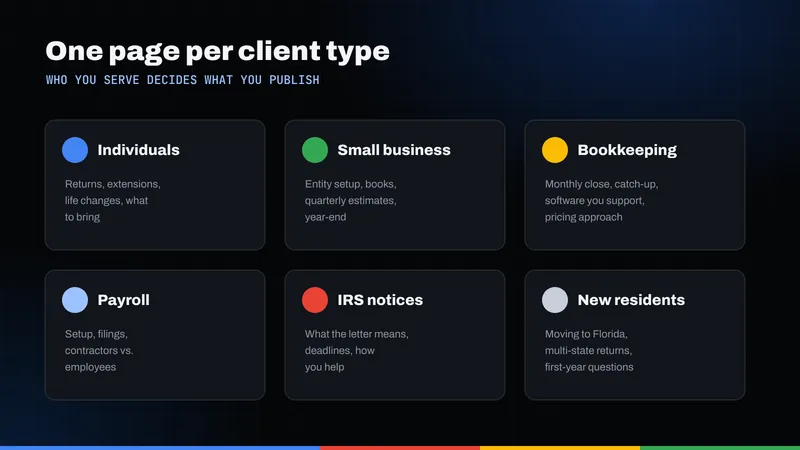
A single "Services" page listing everything in one paragraph is the website equivalent of a suspense account: it's all in there, and nobody can find anything. Each client type searches differently, so each gets its own page. Here is a starting chart of accounts:
| Client type | Page to build | Questions the page must answer |
|---|---|---|
| Individuals and families | Individual tax preparation | What documents do I bring? Do you file state returns for people who moved? How do you price it? Can you handle prior-year returns? |
| Small business owners | Small business tax & accounting | Which entity types do you work with? Do you handle quarterly estimates? What happens between April and December? |
| Businesses with messy books | Bookkeeping & cleanup | What software do you use? How far back can you catch up? Is it monthly or one-time? Who does the work? |
| Employers | Payroll services | Do you file payroll tax returns? How do new hires get onboarded? What do I do if a payroll deposit was missed? |
| Anyone who got a letter | IRS notices & representation | What does this notice mean? What's the response deadline on it? Can you speak to the IRS for me, and what credential lets you do that? |
A few rules for writing them:
- Answer the question, then the follow-up. The IRS notice page should say what to do first (read it, note the response date, don't ignore it), then when to call you.
- Name the author. Put a byline on each page with a link to that person's bio. Google's helpful content guidance explicitly suggests making clear who created the content.
- Be specific about pricing, or specific about why you can't be. More on that below, because Florida's advertising rule has opinions.
- Don't spin up a page per city. One strong page per service beats twenty thin copies with "Aventura" swapped for "Sunny Isles Beach."
For on-page basics like titles, headings and internal links, see our SEO services page.
How do you show credentials people can actually verify?
Most accounting credentials are public records. Instead of writing "licensed and experienced," tell visitors where to confirm it.
Florida CPA licenses
The Florida Department of Business and Professional Regulation (DBPR) licenses CPAs. Its public licensee search at MyFloridaLicense.com lets anyone look up a licensee by name, license number, city or county, or license type. Put each CPA's license number on their bio page and tell readers they can check it there.
PTIN and the IRS directory
A PTIN is a preparer tax identification number. Per the IRS's PTIN requirements page, all paid tax return preparers must have one, and the IRS handles PTIN renewals year by year, so renewal belongs on your annual checklist. Having a PTIN is a requirement, not a distinction, so don't market it as one.
The more useful public record is the IRS's Directory of Federal Tax Return Preparers with Credentials and Select Qualifications. According to the IRS's directory FAQ, it lists preparers with an active PTIN who are also CPAs, enrolled agents, attorneys, enrolled retirement plan agents, enrolled actuaries or Annual Filing Season Program participants. It does not list non-credentialed preparers outside that program. If your preparers qualify, say so and point clients to the directory.
On the bio page
- Full name, credential and license number where one exists
- Years in practice and the kinds of clients served, described factually
- Languages spoken, if you serve clients in more than English
- Which pages on the site they wrote or reviewed
That last item turns a bio from decoration into evidence: it answers Google's "who created this" question.
What schema markup should an accounting firm use?
Schema.org has a type built for this: AccountingService, which its schema.org entry describes as an "accountancy business." It sits under FinancialService, which in turn sits under LocalBusiness, so it inherits the standard local business properties: name, address, phone, opening hours, area served and so on.
- Mark up the firm on the homepage or contact page as an
AccountingService, with the same name, address and phone as your Google Business Profile, character for character. - Mark up each CPA's bio page with
Person, linking back to the firm. - Keep opening hours in the markup consistent with the hours you publish on the page. If seasonal hours change on Google, change them here too.
- Only mark up what's visible on the page. Markup is a description of the page, not a second, better-looking version of it.
Schema won't rank a weak page, but it removes ambiguity about who you are and where you are. Our post on how schema helps search engines explains what it can and can't do.
How should a firm plan content around tax season?
Planning content around the tax year means publishing before people search, and writing when you actually have time.
Two dates anchor the calendar. For the 2025 tax year, the IRS's when-to-file page lists April 15, 2026 as the due date for calendar-year individual returns, and it notes that filing Form 4868 by that date gets an automatic six-month extension to file, which runs to October 15. The same page is clear that an extension to file is not an extension to pay. That alone is worth a page.
Before you publish any deadline, check it again on irs.gov for the year you're writing about. Dates shift when they land on a weekend or holiday, and you want the year in your post to match the year on the IRS page.
A practical cycle
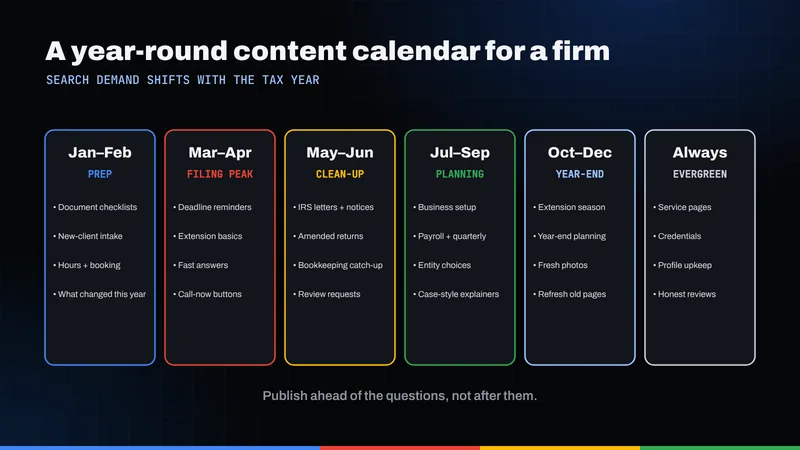
- Late fall (pre-season). Update your individual and small business pages for the coming season. Publish a document checklist, a "what's changed this year" explainer once the IRS confirms the changes, and your seasonal hours.
- January through April (season). Short, fast answers: deadline reminders, extension explainers, "I lost my form, now what" posts. Use Google Business Profile posts for operational updates. Don't start a major site rebuild now.
- Late April through summer (post-season). This is when the long-form work gets written: bookkeeping cleanup guides, entity selection basics, IRS notice explainers. Notices don't follow your busy season, so that page earns its keep year-round.
- Early fall (extension season and planning). Extension-deadline reminders, year-end planning topics for business owners, payroll year-end preparation.
Think of it as accrual-basis publishing: record the content in the period before the demand arrives, not when the phone is already ringing. If you want a realistic sense of how long new pages take to show up, our post on how long SEO takes covers it.
How should an accounting firm get reviews without breaking rules?
Shortcuts here carry legal exposure, not just ranking risk. Two sets of rules apply.
Google's policy. Google's prohibited and restricted content policy says businesses may not offer incentives such as payment, discounts or free services for reviews, may not discourage negative reviews or selectively ask only happy clients, and may not ask staff to hit a review quota. Reviews based on a conflict of interest, including from current or former employees, aren't allowed either.
The FTC's rule. In August 2024 the Federal Trade Commission announced a final rule banning fake reviews and testimonials. Among other things, it prohibits fake reviews (including AI-generated ones), incentives conditioned on a positive or negative sentiment, undisclosed insider reviews, and using unfounded legal threats or intimidation to suppress negative reviews.
So the compliant process is boring, which is the point:
- Send every client the same review request after the engagement wraps, whether the return was simple or painful.
- Offer nothing in exchange: no fee reduction, no gift card, no raffle.
- Don't ask staff, relatives or the bookkeeper's college roommate.
- Reply to every review, briefly and without confirming that the reviewer is a client or mentioning anything about their finances. Confidentiality outranks a snappy comeback.
What do Florida's advertising rules mean for a CPA's website?
If you're a licensed CPA, your website is advertising in the Florida Board of Accountancy's eyes. Rule 61H1-24.001 of the Florida Administrative Code expressly includes websites, email and other electronic communication in its definition of advertising. It prohibits advertising that is fraudulent, false, deceptive or misleading, and it lists examples. A few have direct consequences for SEO copy:
- Partial disclosure of relevant facts. A headline that only tells half the story can be a problem even if each word is true.
- False or unjustified expectations. "We'll get your penalties removed" promises a result you don't control.
- Fear-based appeals. The rule specifically addresses advertising that appeals primarily to a layperson's fears or anxieties about their financial well-being. That rules out a lot of "IRS coming for you?" headlines.
- Fees. Representing that services can be done for a stated fee when that isn't the case, or stating fees without disclosing the variables that affect the final charge, is listed as misleading. If you publish starting prices, say what changes them.
- "Specialist." If a CPA uses "specialist," "specialty" or a similar term implying advanced standing, the ad must say the term is a self-designation and isn't sanctioned by the state or federal government, unless it reflects bona fide formal recognition.
This is a summary, not legal advice, and rules get amended. Have the rule text open when you approve copy, and ask your own counsel or the Board if something is borderline. Non-CPA bookkeepers and preparers aren't governed by this particular rule, but the same habits are simply good practice for anyone handling other people's money. Law firms face a similar discipline under the Florida Bar, which we covered in our law firm SEO guide.
What's specific about North Miami Beach for accountants?
A few practical points for a local firm:
- Language. If your team works in Spanish, Russian, Haitian Creole or another language, say so on the relevant pages, in your Google Business Profile description, and on staff bios. Have translations written properly.
- Address accuracy. Make sure your address and phone are identical across your site, your profile, and directories. A suite number written three different ways is three different entries that won't reconcile.
- Service area honesty. If you see clients in person in North Miami Beach and remotely statewide, say exactly that. Don't imply an office you don't have.
Firms targeting the wider metro may also want broader visibility, which our Miami SEO page addresses. For the local picture, see North Miami Beach SEO. And if you'd like an outside review of what's working on your site and profile, you can request an audit.
Frequently asked questions
Is SEO for CPA firms different from SEO for bookkeepers or tax preparers?
The mechanics are the same: a well-set-up Google Business Profile, clear service pages, real credentials and honest reviews. The difference is the rules. Licensed Florida CPAs are subject to the Board of Accountancy's advertising rule, which covers website content, while non-CPA bookkeepers and preparers mainly need to watch general truth-in-advertising rules and avoid implying credentials they don't hold.
What Google Business Profile category should an accounting firm choose?
Choose the most specific category that describes what the business is, not every service it offers. A licensed firm usually picks an accountant-type category as primary, and a tax-only office picks the tax preparation category. Add additional categories only for genuine parts of the practice, such as bookkeeping, and list individual services in the services section instead.
Can we change our Google hours for tax season?
Yes. Google's guidelines let you use your current seasonal hours as your regular hours. Update them when your extended season hours begin and change them back when the season ends, and keep the hours on your website and in your schema markup matching.
Can we offer a discount to clients who leave a Google review?
No. Google's policy prohibits offering incentives such as discounts or free services for reviews, and the FTC's 2024 rule prohibits incentives conditioned on a review's sentiment. Ask every client the same way and offer nothing in return.
Should a CPA list their license number on the website?
It's a good practice. Florida CPA licenses can be looked up on the DBPR's licensee search at MyFloridaLicense.com by name or license number, so listing the number on a bio page lets clients verify it themselves, and it supports the trust signals Google looks for on financial topics.