SEO for lawyers in North Miami Beach comes down to a handful of partner-level decisions: build a real page for each practice area you want to grow, set up your Google Business Profile the way Google's practitioner rules require, earn reviews without breaking either Google's policies or the Florida Bar's, track every call back to its source, and decide how much budget goes to paid search while organic visibility builds. Everything on your website also has to comply with the Bar's advertising rules in Subchapter 4-7.
Key takeaways
- Treat each practice area as its own product, with a dedicated page written for the person who actually needs that lawyer, not one long "Practice Areas" list.
- Google has specific rules for practitioners: in some setups an individual attorney gets a Business Profile, and in others they share the firm's. Getting this wrong creates duplicates that are hard to clean up.
- Florida Bar rules apply to your website even though websites are exempt from the Bar's filing requirement. Past results, testimonials and "expert" or "specialist" language all have conditions attached.
- Call tracking and intake discipline usually matter more than another blog post. You can't allocate budget well without knowing which channel produced which signed case.
- Paid search and SEO aren't rivals. Ads buy visibility now, and SEO builds visibility you own later. The split should change as organic results come in.
What does SEO for lawyers actually involve in North Miami Beach?
We have sat in a lot of partner meetings where the firm "needs SEO" and nobody can quite say what it is buying. So, a plain definition. Law firm SEO, or SEO for lawyers if you prefer the phrase clients type into Google, is the work of making your firm the obvious, trustworthy answer when someone in your market searches for the kind of help you provide, both in Google's map results and in the ordinary organic listings beneath them.
North Miami Beach is its own city, separate from North Miami and from Miami Beach, and that distinction matters when you write location pages and set service areas. Many firms here also want to compete for broader law firm SEO Miami searches (a more crowded contest; our Miami SEO page covers that wider market). According to the U.S. Census Bureau's QuickFacts, the city's estimated population was 46,236 as of July 2025, 56.5% of residents were born outside the United States, and 71.8% of residents age five and older speak a language other than English at home (2020–2024 estimates). That last figure should shape how your intake and content are built.
What follows is organized around the decisions that reach a partner's desk.
Decision one: how should we structure practice-area pages?
This is where many firm websites underperform. A single page that lists "Personal Injury, Family Law, Immigration, Real Estate, Criminal Defense" with a paragraph under each gives Google little to rank and a prospective client little reason to call. The person searching after a car crash and the person searching for help with a green card application are different people with different fears, and they deserve different pages.
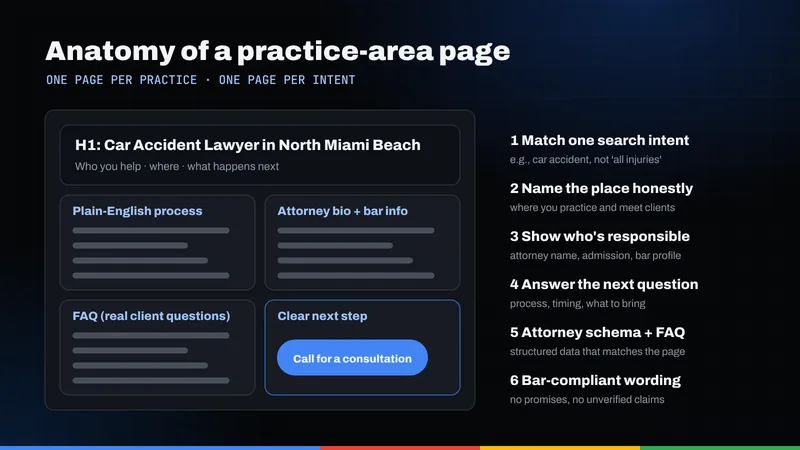
Our recommendation: one strong page per practice area you want to grow, with supporting pages only where there is real substance. A personal injury page might support pages on car accidents, slip-and-fall claims and wrongful death. A family law page might support divorce, custody and support modifications. Avoid thin variations that swap in a different city name.
When we review a practice-area page, we use a checklist like this one.
| Element | What good looks like | Common mistake |
|---|---|---|
| Headline and opening | Names the legal problem in the client's words and the area served | Opens with firm history or a generic welcome |
| Process explanation | Walks through what happens after the first call, in plain language | Legal jargon with no next step |
| Attorney attribution | Names the lawyer responsible for the work, with a link to their bio | Anonymous copy with no named lawyer |
| Results and testimonials | Only used where they meet Florida Bar conditions, with required disclaimers | Case results listed without context or disclaimer |
| Language access | States which languages the firm actually serves clients in | A translation widget and nothing else |
| Contact path | A tracked phone number and a short form visible without scrolling far | One contact form buried at the bottom of the page |
| Structured data | LegalService markup consistent with the Business Profile | No markup, or markup with a different address or phone |
If the firm serves clients in Spanish, Haitian Creole, Russian or another language, the approach in our post on multilingual SEO in North Miami Beach applies directly.
Decision two: one Google Business Profile or several?
Google's guidelines for representing your business include a section on individual practitioners. The key points:
- A practitioner can have a dedicated profile if they work in a public-facing role and can be contacted directly at the verified location during stated hours. Google says support staff should not create their own profiles.
- A practitioner shouldn't have multiple profiles to cover different specializations. One attorney, one profile.
- Where several practitioners work at one location, the organization should have its own profile, separate from each practitioner's, and the practitioner's profile title should include only the practitioner's name.
- Where a single practitioner works under a firm's brand, Google says it's best to share one profile with the organization, named in the format "[brand/company]: [practitioner name]."
Google's guidelines also say your business name should reflect your real-world name and that adding unnecessary information to it isn't permitted. In practice, that means "Smith Law Group," not "Smith Law Group Best Car Accident Lawyer Miami."
The decision is about matching your real structure, not maximizing listings. Our article on Google Business Profile for North Miami Beach businesses covers categories, photos and posting.
Decision three: how do we earn reviews under two sets of rules?
Google's side
Google's prohibited and restricted content policy says businesses may not offer incentives, such as payment, discounts or free services, in exchange for reviews. It also says merchants may not discourage negative reviews or selectively solicit positive reviews from customers. That rules out sending the review link only to happy clients. Google also removes reviews that come from conflicts of interest, which can include current or former employment, so staff reviews are out.
The Florida Bar's side
The Bar's testimonial rules apply when the firm uses reviews in its own advertising, including its website (see the compliance section). The policy we suggest: ask every client whose matter has concluded, ask in the same neutral way each time, never offer anything in return, and never draft the review for them.
Responding to reviews also needs care. A lawyer's duty of confidentiality doesn't disappear because a former client posted publicly. A short, courteous reply that doesn't confirm or discuss the representation is the safer default,.
Decision four: can we trace a signed case back to its source?
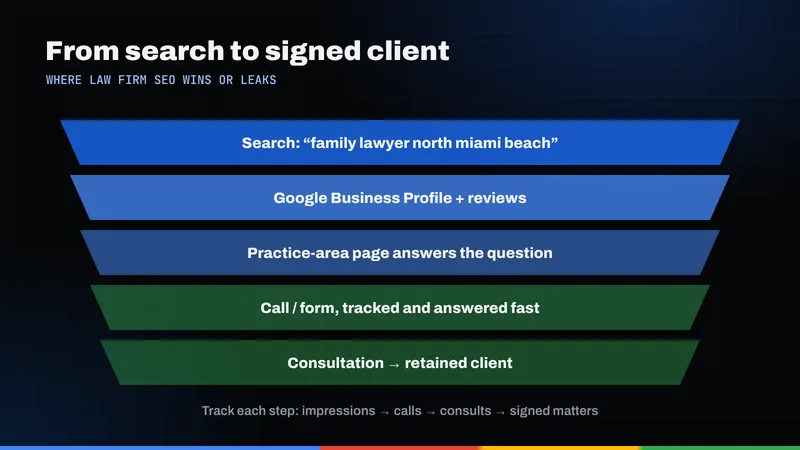
In our experience, this decision changes how a firm spends money more than any other, and it has nothing to do with rankings. If the firm can't tell whether a call came from the Business Profile, an organic page, a paid ad or a referral, every budget conversation turns into opinion.
- Call tracking with dynamic numbers on the website, so calls from organic visitors, paid visitors and direct visitors are recorded separately.
- A distinct tracking number on the Business Profile, with the main number kept as an additional number so your listing details stay consistent.
- An intake log that records the outcome: was this a potential client, what practice area, did they book a consultation, did they sign.
- A response standard. Who answers after hours? In which languages? How quickly is a web form returned? In a city where most residents speak a language other than English at home, the answer to the second question is a competitive issue.
If the website itself is the weak link, our conversion optimization work focuses on exactly this: getting more of the people who already arrive to pick up the phone.
Decision five: how do we split budget between SEO and paid search?
They do different jobs on different timelines, and firms in competitive practice areas often use both for a period. The useful question is how the split should change over time.
| Factor | Paid search (Google Ads) | SEO |
|---|---|---|
| Speed | Visibility as soon as campaigns are approved and live | Builds over months |
| Cost behavior | You pay for each click; visibility stops when spending stops | Ongoing investment in content and authority; visibility tends to persist |
| Control | Precise control over keywords, hours, geography and budget | Less direct control; Google decides rankings |
| Compliance | Paid ads that aren't exempt generally must be filed with the Bar for review | Website content isn't filed, but must still meet the substantive rules |
| Best use | New practice areas, launches, testing which messages produce calls | Practice areas the firm plans to own for years |
A pattern we often recommend: lean on paid search for the practice areas where the firm needs cases now, use the call data to learn which searches actually produce signed matters, and feed those findings into the organic plan. As organic pages begin to earn calls for a given practice area, you can move budget away from ads for those same searches and toward newer areas. That is a budget conversation driven by your own intake data.
What do the Florida Bar's advertising rules mean for our website?
This section is general information to help you ask better questions. It is not legal advice, and the rules and fees change. The authoritative text lives in Chapter 4 of the Rules Regulating The Florida Bar, Subchapter 4-7, and the Bar publishes a Handbook on Lawyer Advertising and Solicitation that explains them in more practical terms.
Your website is advertising
Rule 4-7.11(a) applies the advertising rules to communications in any print or electronic forum, including websites and social networking. Under Rule 4-7.20, lawyer and law firm websites are exempt from the filing requirement, but the handbook is clear that exempt advertising must still comply with the substantive rules. Every practice-area page, blog post and bio is in scope.
Deceptive and inherently misleading content
Rule 4-7.13 prohibits deceptive or inherently misleading communications, including material omissions and statements that imply facts that don't exist.
Past results
Under Rule 4-7.13(b)(2), references to past results must be objectively verifiable and can't leave out facts that would make them misleading.
Testimonials
Rule 4-7.13(b)(9) allows testimonials only under conditions. The handbook describes them: the testimonial must reflect the person's actual experience, the lawyer can't write or draft it, and the person can't receive anything of value for it. If a testimonial mentions results, the ad must clearly and conspicuously say that prospective clients may not obtain the same or similar results. A client testimonial about their own matter also requires the client's informed consent under Rule 4-1.6. Embedding Google reviews on your site is using testimonials, so the same conditions apply.
"Expert," "specialist" and certification
Rule 4-7.14(a)(4) governs these claims. According to the handbook, a lawyer may claim specialization or expertise only if the lawyer can objectively verify the claim based on certification, education, training, experience or substantial involvement in the area. Claims of being "certified" or "board certified" are limited to lawyers who actually hold that certification from The Florida Bar or a properly accredited organization, which must be named. A firm can't claim to be board certified; only individual lawyers can. Watch for these words in title tags and meta descriptions.
Paid ads and filing
Television, radio, print and non-website internet advertising generally must be filed with the Bar for review unless an exemption applies, such as an ad limited to presumptively valid content. The Bar's Advertising Regulation and Information page covers the current filing process, timing and fees, which have recently changed, so check that page rather than relying on an older summary. That page also links to the Ethics Hotline, which is where we suggest firms take any specific question.
When we write for law firms, we flag every claim about results, testimonials or expertise for the responsible attorney to review before publication.
Should we use Attorney or LegalService schema?
Our post on how schema helps search engines explains the basics. Schema.org marks the Attorney type as deprecated, noting that LegalService is "more inclusive and less ambiguous." LegalService is defined as a business that provides legally oriented services, advice and representation, such as law firms, and it sits under LocalBusiness.
Google's local business structured data documentation lists name and address as required and recommends properties such as telephone, url, geo and openingHoursSpecification. It also advises using the most specific LocalBusiness subtype possible. The same documentation says aggregateRating and review markup are intended for sites that review other businesses, so a firm marking up its own reviews about itself is not the intended use.
Above all, keep the name, address and phone in your markup identical to your Business Profile and site footer.
What should we expect from an SEO partner?
Reasonable expectations: the agency should explain what it will do each month in plain terms, report on calls and consultations rather than only rankings, write content your attorneys can review without rewriting it, and understand that the Bar's rules shape what can be said. Our article on choosing an SEO company in North Miami Beach lists the questions we would ask in your seat.
For our part, Ribacoff Enterprises is headquartered in North Miami Beach. Our North Miami Beach SEO work for professional practices covers local SEO in Miami and North Miami Beach, practice-area content, technical fixes and tracking, and many firms pair it with paid search while organic visibility builds. If you would like an outside view of where your firm stands, we can start with a free audit of your site and Business Profile.
Frequently asked questions
How is law firm SEO different from SEO for other local businesses?
The fundamentals are similar, but law firms work under the Florida Bar's advertising rules, which govern website content such as past results, testimonials and claims of expertise.
Should each attorney at our firm have a Google Business Profile?
Under Google's guidelines, a public-facing attorney who can be contacted directly at the verified location may have a dedicated profile, separate from the firm's profile. A solo practitioner working under a firm brand is usually better served by one shared profile named in Google's "[brand]: [practitioner name]" format.
Do we have to file our website with the Florida Bar?
Rule 4-7.20 exempts lawyer and law firm websites from the filing requirement, but the content must still comply with the substantive advertising rules. Many paid ads, including non-website internet ads, generally do need to be filed unless an exemption applies. Confirm specifics with the Bar's ethics staff.
Can we call our attorneys experts or specialists on the website?
Under Rule 4-7.14(a)(4), as the Bar's handbook explains it, a lawyer may claim specialization or expertise only if the claim can be objectively verified through certification, education, training, experience or substantial involvement. Board certification claims are limited to individual lawyers who hold that certification. This is general information, not legal advice.
Should a new practice area start with SEO or Google Ads?
Many firms start with paid search because it produces visibility right away and shows which searches turn into signed cases. Those findings then guide the organic content plan, and budget can shift toward SEO as organic pages begin producing calls.