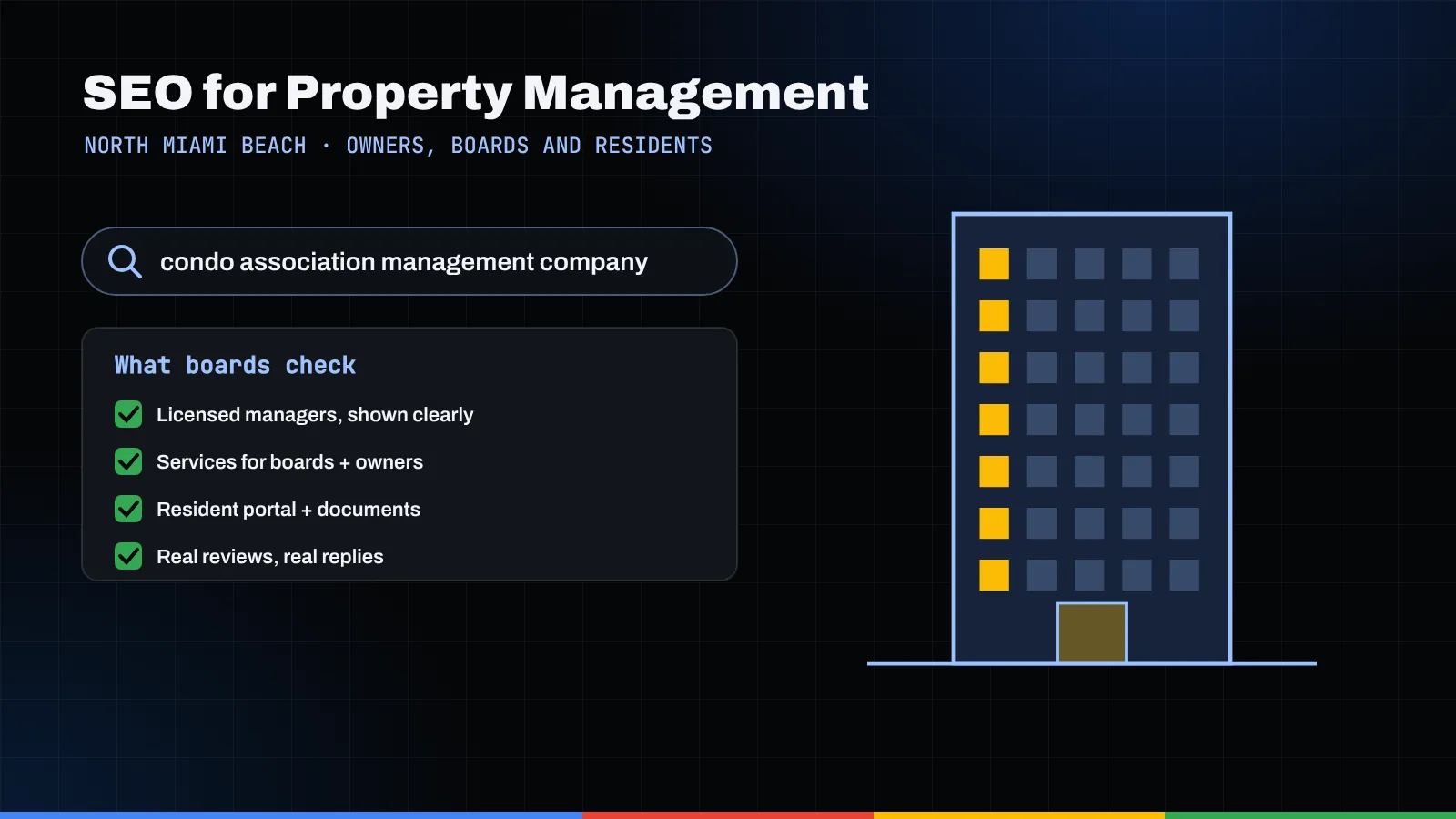
SEO for property management works best as two marketing programs sharing one website. Owners and association boards are hiring a fiduciary, so they look for licensing, process and proof you can handle their money and records. Renters and residents want a unit, a contact or a portal, so they need clear listings, fair language and fast answers. Build each track on purpose, connect them where they overlap, and keep everything you publish verifiable.
Key takeaways
- Split the site into an owner/board track (B2B) and a renter/resident track (B2C). Each has different questions, pages and conversions.
- Google says rental properties such as vacant apartments aren't eligible for a Business Profile, while staffed sales or leasing offices are. Don't create a profile for every building you manage.
- Florida licensing is a trust signal and a legal line: renting property for others for pay falls under the broker definition, and paid association management above set thresholds requires a CAM license.
- Florida's 2024 laws expanded document-posting duties for HOAs with 100 or more parcels and, starting January 1, 2026, condos with 25 or more units. Boards will ask about it.
- Rental ads must avoid any preference or limitation tied to a protected class, and reviews must be earned honestly under Google's policy and the FTC's 2024 rule.
Who is your website actually working for?
Anyone who has run a mixed portfolio knows the phone rings for very different reasons. A duplex owner wants to know what you charge to place a tenant. A condo board treasurer's current manager stopped returning emails. A renter asks whether the two-bedroom is still available. A resident can't find the gate code policy.
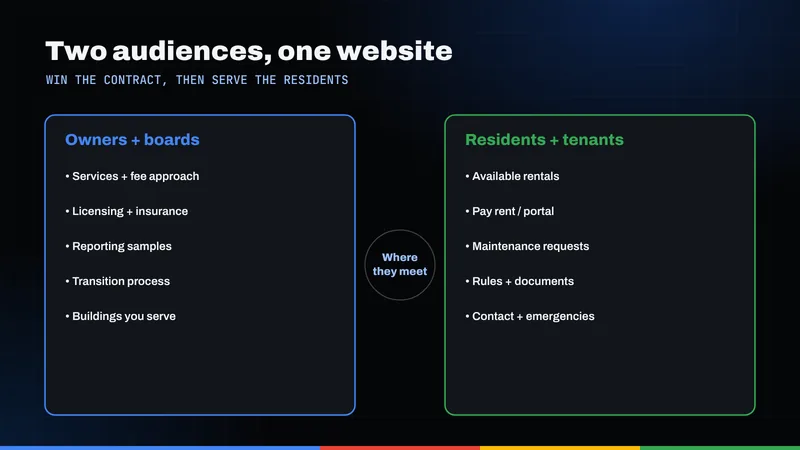
The first two are prospective clients, and their decision takes weeks. The last two are the people your clients hired you to serve, and they decide in minutes whether you look legitimate. Most property management websites blur these groups into one homepage that speaks to nobody. A better structure is a simple split:
- Track A, owners and boards: rental management, association management, onboarding, reporting, licensing and fees in plain terms.
- Track B, renters and residents: available units, application steps, maintenance requests, portal access and office contact details.
- The shared layer: your Google Business Profile, reviews, structured data and the pages both groups land on.
It's the same discipline behind any local SEO engagement: figure out who is searching, what they need to see to act, and which page should answer them.
What can a property manager put on Google Business Profile?
A firm manages twelve buildings, so someone decides each deserves its own Google listing. It feels like coverage. Under Google's rules, it is usually a liability.
Google's business eligibility and ownership guidelines say a business must make in-person contact with customers during its stated hours to qualify. The same page lists rental or for-sale properties such as vacation homes, model homes or vacant apartments as ineligible, then adds that sales or leasing offices are eligible for verification. It also rules out an ongoing service at a location you don't own or have the authority to represent. In portfolio terms:
- Your management office is the core profile. If staff meet owners, board members or applicants there during posted hours, it is a real location.
- A building you manage is not your business location. A lobby where no one from your firm sits during stated hours doesn't qualify, and neither does a vacant unit.
- An on-site leasing office that is actually staffed during posted hours can be eligible. Decide in writing whether the owner or your firm controls that profile, so access isn't a fight when the contract ends.
- A second branch office with its own staff and hours can have its own profile. One profile per real location.
If you don't receive visitors, set up as a service-area business and hide the address. Keep the business name exactly as it appears on your signage, without stuffing "North Miami Beach" or "condo management" into it. Our Google Business Profile guide for North Miami Beach covers categories and photos, and our notes on SEO for multi-location businesses help if you run more than one staffed office.
Track A: which pages win owners and association boards?
Owners and boards are handing over money, records and liability. They read slowly, compare several firms and forward your pages to a co-owner or the rest of the board.
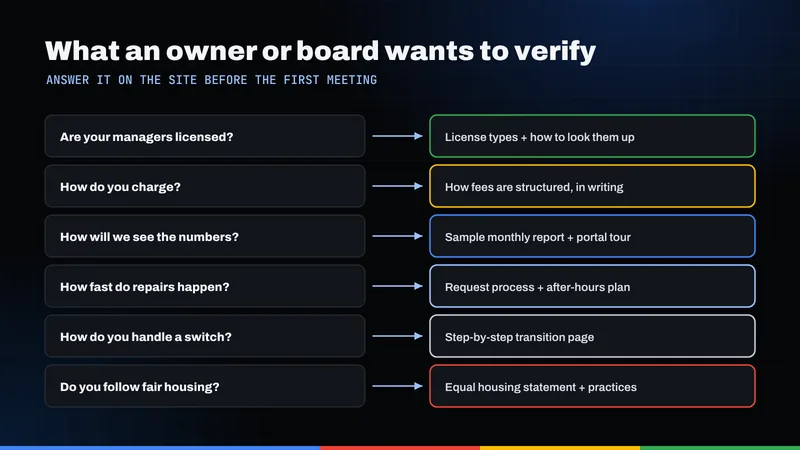
Start by separating the service lines. Rental management and community association management are different businesses with different licenses and buyers. A board member searching for condo association management should land on a page about budgets, meetings, vendor bids and records, not tenant screening. A strong owner or board page includes:
- Scope in plain language. What you handle, what you don't, and what the owner or board still decides.
- How onboarding works. Switching managers is what boards worry about most. Walk through records handover, bank accounts and vendor contracts step by step.
- Reporting. What owners or boards receive and how often, with a redacted sample if you're comfortable sharing one.
- How fees are structured. No price list required, but explain what drives the fee: units, scope, meeting load, leasing activity.
- Licensing and people. Named managers with their license types.
- A clear next step. A proposal form asking for unit count, property type and current management situation.
A slow, cluttered, vague site reads as a slow, cluttered, vague firm. If yours feels like a template you outgrew, that's a website design problem before it is an SEO problem.
Track A: how should you show Florida licensing?
In many industries a license badge is decoration. In Florida property management it is the first thing a careful owner or board checks, and it defines what you can legally advertise.
Rental management and the broker license
Section 475.01, Florida Statutes defines a broker as someone who, for another and for compensation, performs activities that include renting real property. It also covers people who hold themselves out as being in the business of renting or leasing property of others, and specifically includes those who advertise rental property information or lists. A firm that leases and manages homes for owners for a fee should expect to operate under a licensed broker. Confirm your structure with your broker of record or a Florida real estate attorney before publishing service pages.
Association management and the CAM license
Association management is licensed separately under Chapter 468, Part VIII. The DBPR's community association managers and firms page describes a CAM as a licensed person who performs services such as controlling or disbursing association funds, preparing budgets and coordinating maintenance for associations with more than 10 units or budgets over $100,000. Management firms need their own firm license, and anyone can verify a license by name or number.
Turning licensing into content
- List each manager's name and license type on your team page. Accurate, not inflated.
- Invite visitors to verify licenses on the DBPR site. A firm that invites verification signals it has nothing to hide.
- Don't target services you aren't licensed to provide.
Track A: what do Florida's 2024 condo and HOA laws mean for your web offering?
Prospects will ask how you handle the new website requirements. Here is what the statutes say, stated narrowly.
Homeowners' associations (HB 1203, 2024)
HB 1203 took effect July 1, 2024. Under section 720.303(4)(b), by January 1, 2025, an HOA with 100 or more parcels must post specified documents on its website or through a mobile app. The list includes governing documents and rules, budgets, financial reports, insurance policies, director certifications, certain contracts and bid lists, and meeting notices and agendas. The site or app needs a protected area inaccessible to the general public, and an owner who makes a written request must get a username and password. The bill also requires CAMs serving HOAs to complete at least 5 hours of HOA-specific continuing education every two years, 3 of them on recordkeeping.
Condominium associations (HB 1021, 2024)
HB 1021 lowered the condo website threshold from 150 units to 25, effective January 1, 2026. Section 718.111(12)(g) now applies to an association managing a condominium with 25 or more units that does not contain timeshare units. Records generally must be posted within 30 days after the association receives or creates them, and the protected section must be accessible only to unit owners and association employees. The condo list adds items such as structural and life-safety inspection reports.
What this means for SEO and your pitch
- The protected portal is not an SEO asset. Keep it behind login and out of search results, separate from your marketing site.
- Your capability is a selling point. A page explaining how you help associations stay organized on records and posting deadlines answers a question boards already have. Describe process, not legal conclusions, and suggest boards confirm obligations with association counsel.
- Don't overclaim. "Compliance guaranteed" comes back to haunt firms. "We maintain the posting schedule and track deadlines with the board" is honest and specific.
Track B: how do you attract renters without breaking Fair Housing rules?
The resident side moves faster. A renter on a phone wants photos, rent, availability, application steps and a human to contact, and every word you publish must stay inside federal Fair Housing rules.
HUD's advertising and marketing guidance states that the Fair Housing Act prohibits making, printing and publishing advertisements that indicate a preference, limitation or discrimination based on race, color, religion, sex, disability, familial status or national origin. HUD notes this covers people who place real estate ads on websites, and gives examples like "no children" and "no wheelchairs." Practical listing rules:
- Describe the property, not the ideal tenant. "Two bedrooms, second floor, no elevator" describes the unit. "Perfect for young professionals" describes people.
- Watch neighborhood copy. Talk about parks, transit and distances, not who lives nearby.
- Keep screening criteria consistent across every unit you advertise.
- Include your equal housing opportunity statement where your broker and counsel recommend it.
- Fix the template. Most slips come from reused listing templates. Review it once and every future listing improves.
Plenty of renters prefer to search, read and apply in a language other than English. Translated listings and application instructions widen your reach when done with real translations and proper language tags, as covered in our multilingual SEO guide. Hold every language to the same fair housing standard.
Track B: how do you build neighborhood and building-type pages honestly?
Location pages are where property management SEO most often goes wrong. The temptation is fifty near-identical pages, each swapping in a city name. They rarely help anyone, and renters can tell. Formats that hold up:
- Building-type pages. Condo rentals, single-family homes, townhomes. Each explains how leasing works for that type, including association approval steps for condo rentals, and links to current availability.
- Neighborhood pages tied to actual inventory. Publish one only where you manage or list properties, with current units and facts you can verify.
- Owner-facing area pages. A Track A page on managing rentals in North Miami Beach or nearby Aventura should explain considerations you actually handle, not rewritten boilerplate.
Imagine a firm that manages a handful of condo units and several single-family rentals in and around North Miami Beach. Two honest pages, one per property type with real listings and process notes, will usually do more than ten thin "neighborhood guides." Our SEO playbook for real estate agents in North Miami Beach goes deeper on accurate area content. Never claim buildings you don't manage, and pull listings promptly once units lease.
Where do the two tracks meet?
Some assets serve both audiences at once.
Reviews
Owners read resident reviews to judge how you treat tenants, and renters read owner reviews to judge whether you're organized. Google's contribution policy prohibits reviews paid for directly or in kind, content posted because of an incentive, content based on a conflict of interest such as employment, and selectively soliciting positive reviews or discouraging negative ones. The FTC's final rule on fake reviews, announced in August 2024, bans fake reviews, incentives conditioned on a positive or negative sentiment, undisclosed insider reviews and review suppression through threats or intimidation.
A clean process: ask every owner at renewal and every resident after a completed maintenance request, with the same neutral wording. Respond to negative reviews factually without disclosing tenant or association details. Never trade a rent credit or waived fee for a review.
Structured data and the portal
Schema.org's RealEstateAgent type is a subtype of LocalBusiness, which inherits from both Organization and Place. It fits the brokerage side of a rental management firm; an association-only firm is better described as a general LocalBusiness or Organization. Mark up only what's visible on the page: name, address, phone, hours and real offices. Our post on how schema helps search engines explains the mechanics. Residents searching "pay rent" and board members hunting for their document portal also land on your site, so link the portal clearly.
Which page answers which question?
Every row is a question someone is already asking. If you don't have the page, a competitor's page answers it.
| Audience | The question they bring | Page to build |
|---|---|---|
| Rental owner | Who can lease and manage my condo or house? | Rental management service page with scope, onboarding and fee structure |
| Rental owner | Is this firm licensed, and who handles my property? | Team and licensing page with license types and a DBPR verification note |
| Condo or HOA board | Can this firm run our budget, meetings and vendors? | Association management service page |
| Condo or HOA board | How do we keep up with records and posting duties? | Association records and portal support page, process-focused |
| Board or owner | How painful is switching managers? | Transition page with a step-by-step handover |
| Renter | What's available and how do I apply? | Available rentals page, kept current, plus application steps |
| Renter | What is renting a condo unit like here? | Building-type page explaining association approval steps |
| Resident | Where do I pay rent or request a repair? | Resident portal and maintenance request page |
| Everyone | Can I visit or call the office? | Contact page matching the Google Business Profile |
Work the rows in order of pain: clean up Google first, split the service lines, fix the listing template, then add resident paths and honest location pages. Our North Miami Beach SEO page shows how we approach the local market, and if your portfolio stretches south, our Miami SEO page covers local SEO Miami campaigns across the county. For an outside read on both tracks, request a free audit.
Frequently asked questions
Should I create a Google Business Profile for each building I manage?
Generally no. Google lists rental properties such as vacant apartments as ineligible and requires in-person contact with customers during stated hours. Your staffed management office qualifies, and a staffed on-site leasing office can be eligible, but a building where your firm has no one on site during posted hours is not your business location.
Do I need a real estate license to manage rentals in Florida?
Florida's statutory definition of a broker includes someone who, for another and for compensation, rents real property or advertises rental property. A firm that leases and manages homes for owners for a fee should expect to operate under a licensed broker. Confirm your specific setup with a Florida real estate attorney or your broker of record.
When is a CAM license required?
According to Florida's DBPR, paid community association management for associations with more than 10 units or budgets over $100,000 requires a Community Association Manager license, and management firms need a separate firm license. Licenses can be verified by name or license number on the DBPR website.
Which Florida associations must post documents on a website or app?
HOAs with 100 or more parcels had to post specified documents on a website or app by January 1, 2025. For condominiums, HB 1021 lowered the threshold from 150 units to 25 units effective January 1, 2026, excluding condos that contain timeshare units. Both require a protected section that the general public cannot access.
Can I offer a rent discount to residents who leave a Google review?
No. Google's policy prohibits reviews posted because of an incentive, including discounts, and the FTC's 2024 rule bans incentives conditioned on a review's sentiment. Ask every resident and owner the same neutral way and let the reviews reflect real experiences.