Good SEO for architects follows the way clients choose a studio: they search, look at work, check credentials and test whether the firm understands their site. A studio around North Miami Beach earns that attention with case-study portfolio pages, light and well-described images, an accurate Google Business Profile, verifiable credentials and careful writing on coastal questions like hurricane codes and flood zones.
Key takeaways
- Organize the site around the questions a client asks while vetting a firm, not around an internal list of services.
- Treat every project page as a case study with a brief, constraints, decisions and outcome, supported by images with descriptive file names and alt text.
- Make credentials checkable: Florida license numbers, the DBPR lookup and any NCARB or AIA affiliations, stated plainly and accurately.
- Coastal topics such as the High-Velocity Hurricane Zone and FEMA flood maps are what local clients worry about, but write about them carefully and point to official sources.
- One considered essay drawn from your own projects is worth more than a dozen generic posts written to fill a calendar.
How a client actually finds and vets an architect
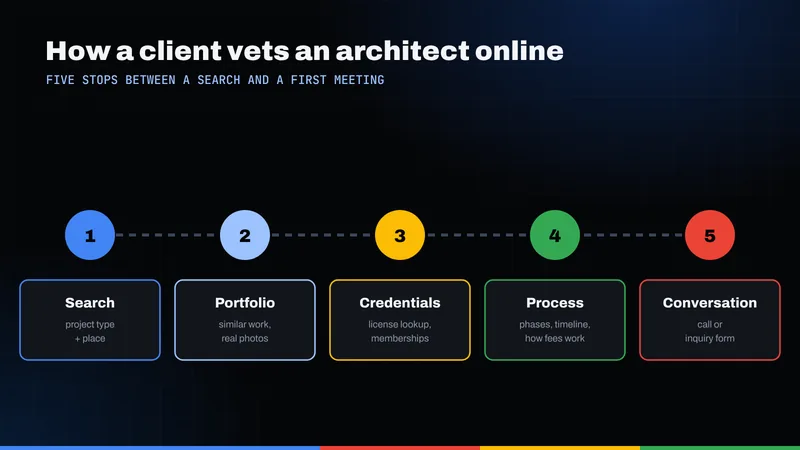
Nobody hires an architect on impulse. A family with a new lot near the Intracoastal, a developer weighing a small mixed-use building, a restaurateur planning an interior that must survive a Florida summer: each moves through a sequence much like walking through a well-planned building. There is an entry, a series of rooms, and a point where they decide whether to stay.
The entry is usually a search, broad ("architecture firm Miami") or pointed ("modern coastal home architect"). Then the client looks at work, often on a phone, often late at night. If the work holds them, they check who you are: licensing, the people behind the name. Then they test fit. Have you handled a site, budget and permitting path like theirs? Only then do they call.
That sequence is the real brief for seo for architects. Rankings put you at the entry, but what keeps someone moving through the rooms is what they find inside. The rest of this piece follows that path and asks what page, profile or asset should be waiting at each stage.
Portfolio pages that rank: the case study as structure
Most studio websites present projects as image galleries with a title and a location. They are beautiful and, to a search engine, nearly silent. A gallery says there are photographs. It does not say what problem was solved, for whom, or why the result works.
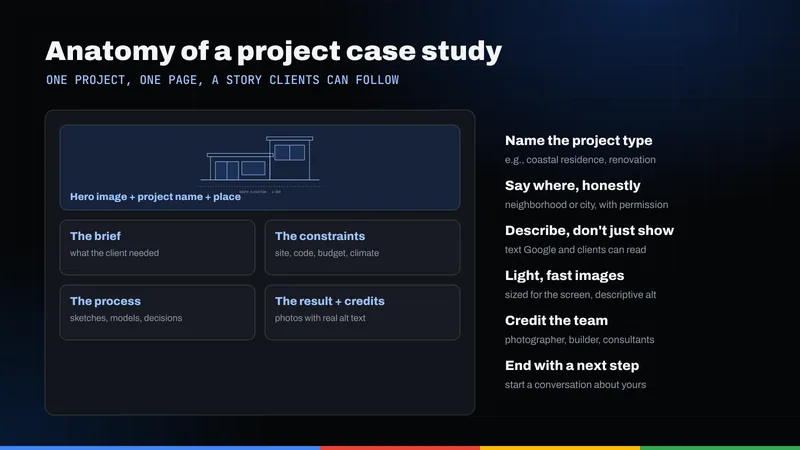
A case study does. Think of each project page as having a structural system of its own, where every section carries some of the load:
- The brief. Who the client was in general terms (a family of five, a boutique retailer), what they needed and what they cared about. You can describe a client without naming them.
- The site and its constraints. Orientation, lot shape, setbacks, existing structures, views worth protecting, the neighbors' windows. On the coast this is also where elevation and wind exposure belong.
- The key decisions. Why the plan turned the way it did, why the roof is shaped the way it is, why that material and not another. This is the section competitors cannot copy, because it is your thinking.
- Process and collaborators. Engineers, contractors, consultants, approvals. Name the type of collaborator even if you do not name the firm.
- The result. What the building does now. Keep it factual. Don't attach numbers you cannot support.
Written this way, a project page naturally uses the language clients search with: building type, city, style, constraints. A studio with twelve thoughtful case studies has twelve doors into the building instead of one.
Give each project its own URL, a title that says what and where ("Raised coastal residence, North Miami Beach," not "Project 07"), and a short introduction above the first image. Our on-page SEO guide covers titles and headings in more depth.
Images that search engines can read, and phones can load
Images are what clients came to see, and they are also the heaviest thing on the page. Google's image SEO best practices are worth reading in full. A few points matter most for a studio:
- Alt text is the main description Google reads. Google calls it the most important attribute for describing an image. Say what is shown ("double-height living room with a perforated steel stair") rather than repeating "architect Miami" on every photo, which Google warns can look like spam.
- File names should describe the image. Google's example is that a descriptive name beats a camera default like IMG00023.JPG. "raised-coastal-residence-stair.webp" tells a crawler something; "DSC_4471.jpg" does not.
- Place images near the text that explains them. Google uses the surrounding content, captions and titles to understand an image. That is another argument for the case-study structure above.
- Use real image elements. Google indexes images in
<img>tags, including inside<picture>, but not images set as CSS backgrounds. Many portfolio themes put hero photography in CSS backgrounds, which leaves it out of Google Images entirely. - Control weight. Google notes images are often the largest part of page size and suggests testing with PageSpeed Insights. Serve WebP or AVIF and responsive
srcsetsizes so a phone never downloads a print-resolution file.
A slow portfolio quietly undoes good photography; see how website speed affects revenue.
Google Business Profile for a design studio
When someone searches "architect near me," map results often appear before any website, so the Google Business Profile is frequently the first real view of your studio. Much of what passes for local seo miami advice comes down to keeping this profile honest and complete. Google's Business Profile guidelines set some boundaries:
- Name. Use the studio's real-world name. Google does not allow taglines, service lists or location keywords added to the name, so "Studio Name" is right and "Studio Name | Luxury Architect Miami" is not.
- Address. The profile must reflect a real location. Google says virtual offices are not eligible. If clients visit your studio, show the address. If you only meet clients at their sites, Google asks you to hide the address and set a service area instead.
- Categories. Google asks for as few categories as possible, as specific as possible, and never used as keywords. Pick the closest match to what you are (architect, interior designer or a similar option in Google's list) and add a secondary category only for a genuine line of work.
- Practitioners. Google allows public-facing practitioners to have their own profiles in some cases, but warns against one person creating multiple profiles for different specialties.
Beyond the rules, treat the profile as a small portfolio: real project photography, an accurate services list, thoughtful answers to questions. Our guide to Google Business Profile in North Miami Beach covers setup, and our local SEO work keeps these profiles accurate over time.
Credentials that are real and checkable
Architecture is a licensed profession, and clients and lenders know it. A site that makes credentials easy to verify earns trust that polished copy cannot buy.
Florida licensing through DBPR
In Florida, architects and interior designers are regulated by the Board of Architecture and Interior Design within DBPR, whose records anyone can search by name or license number. Architects are licensed and interior designers are registered, and the board notes that interior design excludes architectural and engineering work. Describe your services in a way that respects that line.
Section 481.221 of the Florida Statutes also requires a registered architect to include his or her license number in advertising, and an architectural business organization to include its qualifying architect's number. The footer and about page are natural homes for it. Confirm the details with your own counsel.
NCARB and AIA, described accurately
The National Council of Architectural Registration Boards (NCARB) works with state licensing boards across its 55 jurisdictions. It runs the programs behind the Architect Registration Examination, the Architectural Experience Program and the NCARB Certificate, which architects use to apply for licenses in other states. If you hold the Certificate, say so. It matters to clients with projects in more than one state.
The American Institute of Architects is a membership organization, not a licensing body. Its rules on the AIA designation reserve plain "AIA" for Architect Members, who are legally entitled to practice; "Associate AIA" covers members without a U.S. architectural license. Use the exact designation each person holds.
On the team page, give each principal a short biography with license type and state, education and the projects they lead. It is the "who" that Google's helpful content guidance asks publishers to make obvious.
Coastal questions your clients are already searching
A client building near the water in northeast Miami-Dade reads about storms, insurance and flood maps before talking to anyone. A studio that answers those questions accurately earns attention when it matters. This is where architecture firm seo becomes genuinely local, and where generic seo miami playbooks, written for restaurants and retailers, fall short.
The High-Velocity Hurricane Zone
Miami-Dade County's own guidance on construction materials and product control explains that the High-Velocity Hurricane Zone (HVHZ), which covers Miami-Dade and Broward counties, has the most stringent requirements of the Florida Building Code. Products that form the building envelope need approval, and a Notice of Acceptance (NOA) is the document that conveys a product's approval to the industry.
That is plenty to write about without overreaching: why window selection here starts with approved products, or how envelope decisions shaped a project. Avoid quoting specific pressures or ratings unless a licensed professional on your team has checked them against the current code edition. Codes change, so point readers to the official source.
Flood zones and FEMA maps
FEMA's Flood Map Service Center is the official public source for National Flood Insurance Program flood hazard information, searchable by address, and FEMA notes that maps can be superseded. An article can show clients how to look up their property and explain in general terms why a flood designation shapes design conversations, leaving specific elevation requirements to the professionals reviewing each project.
Handled this way, coastal content answers what people type into Google and shows the judgment clients want: respect for the code and honesty about what varies by site.
A map from client question to page
If the site is a building, this table is its circulation diagram. Each question a client asks while vetting a firm should lead somewhere specific.
| What the client is asking | Page or asset that answers it | What makes it convincing |
|---|---|---|
| Who designs homes or spaces like the one I want? | Project case studies by building type and location | A clear brief, constraints, decisions and well-described photography |
| Is this studio close by and real? | Google Business Profile and contact page | Accurate name, address or service area, real photos, consistent details |
| Are these people licensed? | Team page, footer and about page | License numbers, a pointer to the DBPR lookup, NCARB and AIA stated accurately |
| Do they understand building on the coast? | Essays and project notes on hurricane and flood considerations | Links to Miami-Dade and FEMA sources, careful language, real project reasoning |
| How does working with an architect actually go? | A process page covering phases, from first meeting to construction | Plain description of each phase, what the client provides and what they receive |
| Will we work well together? | Studio philosophy, principal biographies, writing | A recognizable point of view and named, accountable people |
Notice that only one row is about rankings in the narrow sense. The rest is about what happens once someone arrives. Search brings people to the door, and the circulation decides whether they reach the contact page.
Schema: describing the studio and its images
Structured data is like the structural drawings behind the renderings: clients never see it, but search engines use it to understand who you are.
For the studio itself, schema.org places ProfessionalService under LocalBusiness, which in turn sits under Organization. Google's documentation recommends using the most specific LocalBusiness subtype that fits for local businesses, and it lists properties such as name, logo, URL, address, telephone and sameAs links to profiles elsewhere. Keep these details identical to your Google Business Profile.
For images, ImageObject can describe creator, credit and license. Google's image license metadata feature requires the image URL plus at least one of creator, credit text, copyright notice or license, a readable way to credit your architectural photographer.
Schema is not a ranking shortcut. It is a precise description of something that should already be true on the page. Our explainer on how schema helps search engines covers the basics if you are starting from scratch.
Thought leadership, not thin content
Many design firms are told they need a blog, and the result is a stream of interchangeable posts: ten trends for the year, five reasons to hire an architect. Google's guidance on creating helpful, people-first content asks whether content shows first-hand expertise, and flags content that mostly summarizes others without adding value. Generic trend lists fail that test almost by design. Architects have better material close at hand:
- A longer essay on one project, from first sketch to final walk-through, including what you would do differently.
- A piece on a material you have used in a salt-air setting and how you detailed it.
- A plain-language guide to the phases of an architectural engagement, written for a first-time client.
- A considered response to a planning or code change that affects your clients, linked to the official source.
Write fewer pieces, make each carry weight, and sign them. Google's guidance says trust is the most important part of E-E-A-T, and an essay signed by a licensed principal is about as trustworthy as a firm website gets. The same holds for AI-generated answers; see SEO vs. GEO.
Where a studio should begin
If the site needs work, resist the urge to redesign everything at once. Start with the load-bearing elements:
- Rebuild your three strongest projects as full case studies, with descriptive file names, alt text and compressed images.
- Clean up your Google Business Profile so the name, categories, address or service area, and photos are accurate.
- Add license numbers and plain credential language to the footer, team page and about page.
- Write one serious piece on a coastal question your clients ask, citing official sources.
- Add Organization or ProfessionalService markup that matches the profile exactly.
Design-build firms will find the construction side in SEO for contractors in North Miami Beach. Our North Miami Beach SEO page explains how we approach the local market, and our portfolio shows the websites we have built. For a second set of eyes on your site, start with a free SEO audit.
Frequently asked questions
What matters most in SEO for architects?
Project pages written as real case studies matter most, because they are what clients come to see and what search engines can understand. Each one should explain the brief, the site, the key decisions and the result, with images that have descriptive file names and alt text.
Which Google Business Profile category should an architecture firm choose?
Choose the most specific category in Google's list that represents your core business, and use as few categories as possible. Google's guidelines say not to use categories as keywords, so add a secondary category only if it describes a genuine line of work.
Do Florida architects have to show a license number on their website?
Section 481.221 of the Florida Statutes requires registered architects to include their license number in advertising, and architectural business organizations to include the license number of their qualifying architect. A site footer or about page is a natural place to show it. Confirm how the rule applies to you with your own counsel.
Should we write about hurricane codes and flood zones?
Yes, carefully. Clients near the coast search for these topics. Explain the concepts in your own words, link to official sources such as Miami-Dade County and FEMA's Flood Map Service Center, and avoid stating specific technical requirements unless a licensed professional has checked them against the current code.
Is a blog worth it for a small design studio?
A few substantial pieces drawn from your own projects and expertise are worth far more than frequent generic posts. Google's helpful content guidance favors first-hand expertise and clear authorship, which is something architects already have.