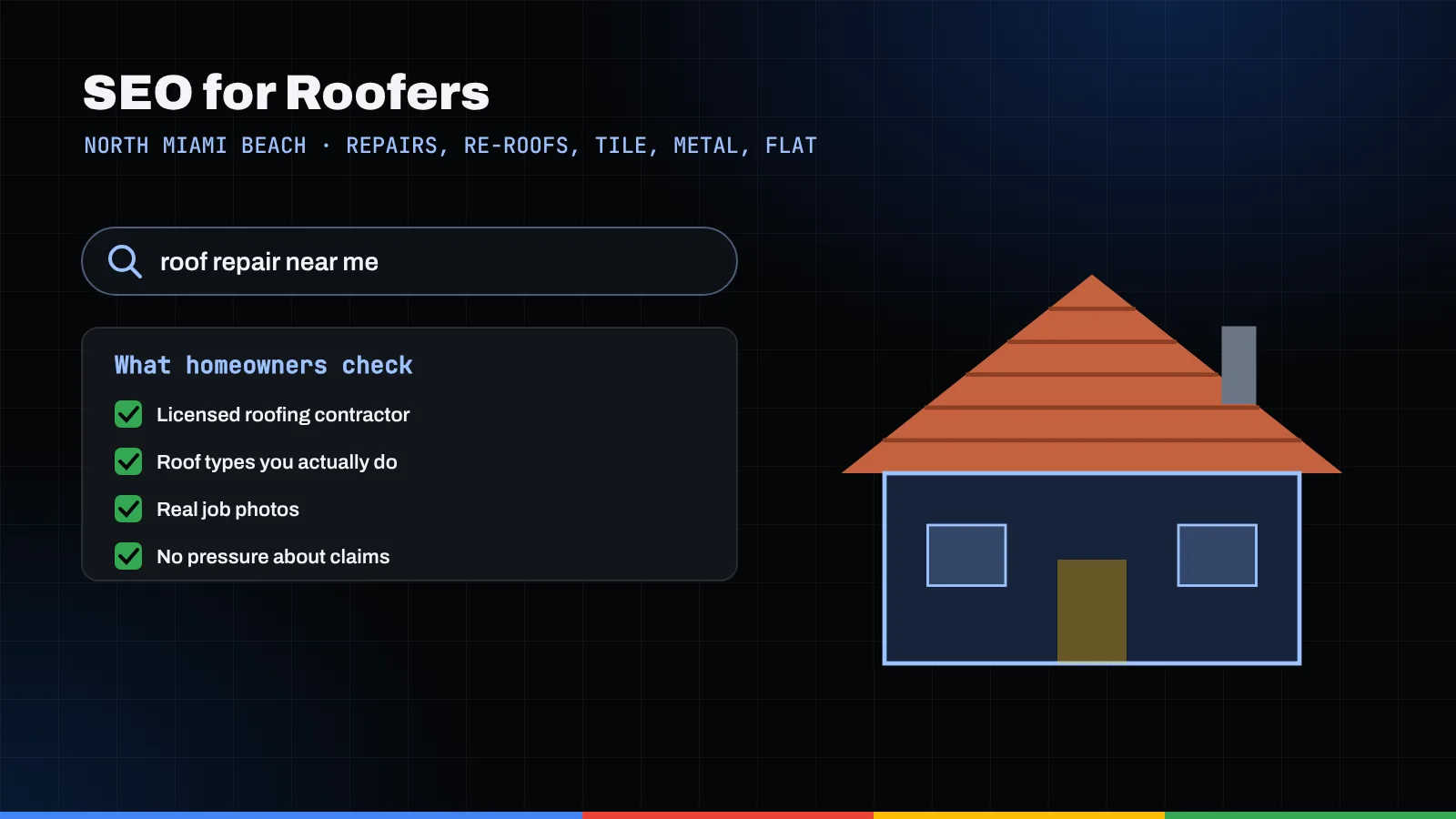
SEO for roofers in North Miami Beach works best when you inspect your online presence the way you'd inspect a roof: from the homepage down to the small details. That means a service-area Google Business Profile, a separate page for each roof type and job, storm content that stays within Florida's rules on insurance-claim solicitation, your license number on every ad, and reviews you collect honestly.
Key takeaways
- Set up your Google Business Profile as a service-area business with the address hidden, a realistic service area and your real business name.
- Build one page per job: tile repair, shingle re-roof, flat roof, metal roof, inspections, leak repair and storm damage. A single "Services" page can't match all of those searches.
- Florida section 489.147 restricts roof-damage insurance-claim advertising, bans rebates and gifts tied to inspections or claims, and fines up to $10,000 per violation. Write storm content with that in mind.
- Section 489.119 requires your certification or registration number in each offer of services and advertisement, regardless of medium.
- Roofers are an eligible Local Services Ads category, and Google's review rules and the FTC's 2024 rule both prohibit buying, gating or faking reviews.
How this roofing SEO inspection is organized
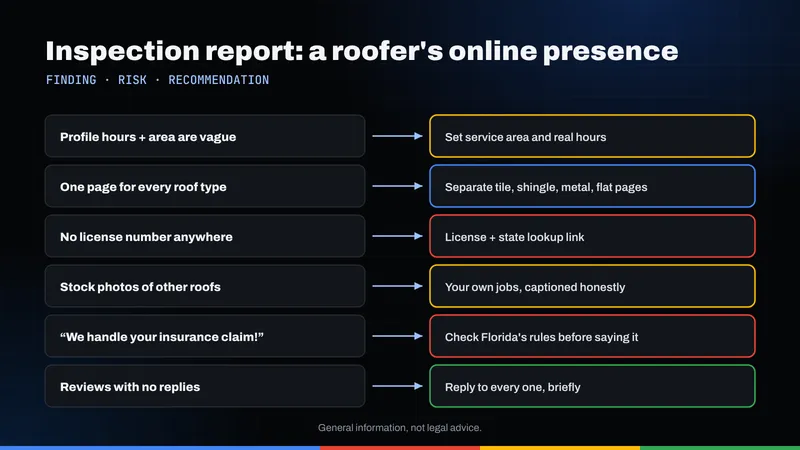
A roof inspection report starts with what the inspector saw, explains what could go wrong, and ends with what to fix. We're using that format for roofing SEO, because most roofing websites don't fail in one dramatic way. They fail the way roofs do: a cracked tile here, a lifted edge there, flashing nobody checked in years. Each section below has a Finding, a Risk and a Recommendation, working from the ridge (your homepage) down to the flashing (schema and technical details). If you also do general contracting, our guide to SEO for contractors in North Miami Beach covers the broader trade picture. This report stays on the roof.
The ridge: your homepage
Finding: the typical roofing homepage leads with a drone photo, a slogan and a "Free Estimate" button. The roof types the company installs, the cities it serves and its license number are either missing or buried in the footer.
Risk: everything else hangs off the ridge. When the homepage doesn't say what you do and where, Google has less to connect it to searches like "tile roof repair North Miami Beach," and a homeowner comparing roofers can't tell quickly whether you handle their roof.
Recommendation: put four things above the fold or close to it:
- A plain statement of what you do, such as "Roof repair and replacement for tile, shingle, flat and metal roofs in North Miami Beach and nearby Miami-Dade communities."
- Your Florida license number, displayed as text, not inside an image.
- A click-to-call phone number that matches your Google Business Profile.
- Links to each roof-type and job page, so the homepage acts as the hub for the rest of the site.
Then check load time on a phone. Drone videos and uncompressed project photos often slow roofing homepages, and our post on how website speed affects revenue explains why that costs calls.
The field: your Google Business Profile
Finding: many roofers run their business from a home or a yard, list that address publicly anyway, and stuff the business name with keywords ("Best Roofing North Miami Beach Roof Repair"). Some list a virtual office to look closer to wealthier ZIP codes.
Risk: each of those choices runs against Google's guidelines. Google's guidelines for representing your business say service-area businesses should hide their address, keep the overall service area within about two hours of driving from their base, and not list a virtual office unless it is staffed during business hours. Extra words in the business name aren't permitted, and Google asks for one profile per business. Breaking those rules risks suspension.
Recommendation:
- Set the profile up as a service-area business. Hide the address if customers don't come to you.
- Choose service areas you actually send crews to, not every city in South Florida.
- Use your real-world business name and a local phone number you control.
- Add services that match your service pages, and post real project photos.
Our Google Business Profile guide for North Miami Beach walks through categories, photos and posts step by step.
The slopes: service pages by roof type and job
Finding: most roofing sites have one "Services" page with a paragraph each on repair, replacement and maintenance. Tile, shingle, flat and metal roofs get a bullet point between them.
Risk: homeowners search for the problem in front of them: a slipped tile, a leak over the kitchen, a flat roof that ponds after rain. A combined page can't answer all of those, so it rarely ranks for any. This is the biggest gap we see in roofing SEO.
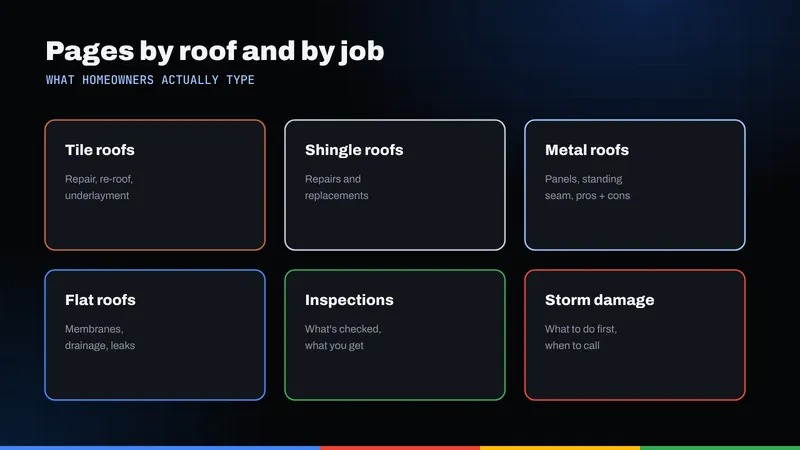
Recommendation: build a page for each roof type and job you want more of, explaining the work, the steps, what to expect (permits, inspections) and photos of real jobs. A starting map:
| Roof job | What homeowners search | Page to build |
|---|---|---|
| Tile roof repair | "cracked roof tile repair," "tile roof leak repair near me" | Tile Roof Repair in North Miami Beach |
| Tile re-roof | "tile roof replacement," "concrete tile roof cost" | Tile Roof Replacement |
| Shingle roof | "shingle roof replacement," "missing shingles repair" | Shingle Roof Repair and Replacement |
| Flat roof | "flat roof leak," "flat roof replacement Miami" | Flat and Low-Slope Roofing |
| Metal roof | "metal roof installation," "standing seam metal roof" | Metal Roofing |
| Leak repair | "roof leak repair," "emergency roof repair" | Roof Leak Repair |
| Inspection | "roof inspection," "roof inspection before buying a house" | Roof Inspections |
| Storm damage | "roof damage after hurricane," "tarp roof after storm" | Storm Damage Repair (see the next section) |
Only build pages for work you're licensed and equipped to do, and don't clone one page across cities with the name swapped. Our local SEO service is built around this kind of page planning. On cost, describe what drives it (roof size, material, slope, decking condition, permits) instead of publishing a price you can't stand behind.
The weather: storm and hurricane content, handled responsibly
Finding: after a storm, some roofing sites publish pages that promise to "get your roof paid for by insurance," offer free inspections with a gift card, or say the company will "handle your claim."
Risk: in Florida, that content can break the law (next section). It's also thin: it doesn't answer what people actually ask after a storm.
Recommendation: build storm content around the homeowner's situation, not the claim:
- Signs water is getting in, and when to call.
- What a roofer checks after high winds: lifted shingles, cracked or displaced tiles, flashing, flat roof membranes.
- What tarping involves and why it's a stopgap.
- That coverage questions go to the homeowner's own insurer, and you don't interpret policies.
- Your license number.
Update the page before hurricane season so it's indexed when people need it, and keep the tone calm.
Code compliance: Florida licensing and insurance-claim advertising rules
Finding: license numbers are missing from Google Ads, social posts and landing pages, and storm-season ads encourage homeowners to file roof claims without any disclosures.
Risk: Florida regulates roofing contractors under chapter 489, and two sections matter directly for your marketing.
Your license number in every ad
Section 489.119 says the registration or certification number of each contractor must appear in each offer of services, business proposal, bid, contract or advertisement, regardless of medium, as defined by board rule. Business stationery and promotional novelties like pencils and clothing are excluded. A first failure brings a notice of noncompliance; later ones can bring fines or citations. Put the number in your site header or footer, on every landing page and in ad copy.
Section 489.147: prohibited property insurance claim practices
Section 489.147 is the one that shapes storm marketing. Here is what the statute says, stated as narrowly as it is written:
- Prohibited advertisement. A written or electronic communication by a contractor that encourages, instructs or induces a consumer to contact a contractor or public adjuster to make a roof damage insurance claim is a prohibited advertisement unless it states, in at least 12-point type and at least half the size of the largest font used, that the consumer pays any deductible, that knowingly paying, waiving or rebating a deductible with intent to defraud is a third-degree felony, and that knowingly filing a false or misleading claim is a third-degree felony. The statute lists door hangers, business cards, magnets, flyers, pamphlets and e-mails as examples. Soliciting a property owner through a prohibited advertisement is banned.
- No rebates or gifts. A contractor may not offer a rebate, gift, gift card, cash, coupon, deductible waiver or anything else of value in exchange for allowing a roof inspection or for making an insurance claim for roof damage.
- No claim handling. A contractor may not interpret policy provisions, advise on coverage or adjust a claim on the insured's behalf unless licensed as a public adjuster.
- No referral fees and no estimate-free authorizations. The statute also bans giving or receiving referral compensation for insurance-paid services and providing a repair authorization without a good-faith, itemized estimate.
- Penalties. Violations can bring discipline and a fine of up to $10,000 per violation, and acts by people working for the contractor, including paid solicitors, count as the contractor's acts.
Recommendation: drop "free inspection plus gift card" offers entirely. Remove "we handle your claim" language. If any web page, ad, text or e-mail encourages people to contact you about a roof damage claim, have a Florida attorney review it against the statute, including whether and how the disclosures apply to that format. We're an SEO agency, not a law firm, and this isn't legal advice. Our insurance agent SEO guide covers the other side of the claim conversation.
Materials on record: product approvals and the HVHZ
Finding: roofing sites say "hurricane-rated" or "meets Miami-Dade code" without naming a product or approval.
Risk: North Miami Beach is in Miami-Dade County, where building envelope products go through product approval. Miami-Dade's Product Control Section handles approvals for exterior products, including roofing, and offers a public Product Approval Search. The Notices of Acceptance (NOAs) we opened identify the approved product, state that it is designed to meet the High Velocity Hurricane Zone requirements of the Florida Building Code, and carry an expiration date. Vague claims are hard for homeowners to check and easy for competitors to contradict.
Recommendation: on each material page, name the product lines you install and offer the applicable approval for the specific product on a job. Only list an NOA number you've confirmed is current for that exact product. Checkable details build more trust than "hurricane-proof."
The gutters: Local Services Ads and paid leads
Finding: roofers either ignore Local Services Ads or run them with a profile that doesn't match the website or Google Business Profile.
Risk: Google's Local Services Ads help page lists roofers among eligible service categories. Providers who pass Google's screening get the Google Verified badge, and pre-badge ads, which let a business receive leads while it finishes onboarding, appear below badged providers. Mismatched names, phone numbers or service lists across LSA, your profile and your site send mixed signals and slow down verification.
Recommendation: check eligibility for your area, complete screening, and keep your name, phone, license and services identical everywhere. Track LSA leads separately from organic calls. If you also run Google Ads, storm-season ad copy needs the same section 489.147 review as your web pages.
The shingles: reviews, collected honestly
Finding: some roofers offer a discount for a five-star review, send review links only to happy customers, or have employees and relatives post reviews.
Risk: Google's policy on fake engagement prohibits offering incentives such as payments, discounts or free services for reviews, discouraging negative reviews or selectively soliciting positive ones, and reviews based on a conflict of interest such as employment. The FTC's final rule announced on August 14, 2024 bans fake reviews, incentives conditioned on positive or negative sentiment, undisclosed insider reviews and review suppression through threats or intimidation. For roofers there's a third layer: section 489.147 already bans gifts tied to inspections or claims.
Recommendation: ask every customer the same way after the job passes final inspection, with a direct link. Reply to negative reviews calmly and with facts. With permission, feature reviews that mention a specific job on the matching service page.
The flashing: schema and technical details
Finding: missing structured data, mismatched contact details, slow photo galleries and project pages with no text.
Risk: none of these sink a site alone, but together they make it harder for search engines and AI assistants to understand who you are and where you work.
Recommendation:
- Schema. schema.org defines a RoofingContractor type under LocalBusiness and HomeAndConstructionBusiness. Use it on your homepage or contact page with your business name, phone, URL, service area and hours, matching your Google profile exactly. Our post on how schema helps search engines explains the mechanics.
- Consistency. The same name, phone and license number on the site, profile, LSA, social accounts and directories.
- Project pages with words. Write a short paragraph per project: roof type, scope, problem found and fix. Keep customer addresses out.
- Images. Compress photos, use descriptive file names and alt text ("replaced concrete tile roof on a two-story home"), and lazy-load galleries below the fold.
- Internal links. Link each storm page to the relevant repair pages, and each material page to inspections and leak repair.
Inspection summary: your roofing SEO punch list
In priority order:
- Fix the Google Business Profile: service-area setup, real name, one profile.
- Add your license number to the site, every landing page and every ad.
- Remove rebate, gift and "we handle your claim" offers, and have claim-related marketing reviewed against section 489.147.
- Build a page for each roof type and job you want more of.
- Rewrite storm content around the homeowner's next steps.
- Replace vague "hurricane-rated" claims with documented product details.
- Ask every customer for a review the same way.
- Add RoofingContractor schema and make contact details consistent.
This is the same order we use for roofing and other home-service clients in our North Miami Beach SEO work, and it scales to broader local SEO in Miami if your crews cover the wider county. If you'd rather have someone walk the roof with you, request a free audit and we'll send back findings, risks and recommendations for your own site.
Frequently asked questions
What is the most important part of SEO for roofers?
For most roofers, it's a correctly set up Google Business Profile plus a separate service page for each roof type and job. Homeowners search for specific problems like tile roof repair or a flat roof leak, and a single combined services page rarely ranks for those searches.
Do roofers have to show their license number on their website and ads?
Florida section 489.119 requires the contractor's registration or certification number to appear in each offer of services and advertisement, regardless of medium, as defined by board rule. Business stationery and promotional novelties are excluded. Showing the number on your website and ads is the safe approach.
Can a Florida roofer offer a free inspection with a gift card after a storm?
No. Section 489.147 prohibits contractors from offering a rebate, gift, gift card, cash, coupon, deductible waiver or anything of value in exchange for allowing a roof inspection or making an insurance claim for roof damage. Violations can bring fines of up to $10,000 each.
Can roofing companies run Google Local Services Ads?
Yes. Google lists roofers as an eligible Local Services Ads category. Businesses that pass Google's screening get the Google Verified badge, and pre-badge ads appear below badged providers while a business finishes onboarding. Check eligibility for your specific area.
Is there a schema type for roofing companies?
Yes. schema.org defines RoofingContractor as a type of HomeAndConstructionBusiness, which is a type of LocalBusiness. Use it with your business name, phone, website, service area and hours, and keep those details identical to your Google Business Profile.