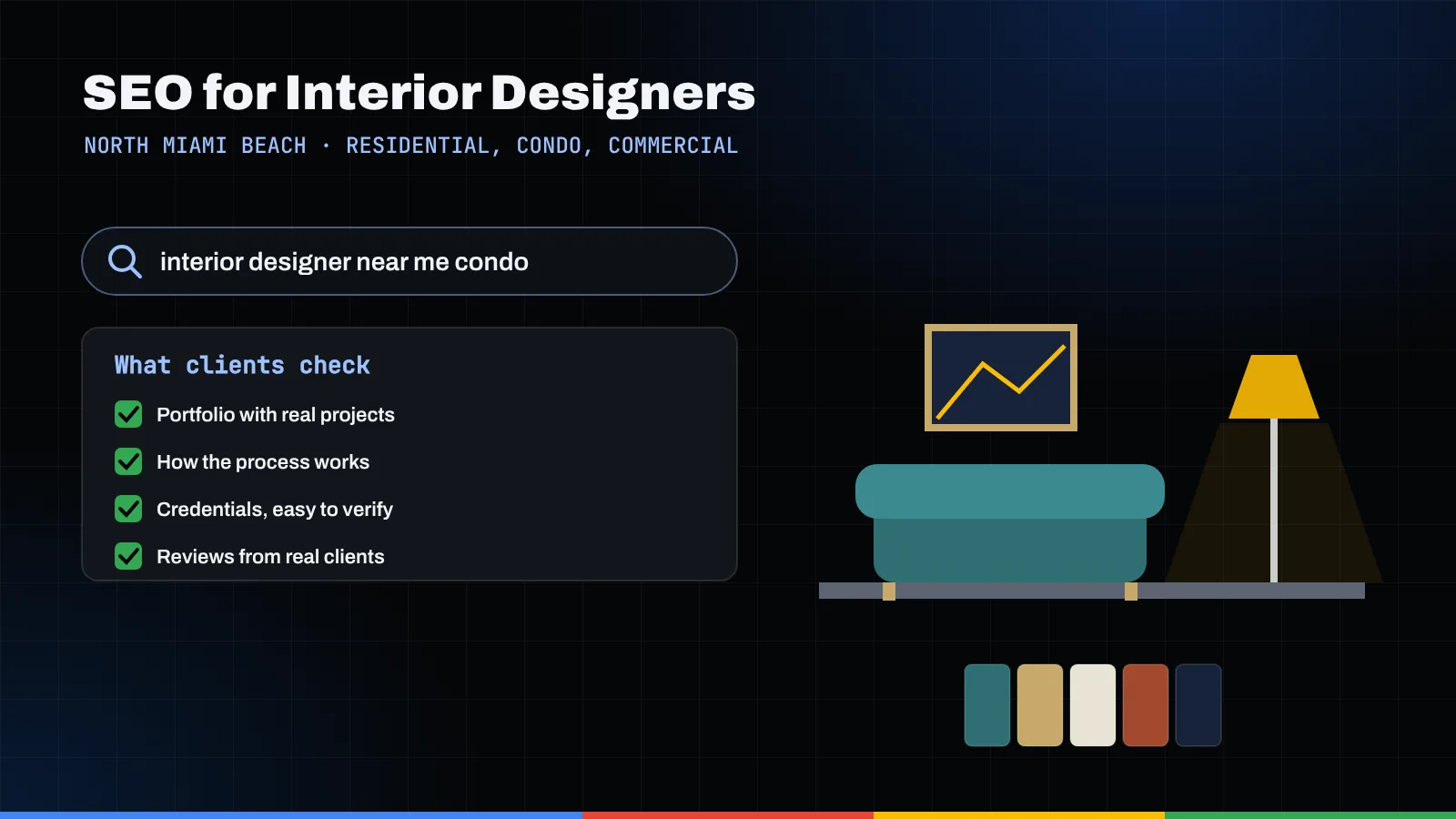
A design client hires on taste, then on trust. SEO for interior designers works when your site shows both: project pages that read as case studies, real and well-described photography, an accurate Google Business Profile, a precise description of your Florida registration status and honestly collected reviews. Rankings bring people to the door. The work and the proof get them to book.
Key takeaways
- Organize the site the way clients think about a project: by type of space and type of client, with one strong page for each.
- Treat every portfolio entry as a case study with the brief, constraints, decisions and credits, illustrated with photography you're licensed to use.
- Google indexes images it finds in HTML, with descriptive file names, alt text and nearby text. Sliders built on CSS backgrounds are invisible to it.
- In Florida, registration isn't required to practice interior design, but the title "registered interior designer" is protected. Say exactly what you hold.
- Ask every client for an honest review, with no incentives and no filtering.
Concept: how a design client actually searches
Every presentation starts with the concept, the one idea the rest of the scheme serves. For a studio website, the concept is that a prospective client is answering two questions at once. Do I love this person's work? And can I trust them with my home, my budget and my building's rules?
The search can be broad ("interior designer near me") or pointed ("condo renovation designer," "coastal modern living room," "restaurant interior designer Miami"). Then comes the look: project photos on a phone, often shared with a spouse or business partner. Then the check. Who is behind the studio? What do past clients say? Has this designer handled a condo board, a hospitality deadline or an oceanfront house?
That sequence is the real brief for seo for interior designers. Much of what gets sold as local SEO Miami treats the job as rankings alone. A studio that ranks with a thin gallery still loses the client at the second question. The scheme below follows the order of a design presentation, because your website is a presentation that runs without you in the room.
Spec sheet: name the three project types you most want, the client behind each and the question each asks before calling. Every later decision serves those three.
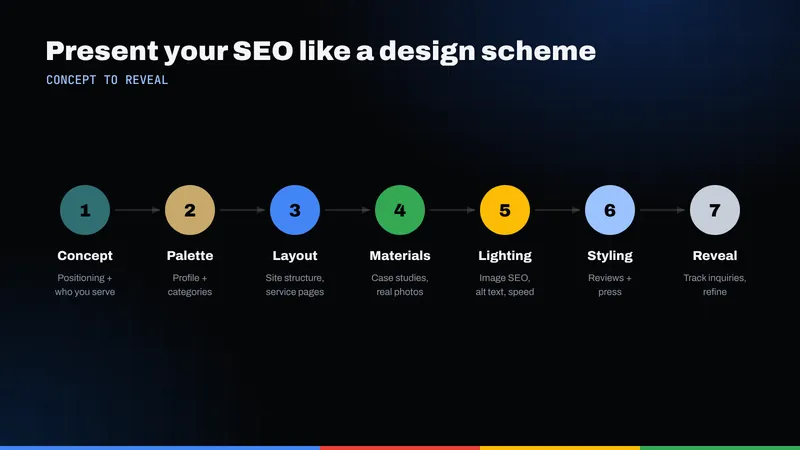
Palette: the words your clients actually use
A palette is a limited set of colors chosen on purpose. Your keyword palette should be a short list of phrases your best clients type, not every term containing "design." Designers describe work in studio language ("transitional," "layered"). Clients describe their problem: the space, the building, the place, sometimes the style.
The phrasing below is illustrative. Confirm real wording with your Search Console data and the questions you hear in consultations.
| Client and project | What they tend to search | Page to build |
|---|---|---|
| Condo owner planning a renovation | "condo interior designer," "condo renovation design," a building or neighborhood name | Condo renovation page covering board approvals, scheduling and working with your contractor |
| Family with a coastal home | "coastal interior design," "beach house interior designer" | Coastal residential page on sun, salt air and durable materials, linked to coastal projects |
| New homeowner furnishing from scratch | "interior designer for new home," "full home furnishing" | Full-home page explaining phases, timelines and procurement |
| Single-room project | "kitchen designer," "living room interior design" | Room pages, each tied to two or three real projects |
| Restaurant or hotel owner | "restaurant interior designer," "boutique hotel designer" | Hospitality page with your registration status and permitting approach stated accurately |
| Office or retail tenant | "office interior design," "retail store design" | Workplace and retail page listing your deliverables and the consultants you coordinate |
"Interior design seo" isn't on the client side of that table. It's the discipline, not the search, and your clients will never type it.
Spec sheet: pick one row per target client, list five phrases in their words, and assign each phrase to exactly one page so your pages don't compete.
Layout: the floor plan of your site
A good floor plan makes circulation obvious. For a studio, that usually means four kinds of rooms:
- Service pages for each project type in your palette: what you do, how a project runs, who it suits.
- Project pages, one per project, each built as a case study.
- A studio page with the people, background, credentials and contact details.
- A process page covering consultation, concept, design development, procurement and installation, in the terms you actually use.
Connect the rooms. A service page should point to the projects that prove it; a project page should point back to its service and forward to a consultation. If you serve several cities, don't clone one page and swap the city name. Write a location page only where you have real work and something specific to say. Our guide to SEO for architects in North Miami Beach covers a similar portfolio-driven structure.
Layout includes speed, too. Design clients browse images on phones, often on weak connections. Good website design for a studio delivers large, sharp images that still load quickly.
Spec sheet: sketch your site as a floor plan, make sure every project page links to a service and a consultation, and merge any city page with nothing original on it.
Materials: portfolio pages built as case studies
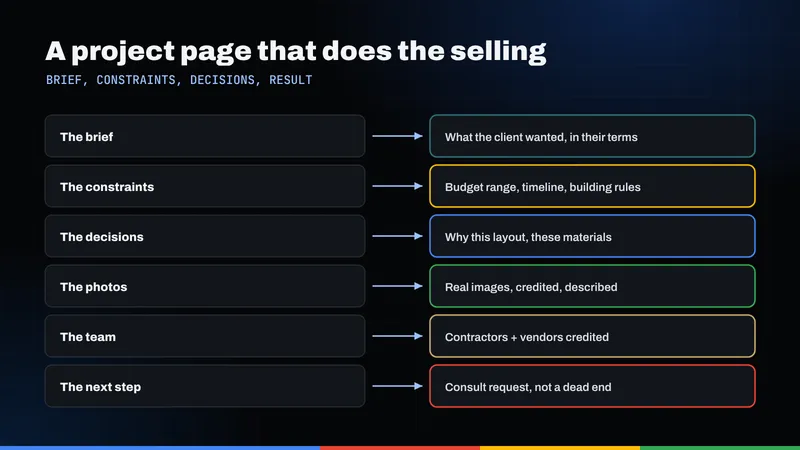
Materials are where a scheme gets real, and your portfolio is the material. A gallery of photos with a project name tells a search engine almost nothing and tells a client only that you have taste. A case study shows you can solve problems. Give each project page a consistent structure:
- The brief: the client (anonymized if they prefer), the space and what they wanted to change.
- The constraints: a budget, an existing layout, condo association rules, a restaurant's opening date, a waterfront exposure that fades fabric.
- The decisions: what you chose and why. That stone, that layout change, that lighting plan.
- The credits: architect, contractor, millworker and photographer, named with their permission.
- The photography: real images of the finished work, plus process or before shots if you have them.
On photography: the photographer usually owns the copyright, and what you can do with the images depends on the license you agreed. Get written permission covering your website, Google profile and any social or directory listings, and credit the photographer as they ask. If a homeowner or their address is identifiable, get their consent too. Our post on SEO for photographers looks at the same issue from behind the lens.
Never present renderings or stock photos as completed work. Label renderings as renderings. A client who discovers a "finished" room was a 3D model will assume the rest of the site is staged.
Spec sheet: rebuild your five strongest projects as case studies of a few hundred words each, confirm the license for every image, and add a credits block to each page.
Lighting: image SEO that lets Google see the work
Lighting decides what a room reveals; image SEO decides what Google can see. Google's image SEO best practices run against how many portfolio themes are built:
- Use HTML image elements. Google doesn't index images set as CSS backgrounds, a common technique in full-screen sliders.
- Write useful alt text. Google calls alt text the most important image metadata. "Living room with white oak built-ins facing a bay view" helps. A string of keywords doesn't.
- Name files descriptively. Rename "DSC_4021.jpg" to something like "coastal-condo-kitchen-quartz-island.jpg."
- Keep images near the text that explains them. Captions help, which is another reason case studies beat galleries.
- Serve the right sizes and formats. Use responsive images with a standard fallback source, in supported formats such as JPEG, PNG, WebP or AVIF.
- Consider an image sitemap if images sit on a CDN or load in ways a crawler might miss.
Spec sheet: check project pages for CSS background images, rename and re-describe the files on your top case studies, and caption every hero image.
Styling: Google Business Profile, Pinterest and Houzz
Styling is the final layer, and the one clients see first. In local search that's your Google Business Profile. Google's guidelines for representing your business decide how to set it up:
- A studio or showroom with permanent signage, staffed during your listed hours and open to clients, can show its address.
- If you work from home or meet clients at their properties, you're a service-area business. Google says to hide your address and set a service area.
- A co-working desk qualifies only with clear signage, staff present and customers received during business hours. Virtual offices aren't eligible.
- Your business name must match your real-world name. Adding "Luxury Interior Design Miami" to it breaks the rules and can get the profile suspended.
Then fill the profile with your own project photos, an honest description, your services and posts about finished work. Our Google Business Profile guide for North Miami Beach businesses covers setup and upkeep.
Pinterest and Houzz are visual platforms where people collect ideas and look for professionals, and many design clients browse them before they reach Google. Treat them as discovery channels that send people back to your site, not replacements for it. Link each image to the matching case study, credit photographers, and keep your name and contact details consistent with your Google profile.
Spec sheet: decide honestly whether you're a storefront or service-area business, fix your profile name and address to match, and link every pin or listing to a specific project page.
Code review: what Florida law says about your title
Every scheme gets a code review. Florida is one of the states that regulates interior design in law, in Part I of chapter 481 of the Florida Statutes, alongside architecture, administered by the Board of Architecture and Interior Design at the Department of Business and Professional Regulation. The current statute says:
- Registration isn't required to practice. Section 481.213(8) says a certificate of registration is not required for a person whose practice is confined to interior decorator services or to interior design as provided in that part.
- Residential work is outside the part. Section 481.229(6)(a) excludes interior design or decorator services for any residential application, defined to include single-family homes, multifamily homes, townhouses, apartments and condominiums.
- "Registered interior designer" is a protected title. Section 481.223(1)(b) bars using it without a valid certificate of registration, while stating it doesn't restrict "interior designer" or "interior design firm."
- Sealed documents need a seal. Under section 481.2131, where a permitting body requires sealed interior design documents, a designer who isn't a licensed architect must use a department-issued seal, and that acceptance doesn't extend to structural, mechanical, electrical, plumbing or life-safety systems.
- Design isn't contracting. Section 481.229(7) says the part doesn't let an interior designer act as a contractor unless registered or certified under chapter 489.
These sections were amended by chapter 2020-160, Laws of Florida, effective July 1, 2020. Plenty of what circulates online predates that law, so rely on the current text.
On advertising, section 481.221(10) requires registered architects, and businesses whose qualifying agent is an architect, to include the architect's license number in ads. It names architects, not interior designers, though it applies if your firm also offers architecture. If you're a registered interior designer, showing your number is still smart: clients can check it in DBPR's license lookup.
For SEO, the rule is precision. If you're registered, say so and give the number. If not, "interior designer" is fine, but never use "registered" or imply you can seal permit documents. On condo and hospitality pages, say which licensed professionals handle permitting, construction and engineering.
Spec sheet: search every page, profile and bio for "registered," add your number where you hold one, and describe your role on permitted projects accurately. This is general information, not legal advice; confirm specifics with the Board or a Florida attorney.
Client sign-off: reviews that hold up
Reviews are the client's signature in public. For design work they matter because nobody can test your taste in advance; they read about communication, budget discipline and how you handled a delayed shipment.
Google's policy on prohibited content forbids incentives for reviews, discouraging negative ones, selectively asking only happy clients and reviews from people with a conflict of interest, such as employees or relatives. The FTC's final rule on fake reviews, announced in August 2024, bans fake reviews and testimonials, incentives conditioned on a particular sentiment, undisclosed insider reviews and suppressing negative reviews through threats or intimidation.
So ask every client after installation, with the same message and a direct link, and answer every review calmly and specifically. Client quotes on case studies should be real, attributed with permission and never edited to change their meaning.
Spec sheet: add a review request to your close-out checklist, send it to every client, and never tie a discount, gift or credit to a review.
Reveal: schema, launch and what to watch
The reveal is where the scheme comes together, and the last layer is structured data. Schema.org has no InteriorDesign type. Its HomeAndConstructionBusiness subtypes include GeneralContractor and HousePainter but nothing for design studios, and schema.org marks the local-business ProfessionalService type as deprecated. For most studios, LocalBusiness is the honest fit; a renovation-led firm could use HomeAndConstructionBusiness.
Fill in only what's visible on the page: name, URL, phone, address (if shown publicly) or area served, images, hours and links to official profiles. Our explainer on how schema helps search engines covers the mechanics.
After launch, track what relates to the business: consultation requests, calls from your profile and which project pages bring people in. Pitches for seo miami often promise a ranking position; a studio should care more about whether the right clients find the right projects. Our North Miami Beach SEO team handles local SEO, site builds and content, and our work page shows the kind of sites we build. If you'd like a second look, request a free audit of your site and profile.
Spec sheet: add LocalBusiness markup matching your visible details, validate it, and review consultation sources monthly against the three project types from your concept.
Frequently asked questions
Do interior designers need a license in Florida?
Section 481.213(8) of the Florida Statutes says a certificate of registration is not required for a person whose practice is confined to interior design or interior decorator services as provided in that part, and section 481.229(6) excludes residential work, including condominiums. The title "registered interior designer" is protected, and sealed permit documents require a department-issued seal.
Can I call myself an interior designer without being registered?
Yes. Section 481.223(1)(b) bars using the title "registered interior designer" without a valid certificate of registration, but states that it doesn't restrict "interior designer" or "interior design firm." Don't use "registered" or suggest you can seal permit documents unless you hold the registration.
Should my studio's Google profile show my address?
Only if you have a location with permanent signage that's staffed during your listed hours and open to clients. If you work from home or visit clients at their properties, Google's guidelines say to hide your address and set a service area. Virtual offices aren't eligible.
What schema type should an interior design firm use?
Schema.org has no InteriorDesign type, and it marks the local-business ProfessionalService type as deprecated. LocalBusiness fits most studios, and a renovation-led firm could use HomeAndConstructionBusiness. Mark up only details visible on the page.
Can I use my photographer's images on my website and Google profile?
Only within the license you agreed. Photographers usually own the copyright, so get written permission covering your website, Google profile and any social or directory listings, credit the photographer as they ask, and get the homeowner's consent where they or their address can be identified.