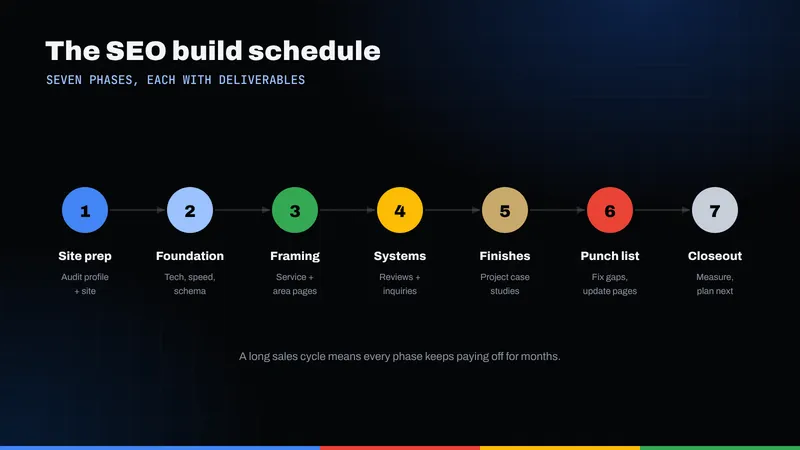
SEO for home builders works best when it runs like a build: prepare the ground, pour a foundation of accurate license and profile details, frame the site around real projects and neighborhoods, then add the systems, finishes and punch list that carry a long research phase to a signed contract. For a custom builder or residential general contractor around North Miami Beach, that means case-study project pages, a Google Business Profile set up the way Google's rules require, your Florida license number wherever you advertise, and honest pages on process, timeline and how pricing is built.
Key takeaways
- Treat search as a phased schedule with deliverables at each phase, not a pile of tactics bought one at a time.
- Florida law requires a contractor's certification or registration number in advertisements regardless of medium, so your website is part of compliance, not just marketing.
- Project pages should read like case studies: scope, constraints, permitting path and real photos, with no invented outcomes.
- Custom-home buyers research for months; pages that explain process, schedule and how a price is assembled do more work than another "luxury homes" page.
- Reviews must be earned and requested evenly. Google's policy and the FTC's 2024 rule both bar fake, incentivized or suppressed reviews.
Why a builder's SEO should be scheduled like a build
An owner's rep walking a job site wants three answers: what phase are we in, what's due before the next one starts, and who signs off. Builders rarely get that clarity from their marketing. They get a monthly report, a few blog posts and a promise that rankings take time.
A house goes up in order for good reasons. You don't hang drywall before rough-in inspection, and you shouldn't pour money into blog content before your Google Business Profile, license disclosures and core service pages are sound. Home builder SEO has the same dependencies, and good SEO for home builders respects them. Skip a phase and the defects show up later, usually as traffic from people who were never going to build anything.
The schedule below runs from site prep to closeout, and each phase ends with deliverables you can hand to whoever runs your marketing and check off. If you run a trade business rather than whole-home projects, our guide to SEO for contractors in North Miami Beach covers the service-call side. This piece stays with custom homes, teardowns and rebuilds, additions and major renovations.
Phase 1: Site prep (know the lot before you dig)
In construction, site prep is surveys, soil, setbacks and utilities. In search, it's understanding who is looking for you, what they type at each stage, and what your site already has. It produces nothing visible, which is why it gets skipped and why so many budgets are wasted.
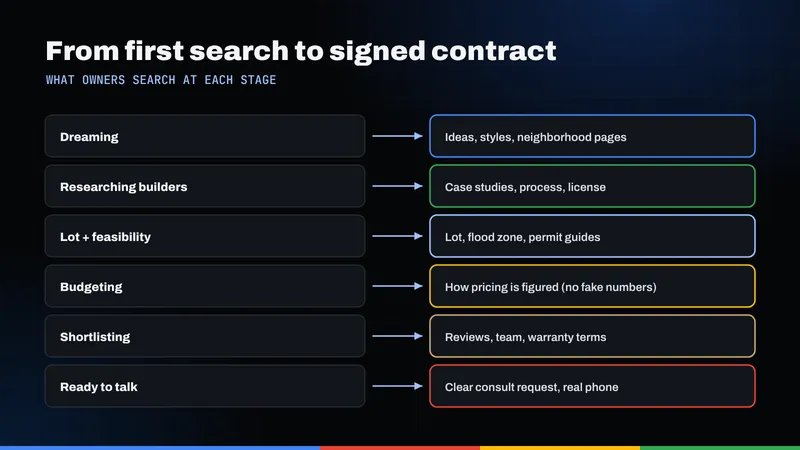
A custom-home buyer is not one search. Months can pass between someone wondering whether to renovate or tear down and that same person comparing two builders' contracts. Mapping those stages to pages is the core of site prep:
| Buyer stage | What they search (examples) | Page to build |
|---|---|---|
| Deciding | "renovate or rebuild house," "add a second story to my house" | Renovate vs. teardown-and-rebuild guide |
| Lot and feasibility | "buying a lot to build a house," "check flood zone before building" | Lot evaluation and feasibility consultation page |
| Finding builders | "custom home builder near me," "home builder North Miami Beach" | Location-specific service page plus Google Business Profile |
| Vetting | "[builder name] reviews," "[builder name] license" | About page with license details, team and portfolio |
| Comparing proposals | "cost plus vs fixed price contract," "how custom home pricing works" | Process and pricing-method explainer (no made-up numbers) |
| Ready to talk | "[builder name] consultation" | Contact page with a short, specific intake form |
Most builder sites have a home page, a gallery and a contact form, which covers about two rows. The gaps become your schedule of values.
Phase deliverables
- A written list of the project types you want more of, so the plan doesn't chase work you'd turn down.
- The buyer-stage map, adjusted to your service area.
- An inventory of existing pages, photos, permits and project records.
- Company-owned access to Google Search Console, analytics and your Business Profile.
Phase 2: Foundation (license, profile and consistent facts)
For a builder, the foundation is the set of facts that has to be right everywhere: legal business name, license, address or service area, and phone number.
Your Florida license is part of your marketing
Florida regulates construction contracting under Chapter 489 of the Florida Statutes. The definitions in section 489.105 separate general, building and residential contractors by scope. A residential contractor, for example, is limited to one-, two- or three-family residences of no more than two habitable stories above no more than one uninhabitable story. The same section distinguishes a certified contractor, who holds a state certificate of competency and may work in any Florida jurisdiction, from a registered contractor, who may work only where they met local competency requirements.
That matters for content. A registered contractor whose site claims to build "anywhere in South Florida" may be overstating what the license allows. Write service-area pages that match your actual license.
The advertising rule is direct. Section 489.119(5)(b) requires a contractor's registration or certification number to appear in each offer of services, business proposal, bid, contract or advertisement, "regardless of medium," as defined by board rule. Put the number in your footer, on your about and contact pages, and in ad copy, then link to the DBPR license search so a prospect can verify it. Serious buyers check anyway; making it easy signals confidence.
Google Business Profile: office, showroom or service area
Builders are often hybrids. Some have a staffed office or design showroom; many work from a home office or wherever this year's job sits. Google's Business Profile guidelines treat those differently. A service-area business should hide its address, and an address should be shown only if the location is staffed and able to receive customers during stated hours, with permanent signage. Virtual offices and rented mailboxes don't qualify, and a service area generally shouldn't extend beyond about two hours of driving time from where the business is based.
So if you have a real office or showroom in North Miami Beach with signage and staff during posted hours, list it. If not, use a service-area profile with the address hidden and the cities you actually build in. Never put a profile on a job site, and don't create extra profiles for neighborhoods you'd like to rank in. Our Google Business Profile guide covers setup step by step.
Phase deliverables
- License number and type (certified or registered, plus classification) in the footer, about and contact pages.
- A link to DBPR's verification tool.
- One Business Profile, storefront or service-area per Google's rules, with the right primary category.
- Identical name, phone and any shown address across the site, profile and major directories.
Phase 3: Framing (the pages that carry the load)
Framing gives the site its shape: which pages exist, how they connect, and which carry the load of ranking and converting.
Service pages, one per real offer
Build a separate page for each kind of work you sell: custom homes, teardown and rebuild, additions, whole-house renovations. Each should explain who it's for, how the process runs, what decisions the owner faces, and link to two or three relevant projects. One "Services" page listing everything gives search engines and buyers very little.
Project pages written as case studies
A gallery of beautiful kitchens tells a search engine almost nothing. A case study tells it, and a careful buyer, a great deal. For each completed project, document:
- Starting point. Existing house, vacant lot or partial demolition, and what the owner wanted.
- Scope. Square footage added, systems replaced, structural work, in plain terms.
- Constraints. Lot shape, setbacks, HOA review, flood zone, a tight street for deliveries.
- Permitting path. Which jurisdiction, what permits, anything that changed the plan. Use real records and get the owner's permission before naming an address.
- Real photos. Before, during and after, with descriptive file names and alt text.
Leave out invented results. Don't claim a project "added 40% to home value" or "finished two months early" without documentation. True, specific details persuade better than round numbers. Our post on SEO for architects goes deeper on design-led case studies and image optimization, and nearly all of it applies to a builder's portfolio.
Community and lot pages
Buyers think in neighborhoods. A page about building in a particular area can rank where your home page never will, if it says something specific: lot sizes you've worked with, HOA or design-review steps you've been through, which building department handles permits. If you have nothing specific to say, skip it. A stack of "Custom Home Builder in [City]" pages with swapped names is the thin content that drags a site down.
A lot page catches people even earlier. Explain what you check before anyone buys (zoning, setbacks, utilities, flood zone, equipment access) and you meet buyers at the feasibility stage, long before they search for a builder by name.
Phase deliverables
- One service page per offer, each linked to relevant projects.
- At least three case studies built from real records and photos, with owner permission.
- Community pages only where you have genuine experience, plus one lot evaluation page.
Phase 4: Systems (schema, speed and tracking)
Rough-in goes behind the walls. Owners never see it, but they notice right away when it's wrong. Site systems are the same.
Structured data
Schema.org lists GeneralContractor as a type under HomeAndConstructionBusiness, which sits under LocalBusiness. Mark up your business with GeneralContractor (or HomeAndConstructionBusiness if that fits better), including name, URL, phone, areaServed, and an address only if you show one publicly. Keep it consistent with the page and your Business Profile. Schema doesn't guarantee rich results, but it removes ambiguity about who you are; see how schema helps search engines for more.
Speed and tracking
Builder sites are photo-heavy, as they should be, but oversized, uncompressed images make project pages crawl on a phone. Resize and compress, use modern formats, and lazy-load galleries below the first screen.
Tracking has to fit a long sales cycle. A lead might submit a form in March and sign in October. Track forms and calls, ask every inquiry how they found you, and record lead source wherever your pipeline lives. Otherwise you'll judge marketing by traffic, which says little about contracts.
Phase deliverables
- Validated GeneralContractor or HomeAndConstructionBusiness schema that matches the profile.
- Compressed, properly sized project images.
- Form and call tracking, plus a lead-source field filled in for every inquiry.
Phase 5: Finishes (content for a long decision)
Finishes are what clients remember. On a builder's site, they're the pages that help someone through a decision that may take a year or more.
Process and timeline
Write out how a project with you runs: first conversation, feasibility, design coordination, permitting, preconstruction, construction phases, inspections, closeout and warranty. You don't need to promise durations. Explain what drives the schedule (permit review, design changes, material lead times, weather) and what the owner can do to keep it moving.
How pricing works, without invented numbers
Owners search for construction costs constantly, and it's tempting to publish a cost-per-square-foot figure. Unless it's your own current, documented data, don't. Explain how a price is built instead: fixed-price versus cost-plus contracts, what allowances are, how change orders work, what pushes cost up on a coastal lot. A buyer who understands your method is easier to work with than one anchored to a number from a random article.
Flood zones and code, sourced carefully
Flood risk is a real concern on many South Florida lots. If you write about it, send readers to FEMA's Flood Map Service Center, where they can search official flood maps by address. Explain what you look at and why it affects design, but don't paraphrase code requirements from memory. Cite the specific provision or tell readers to confirm with the local building department.
Phase deliverables
- A process page from first call to warranty.
- A pricing-method explainer covering contract types, allowances, change orders and cost drivers.
- Flood or code content linked to official sources and reviewed before publishing.
Phase 6: Punch list (reviews and reputation, done right)
The punch list catches defects before move-in. In search, it's reputation: the reviews and replies a buyer reads right before calling.
Ask every client for a review at closeout, not just the ones you're sure about. Google's prohibited and restricted content policy says businesses may not selectively solicit positive reviews or discourage negative ones, and may not offer incentives such as discounts or free services. Reviews posted with a conflict of interest, such as by employees, aren't allowed either.
Federal rules point the same way. On August 14, 2024, the FTC announced a final rule banning fake reviews and testimonials, incentives conditioned on a particular sentiment, undisclosed insider reviews, and review suppression through intimidation or groundless threats. That reaches testimonials on your own site, not just Google.
Reply to every review, briefly and specifically. A calm answer to a critical review shows how you handle problems, which is what an owner really wants to know about a builder.
Phase deliverables
- One standard review request sent to every client at closeout.
- No incentives, no filtering, no employee or family reviews.
- Site testimonials only from real clients, with permission.
Phase 7: Closeout (measure, hand over, maintain)
Closeout is documentation and warranty. For SEO, it's measuring what worked and setting a maintenance plan.
In Search Console, look at which queries bring impressions and clicks and which project and service pages earn them. Compare that with your lead-source records. A modest page that produced two consultations matters more than a popular post read by people out of state. Expect results to build over months; our post on how long SEO takes explains why.
Then keep building. Add a case study when a project closes, update the process page when your process changes, and keep license details current. A lot of generic local SEO Miami advice treats a website as finished. A builder's site should grow with every completed job, and that specific, verifiable record is also what AI search tools draw on when they describe local builders.
Phase deliverables
- A quarterly review of Search Console data against real leads and contracts.
- A new case study after each completed project.
- Annual checks of license details, profile information and schema.
If you'd like help running this schedule, our North Miami Beach SEO team handles local SEO, site structure and content for builders, and our SEO Miami service covers the wider county. See the kinds of sites we build on our work page, or request an audit and we'll walk your current site through each phase and show you where the gaps are.
Frequently asked questions
What is the most important first step in SEO for home builders?
Get the foundation right: one accurate Google Business Profile set up under Google's storefront or service-area rules, your Florida license number on your site and in your ads, and consistent business details everywhere. Content built on inconsistent facts tends to underperform.
Do I have to put my contractor license number on my website?
Florida Statutes section 489.119(5)(b) requires a contractor's registration or certification number in each offer of services, proposal, bid, contract or advertisement, regardless of medium, as defined by board rule. Most builders put it in the footer and on the about and contact pages. Confirm specifics for your ads with your attorney or the licensing board.
Should my Google Business Profile show my address if I work from job sites?
Only if you have a location that is staffed during stated hours, can receive customers and has permanent signage. Otherwise Google's guidelines call for a service-area profile with the address hidden. Job sites, virtual offices and mailboxes don't qualify.
Can I publish typical construction costs per square foot?
Only if they come from your own current, documented project data, and even then they date quickly. It's usually more useful to explain how your pricing works: contract types, allowances, change orders and the factors that drive cost on a given lot.
Is it okay to offer clients a gift for leaving a review?
No. Google's review policy prohibits incentives such as discounts or free services in exchange for reviews, and the FTC's 2024 rule bans incentives conditioned on a particular sentiment. Ask every client the same way at closeout, with no rewards and no filtering.