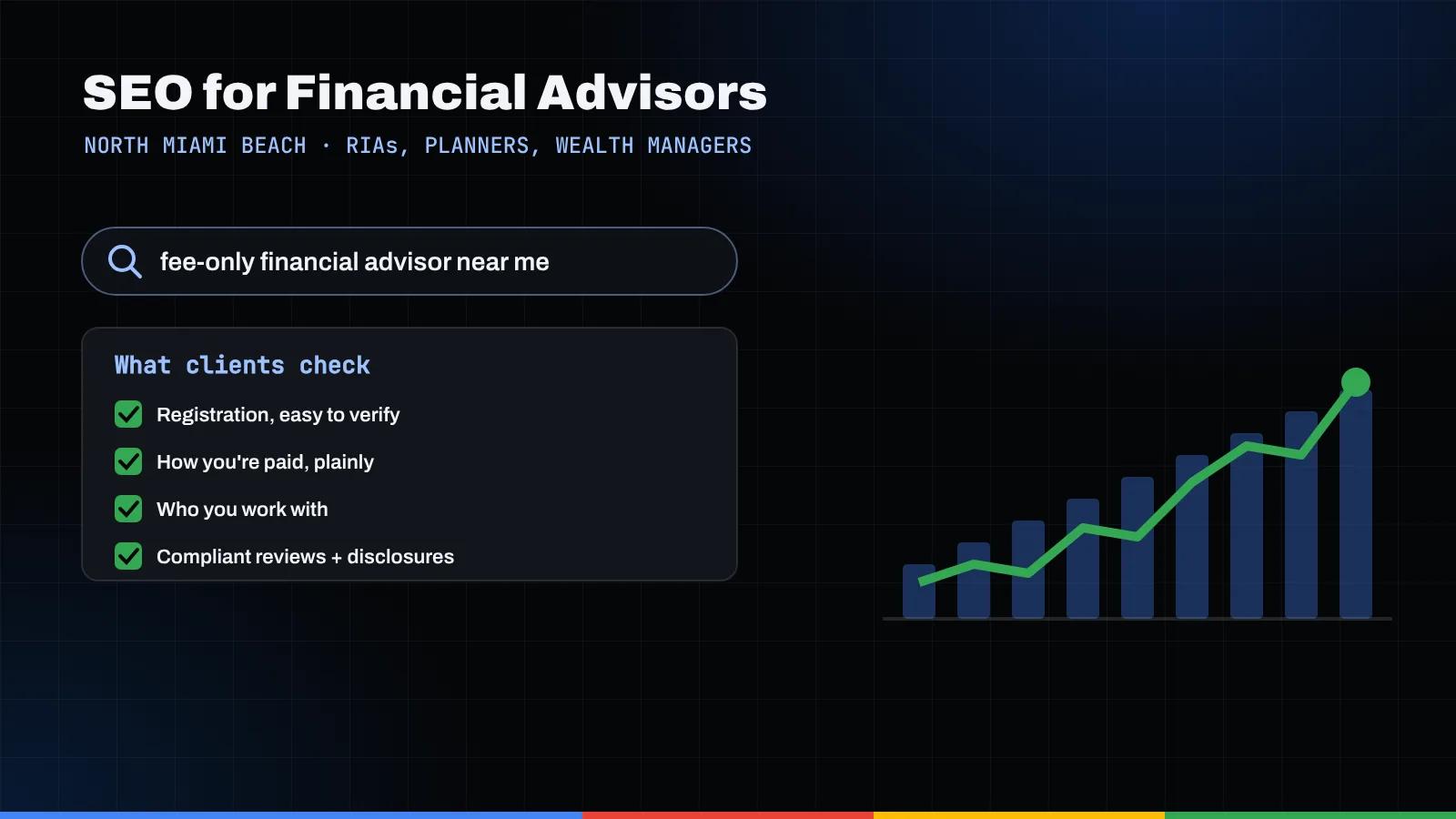
SEO for financial advisors rewards the same habit good investing does: small, steady deposits made for years, with nothing that could blow up the account. For an RIA or wealth manager in North Miami Beach, that means a site that names who gives the advice and how to verify them, educational content that never promises returns, and an accurate Google Business Profile. Every page should be something your compliance reviewer would sign off on.
Key takeaways
- Google gives extra weight to trust on topics that affect people's financial stability, and it says trust is the most important part of E-E-A-T.
- Your website is advertising. SEC-registered advisers answer to the Marketing Rule, broker-dealer communications fall under FINRA Rule 2210, and Florida's Office of Financial Regulation registers smaller advisers.
- Testimonials and endorsements are now allowed for SEC-registered advisers, but only with clear and prominent disclosures and oversight.
- Link to BrokerCheck and the SEC's Investment Adviser Public Disclosure site so prospects can check your record in one click.
- Publish on a calm, repeatable cadence and let the library compound. Skip shortcuts like incentivized reviews.
Why does SEO for financial advisors work like compounding?
Advisors already know how compounding works. Returns are small at first, and the curve only becomes obvious after enough periods have passed. The one thing that wrecks it is a large, avoidable loss.
Financial advisor SEO behaves the same way. One article on Roth conversions changes little on its own. A library of them, each reviewed, dated and attributed to a real professional, starts to earn trust from readers and search engines, and every new page strengthens the ones before it.
The "large loss" here is a compliance problem: a performance claim you can't support, a testimonial without required disclosures, or a review campaign that breaks Google's rules. Any of those can force you to pull content and explain yourself. So the strategy is deliberately conservative. Make deposits you'll never have to withdraw.
Everything below is general information about marketing, not legal or compliance advice. Your compliance officer or counsel decides what applies to your firm.
Which rules apply to a financial advisor's website?
Before writing a page, figure out which regulator reads your marketing. That depends on how you're registered.
- SEC-registered investment advisers. The SEC's small entity compliance guide to the Marketing Rule explains that Rule 206(4)-1 under the Advisers Act applies to advisers registered, or required to be registered, with the Commission. It covers communications offering advisory services to prospective clients, which describes most of an advisory website.
- State-registered advisers in Florida. Florida's Office of Financial Regulation says on its state-registered advisers page that investment advisers with less than $100 million in assets under management are subject to state registration and regulatory requirements under chapter 517, Florida Statutes. If that's you, ask counsel which Florida advertising provisions apply.
- Broker-dealers and their registered reps. FINRA Rule 2210 governs communications with the public. At a high level, it requires communications to be fair and balanced, bans false, exaggerated, promissory or misleading claims, and generally requires a registered principal to approve retail communications before use. FINRA has proposed changes to that approval process, so confirm the current version with your compliance team.
Compliance check: Some advisers are dually registered or affiliated with a broker-dealer, so more than one set of rules may touch the same page. Name who signs off on new pages before you publish anything.
What does Google expect from a financial advisor's content?
Google's guidance on creating helpful, reliable, people-first content describes E-E-A-T: experience, expertise, authoritativeness and trustworthiness. It says trust is the most important of the four, and that Google's systems give extra weight to strong E-E-A-T on topics that could affect people's health, financial stability or safety. Retirement and investment advice sits squarely there.
Google also says E-E-A-T itself isn't a specific ranking factor. What you can control is whether a page answers three plain questions:
- Who wrote it? Google encourages accurate bylines where readers expect them and warns against deceptive authorship. For an advisory firm, the byline should lead to a bio with the professional's role, credentials and a link to their public regulatory record.
- How was it made? If a draft started with AI or a vendor, a qualified person at the firm should review it, and the page should show a review date.
- Why does it exist? A page that helps a recently widowed client understand beneficiary designations has a clear reason to exist. A page that exists only to rank for "best financial advisor near me" doesn't.
A fair, balanced, attributed and accurate page tends to satisfy Google and regulators at once. That overlap is why a compliance-first approach doesn't cost you rankings.
Which content deposits compound for an RIA?
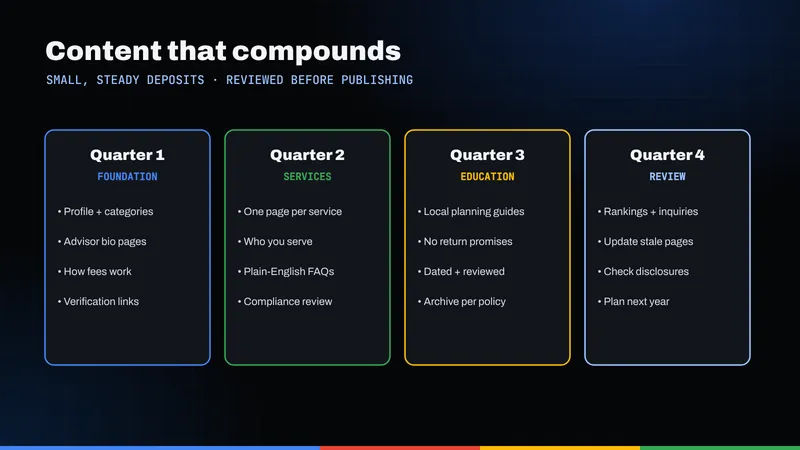
Think of your content plan as a portfolio with a long holding period: assets that stay accurate for years, not pieces that go stale or create risk when markets move. For RIAs and wealth managers, the durable holdings are:
- Service pages by client situation. Retirement income planning, business owner planning, planning for a surviving spouse, cross-border families. Each explains who it's for, how the engagement works and how fees are structured.
- Evergreen explainers. How a fee-only arrangement differs from commission-based compensation, what a fiduciary duty means, how required minimum distributions work.
- Process pages. What happens in a first meeting and what documents to bring.
- Team bios. Real people, real roles, verifiable records. On a money topic, bios often do more trust work than the homepage.
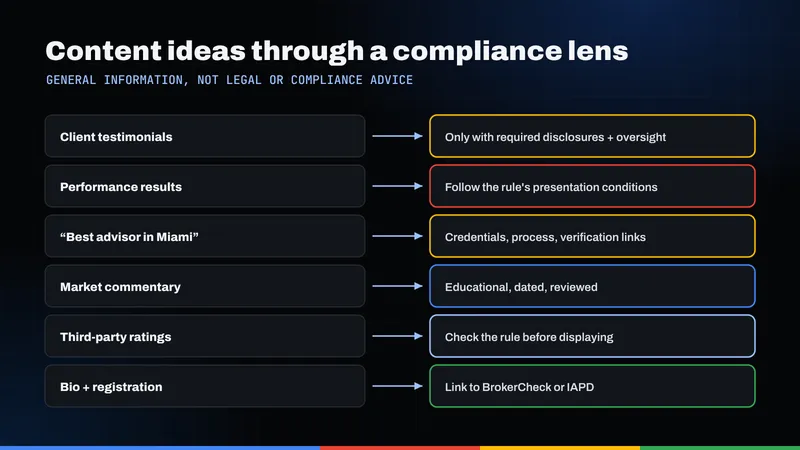
Here is how common content ideas map to compliance considerations. Treat it as a starting point for your compliance reviewer, not a rulebook.
| Content idea | Compliance consideration | Safer approach |
|---|---|---|
| "Our clients beat the market" landing page | Performance claims must be fair, balanced and substantiated; the SEC rule sets presentation requirements | Describe your process and philosophy; route any performance presentation through compliance |
| Client success story | Likely a testimonial; needs clear and prominent disclosures and oversight under the Marketing Rule | Use an anonymized, clearly labeled hypothetical, or a compliant testimonial approved in advance |
| Market outlook blog post | Predictions and projections are restricted for broker-dealer communications and can mislead in any advertisement | Explain how you think about risk and rebalancing without forecasting returns |
| "Top advisor" award badge | Third-party ratings require specific disclosures, including the date, the period covered, the rater and any compensation paid | Show it only with the full disclosure next to it, or leave it out |
| Retirement calculator | The rule has specific provisions for hypothetical performance and interactive tools; hidden assumptions can mislead | Show inputs and assumptions plainly and state that results are illustrations, not projections |
| Google review widget on the homepage | Reviews from clients shown on your site may be treated as testimonials | Ask compliance before embedding; if approved, add the required disclosures |
Compliance check: The SEC's guide notes that advisers must keep copies of all advertisements they disseminate. Archive every page version you publish.
How should an advisor handle performance and numbers on the site?
The fastest way to turn a good website into a liability is to post return figures casually. The Marketing Rule doesn't ban performance advertising, but it attaches conditions. According to the SEC's compliance guide, gross performance can't be shown unless net performance is also presented, results generally must be shown for specific time periods, and extracted performance and hypothetical performance each come with their own requirements. All advertisements are also subject to general prohibitions, including no untrue or misleading statements, no claims you can't substantiate on demand, and no unfair choice of time periods.
You rarely need performance figures to rank. Someone searching "how to roll over a 401(k)" wants an explanation, not a track record. Keep performance out of blog posts, service pages and title tags, and let compliance decide where else it belongs. If a post cites a contribution limit or tax threshold, link the official source and date the post. A dated figure ages gracefully; an undated one quietly becomes wrong.
Compliance check: Read each number on the page and ask whether you could produce support for it tomorrow. If not, cut it.
Can financial advisors ask for Google reviews?
Under the amended Marketing Rule, which had a compliance date of November 4, 2022, SEC-registered advisers can use testimonials and endorsements, with conditions. The SEC's guide says an advertisement must clearly and prominently disclose whether the person giving the testimonial or endorsement is a client and whether they were compensated, along with further disclosures about compensation and conflicts of interest. The adviser must oversee compliance, generally needs a written agreement with paid promoters, and certain disqualified persons can't act as paid promoters.
A Google review lives on a third-party platform, but once you quote it on your site, embed a widget or feature it in an ad, you may be using it as a testimonial. The SEC's Division of Examinations addressed related practices in its December 2025 risk alert on Marketing Rule compliance. Staff observed advisers posting testimonials or endorsements from third-party websites on their own sites without the required disclosures, and advisers giving clients gift cards to write reviews on third-party sites without the disclosures required for paid testimonials.
Google's contributed-content policy also bans reviews posted because of a business incentive and prohibits selectively asking only happy customers. Our Google Business Profile guide for North Miami Beach covers the mechanics of asking for reviews.
- Get compliance approval for the review request's wording and sender.
- Ask every client the same way, with nothing of value attached.
- Respond without confirming the reviewer is a client or discussing their account.
- Decide in advance whether reviews will appear on your site, and with what disclosures.
Compliance check: A third-party award or "top advisor" ranking is a third-party rating under the rule. The rule text requires disclosure of the date the rating was given, the period it covers, who gave it and any compensation you paid. The same risk alert flagged ratings shown without dates and undisclosed fees paid to be considered for ratings.
How should advisors set up their Google Business Profile?
Some prospects want an advisor they can meet in person, so map results matter. Google's Business Profile guidelines name financial planners as individual practitioners, alongside doctors, lawyers and insurance agents. Your options:
- Firm profile. The office, under the firm's real-world name, at the address where clients meet you.
- Practitioner profiles. A public-facing advisor who can be contacted directly at the verified location during stated hours can have a dedicated profile. When several practitioners share a location, the firm keeps its own profile, and each practitioner's profile title includes only their name. Support staff shouldn't have profiles.
- Solo advisor under a brand. If you're the only public-facing practitioner at a location and represent a branded organization, Google says to share one profile named in the "[brand]: [practitioner name]" format.
Keep names free of keywords and make sure the address matches your website and regulatory filings. A broader local SEO plan ties the profile, site and citations together. Advisors weighing local SEO Miami-wide, with offices beyond North Miami Beach, should apply the same principles: real locations, consistent details, no virtual offices. Our SEO Miami page covers multi-office visibility.
Compliance check: Profile posts and descriptions are public communications. Review them like website copy.
How do verification links and schema build trust?
A prospect deciding who will manage their savings will check you out. Make that easy. Two free public tools belong on every advisor bio. BrokerCheck lets people look up the employment history, licenses and any disciplinary record of brokers and investment advisors. The SEC's Investment Adviser Public Disclosure site provides information on investment adviser firms regulated by the SEC and state securities regulators. Linking to your own record says something a paragraph of reassurance can't: check for yourself.
If you're an SEC-registered adviser or broker-dealer serving retail investors, the SEC's Form CRS guidance says to post the current relationship summary prominently on your public website, if you have one. It's a compliance task and a trust signal. State-registered advisers aren't covered by that requirement.
Schema.org's FinancialService type is a subtype of LocalBusiness, described simply as a financial services business, and it includes a property for describing fees and commissions. Keep every marked-up value identical to what's visible on the page. Our explainer on how schema helps search engines walks through the basics.
Our mortgage broker SEO guide follows the same pattern for licensing: let readers verify instead of asking them to trust you.
What's different about advising in North Miami Beach?
If your prospects in and around North Miami Beach include families who would rather read about money in another language, and your team advises in that language, state it on bios and service pages. Translated pages need the same compliance review, and a disclosure must be just as clear in translation. Our multilingual SEO guide covers how to structure those pages so each language can rank on its own.
Cross-border topics fit too. Imagine a page titled "What to ask an advisor if you have accounts in two countries." It recommends no product and forecasts nothing; it lists the questions and explains why each matters. That page can attract the right prospects for years.
Be specific about where you meet clients, including the address and whether you meet by video. Skip local claims you can't source. A firm exact about small things signals it will be exact about large ones. Our North Miami Beach SEO page explains how we approach local visibility for firms based here.
What does a measured publishing cadence look like?
Consistency beats intensity. A sustainable rhythm for a small advisory team might be:
- Quarterly: list the client questions you heard most and assign each to an advisor.
- Monthly: publish one or two reviewed explainers, each with a byline, a review date and links to official sources.
- Every new page: link it to related older pages and the relevant service page.
- Twice a year: rebalance. Update dated figures, retire stale pages and recheck bios against public records.
- Always: archive what you publish and log who approved it.
Rankings move slowly in financial niches; our post on how long SEO takes sets honest expectations. Track qualified consultation requests and the pages those prospects read first.
We build SEO programs for professional firms and work alongside your compliance reviewer, not around them. For a clear-eyed look at where your site stands, request an SEO audit and we'll show you which deposits to make first.
Frequently asked questions
Does the SEC Marketing Rule apply to my website and blog?
If you're an SEC-registered investment adviser, likely yes. The rule covers communications that offer advisory services to prospective clients, which describes most advisory websites. State-registered advisers in Florida answer to the Office of Financial Regulation instead, and broker-dealer communications fall under FINRA Rule 2210. Confirm the details with your compliance team.
Can financial advisors use testimonials and Google reviews now?
SEC-registered advisers can use testimonials and endorsements under the amended Marketing Rule, but only with clear and prominent disclosures about whether the person is a client, whether they were paid and any material conflicts, plus oversight by the adviser. Quoting or embedding Google reviews on your own site may count as using testimonials, so get compliance approval first.
Can we offer clients a gift card for leaving a review?
We advise against it. Google doesn't allow reviews posted because of a business incentive, and the SEC's December 2025 risk alert noted advisers giving clients gift cards for third-party reviews without the disclosures required for paid testimonials. Ask every client the same way, with nothing attached.
Should we link to BrokerCheck and the SEC's adviser search on our site?
Yes, it's one of the strongest trust signals available. BrokerCheck shows the employment history, licenses and any disciplinary record of brokers and investment advisors, and Investment Adviser Public Disclosure covers firms regulated by the SEC and state regulators. Linking each advisor bio to their record lets prospects verify you in one click.
What schema type fits a financial advisory firm?
Schema.org's FinancialService, a subtype of LocalBusiness described as a financial services business, fits an advisory office. It includes a property for describing fees and commissions. Keep every marked-up value identical to what's visible on the page, and pair it with accurate advisor bios.