Build the website for the two very different people who search for you: the grieving adult child who needs probate help this week, and the calm planner who wants a will or trust before anything happens. Give each a clear path, a plain-English page for every service, an easy phone number, and trust signals that follow the Florida Bar's advertising rules.
Key takeaways
- Estate planning searches come from two journeys, urgent probate and unhurried planning, and the site should welcome both from the home page.
- Every core service deserves its own plain-English page: wills, revocable trusts, powers of attorney, health care surrogates, probate administration, guardianship alternatives and Florida homestead.
- Older searchers need large readable text, strong contrast, simple navigation and a phone number they can tap without hunting.
- Multilingual families need real translated pages, and the Florida Bar requires an ad's required information to appear in every language the ad uses.
- Google gives extra weight to trust on topics like money and family security, so verifiable credentials matter more than polished claims.
Who is really typing "estate planning attorney" into Google?
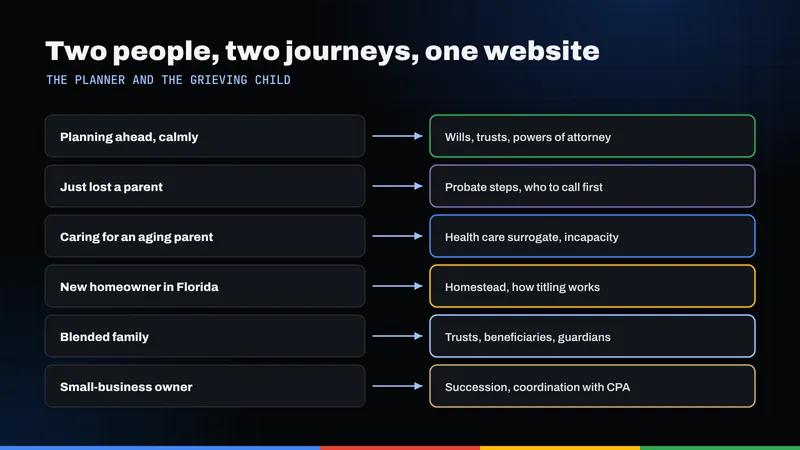
Picture two people opening a laptop on the same evening.
The first is in her fifties. Her father passed away nine days ago. There is a folder of papers on the kitchen table, a house in his name, and a bank asking for "letters of administration." She does not know what probate is. She just knows she needs someone, soon.
The second is in his sixties, maybe newly retired. Nothing is wrong. He simply decided it was time to get his affairs in order, and he will read several websites over a couple of weeks before he calls anyone.
Both land on estate planning law firm websites, and too many of those sites are written for other lawyers rather than for either of them. Good SEO for estate planning attorneys starts with the decision to write for these two people by name, and to build a site where each can find their own door within a few seconds.
What follows is two letters, one to each of them, then a practical look at the pages and trust signals that let one site serve both. It is general information about marketing a law practice, not legal advice; each Florida law mentioned links to its official source.
A letter to the one who just lost a parent
If someone you love has died, we are sorry. Here is what you deserve from a law firm's website when you arrive.
You should know within seconds that you are in the right place
The first screen should say, in ordinary words, that the firm helps families after a loved one passes away: something like "Lost a parent? We can help you through probate, step by step," with a phone number right beside it.
You should be able to understand probate without a law degree
A good probate page explains what probate is, why the bank or title company is asking for court papers, and what usually happens first. It can also tell you, accurately, that Florida offers more than one path. For example, Florida law allows a shorter process called summary administration in certain situations, such as when the Florida estate (less property exempt from creditors) does not exceed $150,000, or when the person has been dead for more than two years, according to section 735.201, Florida Statutes. A page that explains this plainly, then says "whether it fits your family depends on details we can review together," is helpful and honest.
You should not have to fill out a long form at midnight
When you are grieving, a twelve-field form feels like a wall. A short form (name, phone, one sentence) and a click-to-call button are kinder.
You should see what to gather
A simple checklist page, "What to bring to your first probate meeting," answers a real question and gives search engines a clear, useful page for the small questions people type in the first weeks after a death.
A letter to the one planning ahead
If you want to put a plan in place while life is calm, good for you. You have time, and a good website will respect that.
Pages that explain each document, one at a time
Will, revocable trust, power of attorney, health care surrogate: each deserves its own plain-English page explaining what the document does and who it is for. A health care surrogate page, for instance, can explain that Florida requires the designation to be in writing and signed in the presence of two adult witnesses, at least one of whom is neither your spouse nor a blood relative, as set out in section 765.202, Florida Statutes.
Honest answers to the questions everyone asks
Planners tend to search the same handful of questions. Does Florida have an estate tax? The Florida Department of Revenue states that a federal change eliminated Florida's estate tax for people who died after December 31, 2004. Can I sign my will online? Florida does have rules for electronic signatures and remote witnessing of wills in section 732.522, Florida Statutes, with specific conditions attached. Can I leave my house to anyone I want? Not always: Florida law provides that a homestead is not subject to devise if the owner is survived by a spouse or a minor child, under section 732.4015, Florida Statutes, which carries out a provision of the State Constitution.
You may not want to call yet. A page titled "What happens at your first estate planning meeting" lets you get comfortable at your own pace, and a firm that answers your questions clearly is the one you will remember when you are ready.
Which pages does an estate planning website need?
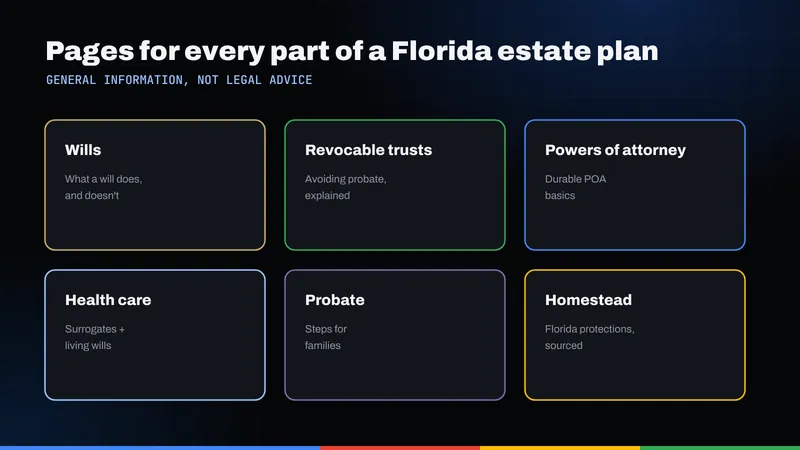
Put the two letters side by side and a site map almost writes itself: one focused page per service, linked from a home page that splits into "a loved one has passed" and "planning for the future." Here is a practical starting set for a wills and trusts lawyer website.
| Page | Who it mainly serves | What it should answer |
|---|---|---|
| Probate administration | Adult child, urgent | What probate is, why banks ask for it, the types of administration, first steps |
| What to bring to a probate meeting | Adult child, urgent | A printable list of documents and information to gather |
| Wills | Planner, calm | What a will does and does not control, how it is signed in Florida |
| Revocable living trusts | Planner, calm | How a trust differs from a will, who it tends to suit, what funding means |
| Durable power of attorney | Planner, and adult children of aging parents | Who handles finances if you cannot, and why timing matters |
| Health care surrogate and living will | Planner, and families in a medical crisis | Who speaks for you medically, how the designation is signed |
| Guardianship alternatives | Families of a parent with declining capacity | Options families often ask about before a court process |
| Florida homestead | Both | Why the family home follows special rules, in plain terms |
A single "Estate Planning Services" page that lists everything in one paragraph struggles to rank for "health care surrogate attorney" or "probate attorney North Miami Beach," and helps neither reader. Our broader SEO services follow this same principle: one clear page per real question. If your practice also handles litigation or other areas, the law firm SEO guide for North Miami Beach covers how to organize many practice areas without them competing with each other.
How should the site work for older searchers?
Many planners are older, and many adult children are reading on a phone in a hospital hallway. Both deserve a site that is easy to use.
The W3C's Web Accessibility Initiative notes that age can bring reduced contrast sensitivity, reduced near-focus, reduced dexterity and difficulty clicking small targets, and that existing accessibility standards address most older users' needs. In practical terms, that points to a few habits:
- Generous text size and strong contrast. Pale gray type on white looks elegant in a design file and is hard to read at 70.
- Short sentences and familiar words. Define "personal representative" the first time you use it. Avoid Latin where English will do.
- Phone-first contact. A large, tappable phone number in the header on every page, plus office hours stated plainly.
- Big buttons, simple menus, no pop-ups. Two clear paths from the home page beat a dropdown with fourteen items.
These choices are as much about website design as SEO. When people can read and act on a page easily, they stay and call, which is what search engines are trying to reward. The senior living SEO article covers more on writing for older readers and the adult children who research on their behalf.
What about families who speak more than one language?
Estate planning is a family conversation, and in North Miami Beach it often happens in more than one language. A parent may be most comfortable in one language while the adult child searches in another.
- Translate real pages, not just a banner. A "Hablamos español" line does not explain a revocable trust. Reviewed translations of the core service pages do.
- Give each language its own URL. Separate, linked language versions let search engines show the right page to the right searcher. Our guide to Spanish and multilingual SEO walks through the setup.
- Only promise the languages you can serve. If no one at the firm speaks a particular language, say you can arrange an interpreter rather than implying otherwise.
- Carry required disclosures into every language. The Florida Bar's lawyer advertising handbook explains that under Rule 4-7.12, all required information in an advertisement must appear in the same language used in the advertisement, and in every language if more than one is used. See the Florida Bar's Handbook on Lawyer Advertising and Solicitation.
What builds trust without breaking the Florida Bar's rules?
People are handing an estate planning attorney their family's future, and Google treats subjects like this with extra care. Its guidance on creating helpful, people-first content says that of the qualities it looks for (experience, expertise, authoritativeness and trustworthiness), "trust is most important," and that for topics affecting health, financial stability or safety its systems give even more weight to content showing those qualities.
For an estate planning site, trust usually looks like this:
- Real attorney bios with bar admission, education and the kinds of matters each lawyer handles,.
- A named author on every article, linked to that attorney's bio, with a "last reviewed" date on pages that explain the law.
- A real office address and phone number that match the firm's Google Business Profile.
- Clear explanations of how fees work, even if the answer is "it depends, and here is what it depends on."
Then there are the Florida Bar's advertising rules. The Bar's handbook summarizes several points that matter here:
- Past results: under Rule 4-7.13, information about past results must be factually verifiable and cannot omit facts that would make the results misleading.
- Testimonials: the handbook lists conditions, including that the person giving the testimonial must be qualified to evaluate the lawyer, the lawyer may not write or draft it, the person may receive nothing of value for it, and if it mentions results the ad must include a disclaimer that prospective clients may not obtain the same or similar results.
- Quality claims: an ad cannot characterize or compare lawyers' skills, experience, reputation or record unless the characterization is objectively verifiable.
- Required content: under Rule 4-7.12, ads must include the name of at least one lawyer or firm and the city, town or county of a bona fide office location.
Read the handbook itself before publishing, and when in doubt, ask the Bar's ethics staff. The rules push sites toward what serves readers anyway: explanations instead of superlatives.
How does local search fit for a North Miami Beach estate practice?
Most people want an estate planner they can visit, or at least one who knows their county's courthouse. That makes local search important, especially for the urgent probate journey, where someone may type "probate attorney near me" and call a firm straight from the map results.
- Google Business Profile. Choose an accurate primary category, list your real hours, add photos of the actual office, and answer common questions. Our Google Business Profile guide for North Miami Beach covers the details.
- A genuine local page that says something real: where the office is, parking, whether you make home or hospital visits, and which languages you speak.
- Consistent name, address and phone across the website, the profile and legal directories.
Our North Miami Beach SEO work is built around these fundamentals. Many families start this conversation with a financial advisor, and the financial advisor SEO article covers similar trust themes from that side of the table.
What could this look like for a small firm?
Imagine a hypothetical two-attorney practice we will call Lanternwick Estate Law, with an office in North Miami Beach. (The name is invented for this example; it is not a real firm or a client.)
Say its old website had one long services page and a contact form. A rebuild around the two journeys might include:
- A home page with two doors. One panel reads "A loved one has passed." The other reads "Planning for the future." Each leads to its own short hub page.
- Eight focused service pages, matching the table above, each written in plain English and reviewed by one of the attorneys, with that attorney's name and a review date at the bottom.
- Spanish versions of the probate, will and health care surrogate pages first, for example, if those are the questions Spanish-speaking families raise most often at intake, with more languages added only as the firm can serve them.
- A sticky phone button on mobile and a three-field form on the probate pages.
- A small library of answers, such as "What is summary administration?", each linked to the relevant service page.
Nothing about this is flashy. It is simply a site that knows who it is talking to, which is the whole idea behind estate planning law firm marketing done well.
Where should you start?
Start with three things: split probate and planning into separate paths from the home page, write a real probate page and a real will page in plain English, and put a tappable phone number at the top of every page. Add the remaining service pages and translations over the following months. If you would like a second set of eyes, you can request a free website and SEO audit, and we will review your site against both journeys in plain English.
Frequently asked questions
What is SEO for estate planning attorneys?
It is the work of making an estate planning firm's website easy to find and easy to use for people searching for wills, trusts, probate and related help. That means focused plain-English pages, clear paths for urgent probate visitors and calm planners, and trust signals that follow Florida Bar rules.
Should probate and estate planning have separate pages?
Yes. The person handling a parent's estate and the person planning ahead are asking different questions with different urgency. Separate pages let each one find answers quickly and let search engines match each page to the right searches.
Can an estate planning website show client testimonials in Florida?
The Florida Bar's advertising handbook describes conditions for testimonials, including that the lawyer may not write them, the person may receive nothing of value for them, and a disclaimer is required if they mention results. Read the Bar's handbook and the rules themselves, or ask Bar ethics staff, before publishing any.
Does Florida have a state estate tax?
According to the Florida Department of Revenue, a federal change eliminated Florida's estate tax for people who died after December 31, 2004. Federal rules are separate, so families should ask an attorney or tax professional about their own situation. This is general information, not legal advice.
How do I make my law firm website easier for older clients to use?
Use larger text with strong contrast, short sentences, simple menus, large buttons and a tappable phone number at the top of every page. Avoid pop-ups and auto-playing media. The W3C's guidance on older users and web accessibility is a helpful starting point.