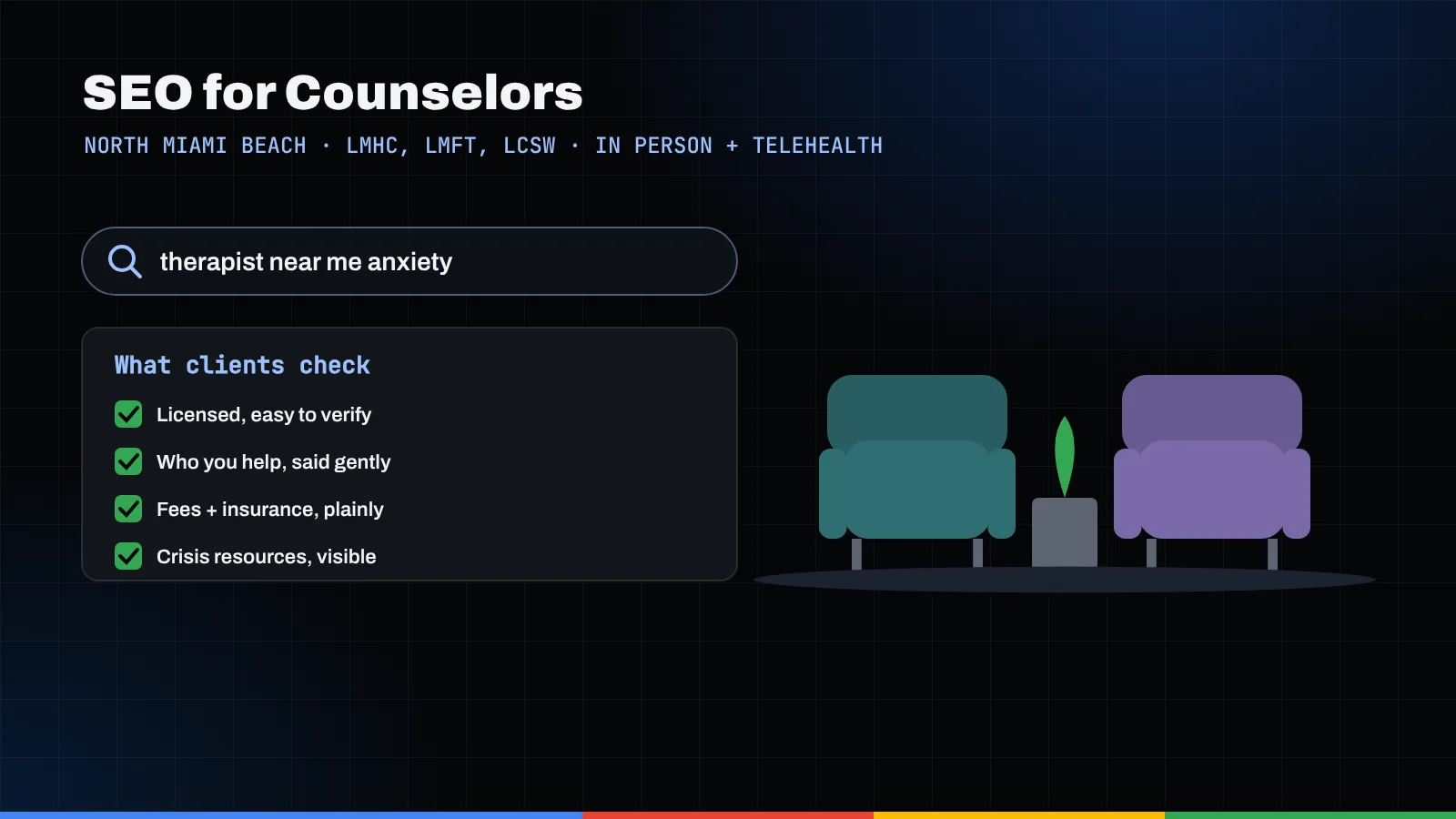
SEO for counselors means helping someone who is having a hard week find a licensed clinician they can trust, without pressure and without promises. For a private practice in North Miami Beach, that comes down to an accurate Google Business Profile, a page for each clinician with their Florida license title, plain-language pages for the concerns you actually treat, crisis resources on every page, and review habits that respect your ethics code and HIPAA.
Key takeaways
- Florida's chapter 491 requires LCSWs, LMFTs and LMHCs to show their full title or its abbreviation on promotional materials that name them, which includes your website and ads.
- Google allows a clinician who sees clients directly to have their own profile, but a therapist working from home should hide that address, and a mailing-only virtual office isn't eligible.
- The ACA and NASW codes of ethics both say not to solicit testimonials from current clients, so a counselor's review plan looks nothing like a restaurant's.
- A review reply that confirms someone is a client can be a HIPAA problem. HHS has settled with a practice over exactly that.
- Write for people in distress: short sentences, clear next steps, honest fees, and a visible link to the 988 Suicide & Crisis Lifeline.
Before the first session: how people search when they're struggling
Most people don't type "licensed mental health counselor" into Google. They type what hurts. "Can't sleep, mind racing." "How to stop fighting with my husband." "Therapist who speaks Spanish near me." Sometimes at 2 a.m., sometimes on a lunch break with the door closed, usually on a phone.
That shapes everything about SEO for counselors. Your site isn't trying to impress anyone. It is trying to be the calm, clear page a person lands on when they are tired, anxious or unsure whether therapy is even for them. Good therapist SEO is mostly good listening, written down.
To keep things concrete, imagine a hypothetical group practice we'll call Tidewren Counseling: an LMHC, an LMFT and an LCSW in North Miami Beach, offering in-person and telehealth sessions in English and Spanish. Tidewren isn't real, and nothing here describes results for anyone. Here is how it might map what people are living through to what they search and the page that should meet them:
| What someone may be going through | What they might search | Page to build |
|---|---|---|
| Worry that won't switch off, trouble sleeping | "anxiety therapist north miami beach," "therapy for anxiety near me" | Anxiety counseling page in everyday language |
| A relationship under strain | "couples counseling near me," "marriage counselor miami" | Couples therapy page naming the LMFT who leads it |
| Grief after a loss | "grief counselor near me," "how to cope with losing a parent" | Grief counseling page plus a gentle article on early grief |
| Wanting care in their first language | "terapeuta en español north miami beach" | Spanish versions of core pages, written or reviewed by a fluent clinician |
| A packed schedule or limited mobility | "online therapist florida," "telehealth counseling" | Telehealth page explaining who you can see and how sessions work |
| Unsure therapy is worth it, worried about cost | "how much does therapy cost," "does insurance cover counseling" | Fees and insurance page with plain answers |
| A teenager who seems withdrawn or is struggling at school | "teen therapist near me," "counselor for my teenager" | Teen and family page written for parents |
Notice the first column describes experiences, not diagnoses. Your pages should too. People recognize themselves in "trouble sleeping" long before they recognize a clinical label.
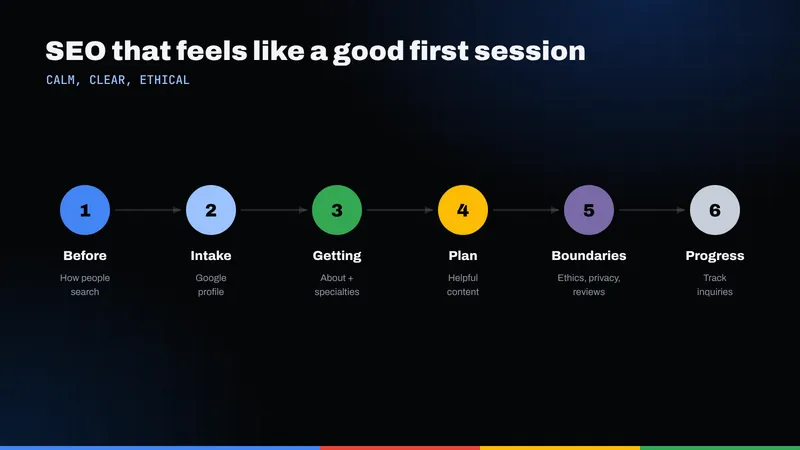
Intake: setting up the Google profile
For a local practice, the Google Business Profile is often the first thing a person sees, before your website. Treat it like an intake form: every detail should be accurate.
Practice profile, practitioner profile, or both
Google's guidelines for representing your business address individual practitioners directly. A practitioner can have their own profile if they work in a public-facing role and can be reached directly at the verified location during stated hours; support staff shouldn't. Where several practitioners share a location, the organization gets its own profile, and each practitioner's profile title should include only their name.
For a solo clinician working under a practice brand, Google says it's best to share one profile with the organization, named "[brand]: [practitioner name]." A one-person Tidewren would follow that pattern with a single profile.
Two more rules matter for therapists. A practitioner shouldn't create multiple profiles to cover different specializations. And the name must match your real-world name; tacking on "Anxiety Therapy North Miami Beach" counts as unnecessary information and can get a profile suspended.
Home offices and privacy
Many clinicians see clients by telehealth from home. Google says a service-area business should hide its address, using the example of a business run from a residence. It also says a rented mailing address you don't operate from, a virtual office, isn't eligible for a profile.
- If you see clients in a real office, show that address and keep your hours accurate.
- If you work only from home, don't publish your home address, and read the guidelines carefully before creating a profile for a telehealth-only practice.
- Don't rent a mailbox to get a pin on the map. It isn't eligible and puts the profile at risk.
Clinician's note: Your safety counts too. Keeping your home address off the internet is a reasonable boundary, not a marketing compromise.
From there, fill in services, write a plain description and add real photos of the office, never of clients. Our guide to the Google Business Profile in North Miami Beach walks through each field, and our Google Maps SEO work focuses on this layer.
Florida license titles belong on every clinician page
Florida licenses clinical social workers, marriage and family therapists and mental health counselors under chapter 491 of the Florida Statutes, through the Board of Clinical Social Work, Marriage and Family Therapy, and Mental Health Counseling.
Section 491.0149 is easy to miss. It requires licensees to display their license where they practice, and it requires LCSWs, LMFTs and LMHCs to include their full title or abbreviation on promotional materials that name them. Registered interns and provisional licensees must use their own titles. A website bio, a directory listing and an ad that names a clinician are all promotional materials, so the title goes on each one.
- Write names consistently, such as "Inés Calloway, LMHC" for a clinician we'll imagine at Tidewren.
- If a team member is a registered intern, use the intern title. Don't round it up.
- Consider listing license numbers. Florida's Department of Health runs a public license verification search, and making it easy for a careful client to look you up builds trust.
This is general information, not legal advice. If you're unsure how a rule applies to a specific ad, ask the board or a health care attorney before publishing.
Getting to know you: about and specialty pages
Choosing a therapist is personal. People want to know who you are, how you work and whether they will feel safe with you.
One page per clinician
Give each clinician a real bio page, not a paragraph on a team grid. Include their license title, who they work with, the concerns they focus on, approaches they're trained in (explained in a sentence anyone can follow), languages, whether they see clients in person, by telehealth or both, and a short note in their own voice about what a first session is like.
One page per concern you actually treat
Build specialty pages only for work your clinicians are trained to do, and name who does it. Don't build a page for a concern nobody on staff treats just because people search for it.
A gentle shape works well: what this can feel like, how therapy might help, what working together looks like, who on the team does this work, and how to reach out. Avoid promising outcomes. "Therapy helps many people feel more able to cope" is honest. "Overcome anxiety in eight sessions" is not.
Clinician's note: Read each page aloud as if a client were sitting across from you. If a sentence would sound like a sales pitch in the room, it will sound that way on the screen.
Design matters as much as words. Readable contrast, large tap targets, a short form and a visible phone number all lower the effort it takes to reach out. Our website design team builds with that low-friction path in mind.
Treatment plan: content that helps before anyone books
A treatment plan has goals, steps and a way to check progress. Your content can work the same way.
- Start with practical pages. Fees, insurance, cancellation policy, what happens at intake and how telehealth works. These answer the questions that quietly stop people from booking.
- Then write gentle explainers. "What's the difference between an LMHC, an LMFT and an LCSW?" "What to expect in your first session." "How to suggest couples counseling to your partner." Keep each accurate, kind and readable on a phone.
- Link explainers to the people who do the work, so every reader has a clear next step.
Bilingual and telehealth pages
North Miami Beach is a multilingual city, and many people would rather talk about hard things in their first language. If your clinicians offer sessions in Spanish, Haitian Creole, Russian or another language, give those services real pages, not machine translations. Our guide to Spanish and multilingual SEO in North Miami Beach covers the technical setup.
For telehealth, say where clients need to be located during sessions. Florida has written the Professional Counselors Licensure Compact into section 491.017, and the compact says counselors practicing under it follow the laws of the state where the client is located. Until you've confirmed with the board what your license allows today, describe telehealth as available to clients in Florida.
A safety net on every page
Some people who find a therapy website are in crisis. Your site should never make them dig for help.
Put a short, calm crisis note in the footer of every page and on your contact page. The 988 Suicide & Crisis Lifeline can be reached by calling or texting 988 or by online chat, and it says it is available 24/7 and that conversations are free and confidential. A line such as "If you are in crisis or thinking about suicide, call or text 988, or call 911 in an emergency" is enough.
Also tell people on your contact form how quickly you usually reply and that it isn't monitored for emergencies, and repeat the crisis line in auto-reply emails and your voicemail greeting.
Clinician's note: This isn't an SEO tactic. It's duty of care, visible on your website.
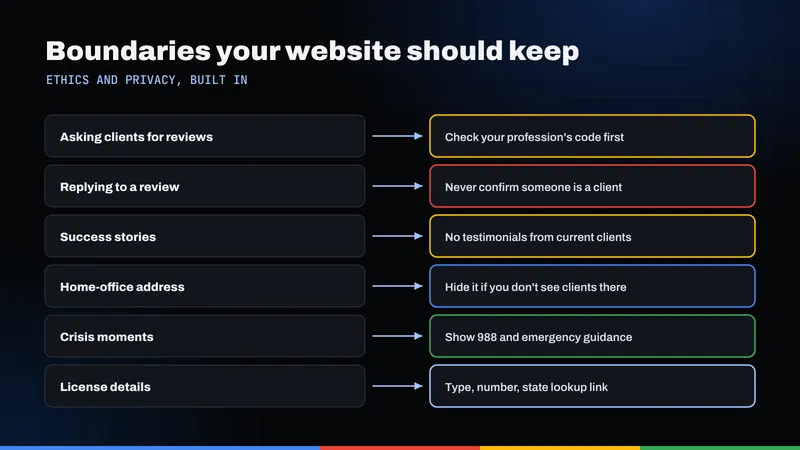
Boundaries: ethics, privacy and reviews
Reviews help most local businesses in maps. For counselors, they come with limits that matter more than rankings.
What the ethics codes say
The 2014 ACA Code of Ethics, standard C.3.b, says counselors who use testimonials do not solicit them from current clients, former clients or others who may be vulnerable to undue influence, and get permission before using any testimonial. The NASW Code of Ethics, standard 4.07, says social workers should not solicit testimonial endorsements from current clients or others vulnerable to undue influence. LMFTs should check the AAMFT code and any other code that binds them.
- Don't ask clients for reviews, in session, by email or on intake paperwork.
- Do make your profile easy to find for anyone who chooses to review you, for example with a link in your site footer.
- Put your energy into what you control: a complete profile, accurate details and strong pages.
Replying without breaking confidentiality
A reply that confirms someone was in treatment discloses something private, even if the review was kind. HHS's Office for Civil Rights announced a $23,000 settlement with a dental practice in December 2022 after it disclosed patient information while responding to online reviews, and stated that this practice is illegal under HIPAA.
A safer pattern neither confirms nor denies a relationship: "Thank you for sharing this. We can't discuss anyone's care online, but we'd welcome a call to our office if there's something we can help with." Use the same calm wording for positive and negative reviews.
Clinician's note: Privacy extends to analytics and forms. Ask whoever handles your compliance which tracking tools and form providers are appropriate on pages where people describe symptoms.
Structured data for a counseling practice
Schema markup helps search engines read the facts on your pages. On schema.org, MedicalBusiness is a type of LocalBusiness with more specific subtypes, including Psychiatric, which describes the branch of medicine concerned with mental illness.
For a counseling practice without psychiatrists, our view is that the general MedicalBusiness type is the more honest fit. Mark up the practice name, address (only for a public office), phone, hours and URL, add Person markup on each clinician page, and match every value to what's visible on the page and on your Google profile. Our explainer on how schema helps search engines covers the basics.
Progress: tracking what matters, gently
You measure client progress against goals, not vanity numbers. Do the same with search.
- Google Business Profile insights: calls, website clicks and direction requests over time.
- Search Console: which queries reach your specialty and bio pages, and whether bilingual pages are being found.
- Inquiries by source: an optional "How did you hear about us?" question at intake.
- Fit, not just volume: if more inquiries come from people your team isn't trained to help, a page needs clearer wording.
Review quarterly, change one or two things and give them time. Anyone who promises a specific ranking or number of new clients is promising something no one controls. Our post on SEO KPIs for North Miami Beach businesses explains which measures are worth watching.
If you'd like a second set of eyes, Ribacoff Enterprises offers local SEO for practices across Miami-Dade. If you've been reading about local SEO in Miami, or SEO in Miami generally, remember that for a therapy practice the neighborhoods around your office usually matter more than the whole metro; our North Miami Beach SEO page explains how we work close to home. You can also request a free audit of your profile and site, handled as discreetly as you'd expect.
Frequently asked questions
What is SEO for counselors?
It is the work of helping people looking for therapy find your practice in Google search and maps. For counselors, that means an accurate Google Business Profile, clinician pages with license titles, clear pages for the concerns you treat, honest fee information, crisis resources on every page and review habits that fit your ethics code.
Does each therapist in a group practice need their own Google Business Profile?
Not necessarily. Google allows a public-facing practitioner who can be reached at the verified location during stated hours to have a profile titled with only their name, separate from the practice profile. For a solo practitioner working under a brand, Google says it's best to share one profile named "[brand]: [practitioner name]."
Can I list my home address if I see clients by telehealth from home?
You shouldn't publish it. Google's guidelines say a service-area business should hide its address, including a residential one, and that a rented mailing address you don't work from isn't eligible. Read the guidelines carefully before creating a profile for a telehealth-only practice.
Do I have to include my license title on my website in Florida?
Section 491.0149 of the Florida Statutes requires licensed clinical social workers, marriage and family therapists and mental health counselors to include their full title or its abbreviation on promotional materials that name them, with similar rules for interns and provisional licensees. Treat bios, directory listings and ads as promotional materials.
Can I ask my clients to leave Google reviews?
The ACA Code of Ethics says counselors do not solicit testimonials from current or former clients or others vulnerable to undue influence, and the NASW Code says social workers should not solicit testimonial endorsements from current clients. Check your own code, and when you reply to any review, don't confirm that the person is or was a client.