SEO for dermatologists works best as a head-to-toe exam of your online presence: a homepage that proves who your physicians are, a correctly structured Google Business Profile, one page for each condition and procedure, consistent directory and insurance listings, and a steady review and tracking routine. For a North Miami Beach practice, that also means keeping medical dermatology clearly separate from cosmetic marketing and following Florida and HIPAA rules on credentials, photos and patient privacy.
Key takeaways
- Google gives extra weight to trust signals on health topics, so named physician authors, real credentials and links to verification tools matter more for a dermatology site than for most businesses.
- In Florida, a physician may only advertise as a "board-certified specialist" with recognition from an ABMS member board or another agency the Board of Medicine approves.
- The practice and each public-facing dermatologist can have Google Business Profiles, but one doctor should not get several profiles for different specialties.
- Build a separate page for each condition and procedure, and write skin cancer content that educates and points to a visit, never one that diagnoses.
- Before and after photos and patient stories used in marketing generally need the patient's written HIPAA authorization, and review replies should never confirm someone is a patient.
Why approach dermatology SEO like a full-body skin check?
A good skin check is systematic. The dermatologist starts at the scalp, works down, and doesn't skip the spots patients forget, like the soles of the feet.
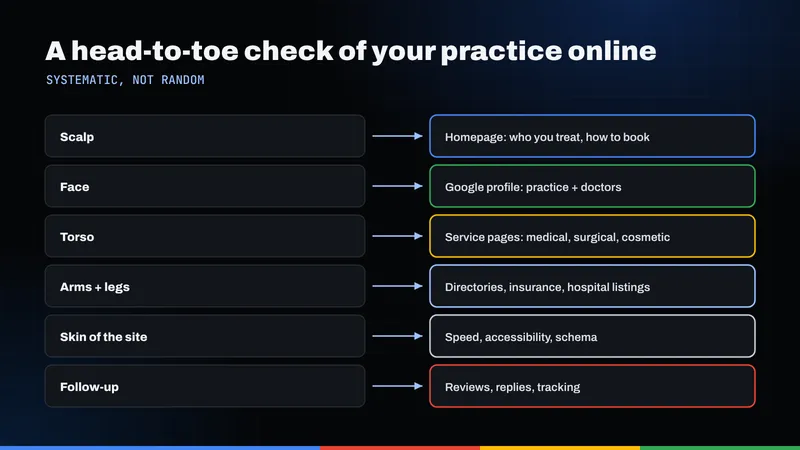
Dermatology SEO deserves the same method. A practice can have a polished website and still be missing from the map pack, or rank for "dermatologist near me" while its Mohs page sits unindexed. So this guide moves from the top down:
- Scalp: the homepage and physician bios
- Face: your Google Business Profile
- Torso: service and condition pages
- Extremities: directories, insurance listings and photos
- Follow-up: reviews, schema and tracking
The scope here is a physician-led practice: medical dermatology, skin cancer screening and Mohs surgery, pediatric dermatology, and cosmetic dermatology alongside. If your business is mainly aesthetic treatments, our guide to med spa SEO in North Miami Beach is the better fit. The two audiences search differently, and mixing them up hurts both.
Clinical note: Nothing in this article is medical advice. The skin-check framing is a way to organize marketing work, not a description of how to examine skin.
The ABCDE checklist for dermatology SEO (a playful mnemonic)
Dermatologists teach patients the ABCDEs of melanoma. We borrowed the shape of that idea for a marketing checklist, and we want to be clear about the borrowing: the letters below are an SEO memory aid only. The real ABCDEs, which describe warning signs in moles, are explained by the American Academy of Dermatology, and that is the page your patients should read.
- A is for Authorship. Every medical page names a physician author or reviewer with real credentials.
- B is for Business Profile. The practice and its doctors are set up on Google the way Google's guidelines describe.
- C is for Condition pages. Each condition and procedure gets its own focused page.
- D is for Directories. Your name, address, phone, hours and insurance details match everywhere.
- E is for Evolving. You track results, refresh content and keep up with reviews, because nothing stays the same for long.
Run through them once a quarter, and start with whichever letter looks "irregular."
Scalp: does your homepage prove who your doctors are?
Why trust carries extra weight on health topics
Google's guidance on creating helpful, reliable content describes E-E-A-T (experience, expertise, authoritativeness and trust) and says that of these, trust is the most important. It also explains that Google's systems give even more weight to strong E-E-A-T for "Your Money or Your Life" topics, the ones that could significantly affect people's health, financial stability or safety. Skin cancer, eczema in infants and prescription acne treatment all sit squarely in that category.
The same guidance asks whether pages carry a byline where readers would expect one and warns that fabricating creator profiles is a form of deception. For a dermatology site, the practical takeaway is simple: real doctors, real names, real credentials.
What a strong physician bio includes
- Full name and degree (MD or DO)
- Board certification, stated precisely and only if current
- Medical school, residency and any fellowship, such as Mohs surgery or pediatric dermatology training
- Florida license information, or a link where patients can look it up
- Clinical focus areas written in plain English
- Languages spoken, if the doctor sees patients in those languages
Let patients verify, and be precise about "board certified"
Confident practices make verification easy. The American Board of Dermatology offers a public search on its homepage under "Is My Dermatologist Board Certified?", where patients can look up a doctor by name or NPI. For licensing, the Florida Department of Health's MQA license verification portal lets anyone search by profession, name or license number. Linking to both from your "About our doctors" page costs nothing and signals that you have nothing to hide.
Wording matters here. Under section 458.3312 of the Florida Statutes, a physician licensed under chapter 458 may not hold himself or herself out as a board-certified specialist without formal recognition from a specialty board of the American Board of Medical Specialties or another recognizing agency approved by the board. The same section allows a physician to describe the services offered and to say the practice is limited to certain services, as long as that accurately reflects the physician's scope. The American Board of Dermatology is one of the ABMS member boards.
So a headline like "Board-Certified Dermatologists" is only accurate if every physician it covers holds that certification, and nurse practitioners and physician assistants should be listed under their own correct titles. Have your healthcare attorney review any wording you're unsure about.
Clinical note: Put the medical reviewer's name and a "last reviewed" date on every condition page. It's a small detail that answers the question a careful patient is silently asking.
Face: is your Google Business Profile set up correctly?
For "dermatologist near me" and similar searches, many patients meet you on the map before they ever see your website. Your Google Business Profile is the face of the practice.
Practice profiles and doctor profiles
Google's guidelines for representing your business cover individual practitioners such as doctors directly. A practitioner can have a dedicated profile if they work in a public-facing role and can be contacted at the verified location during stated hours. When several practitioners share a location, the organization gets its own profile separate from theirs, and each practitioner's profile title includes only the practitioner's name.
A few other rules that come up often in dermatology:
- Solo dermatologist at a branded practice: Google says to create a single profile named in the format "[brand]: [practitioner name]" rather than two competing profiles.
- One doctor, many specialties: A practitioner shouldn't have multiple profiles to cover different specializations. Your Mohs surgeon doesn't get a second profile for cosmetic work.
- Support staff: Google says support staff should not create their own profiles.
- Departments: Publicly facing departments that operate as distinct entities, such as a hospital's department of dermatology, may have their own profiles with distinct names.
Categories, services and the name field
Choose the primary category that best describes the practice, then list services that match the pages on your site. Keep the business name as it appears in the real world, without stuffing in "skin cancer" or "Botox." Our Google Business Profile guide for North Miami Beach covers photos and hours, and our Google Maps SEO service handles the ongoing work for practices that would rather not.
Torso: do you have a page for every condition and procedure?
A single "Services" page listing twenty treatments gives Google little to rank and patients little to read. One focused page per condition or procedure works much better.
Here's how that maps out for a full-service practice. The search phrases are illustrative; check them against your own keyword research.
| Condition or service | What patients search | Page to build |
|---|---|---|
| Skin cancer screening | "skin check near me," "mole check dermatologist" | Skin cancer screening page explaining what a visit involves and how to book |
| Mohs surgery | "Mohs surgeon," "Mohs surgery recovery" | Mohs surgery page with the surgeon's training, what to expect on the day and aftercare |
| Acne | "acne dermatologist," "adult acne treatment" | Acne treatment page covering evaluation and treatment approaches in general terms |
| Eczema and psoriasis | "eczema doctor," "psoriasis specialist" | Separate pages for each condition, written for patients living with them long term |
| Pediatric dermatology | "pediatric dermatologist," "baby eczema doctor" | Pediatric page written for parents, with ages seen and what to bring |
| Rashes, hair loss and nail problems | "hair loss dermatologist," "nail fungus doctor" | Individual condition pages, linked from a general medical dermatology hub |
| Cosmetic dermatology | "Botox dermatologist," "laser treatment for sun spots" | Cosmetic section with its own pages, clearly separated from medical services |
Writing skin cancer content without diagnosing
Skin cancer pages carry the most weight and the most risk. Patients often arrive worried, so the goal is to be calm, accurate and useful, then point them toward an appointment.
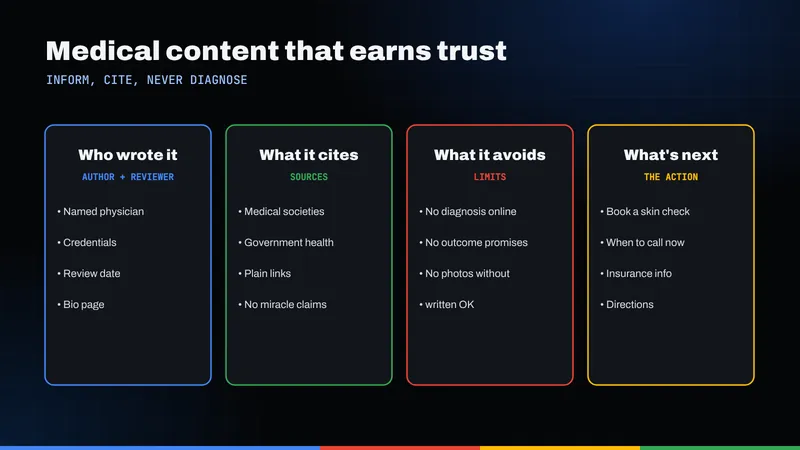
- Educate, don't diagnose. Explain what a screening visit involves. Avoid copy that implies a reader can rule anything in or out from a web page.
- Link to authoritative sources. Point readers to resources like the AAD's patient pages rather than paraphrasing medical criteria in your own words.
- Make the next step obvious. A visible phone number and booking link near the top, not buried in the footer.
- Avoid outcome promises. Don't claim cure rates or results you can't document, and don't imply every patient will have the same experience.
Clinical note: If the copy would alarm a nervous patient or overpromise to them, revise it.
How do you keep medical dermatology separate from med spa marketing?
Many dermatology practices offer both medical and cosmetic care. The two should read like different departments on your website.
Medical dermatology patients are often referred, insured and anxious. They want to know whether you take their plan, how soon they can be seen and whether the doctor is qualified. Cosmetic patients tend to be comparison shopping and care about galleries and who performs the treatment.
When a site blends them, promotional language seeps into skin cancer pages and patients looking for a psoriasis appointment hit a banner about filler specials. That undercuts the trust Google's guidance asks for.
- Give cosmetic services their own section and navigation path.
- Keep pricing promotions, packages and seasonal offers out of medical pages.
- State clearly who performs each cosmetic treatment and their credentials.
For aesthetics-focused businesses that aren't dermatology practices, the strategy shifts considerably, and we cover it in the med spa guide mentioned above. If your practice also includes other specialties under one roof, the broader dental and medical SEO guide for North Miami Beach covers multi-specialty basics.
Extremities: are your directories and insurance details consistent?
Directories are where dermatology SEO most often goes quietly wrong. Patients find doctors through insurer directories, hospital pages, health directories and map apps, and those listings drift out of sync with your site.
What to check
- Name, address and phone: identical everywhere, including suite numbers.
- Doctor-level listings: each physician's listing points to the correct location and a page about that doctor, not a generic homepage.
- Departed doctors: remove or update listings for physicians who have left, so patients aren't booking with someone who isn't there.
- Insurance: list only the plans you actually accept, note if acceptance differs between medical and cosmetic services, and show when the list was last updated.
- Languages: if your physicians see patients in Spanish, Haitian Creole, Russian or other languages, say so consistently. Our multilingual SEO guide for North Miami Beach explains how to build pages in those languages properly.
Clinical note: Sweep your directories twice a year and whenever a doctor joins or leaves.
Can you use before and after photos and patient stories?
Photos are powerful marketing for cosmetic dermatology, and one of the easiest ways to create a privacy problem.
The HHS guidance on marketing under the HIPAA Privacy Rule says that, with limited exceptions, the rule requires an individual's written authorization before their protected health information can be used or disclosed for marketing. A patient's treatment photo used to promote your practice is health information about that patient, so the safe path is a signed HIPAA-compliant authorization before anything is posted.
A practical photo and testimonial routine
- Get a written authorization that names the specific use (website, social media, ads) before publishing.
- Honor revocations quickly, and remove the images everywhere they appear.
- Apply the same rule to written testimonials and video stories, not just photos.
Have your privacy officer or healthcare attorney approve the authorization form itself.
Follow-up: how should you handle reviews and track progress?
HIPAA-safe review replies
Reviews influence both rankings and patient choice, so ask for them consistently after visits. When you reply, the rule is strict: don't confirm the reviewer is a patient and never mention diagnoses, procedures, appointment details or results, even when the reviewer has shared those details publicly. A safe reply thanks the person, says the practice takes feedback seriously and invites them to call the office directly. Give staff two or three approved templates.
Schema markup for dermatology
Structured data helps search engines understand what each page represents. Schema.org includes a Dermatology type, which sits under MedicalBusiness and also serves as a value in the MedicalSpecialty list. MedicalClinic and Physician are related types, and both support a medicalSpecialty property, so a clinic page can declare Dermatology as its specialty. Physician also supports properties such as hospitalAffiliation and usNPI for individual doctor pages. Mark up only what's visible and accurate. Our explainer on how schema helps search engines covers the basics.
What to track
Track calls and bookings from each Google profile, organic visits and conversions per condition page, new reviews and response time, and directory accuracy. Our post on SEO KPIs for North Miami Beach businesses explains how to set up these measurements without drowning in dashboards.
When does it make sense to bring in help?
Some practices handle this in-house; others would rather keep doctors and staff focused on patients. Practices drawing patients from across the county may want broader local SEO in Miami too; the fundamentals of SEO in Miami are the same exam on a bigger map. Ribacoff Enterprises is based in North Miami Beach and provides local SEO, Google Maps optimization, website design and content for healthcare practices. You can learn more about how we approach the city on our North Miami Beach SEO page.
If you'd like a second opinion on your own practice, we'll go through the full head-to-toe checklist with you. Request a free SEO audit and we'll show you what looks healthy and what needs attention.
Frequently asked questions
Should each dermatologist in our practice have a Google Business Profile?
Google allows profiles for public-facing practitioners who can be contacted at the verified location during stated hours. The practice keeps its own separate profile, each doctor's profile uses only the doctor's name, and a solo dermatologist at a branded practice uses one profile named "[brand]: [practitioner name]." A doctor shouldn't have multiple profiles for different specialties.
Can our website say "board-certified dermatologists"?
Only if it's accurate for every physician the claim covers. Florida's section 458.3312 says a physician may not hold out as a board-certified specialist without recognition from an ABMS specialty board or another agency approved by the Board of Medicine. Link to the American Board of Dermatology's public search so patients can verify.
How should we write about skin cancer on our website?
Explain what a screening visit involves, link to authoritative patient resources like the American Academy of Dermatology, and make booking easy. Avoid copy that invites self-diagnosis, avoid outcome promises, and have a physician review each page and note the review date.
Do we need patient permission to post before and after photos?
Generally, yes. HHS guidance says the HIPAA Privacy Rule requires a patient's written authorization, with limited exceptions, before their protected health information is used for marketing. Get a signed authorization that covers each specific use, and remove images promptly if a patient revokes it.
How do we reply to a negative review without violating HIPAA?
Don't confirm the reviewer is a patient and don't mention diagnoses, procedures or appointment details, even if the reviewer did. Thank them, say you take feedback seriously and invite them to call the office privately. Use pre-approved reply templates for consistency.