Good SEO for optometrists works like a comprehensive eye exam: test whether patients can find you, focus each page on one search, check the edges (insurance listings and directories), then confirm the practice looks trustworthy and compliant. For a North Miami Beach practice, that means a correctly built Google Business Profile, one page per service, honest vision-plan information, verifiable licenses and content that respects Florida and FTC rules.
Key takeaways
- Google lets public-facing optometrists have their own Business Profiles, but the practice keeps a separate one, and a solo doctor at a branded practice shares a single profile.
- Give each service its own page: eye exams, contact lens fittings, pediatric exams, dry eye care and the optical shop.
- List only the plans you actually accept, and keep the list current everywhere.
- Florida requires trade-name communications to include the optometrist's licensed name, and any free or discounted exam ad needs the 72-hour disclosure in capital letters.
- The FTC's Eyeglass and Contact Lens Rules require automatic prescription release, so your website copy should never suggest otherwise.
Why approach SEO for optometrists like an eye exam?
An eye exam moves in order: how well someone sees, the prescription, the edges of the visual field, then the health of the eye.
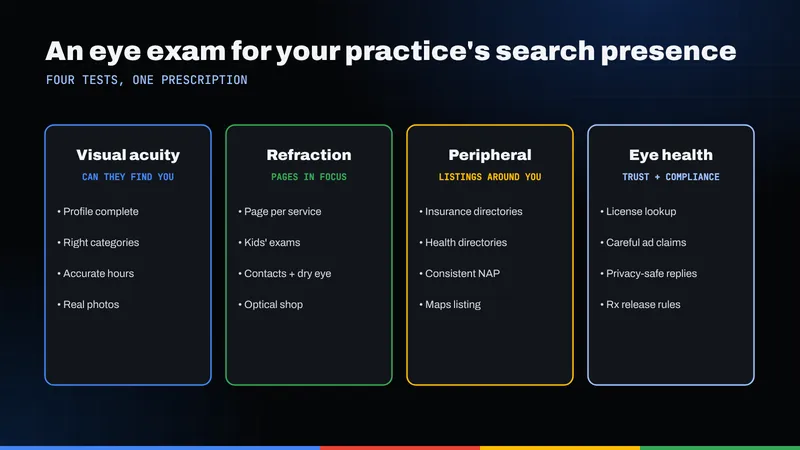
Search visibility breaks down the same way. A practice can have a lovely website and be invisible on the map, or rank on the map and still lose patients because their vision plan isn't listed. So this guide follows four stages: visual acuity (can people find you), refraction (are pages focused on the right searches), peripheral vision (directories and insurance listings) and eye health (trust and compliance).
If you run a general health practice as well, our post on dental and medical SEO in North Miami Beach covers the broader healthcare basics.
Prescription: Search for your practice on a phone, the way a patient would, and note what you see.
Visual acuity: can nearby patients find your practice?
For most eye care searches, patients see the map before any website, so your Google Business Profile is the first test.
Practice profiles and practitioner profiles
Should each optometrist have a profile? Google's Business Profile guidelines answer it directly. An individual practitioner can have a dedicated profile if they work in a public-facing role and can be contacted directly at the verified location during stated hours. Support staff should not create their own profiles, and a practitioner should not have several profiles to cover different specialties.
How you set it up depends on the shape of the practice:
- Several optometrists at one location: the practice gets its own profile for that location, and each doctor's profile uses only the doctor's name, not the practice name.
- One optometrist at a branded practice: the doctor and the practice share one profile, named in the format "[brand]: [practitioner name]."
Getting the details right
Google's guidelines also ask that the business name match the name you use in the real world, on your signage and stationery. Adding "Best Eye Doctor Miami" to the name is a guideline violation. Beyond the name, focus on:
- A primary category that describes the core of the practice, with additional categories only for services you truly offer.
- Accurate hours, including separate optical shop hours if they differ.
- A booking link that goes straight to scheduling, and real photos of the office and frame displays.
Our Google Business Profile guide for North Miami Beach covers setup step by step, and our local SEO service can manage it for you.
Prescription: Audit every profile at your address, remove duplicates and staff profiles, and match the name to your signage.
Refraction: are your pages focused on the right searches?
Refraction narrows a blurry image into a sharp one, lens by lens. A single page listing "eye exams, contacts, glasses, dry eye, kids" in one paragraph is a blurry image: Google can't tell which search it answers, and patients can't find what they came for. Optometry SEO works better with one page per service, built around the questions patients bring with them:
| Service | What patients search | Page to build |
|---|---|---|
| Comprehensive eye exams | "eye exam near me," "optometrist North Miami Beach," "eye doctor open Saturday" | What happens, how long, what to bring, booking |
| Contact lens fittings | "contact lens exam," "contacts for astigmatism," "first time contacts" | Fittings, follow-ups, lens types, prescription release |
| Pediatric eye exams | "kids eye exam," "children's eye doctor near me," "school vision check" | For parents: ages seen, how the exam adapts, how to prepare |
| Dry eye care | "dry eye treatment," "dry eye doctor," "eyes burning and watery" | How you evaluate symptoms and options offered, no promises |
| Eyewear and optical shop | "eyeglasses store near me," "designer frames," "prescription sunglasses" | Frames, lens options, fitting, adjustments, shop hours |
| Vision and medical insurance | "eye doctor that takes my insurance," "[plan name] optometrist" | Plans you accept and how to confirm benefits |
What a focused page includes
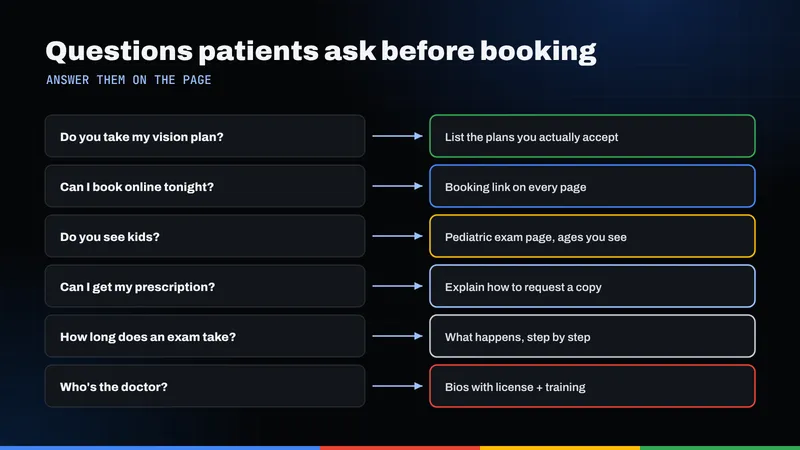
Each page should answer front-desk questions. On a contact lens page: Is a fitting different from a regular exam? Will I get my prescription? On a pediatric page: What's the youngest age you see, and is dilation involved?
Write in the warm, clear voice your doctors use in the exam chair, and don't promise outcomes, especially on dry eye pages. "We'll evaluate your symptoms and talk through options" is honest. "We'll cure your dry eye" is a claim you can't guarantee.
Location without stuffing
North Miami Beach patients come from many backgrounds. If your team speaks Spanish, Haitian Creole, Russian or Hebrew, say so on each service page and in your profile, and consider translated pages. Our multilingual SEO guide covers the setup. Mention the city naturally, in directions and parking notes, not in every sentence.
Prescription: Start with the two services that matter most to your schedule.
Peripheral vision: are insurance listings and directories working for you?
A visual field test catches what a patient misses looking straight ahead. In search, your peripheral vision is everything outside your own site and profile: vision plan directories, insurance directories, health listing sites and local directories. Many patients start there.
The insurance page
An insurance page answers the question that often decides whether a patient books at all. The rule is simple: list the plans you actually accept. Not plans you took years ago, and not plans listed just to attract searches. A patient who finds out at check-in that you're out of network will remember it.
A good insurance page:
- Separates vision plans (routine exams, frames and lenses) from medical insurance (which may apply to medical eye visits such as dry eye or eye infections), if your practice bills both.
- Asks patients to confirm benefits with their plan before the visit.
- Explains how out-of-network benefits or self-pay work, if you offer them.
- Shows a "last updated" date, so patients and your staff know it's current.
Directory consistency
Your practice name, address, phone number and hours should match across your website, Google profile, insurance directories and other listings. An old suite number or a departed doctor confuses patients and search engines alike. Ask each plan how corrections to its directory are made, and make checking them part of someone's job.
Prescription: List every directory that shows your practice, correct doctors, address, phone and plans, and review quarterly.
Eye health: do patients and regulators see a trustworthy practice?
The last part of the exam looks at what the patient never sees. For a practice, that's trust: credentials, accuracy and compliance. Patients notice when a site feels vague, salesy or unverifiable.
Make licenses easy to verify
Every optometrist bio should include the doctor's full licensed name, education, the services they focus on and their Florida license number. Then link to the Florida Department of Health's MQA license verification portal, where anyone can select the Board of Optometry and search by name or license number.
Practice names and trade names
Florida allows brand names, with conditions. Under section 463.014, Florida Statutes, an optometrist practicing under a trade name or service name must include, in information given to consumers, the name under which the practitioner is licensed or the name of their professional association. The same section bars practice names that are, contain or are intended to serve as an affirmation of the quality or competitive value of the optometric services.
- If you operate as, say, "Bayside Eye Studio," include the optometrist's licensed name on the website, in ads and in your Google profile description.
- Avoid brand names built on quality claims, like "Best Vision" or "Top Eye Care."
- Factual information about location and the availability of optometric services is expressly allowed.
Free and discounted exam offers
In Florida, section 456.062 applies to licensees under several chapters, including chapter 463 for optometrists. Any advertisement for a free, discounted fee or reduced fee service, examination or treatment must include this statement in capital letters, clearly distinguishable from the rest of the text:
"THE PATIENT AND ANY OTHER PERSON RESPONSIBLE FOR PAYMENT HAS A RIGHT TO REFUSE TO PAY, CANCEL PAYMENT, OR BE REIMBURSED FOR PAYMENT FOR ANY OTHER SERVICE, EXAMINATION, OR TREATMENT THAT IS PERFORMED AS A RESULT OF AND WITHIN 72 HOURS OF RESPONDING TO THE ADVERTISEMENT FOR THE FREE, DISCOUNTED FEE, OR REDUCED FEE SERVICE, EXAMINATION, OR TREATMENT."
That covers landing pages, profile offer posts, social posts and ads. This is general information, not legal advice; have your attorney or professional association review any offer before it runs.
Prescription: Add license numbers to every bio, pair your brand with a licensed name, and attach the 72-hour statement to every offer.
What do the FTC prescription rules mean for your website copy?
Two federal rules shape what your exam, contact lens and optical pages should say.
The Eyeglass Rule
The FTC's Eyeglass Rule compliance guidance says prescribers must give patients a copy of their eyeglass prescription immediately after a refractive exam, automatically, without waiting to be asked. You can't require a glasses purchase, charge for the copy or demand a waiver. Prescribers with a financial interest in eyewear sales must get written confirmation of receipt and keep it for at least three years, and digital delivery requires the patient's consent.
The Contact Lens Rule
The FTC's Contact Lens Rule guide for prescribers is similar: the prescription goes to the patient at the end of the fitting, even unasked, with no lens purchase, extra fee or waiver required. Prescribers with a financial interest in lens sales need a confirmation of release, collected only after the prescription is handed over.
Turning the rules into helpful content
Patients search questions like "will my eye doctor give me my prescription." Answering plainly is both compliant and reassuring:
- On your eye exam page: "You'll receive a copy of your glasses prescription at the end of your exam, whether or not you buy eyewear from us."
- On your contact lens page: "Your contact lens prescription is yours once the fitting is complete."
- On your optical page: sell on frames, fit and adjustments, never on the idea that patients must buy from you.
Prescription: Search your site for "prescription" and rewrite any sentence that conflicts with automatic, free release.
How should you earn and answer patient reviews?
Reviews shape how patients judge a practice on the map. The limit for optometry: a review reply is a public statement from a HIPAA-covered provider.
Asking for reviews
Ask every patient the same way, at the same point in the visit, with nothing offered in return. Don't offer discounts on frames or contact lens boxes for reviews, don't ask only the patients who seemed happy, and don't have staff stand over patients while they write one.
Replying without disclosing anything
The HHS Office for Civil Rights has acted against providers who revealed patient details in review replies. In a 2023 settlement announced by HHS, a New Jersey provider that disclosed patients' diagnosis and treatment details in responses to negative online reviews paid $30,000 and agreed to a corrective action plan. OCR's director put it plainly: "Simply put, this is not allowed."
A HIPAA-safe reply never confirms the reviewer is a patient or mentions visits, diagnoses or purchases:
- Positive review: "Thank you for taking the time to share this. Our team works hard to make every visit comfortable."
- Negative review: "We take every concern seriously. Please call our office manager at [main number] so we can talk this through privately."
Separately, if you want to feature a patient's story or photo on your website, get the patient's written permission first and have your compliance lead approve the form.
Prescription: Write two or three approved reply templates and share them with whoever manages your profile.
Which schema types fit an optometry practice?
Structured data tells search engines what kind of business a page describes. On the schema.org MedicalBusiness page, both Optician and Optometric appear as more specific types of MedicalBusiness, which itself sits under LocalBusiness.
- Optometric fits the practice itself, the place patients go for exams and fittings.
- Optician fits a retail optical shop, especially one with its own hours or entrance.
- MedicalBusiness is the broader parent type if neither specific type fits.
Whatever type you choose, the details in your markup (name, address, phone, hours, URL) should match your Google profile and the visible page exactly. Schema won't rescue a thin page, but it removes ambiguity. Our post on how schema helps search engines explains the mechanics in more depth.
Prescription: Add validated practice markup to your homepage and contact page, and update it when hours change.
What does a follow-up plan look like?
Good exams end with a recall date, and optometry SEO needs the same habit, because profiles drift, plans change and doctors come and go. A sensible order: fix profiles and listings first, then service and insurance pages, then bios, prescription copy and disclosures, then schema and a review routine. After that, recheck insurance lists, directories and hours every quarter.
If your practice also draws patients from across Miami-Dade, the wider local SEO Miami picture matters too; our Miami SEO page covers that broader market, and our North Miami Beach SEO page explains how we approach the city itself. If you'd like a second set of eyes on your profile, pages and listings, request a free SEO audit and we'll walk through what we find.
Prescription: Put a quarterly "listings and insurance check" on the calendar now, assigned to a named person.
Frequently asked questions
Should each optometrist in our practice have a Google Business Profile?
Google allows profiles for public-facing practitioners who can be reached at the verified location during stated hours. The practice keeps its own profile, each doctor's profile uses only the doctor's name, support staff don't get profiles, and a solo optometrist at a branded practice shares one profile named "[brand]: [practitioner name]."
Can our insurance page list every vision plan patients ask about?
No. List only the plans you actually accept, separate vision plans from medical insurance if you bill both, and show when the page was last updated. An outdated list leads to surprised patients at check-in and confusion in insurance directories.
Can a Florida optometrist advertise a free eye exam?
Florida's section 456.062 applies to optometrists and requires any ad for a free, discounted or reduced-fee service or exam to include a capital-letter statement about the right to refuse or be reimbursed for other services within 72 hours. Have your attorney review any promotion before it runs.
What should our website say about prescriptions?
Under the FTC's Eyeglass and Contact Lens Rules, patients receive their prescriptions automatically after a refractive exam or completed fitting, without buying anything, paying extra or signing a waiver. Say so plainly on your exam and contact lens pages, and remove any copy that suggests otherwise.
How do we reply to a negative review without violating HIPAA?
Don't confirm the reviewer is a patient and never mention appointments, diagnoses, prescriptions or purchases. Thank them, say you take concerns seriously and invite them to call the office privately. HHS has settled with a provider that disclosed patient details in review replies.