SEO for orthodontists works when your online presence answers the questions a worried parent or a cautious adult asks before booking a consultation. That means a correctly set up Google Business Profile, a plain-spoken page for each treatment, credentials anyone can check, and reviews you earned honestly. In Florida it also means writing within the dental advertising statute, which limits "best" claims, promised results and loose use of the word "specialist."
Key takeaways
- Orthodontic patients research in stages. Map each stage, from the first search to the consultation, to a page or listing that answers it.
- Follow Google's practitioner rules: the practice gets its own profile, an orthodontist's profile uses only their name, and support staff don't get profiles.
- Treatment pages for braces, aligners, retainers and early treatment should explain, not promise. Florida law bars ads that create unjustified expectations of favorable results.
- Back every credential with something a parent can verify: residency training, board certification status and a Florida license lookup.
- Get written patient authorization before using photos or stories in marketing, and never buy, filter or fake reviews.
Who is actually searching for an orthodontist?
Most orthodontic searches start with a small worry, not a shopping list. Here are two hypothetical people, composites of questions every orthodontic office hears. Neither is a real patient or client.
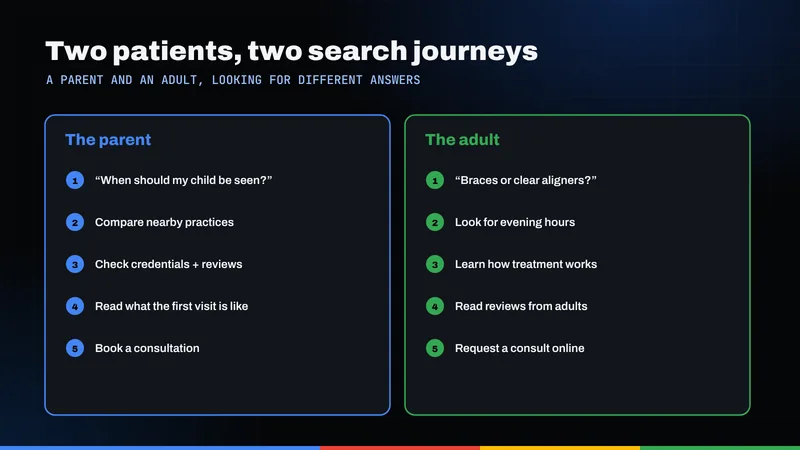
Imagine a parent we'll call Dana. Her daughter's dentist mentioned crowding and suggested "getting an ortho opinion." That evening, Dana searches on her phone. Does her child need treatment now or later? Is the office good with nervous kids? How does payment work? Can visits fit around school pickup? She won't call the first office she sees.
Now imagine an adult we'll call Marcus. He wore braces as a teenager, skipped his retainer, and his front teeth have shifted. He wonders whether a local orthodontist offers clear aligners, whether he'd be the oldest patient in the waiting room, and whether a consultation commits him to anything.
Both follow roughly the same consultation journey: a map search, the listing and reviews, the website, a check on the doctor, then a call or booking form. Good orthodontist SEO makes sure each step has a clear, honest answer waiting. If you want the city-level view of how we approach this market, our North Miami Beach SEO page covers it. Our earlier post on dental and medical SEO in North Miami Beach covers the general health-practice basics, like provider pages and responding to reviews without disclosing patient details. This guide stays on what is specific to orthodontics.
What should a parent see on your Google Business Profile?
For Dana, the first impression is usually the map pack. A few orthodontic-specific settings matter more than most.
Pick the category that matches what you actually do
Google's Business Profile guidelines say to choose the fewest categories it takes to describe your core business, and to make them as specific as possible while still representing your main business. For an office that only does orthodontics, that points to an orthodontic category rather than a general dental one. A general dental office that offers aligners as one service shouldn't present itself to Google as an orthodontic practice. Accuracy here also keeps you consistent with the Florida advertising rules covered below.
Follow the practitioner rules
Many orthodontic offices have more than one doctor. Under the same guidelines:
- A practitioner can have their own profile only if they are public-facing and can be reached at the verified location during stated hours.
- When several practitioners work at one location, the organization creates its own profile for that location, and each practitioner's profile title includes only the practitioner's name.
- If one practitioner is the only public-facing one at a branded location, Google says it's best for the practitioner to share the organization's profile, named in the format "[brand]: [practitioner name]."
- Support staff such as treatment coordinators should not create profiles, and one practitioner shouldn't have several profiles to cover different specialties.
Keep the business name as it appears on your sign. Google's guidelines say unnecessary information in the name isn't permitted, so "Braces & Invisalign North Miami Beach" tacked onto the end of a practice name is a liability, not a ranking trick. For a deeper walkthrough of profile setup, see our Google Business Profile guide for North Miami Beach.
Fill in what parents scan for
After-school hours, a photo of the real entrance and parking, and a short description of who you treat (children, teens and adults) answer Dana's practical questions before she reaches your website. Our local SEO work starts with exactly this kind of cleanup.
Which treatment pages does an orthodontic website need?
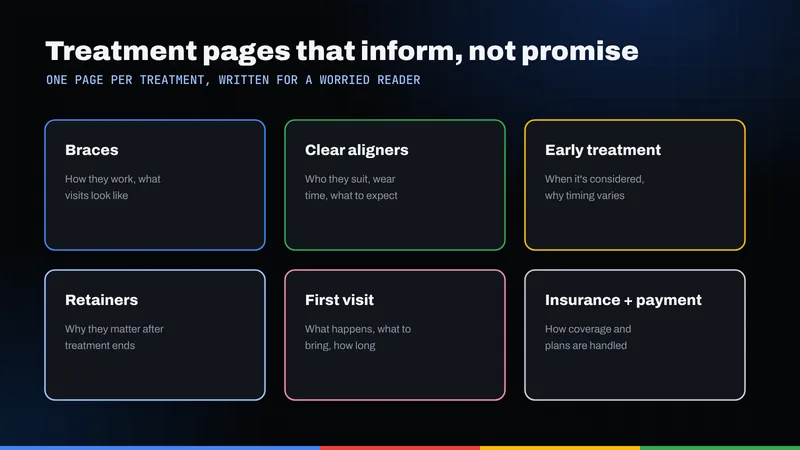
Once Dana or Marcus clicks through, they want the page that matches their worry. A single "Services" page with a bulleted list doesn't do that. Each core treatment deserves its own page, written for someone who doesn't know the vocabulary yet.
- Braces. Types you offer, what the first weeks feel like, visit frequency, and what to do if a bracket comes loose.
- Clear aligners. How they work, who tends to be a candidate and who may not be, why wear time matters, and how in-office supervision fits in. Speak to adults directly here.
- Retainers. Why retention matters, the types you use, and what happens if one is lost. Marcus's story is a retainer story.
- Early or Phase 1 treatment. What an early evaluation looks for, and the honest note that not every child seen early needs treatment right away. Parents trust an office that says "sometimes we just monitor."
- First consultation. What happens, how long it takes, what to bring, and whether there's any obligation.
The tone rule for all of these is to inform, not promise. Avoid lines like "perfect smile guaranteed." In Florida, as we'll see, that isn't just good manners. It's the law.
To check coverage, list the questions patients ask at the front desk and make sure each one has a home on the site.
| Patient question | Page that should answer it |
|---|---|
| "Is my child too young to be seen?" | Early / Phase 1 treatment page |
| "Braces or aligners: which makes sense for me?" | Braces and clear aligners pages, cross-linked |
| "I'm an adult. Is that normal?" | Adult orthodontics or clear aligners page |
| "What happens at the first visit, and do I have to commit?" | First consultation page |
| "How does payment work? Do you take my insurance?" | Fees, insurance and payment plans page |
| "Who will actually treat my child?" | Doctor profile page with training and license details |
| "What happens after the braces come off?" | Retainers page |
| "Can I get there after school, and where do I park?" | Location and hours page |
If many of your families speak a language other than English at home, the same table applies to each language version. Our post on Spanish and multilingual SEO explains how to structure translated pages so they can rank on their own.
How can a parent check that an orthodontist is qualified?
Parents like Dana often don't know that "orthodontist" means something specific. Your site can explain it calmly and give them ways to check it themselves.
Specialty training
The American Association of Orthodontists explains that orthodontists complete additional education after dental school that culminates in a two- to three-year orthodontic residency, and that the AAO is open only to qualified orthodontists. A doctor profile can state where the doctor completed dental school and residency. Facts a parent can confirm persuade more than adjectives.
Board certification
The American Board of Orthodontics describes board certification as something an orthodontist may pursue, involving a written examination and a scenario-based clinical examination. The ABO also says certification renewal requirements must be met every 10 years, and an annual fee is required to maintain board-certified status. If your doctor is board certified, say so and keep the claim current. If not, don't imply it.
Florida license
Every dentist practicing in Florida, orthodontists included, is licensed by the state. The Florida Department of Health's license verification search lets anyone look up a provider by name or license number. Consider listing each doctor's license number on their profile page and linking to the lookup. It's a small gesture that tells a careful parent you have nothing to hide.
What can a Florida orthodontist say in ads and on the website?
This is the section most marketing templates get wrong. Florida's dental advertising statute, section 466.019 of the Florida Statutes, defines advertising broadly enough to include websites and social media. It says a dentist's advertisement may not contain false, misleading or deceptive statements, and it specifically lists statements that:
- contain laudatory statements about the dentist or group of dentists;
- are intended or likely to create false, unjustified expectations of favorable results;
- relate to the quality of dental services compared to other available dental services;
- contain fee information without a disclaimer that the fee is a minimum fee only.
Read that list with a marketer's eye and a lot of familiar copy disappears. "Best orthodontist in Miami" and "results guaranteed" run straight into it. Specific, checkable facts persuade better anyway.
The word "specialist"
A separate section, 466.0282, governs specialty claims. In summary, a Florida dentist may not hold out as a specialist unless they completed an American Dental Association and Commission on Dental Accreditation approved specialty program and are eligible for examination by, or a diplomate of, a national specialty board recognized by the ADA (there is also a narrow grandfather clause dating to 1964). The same section sets disclosure requirements for dentists who announce a practice emphasis in an area without qualifying credentials. Orthodontics and dentofacial orthopedics is an ADA-recognized specialty, so a residency-trained orthodontist can generally describe that status accurately. A general dental office offering aligners should not call itself an orthodontic specialist.
Telehealth and aligners
Section 466.019 also requires a clearly legible disclaimer in ads for dental services provided through telehealth that cover things like digital scanning of teeth, placing or adjusting appliances, or correcting malformations of teeth or jaws. It recommends an in-person examination with a Florida-licensed dentist before telehealth treatment begins. If you advertise virtual consultations or remote monitoring for aligners, ask your attorney whether it applies.
We aren't lawyers, and this isn't legal advice. Have counsel review site copy, ads and profile descriptions against the current statutes before launch.
Why does Google hold orthodontic pages to a higher bar?
Orthodontic care affects health and family budgets, which puts it in what Google calls "Your Money or Your Life" territory. Google's guidance on creating helpful, reliable content says its systems give even more weight to content with strong experience, expertise, authoritativeness and trustworthiness (E-E-A-T) on these topics, and that trust is the most important of the four. It also encourages accurate bylines where readers expect them and warns against fabricated author profiles or false credentials.
For an orthodontic site, that translates into a few habits:
- Name the doctor who reviewed each treatment page, with a link to their profile and a "last reviewed" date.
- Use real photos of your team and office, not stock smiles.
- Keep name, address, phone, hours and doctors consistent across the site, the Google profile and directories.
- Use structured data honestly. The schema.org
Dentisttype covers a dental office, and its properties should mirror what the page and profile already say. Our explainer on how schema helps search engines walks through the basics.
None of this guarantees rankings, but it makes your pages the kind Google says it wants to show.
Can you post before-and-after photos and patient stories?
Before-and-after photos are persuasive and easy to mishandle. Patient photos, names and treatment details from your records are protected health information. The U.S. Department of Health and Human Services explains in its HIPAA marketing guidance that the Privacy Rule generally requires an individual's written authorization before protected health information is used or disclosed for marketing.
In practice, keep it general and keep it documented:
- Get a written marketing authorization, reviewed by your compliance advisor, before any patient photo, smile video or story goes on the website, Google profile or social media. For children, ask your advisor who must sign and how long the authorization lasts.
- Show results as examples of individual cases, not as what every patient will get. That also keeps you on the right side of the "unjustified expectations" language in Florida's statute.
- Keep a simple log: which image, which authorization, where it's used, and when it comes down.
When in doubt, use diagrams or photos of your office instead.
How should an orthodontic office ask for reviews?
Long treatment gives you natural moments to ask for a review: after the consultation, when braces come off, at the retainer check. The rules are the same at each.
Google's review policies prohibit incentivized reviews, reviews from people with a conflict of interest such as current or former employees, and selectively asking only happy customers. The Federal Trade Commission's 2024 final rule on fake reviews and testimonials goes further. It bans fake reviews, incentives conditioned on a particular sentiment, undisclosed insider reviews, and suppressing negative reviews through threats or intimidation.
So skip the gift card raffles and the "only text the happy families" routine. Ask every patient or parent the same way, at the same milestones, with a direct link, and reply in general terms that never confirm someone is a patient. A parent learns more from a calm reply to a critical review than from a wall of five stars.
What does the full consultation journey look like?
Put together, Dana's path looks like this: an accurate listing with after-school hours, an early-treatment page that doesn't oversell, a doctor profile with residency and license details, reviews from other parents, and a short booking form. Marcus takes the same path through the aligner and retainer pages.
Families rarely limit themselves to one city. A North Miami Beach parent may compare offices across Miami-Dade, so you're competing in the wider local SEO Miami picture, not just your ZIP code. Our SEO in Miami work aims to make you the most specific, verifiable option a family finds.
Every step is measurable. Track profile calls separately from website calls and forms, watch which treatment pages lead to consultation requests, and note where people drop off, often at a long booking form or a vague fees page. Our website design team builds orthodontic sites around this path rather than around a template, with the booking step kept short and visible on mobile.
If you'd like an outside look at where your practice's journey breaks down, from profile settings to treatment pages to advertising language that needs a second look, request a free SEO audit. We'll show you what we find and what we'd fix first.
Frequently asked questions
How is SEO for orthodontists different from general dental SEO?
Orthodontic patients tend to research around specific worries: a child's bite, adult aligners, the cost of a long treatment. That calls for separate pages for braces, aligners, retainers and early treatment, credentials parents can verify, and careful use of the word "specialist" under Florida law.
Should each orthodontist in our practice have a Google Business Profile?
Google allows profiles for public-facing practitioners reachable at the verified location during stated hours. The practice keeps its own profile, practitioner profiles use only the doctor's name, and support staff don't get profiles. A solo doctor at a branded office usually shares the practice profile.
Can a Florida orthodontist call themselves the best orthodontist in town?
That's risky. Section 466.019 of the Florida Statutes bars dental advertising that contains laudatory statements, creates unjustified expectations of favorable results, or compares service quality to other available dental services. Use checkable facts like training, board certification status and services offered instead.
Can we post before-and-after photos of patients?
HHS guidance says the HIPAA Privacy Rule generally requires written authorization before protected health information is used for marketing. Get a written authorization reviewed by your compliance advisor before posting any patient photo or story, and present results as individual examples, not promises.
Can we offer a discount for leaving a review?
No. Google's review policies prohibit incentivized reviews and selectively asking only happy patients, and the FTC's 2024 rule bans incentives conditioned on positive or negative sentiment. Ask every patient the same way, at the same milestones, with no reward attached.