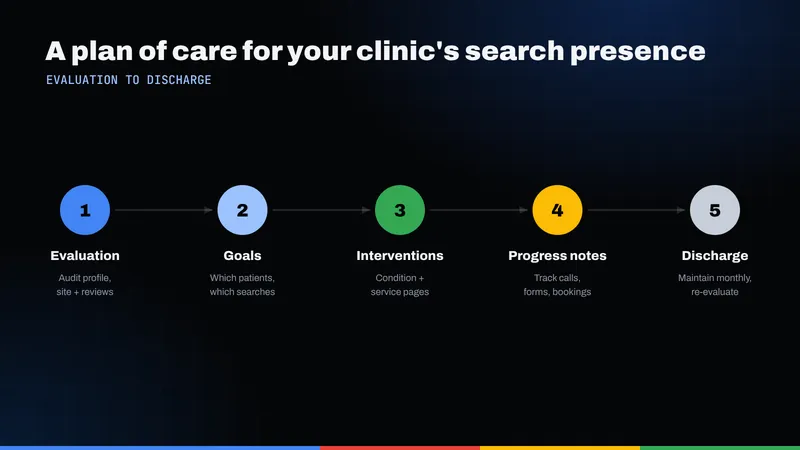
SEO for physical therapists works like a good plan of care: evaluate where patients find you today, set measurable goals, deliver targeted interventions, and check progress before you change course. For a North Miami Beach clinic, that means a correctly structured Google Business Profile, honest condition pages, accurate direct access content, verifiable licenses and HIPAA-safe review replies.
Key takeaways
- Google lets individual practitioners have their own Business Profile, but only under specific conditions, and a solo PT at a branded clinic shares one profile with the practice.
- Florida law lets a physical therapist implement a plan of treatment they developed, with a practitioner of record review required if care runs past 30 days for a condition no practitioner of record has assessed.
- Build a page for each condition and service patients actually search, explaining the approach without guaranteeing recovery.
- The free or discounted service disclosure in Section 456.062 applies to physical therapists licensed under chapter 486.
- Patient testimonials need written HIPAA authorization; a Los Angeles-area PT practice paid a federal settlement for posting them without it.
Evaluation: where do patients find your clinic right now?
No therapist treats without an evaluation, and no clinic should start SEO without one. The goal is a baseline you can measure against.
Imagine a three-therapist outpatient clinic off a busy corridor in North Miami Beach. It treats orthopedic injuries, post-surgical knees and shoulders, runners and weekend athletes, patients with dizziness, and a growing pelvic health caseload., plus aquatic sessions in a pool. Most new patients arrive by physician referral, and the owner suspects the website brings in almost nobody. This clinic is an example, not a client.
A practical evaluation covers five areas:
- Google Business Profile. Is there one clinic profile? Are therapists listed separately, and should they be?
- Website pages. A page per condition and service, or one long "Services" page?
- Search visibility. What does Search Console show for queries like "physical therapy near me," "vestibular therapy" or "pelvic floor therapist"?
- Trust signals. Can a patient see who will treat them and their license number?
- Conversion path. Can a patient call or book easily from a phone?
Document what you find the way you'd record range of motion on day one. Physical therapy SEO is easier to judge when you know where you started.
Plan of care: Spend one hour listing every service you offer, every insurance question your front desk hears, and every search phrase patients mention at intake.
Goals: what should SEO for physical therapists actually achieve?
Rehab goals are specific and functional: not "feel better" but "climb stairs without a rail." SEO goals deserve the same discipline.
- Short-term goals (first few months): a clean, verified profile, accurate service pages, working schema, and appointment requests that are tracked by source.
- Long-term goals: more patients who find you directly, steady visibility in the map results for your core services.
Notice what's missing: promises of ranking first or doubling caseload. Nobody can guarantee rankings. Our post on which SEO KPIs to track in North Miami Beach explains how to read progress honestly.
Patients often compare clinics across northeast Miami-Dade, so you're competing in the wider local SEO Miami picture, not just your ZIP code. Our North Miami Beach SEO page explains how we look at the city, and the SEO Miami page covers the broader county market.
Plan of care: Pick three measurable goals, such as tracked appointment requests per month, calls from the profile, and impressions for your top five service queries.
Intervention 1: explain direct access in Florida accurately
Many patients don't know whether they need a referral to see a physical therapist. That uncertainty is one of the best content opportunities a Florida clinic has, as long as the answer is correct. In the definition of "practice of physical therapy," Section 486.021(11) of the Florida Statutes states that a physical therapist may implement a plan of treatment developed by the physical therapist, or one provided by a practitioner of record or an advanced practice registered nurse. The same subsection sets two limits worth explaining to patients:
- The 30-day rule. If physical therapy is required beyond 30 days for a condition not previously assessed by a practitioner of record, the therapist must have a practitioner of record review and sign the plan. There is an exception for patients already diagnosed by a physician licensed in another state.
- Referral outside scope. If the patient's condition is found to be outside the scope of physical therapy, the therapist must refer the patient to, or consult with, a practitioner of record.
The statute defines a practitioner of record by license chapter: practitioners in active practice licensed under chapters 458, 459, 460, 461 or 466 of the Florida Statutes.
How to turn this into a page
- Title it around the patient's question, for example "Do I need a referral for physical therapy in Florida?"
- Explain the rule and both limits, and link to the statute.
- Add a clear note that insurance plans can set their own referral or authorization requirements, and invite patients to call so staff can check.
- Have a licensed PT review the page.
Plan of care: Publish one direct access page, link it from every condition page, and set a yearly reminder to recheck the current statute.
Intervention 2: set up Google Business Profiles for the clinic and individual PTs
Google's guidelines for representing your business include specific rules for individual practitioners such as doctors and lawyers, and they apply neatly to physical therapists:
- A practitioner can have a dedicated profile if they work in a public-facing role and can be contacted directly at the verified location during stated hours.
- Support staff should not create their own profiles, and a practitioner shouldn't create multiple profiles for different specializations.
- When several practitioners work at one location, the clinic gets its own profile, separate from theirs, and each practitioner profile title includes only that practitioner's name.
- When a therapist is the only public-facing practitioner at a branded clinic, Google says the clinic and practitioner should share a single profile in the format "[brand]: [practitioner name]."
For our example clinic, that means one clinic profile plus, optionally, one per therapist. Beyond structure, fill in services that match your real offerings, upload genuine photos of your gym, treatment rooms and pool. Our Google Business Profile guide for North Miami Beach covers setup, and our Google Maps SEO service covers ongoing profile management.
Plan of care: Audit every profile tied to your address this week. Merge or remove duplicates, and confirm each remaining profile follows the practitioner rules.
Intervention 3: build condition and service pages that inform without promising
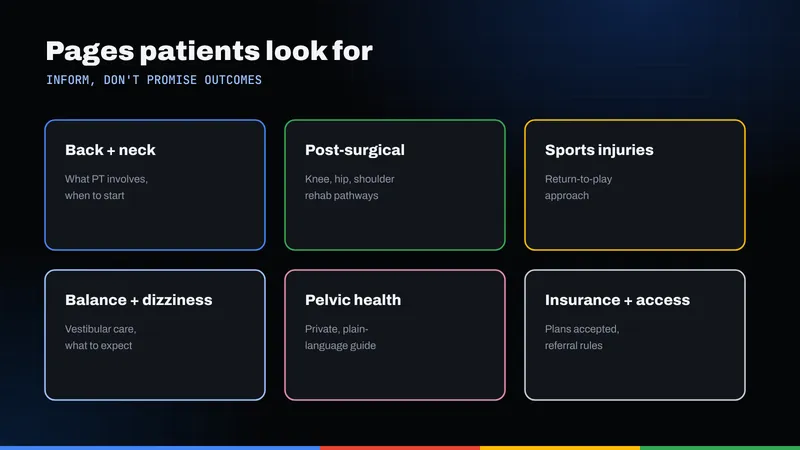
A single "Services" page with a bulleted list can't rank for vestibular therapy and pelvic floor therapy and ACL rehab at the same time. Give each its own page. The table maps services to example phrases (validate them against your own Search Console data) and the page that answers them.
| Condition or service | What patients search | Page to build |
|---|---|---|
| Orthopedic rehab | "physical therapy for back pain," "shoulder pain physical therapy near me" | One page per body region (back, neck, shoulder, knee, hip) |
| Sports rehab | "sports physical therapy," "runner's knee physical therapist" | Sports PT page covering return-to-sport testing |
| Post-surgical rehab | "physical therapy after knee replacement," "ACL surgery rehab" | Pages by surgery type explaining how you work with the surgeon's protocol |
| Vestibular therapy | "vertigo physical therapy," "dizziness treatment physical therapist" | Vestibular page explaining the assessment and who should see a physician first |
| Pelvic health | "pelvic floor physical therapy," "postpartum physical therapy" | Pelvic health page with a clear, calm description of the first visit, privacy and consent |
| Aquatic therapy | "aquatic therapy near me," "pool therapy for arthritis" | Aquatic page covering who it may suit, pool details and what to bring |
| Direct access | "do I need a referral for physical therapy Florida" | Direct access page based on Section 486.021(11) |
Writing guidelines for each page
- Describe the process, not the outcome. "Your first visit includes a movement assessment and a discussion of your goals" is accurate. "Get rid of back pain in four weeks" is a promise no clinician can make.
- Answer front-desk questions: visit length, what to wear, insurance, referrals.
- Name the author and reviewer.
If you've read our chiropractor SEO post, note that PT pages lean more on surgical protocols, referral relationships and specialties like vestibular and pelvic health. Our local SEO service builds these page sets and the internal links between them.
Plan of care: Start with the three services that bring in the most revenue or the most phone questions, and write those pages first.
Intervention 4: make credentials verifiable and offers compliant
Make credentials easy to check. Florida's Department of Health runs a public license verification search where anyone can look up a physical therapist or physical therapist assistant by name, license number, city, county or ZIP code.
On each therapist bio, include:
- Full name and credentials (PT, DPT, PTA and any board specialty certifications they actually hold)
- Florida license number, with a link to the state's verification search
- A real photo, used with the therapist's permission
Free screenings and discounted first visits
Before advertising a free screening or discounted evaluation, read Section 456.062 of the Florida Statutes. Its list of covered practitioners includes those licensed under chapter 486, which is the physical therapy chapter. When an ad offers a free, discounted or reduced-fee service, it must include a statement in capital letters, clearly distinguishable from the rest of the text, telling patients they have the right to refuse to pay, cancel payment or be reimbursed for any other service, examination or treatment performed as a result of and within 72 hours of responding to the ad.
Plan of care: Add license numbers to every bio, and send any landing page with a free or discounted offer to whoever handles compliance before it goes live.
Intervention 5: write insurance and Medicare pages without inventing coverage
"Do you take my insurance?" may be the most common question a PT front desk answers.
- List the plans you are actually in network with, and date the list so patients know when it was last checked.
- Invite patients to call for a benefits check.
- Avoid sentences like "most plans fully cover physical therapy." It sets up billing surprises.
For patients on Original Medicare, link to Medicare's own fact sheet, Medicare Coverage of Outpatient Occupational Therapy, Physical Therapy, and Speech-language Pathology Services. It explains that Part B covers medically necessary outpatient physical therapy, notes that it applies to Original Medicare rather than Medicare Advantage plans, and explains that a provider who believes a service isn't medically necessary must give you an Advance Beneficiary Notice first.
Plan of care: Ask your billing lead to review the insurance page every quarter and note the review date on the page.
Intervention 6: earn reviews and reply without exposing patient information
Reviews influence which clinic a patient calls. PT patients see you many times, so ask every patient the same way, at a natural point such as discharge, and never pay for or screen reviews.
Replying is where clinics get into trouble. Even confirming that a reviewer is your patient can disclose protected health information. A safe reply thanks the person, skips any care details and moves the conversation offline: "We take every concern seriously. Please call our office manager so we can talk this through privately." No names, dates, body parts or treatment details.
Testimonials need written authorization
The U.S. Department of Health and Human Services announced a $25,000 settlement with Complete P.T., Pool & Land Physical Therapy, a Los Angeles-area practice, after it posted patient testimonials with full names and full-face photos on its website without valid HIPAA authorizations. If you want to feature patient stories, get a signed, HIPAA-compliant authorization first.
Plan of care: Write two or three approved reply templates, train staff to use them, and audit your website for any patient photo or story without a signed authorization.
Intervention 7: add schema that describes your clinic correctly
The trap for PT clinics is that schema.org's PhysicalTherapy type is not a business type. It sits under MedicalTherapy.
A cleaner setup:
- Mark up the clinic as MedicalClinic, which descends from both MedicalBusiness and MedicalOrganization, with your name, address, phone, hours and geo coordinates matching your Business Profile.
- Set its
medicalSpecialtyproperty to Physiotherapy, which schema.org lists as a MedicalSpecialty value. - Use
availableService, which accepts MedicalTherapy, to list services such as a PhysicalTherapy entry for aquatic therapy or vestibular rehab, each with a name and description that match the page. - Add Person markup for therapists on their bio pages.
Only mark up what's visible on the page, and validate it before publishing. Our post on how schema helps search engines covers the basics.
Plan of care: Replace any incorrect "PhysicalTherapy as business" markup and validate the clinic page's markup before republishing it.
Progress notes and discharge: how do you know it's working?
Re-evaluate on a schedule, just as you would with a patient. Monthly progress notes should compare against the baseline from your evaluation:
- Calls, direction requests and website clicks from your Business Profile
- Search Console impressions and clicks for each service page
- Appointment requests tracked by source
- Number of new reviews and how quickly you replied
If a page isn't gaining impressions after a reasonable period, adjust the intervention. Improve the content, add internal links, or check that the page targets a phrase patients actually use.
Discharge in SEO doesn't mean stopping. It means moving to a home program: profile updates, page refreshes when protocols or contracts change, and review requests at discharge. If your site itself is slow or hard to use on a phone, that's a separate fix our website design team handles.
If you'd like a second opinion on where your clinic stands, request a free SEO audit and we'll document your baseline and suggest a plan of care.
Plan of care: Put a 30-minute monthly review on the calendar and keep notes, so next quarter's decisions are based on data rather than memory.
Frequently asked questions
What is SEO for physical therapists?
It is the work of helping patients find your clinic in Google search and maps. For a PT clinic that means an accurate Google Business Profile, a page for each condition and service, verifiable therapist credentials, honest insurance information, reviews handled privately and correct schema markup.
Can patients in Florida see a physical therapist without a referral?
Section 486.021(11) of the Florida Statutes lets a physical therapist implement a plan of treatment they developed. If treatment is needed beyond 30 days for a condition not previously assessed by a practitioner of record, a practitioner of record must review and sign the plan, and the therapist must refer out if the condition is outside the scope of physical therapy. Insurance plans may have their own requirements.
Should each physical therapist have their own Google Business Profile?
They can, if they are public-facing and can be contacted directly at the verified location during stated hours. The clinic keeps its own separate profile. A therapist who is the only public-facing practitioner at a branded clinic shares one profile with the clinic, and no therapist should have separate profiles for different specialties.
Can we post patient success stories on our website?
Only with a signed, HIPAA-compliant authorization from the patient. HHS reached a $25,000 settlement with a Los Angeles-area physical therapy practice that posted testimonials with patient names and photos without valid authorizations.
What schema should a physical therapy clinic use?
Use MedicalClinic for the clinic itself, set medicalSpecialty to Physiotherapy, and list services with availableService. The schema.org PhysicalTherapy type describes a therapy, not a business, so it belongs in the services list rather than as the clinic type.