Chiropractor SEO works best when you treat it like patient care: take a history of how people find you, assess what your site and Google profile actually say, then follow a plan that informs rather than promises. For a North Miami Beach office, that means accurate service pages, a correctly configured Google Business Profile, credentials patients can verify, honest reviews, and advertising that stays inside Florida's chiropractic rules.
Key takeaways
- Google gives extra weight to health topics and says trust matters most, so chiropractic pages need to be accurate, clearly authored and easy to verify.
- Florida treats false, deceptive or misleading advertising as grounds for discipline, and the Board's rule bars claims that create unjustified expectations of cures or imply superiority over other chiropractors.
- Any ad for a free or discounted exam needs the 72-hour refund disclosure from Section 456.062 and the usual fee for that service.
- Build pages around the questions patients ask before booking, and describe what happens in the office rather than what will happen to their body.
- Get written authorization before using patient stories, ask every patient for reviews the same way, and never pay or filter for good ones.
Intake: how does a careful patient choose a chiropractor?
Every good visit starts with a history, and so does a good marketing plan. Before changing a single page, picture who is searching and what they are worried about.
Imagine a patient we'll call Elena. She has had a stiff lower back for a few weeks and has never seen a chiropractor. A coworker recommended one, but she wants to check for herself. She searches "chiropractor near me," opens a few listings, reads reviews, then visits the websites. She wants to know whether treatment is gentle, whether X-rays are routine, what the first visit costs, whether her insurance is accepted, and whether the doctor is properly licensed. If those answers are missing or sound like a sales pitch, she moves on.
Elena is a composite, not a real patient or client. Her path is still worth mapping: a map search, a listing, reviews, a website, a credential check, then a call or online booking. Good SEO for chiropractors puts a calm, accurate answer at each step.
Patients rarely look at one office in isolation. They compare listings side by side, sometimes across Miami-Dade, so a North Miami Beach office is competing in the wider local SEO Miami picture, not just its own ZIP code. Our North Miami Beach SEO page explains how we approach the city as a whole, and our earlier post on dental and medical SEO in North Miami Beach covers general health-practice basics like provider bios and review replies. This guide stays on what is specific to chiropractic.
Why does Google look harder at chiropractic content?
Google's guidance on creating helpful, reliable, people-first content describes "Your Money or Your Life" (YMYL) topics: subjects that could significantly affect a person's health, financial stability or safety. Its systems give more weight to signals of experience, expertise, authoritativeness and trustworthiness (E-E-A-T) on those topics, and the page says that of these, trust is most important.
A page about neck pain on a small practice's site is still health information. Google also says E-E-A-T isn't a single ranking factor; it describes what its systems try to reward. In practice, that points to three habits:
- Show who wrote or reviewed each health page. Google encourages accurate bylines and warns that invented author personas or false credentials are deceptive.
- Write for the patient first. Fifty near-identical "chiropractor in [neighborhood]" pages are written for rankings, not people.
- Stay within what you can support. If a statement would make a careful colleague raise an eyebrow, cut it.
"First, do no harm" translates well here. A cautious page may convert a bit more slowly than a bold one, but it won't mislead a patient, invite a Board complaint or undercut the trust Google says it looks for.
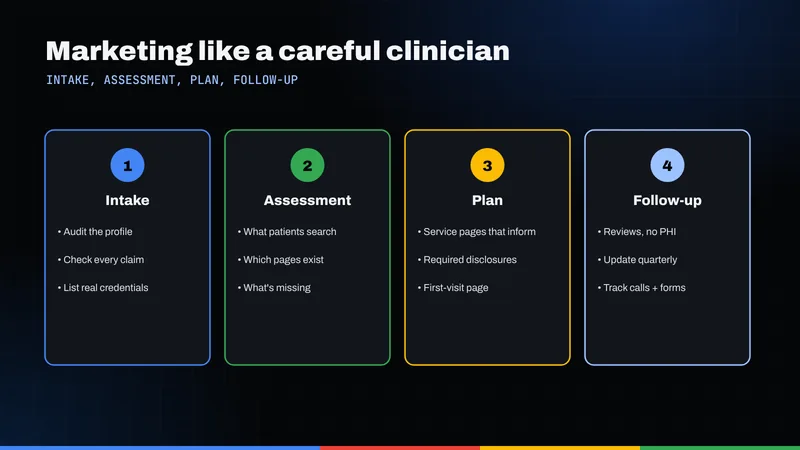
Assessment: what should you check before changing anything?
An exam comes before a treatment plan. A useful chiropractor SEO assessment covers four areas, and you can do most of it yourself in an afternoon.
- Your Google Business Profile. Is the name your real-world name, without added keywords? Is the primary category accurate? Do hours, phone and address match your website exactly?
- Your website's claims. Read every page as a Board investigator would. Flag "cure," "fix," "guaranteed," "best" and "the only," plus every fee offer, free exam and X-ray promotion, and check what disclosures sit next to them.
- Your credentials. Each doctor's bio should give a full name, degree and Florida license number. Patients can confirm a license through the Florida Department of Health's license verification search, which includes the Board of Chiropractic Medicine. Linking to it from a bio is a small, concrete trust signal.
- Your technical basics. Pages should load quickly on a phone, booking should take a few taps, and each service should have one clear page. Our guide to what makes a website rank locally covers the on-site pieces.
Write down what you find before fixing anything. A baseline is what makes follow-up meaningful.
What do Florida's chiropractic advertising rules mean for your website?
This is where chiropractic marketing differs most from ordinary small-business SEO. Your website, Google profile, social posts and paid ads are all advertising. We aren't lawyers and this isn't legal advice, but these are the provisions every practice should read with its own counsel.
The statute and the Board rule
Section 460.413 of the Florida Statutes lists grounds for discipline of chiropractic physicians. They include "false, deceptive, or misleading advertising"; ads that don't identify the licensee as a chiropractic physician or the clinic as chiropractic; advertising under a name other than one's own; and advertising free or discounted services without prominently stating the usual fee.
The Board of Chiropractic Medicine's Rule 64B2-15.001, "Deceptive and Misleading Advertising Prohibited", fills in the details. Advertising is considered deceptive or misleading if it, among other things:
- misrepresents facts or only partially discloses relevant facts;
- "creates false, or unjustified expectations of beneficial treatment or successful cures";
- makes representations about the quality of the chiropractic services offered;
- suggests skills or attributes superior to other chiropractors, beyond a simple listing of earned professional achievements;
- uses a practice name that doesn't include "chiropractor," "chiropractic" or an easily recognizable derivative.
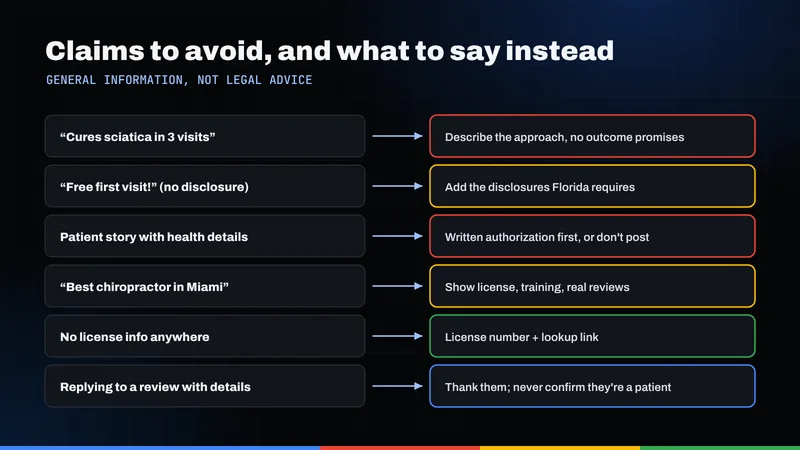
For SEO, the translation is simple. "North Miami Beach's best chiropractor," "we fix sciatica" and "results guaranteed" are exactly what these provisions describe. Replace them with checkable facts: where the doctor trained, which techniques the office uses, what the first visit involves, and the license number. Facts rank fine, and they hold up to scrutiny.
Free or discounted first visits
Section 456.062 of the Florida Statutes, which covers chiropractic licensees among other professions, requires any ad for a free, discounted or reduced-fee service, examination or treatment to include this statement in capital letters, clearly distinguishable from the rest of the text:
"THE PATIENT AND ANY OTHER PERSON RESPONSIBLE FOR PAYMENT HAS A RIGHT TO REFUSE TO PAY, CANCEL PAYMENT, OR BE REIMBURSED FOR PAYMENT FOR ANY OTHER SERVICE, EXAMINATION, OR TREATMENT THAT IS PERFORMED AS A RESULT OF AND WITHIN 72 HOURS OF RESPONDING TO THE ADVERTISEMENT FOR THE FREE, DISCOUNTED FEE, OR REDUCED FEE SERVICE, EXAMINATION, OR TREATMENT."
Build three more points into your templates:
- Section 460.413 requires the usual fee for the free or discounted service to appear prominently in the ad.
- The Board rule says an ad for free X-rays or video fluoroscopy must disclose that they will only be given if medically necessary.
- The rule treats a free or fixed-price offer as misleading if the practice bills a higher charge for that service to a third-party payor.
The cleanest setup is one offer page carrying the full disclosure and usual fee, with every banner, Google post and social ad linking to it and repeating the required text. If the disclosure would crowd a small ad unit, the offer belongs on a landing page, not in the ad.
Plan: how should condition and service pages be written?
Patients search by symptom and by question, so condition and service pages carry most of your search visibility. They are also where the advertising rules bite hardest. Each page should inform: what a visit for that concern looks like at your office, and when a patient should see a different kind of clinician instead.
- What the patient may be experiencing, in plain language, without diagnosing them.
- What happens at an evaluation, including history, exam, and when imaging is or isn't ordered.
- What care at your office can involve, naming only techniques you actually perform. The Board rule treats claims about services you don't perform as misleading.
- When you refer out, stated without hedging. Few paragraphs build more trust.
- Who wrote or reviewed the page, with name, degree, license number and a last-reviewed date.
Avoid outcome language. "Many patients come to us for an evaluation of lower back pain" describes your practice. "We eliminate lower back pain" makes a promise the rule forbids. If you cite research, link the original and describe its limits honestly.
This table maps common pre-booking questions to the page that should answer them. Treat it as a starting checklist.
| Patient question | Page that answers it |
|---|---|
| Is this chiropractor licensed in Florida? | Doctor bio with license number and a link to the state verification search |
| What happens at my first visit? | New patient page covering history, exam, paperwork and when imaging is used |
| Do you see patients for neck or back pain? | Individual condition pages that explain the evaluation, without promising relief |
| What techniques do you use? Is it gentle? | Techniques page listing only methods your doctors perform |
| Do you take my insurance? What does it cost? | Insurance and fees page |
| Is there a new-patient special? | Offer landing page with the usual fee and the full 72-hour disclosure |
| Do you speak my language? | About page and bios listing languages staff actually speak |
| Where do I park? | Contact page with the same name, address and phone as your Google profile |
If you serve patients in more than one language, our guide to Spanish and multilingual SEO in North Miami Beach covers how to structure translated pages. Layout matters too: a calm, readable page with an obvious booking button does more than stock photography, which is the kind of work our website design team does for health practices.
How should a chiropractic office set up its Google Business Profile?
For many patients, the Google listing is the first exam room they walk into. Google's guidelines for representing your business include practitioner rules:
- A doctor can have their own profile if they work in a public-facing role and can be contacted directly at the verified location during stated hours.
- A multi-doctor office should have a practice profile separate from each practitioner's, and a practitioner's profile title should include only the doctor's name.
- A solo doctor at a branded practice should use one profile named "[brand]: [practitioner name]."
- Support staff should not create profiles, and a practitioner shouldn't have several profiles for different specialties.
Google also says the name should reflect your real-world name and that categories shouldn't be used as keywords. "Smith Chiropractic," which also satisfies Florida's naming rule, is fine. "Smith Chiropractic Best Back Pain Doctor North Miami Beach" is not. Profile posts are advertising too, so they get the same claims review. Our Google Business Profile guide for North Miami Beach covers the rest of the profile, and our local SEO service can keep it current.
Which structured data fits a chiropractic practice?
Structured data helps search engines understand who you are, where you are and what you offer. One wrinkle: schema.org has no "Chiropractor" type. "Chiropractic" exists only as a value of MedicineSystem, and it isn't among the MedicalSpecialty values. MedicalBusiness, a kind of LocalBusiness for businesses run by health professionals, is a reasonable base.
Keep the markup matched to what is visible on the page: name, address, phone, hours, geo coordinates, area served, languages and links to your official profiles. Don't mark up reviews collected elsewhere or services you don't offer. Our post on how schema helps search engines explains implementation and testing.
How should you handle reviews, testimonials and patient privacy?
Patient voices are persuasive, and they are where well-meaning offices most often step wrong.
HIPAA and patient stories
HHS guidance on marketing under the HIPAA Privacy Rule says that, with limited exceptions, a covered entity needs an individual's written authorization before using or disclosing protected health information for marketing. A video testimonial, a posture photo or a named story on your site all involve patient information, so get a written authorization reviewed by your compliance advisor first. Even then, a testimonial is still advertising under the Board rule. Present it as one person's experience, and prefer stories about the care and the office over dramatic outcomes.
When replying to reviews, thank the reviewer and invite them to call, without confirming they are a patient or mentioning their care.
Honest reviews
Google's Maps content policy treats paid or incentivized reviews as fake engagement, bars businesses from discouraging negative reviews or selectively asking only satisfied customers, and prohibits conflict-of-interest reviews, such as those from employees. The FTC's final rule on fake reviews and testimonials, announced in August 2024, bans fake reviews, incentives conditioned on positive or negative sentiment, undisclosed insider reviews and suppressing negative reviews through threats or intimidation.
- Ask every patient the same way, at the same point in care, such as the end of a care plan.
- Offer nothing in exchange: no discount, no free adjustment, no raffle entry.
- Don't let staff or family post reviews, and don't screen for happy patients before asking.
Follow-up: how do you know the plan is working?
A good plan of care includes re-evaluation. Pick a few measures, check them on a schedule and adjust.
- Google Business Profile performance: calls, direction requests and website clicks.
- Search Console: which condition and service pages earn impressions and clicks, and for which queries.
- Booked new-patient visits by source, tracked at the front desk or in your scheduling software.
- A compliance re-check whenever you add an offer, a page or a testimonial.
Expect gradual change rather than a sudden jump. Our post on the SEO KPIs that matter in North Miami Beach explains how to read these numbers without overreacting to one week.
Ribacoff Enterprises handles local SEO, websites and Google profiles for businesses across South Florida, and we write health content with the cautious, verifiable approach described here. For a second opinion on your chiropractic site, request a free SEO audit, and we'll start where you would with a new patient: the assessment.
Frequently asked questions
What makes chiropractor SEO different from general medical SEO?
Chiropractic advertising in Florida has its own statute and Board rule, and patients often arrive worried about safety, X-rays and cost. That calls for condition pages that explain the evaluation without promising relief, bios with verifiable license numbers, and careful handling of new-patient offers.
Can a Florida chiropractor advertise a free first exam?
Yes, with conditions. Section 456.062 requires the 72-hour refund disclosure in capital letters, Section 460.413 requires the usual fee to be stated prominently, and the Board rule requires free X-ray offers to say they are given only if medically necessary.
Can we say we treat sciatica or headaches on our website?
You can describe the concerns patients bring to your office and how you evaluate them, but avoid promising relief or cures. The Board's advertising rule treats claims that create unjustified expectations of beneficial treatment or successful cures as misleading.
Should each chiropractor in our office have a Google Business Profile?
Google allows profiles for public-facing practitioners reachable at the verified location during stated hours. The practice keeps a separate profile, each doctor's profile uses only their name, support staff don't get profiles, and a solo doctor at a branded practice uses one profile named "[brand]: [doctor name]."
Can we give patients a discount for leaving a review?
No. Google's Maps content policy treats incentivized reviews as fake engagement, and the FTC's 2024 rule bans incentives conditioned on positive or negative sentiment. Ask every patient the same way, with nothing offered in return.