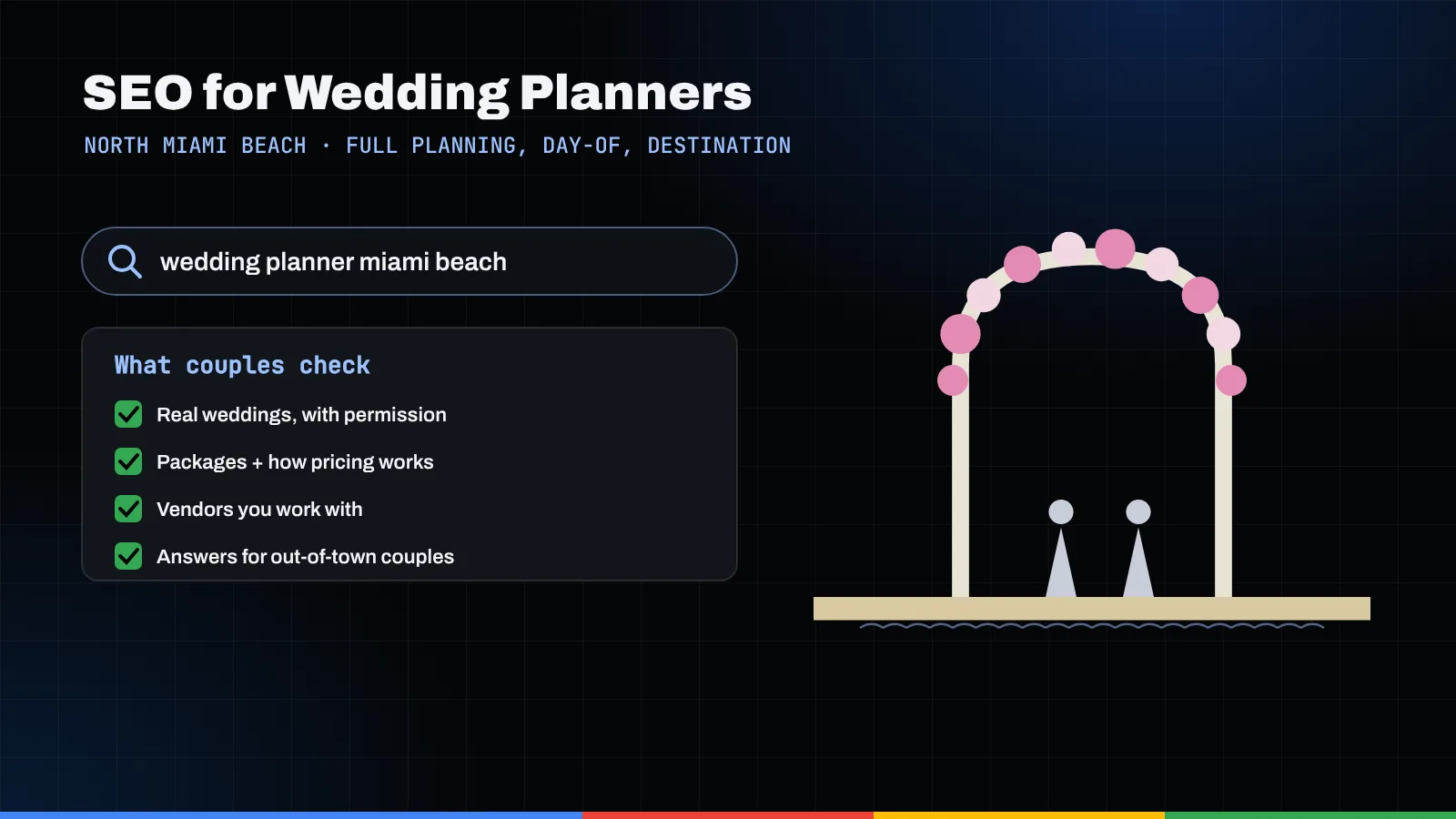
SEO for wedding planners works best when you treat it like a wedding timeline: settle your positioning first, then your Google Business Profile, package pages, real-wedding portfolio, reviews and booking flow, in that order. Each step answers a question a couple asks at a specific stage of their planning, and the planner whose site answers it clearly is usually the one who gets the consultation.
Key takeaways
- Decide who you plan for (full planning, partial planning, day-of coordination, destination, beach or multi-faith weddings) before you write a single page.
- Most home-based planners are service-area businesses on Google: hide the home address and list the areas you serve.
- Build one page per service package that explains how pricing works, even if you don't publish numbers.
- Real-wedding stories need the couple's permission and full vendor credits; Event structured data is for public events like bridal shows, never private weddings.
- Ask every couple for a review the same way, with nothing offered in return, and track which pages actually lead to consultations.
12 months out (positioning): decide who you plan for
Every good wedding starts with a vision board, not a vendor list. Your website should too. Before keywords, decide which couples you're built to serve, because "wedding planner" alone covers a dozen very different businesses:
- Full planning: engagement through send-off, including budget, design and every vendor.
- Partial planning: stepping in a few months out for couples who booked the big pieces.
- Day-of (month-of) coordination: running logistics in the final weeks so the couple can be guests at their own wedding.
- Destination weddings: couples planning South Florida from another state or country.
- Beach and waterfront ceremonies: wind, tide, permits and sand-in-the-shoes logistics.
- Cultural and multi-faith weddings: two traditions, sometimes two ceremonies in one weekend.
Each is a different search, a different worry and a different page. That's the heart of SEO for wedding planners: matching each kind of couple to a page written for them. When everything sits on one "Services" page, Google has nothing specific to match and the couple has nothing specific to trust.
To make it concrete, imagine a hypothetical studio we'll call Mangrove & Lace Events, run from a home office in North Miami Beach. (The name is invented for this article; it isn't a real business or client.) Say the owner decides her sweet spot is full planning for multi-faith and destination couples, with day-of coordination on the side. That one decision tells her which pages to build first, which photos to lead with and what to say on her Google profile.
Planner's note: positioning isn't saying no to every other couple. It's making sure the couples you serve best recognize themselves within seconds.
Where the couple is, what they search, and what to build
Couples move through planning in stages, and their searches change as they go. Here's the map I use to line each stage up with the page that should catch it.
| Couple's stage | What they tend to search | Page to build |
|---|---|---|
| Just engaged, dreaming | wedding planner near me, wedding planner North Miami Beach, beach wedding ideas South Florida | Home page with clear positioning; a style or approach page |
| Comparing planning levels | full service wedding planner vs day of coordinator, partial wedding planning | One page per package, plus a "which level is right for us" guide |
| Planning from out of town | destination wedding planner Miami, planning a Florida wedding from abroad | Destination couples page covering remote planning, travel and legal basics |
| Blending traditions | multi-faith wedding planner, Jewish Hindu wedding planner Miami, bilingual wedding planner | Cultural and multi-faith weddings page, ideally with real-wedding stories |
| Choosing a setting | beach wedding permit, park wedding North Miami Beach | Beach and outdoor ceremonies page that explains how permits get handled |
| Checking you out | [your business name] reviews, [your name] real weddings | Portfolio, reviews page, about page with your story and team |
| Ready to talk | book wedding planner consultation, wedding planner availability 2027 | Inquiry page with a short form and a clear next step |
You don't need every row live on day one. Start with the rows that match your positioning, then fill in the rest over the following months. That sequencing is most of what good wedding planner SEO comes down to: build the page a couple needs right before they need it.
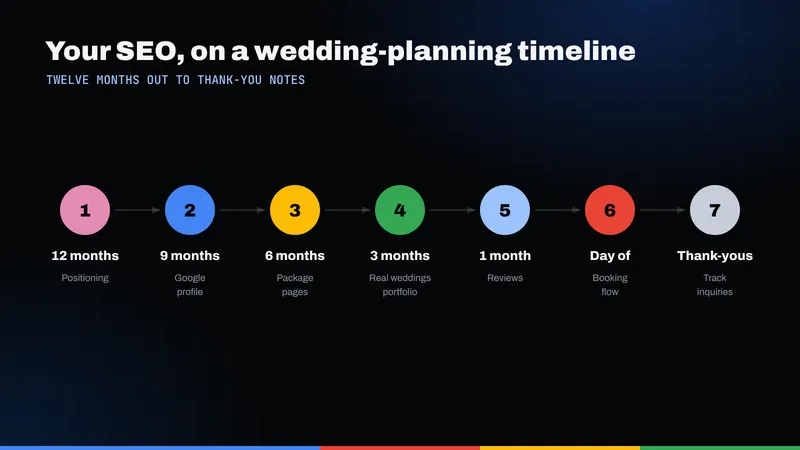
9 months (Google profile): set up your Business Profile correctly
For many planners, the Google Business Profile is the first impression, long before the website. It's also where home-based planners get tripped up.
Are you a service-area business?
Most planners meet couples at venues, coffee shops or on video, not at home. Google's guidelines for service-area businesses are direct: if you don't serve customers at your business address, remove the address and enter only your service area. You can list up to 20 service areas, they can't be set as a radius, and the overall area shouldn't extend more than about two hours of driving time from your base.
So our hypothetical Mangrove & Lace would turn off the "show business address" setting (Google explains it on its manage your business address page) and list North Miami Beach plus the nearby cities where she actually works. A studio with permanent signage where couples come to meet you may qualify as a hybrid business showing both an address and a service area.
Fill in the details
- Primary category: the most specific one for your core business; add others only for services you truly provide.
- Services: full planning, partial planning, day-of coordination, destination planning, each with a plain-English line.
- Photos: real weddings you planned, credited and approved, plus a photo of you or your team.
- Languages: if you plan in Spanish, Haitian Creole, Hebrew or Russian, say so here and on the site.
Our Google Business Profile guide for North Miami Beach goes deeper, and the profile is the core of our local SEO work. Much of what people mean by local SEO in Miami starts right here.
Planner's note: don't list a virtual office or a favorite venue as your address. Google's guidelines tie the address to where you actually serve customers.
6 months (service packages): one page per offer
When couples compare planners, they're really comparing packages. Give each package its own page so it can rank for its own search. A full planning page and a day-of page serve completely different couples.
- Who it's for: "You've booked your venue and photographer and want someone to run the final month" beats a list of adjectives.
- What's included: meetings, vendor sourcing, budget tracking, design, rehearsal, day-of hours, assistants.
- How pricing works: flat fee, starting price, percentage of budget or custom quote. You don't have to publish a number, but explain the structure and what changes it (guest count, multi-day events, travel, number of ceremonies). Any starting price you publish should be one you'll honor.
- A short FAQ: the questions you answer on every consultation call.
Destination couples planning from far away
A couple in Chicago, London or São Paulo can't drive by your office. They search from home, often with "Miami" in the query, and need proof you can run their wedding remotely. A destination page should explain how planning works across time zones, which airports and hotel areas you work with, and how you help with guest travel. If many couples come from Latin America, consider a Spanish version; our multilingual SEO guide covers the setup.
They'll also ask about the legal side. The Miami-Dade Clerk of Court and Comptroller's marriage license page says Florida residents must wait three days before marrying unless an exception applies, non-Florida residents are exempt from that wait, and the wait may be waived for couples who complete a premarital course of at least four hours from a Miami-Dade registered provider. A license is valid for 60 days after issuance. Summarize this, link to the clerk, and tell couples to confirm current rules there.
Beach and outdoor ceremonies
Beach and park ceremony rules depend on who manages the land: city, county, state or private owner. Don't publish permit rules you haven't confirmed with the agency in charge. In North Miami Beach, the city's Parks & Recreation page links to a facility rental request form and a City Events Policy, the place to start for city-run spaces. Elsewhere, an honest line works: "We confirm permit requirements with the managing agency for every outdoor ceremony and handle the application with you."
Planner's note: a "rain and wind plan" section on your beach page earns trust. Couples already worry about it.
3 months (real weddings portfolio): tell the story, credit the team
Real-wedding stories are a planner's tasting menu. They show how you think, not just what the flowers looked like, and each one can be its own indexable page.
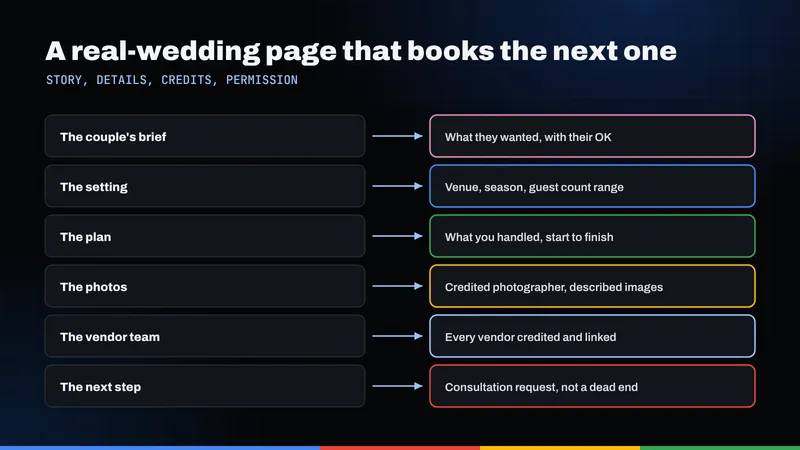
For illustration, picture a couple we'll call Maya and Theo (invented for this example): she grew up in a Haitian Catholic family in Miami, he's from a Jewish family in New Jersey, and they wanted a ceremony that honored both. A strong page would include:
- The brief: what they wanted and what made it tricky (two officiants, guests flying in).
- How you planned it: the order of rituals and the timeline that made it fit.
- Day-of moments: a short narrative with approved photos.
- Vendor credits: photographer, venue, florist, caterer, officiants, music and rentals, named and linked.
Get the couple's written permission, and confirm usage rights with the photographer, who usually owns the images. Credits are good manners and build the vendor relationships that lead to mentions and links; our photographer SEO guide shows the other side of that exchange.
Structured data that fits a planner
For a planner, LocalBusiness markup with your name, service area (areaServed), languages (knowsLanguage) and offers (makesOffer) covers the basics; schema.org lists all of these as LocalBusiness properties. Older advice suggests ProfessionalService, but schema.org notes that type was deprecated due to confusion with Service. See our explainer on how schema helps search engines.
And don't mark up private weddings as Events. Google's Event structured data guidelines say events must be bookable by the general public and exclude invitation-only events. Save Event markup for a public bridal show or open workshop.
1 month (reviews): ask honestly, ask everyone
Couples read reviews like a toast: listening for specifics. The way to earn detailed ones is to ask every couple, the same way, at the right moment.
Google's contribution policy prohibits reviews posted because of a business's incentive, bars discouraging negative reviews or selectively soliciting positive ones, and rules out conflict-of-interest reviews such as those from employees. The FTC's final rule on fake reviews, announced August 14, 2024, bans fake reviews, incentives conditioned on a particular sentiment, undisclosed insider reviews and certain review suppression.
- Send every couple the same short request a week or two after the wedding.
- No discounts, gift cards or album upgrades in exchange.
- Don't ask assistants, family or vendor friends to review you.
- Reply to every review without sharing private details.
Directories like The Knot and WeddingWire have their own review and listing rules, so read them first, and keep your name, phone and service description consistent everywhere.
Planner's note: reviews that mention the type of wedding are gold, but you can't script them. Ask what stood out, and let couples write it.
Day of (booking flow): make the next step easy
All that planning means little if the inquiry form is a maze. When a couple is ready, make it effortless:
- A short form: names, contact details, date or season, guest count, venue if known and the service they want. Save the long questionnaire for later.
- Clear expectations: say how quickly you respond and what happens next.
- Time zones: a scheduling link that shows destination couples their own time.
- Phone-tested: fill the form on a phone, top to bottom.
- Call and text options: some couples, and many parents, would rather talk.
A beautiful site that hides the form under three menus loses couples quietly. Our website design team keeps the inquiry one tap away.
Planners share couples with other vendors, so it helps to know their side: the wedding venue guide covers what couples ask venues, and the florist guide covers seasonal inquiry rushes.
Thank-you notes (tracking): learn what actually worked
After the wedding come the thank-you notes; after a season of SEO comes the review of what worked. A few honest answers beat a complicated dashboard.
- Ask every inquiry how they found you with a simple question on the form.
- Watch Business Profile performance: calls, website clicks and direction requests.
- Check which pages lead to inquiries, and invest next season where couples actually come from.
- Track bookings, not just traffic. Five serious couples beat five hundred browsers.
Debrief every few months, like after a big weekend. Whether you call it local SEO in Miami or just getting found, it's a season-by-season habit. Our North Miami Beach SEO page explains how we approach SEO in Miami's northern suburbs, and you can start with a free audit of your planning site to see which stage of the timeline needs attention first.
Planner's note: the best SEO plans look like the best wedding plans. Decide what matters, put it in order, and check in before anything goes sideways.
Frequently asked questions
What is the most important part of SEO for wedding planners?
Clear positioning, followed by a correctly set up Google Business Profile. Once you know which couples you serve best, every page, photo and profile detail can speak directly to them, which makes it easier for Google to match you with the right searches.
Should a home-based wedding planner show their address on Google?
Usually not. Google's guidelines say that if you don't serve customers at your business address, you should remove the address and list your service area instead. If you have a studio with permanent signage where couples meet you, you may qualify as a hybrid business.
Do I need to publish prices on my wedding planning packages?
No, but you should explain how pricing works: flat fee, starting price, percentage of budget or custom quote, plus what changes the cost. If you do publish a starting price, make sure it's one you will honor.
Can I use Event schema for the weddings I plan?
No. Google's Event structured data guidelines require events to be bookable by the general public and exclude invitation-only events. Use Event markup only for public occasions, such as a bridal show or open workshop, and describe your business with LocalBusiness markup.
How should I explain Florida marriage license rules to destination couples?
Summarize the basics and link to the Miami-Dade Clerk of Court and Comptroller's marriage license page. It says non-Florida residents are exempt from the three-day waiting period that applies to Florida residents, and that licenses are valid for 60 days. Ask couples to confirm current rules there.