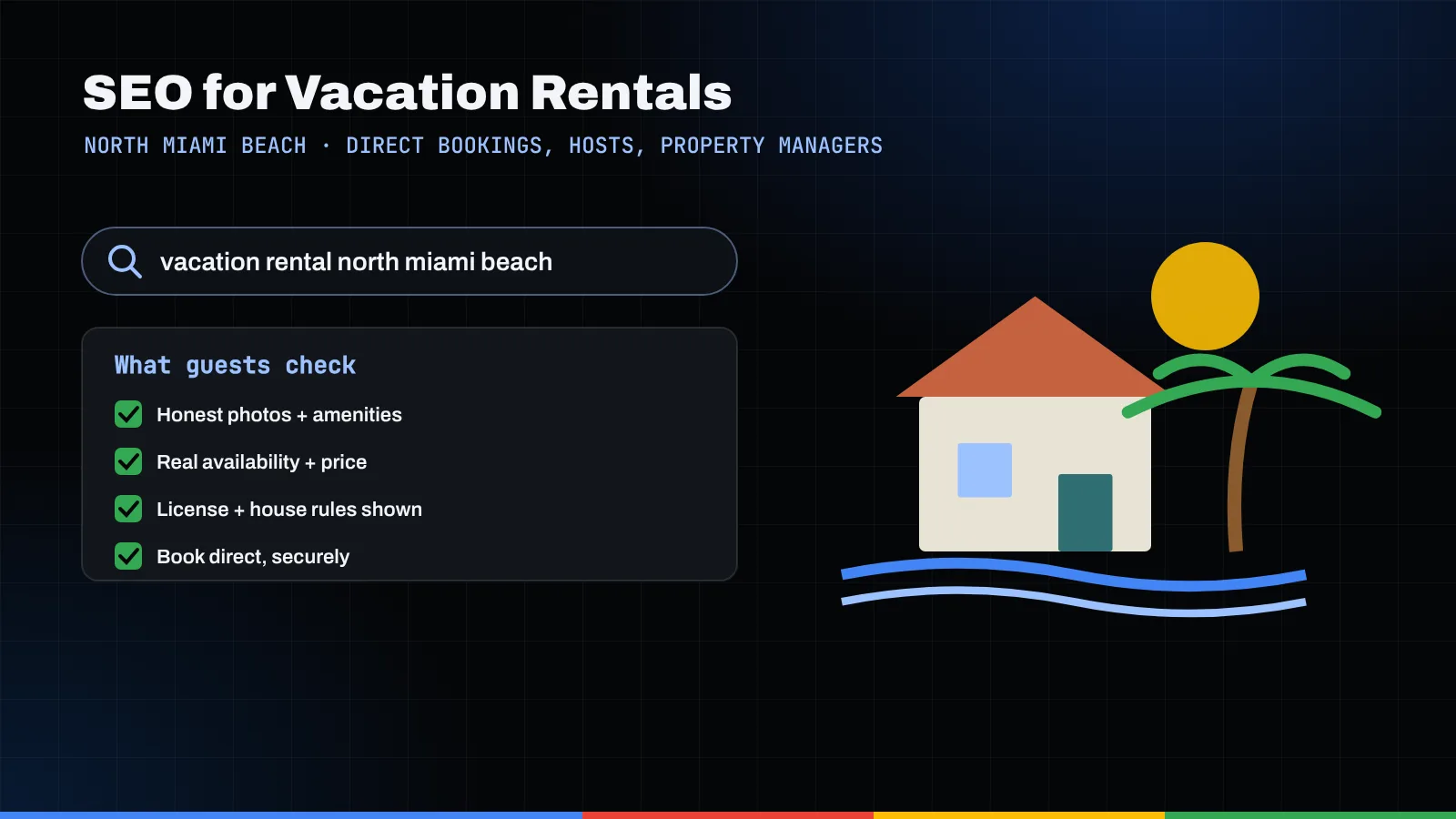
SEO for vacation rentals means giving each property its own search-ready home on your website, so guests can find you, trust you and book you without going through a listing site. Build one page per property with honest photos and full amenity lists, add neighborhood content that answers real trip questions, use VacationRental structured data where it applies, and show your Florida license and house rules in plain sight. Then earn reviews the right way and give past guests a reason to come back direct.
Key takeaways
- A direct booking website with one dedicated page per property gives search engines and guests something specific to land on, instead of a single generic "our rentals" page.
- Google shows vacation rental listings across Search, Maps and Google Travel, but getting in runs through Google's partner program or a connectivity provider, not a Business Profile for an individual home.
- Neighborhood guides earn search visits long before a guest is ready to book, as long as every place you mention is real and every claim is checked.
- Florida vacation rentals are licensed by the DBPR Division of Hotels and Restaurants under Chapter 509, and transient rentals carry state and Miami-Dade County tax obligations; displaying your compliance builds trust.
- Ask every guest for a review the same way, with no rewards attached, and keep past guests close with an email list and a returning-guest page.
Why do direct bookings start with search?
Most hosts start the same way: list the condo on a big booking platform and watch the calendar fill. Then the questions creep in. Who owns the guest relationship? Why can't you email last summer's family about your new two-bedroom? Why does someone else's policy change reshape your season?
A direct booking website is the usual answer, and SEO for vacation rentals is what gets that website found. The listing sites aren't the enemy; they're a fine source of first-time guests. The goal is balance: a site that ranks for the searches guests actually type and turns one-time guests into repeat ones.
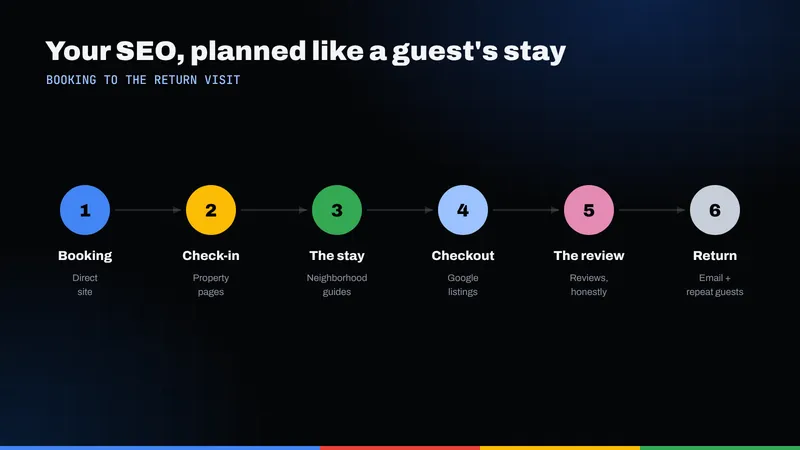
This guide follows a guest's stay, from booking to the return visit. Along the way, imagine a small, hypothetical North Miami Beach operator called Saltgrass Hideaway, with a garden cottage and a couple of condo units. The name is invented for illustration; it isn't a real business or client.
Booking: build a direct booking website with one page per property
Here's the mistake we see most often. A host builds a pretty homepage, adds a booking widget, and lists every unit on one long page with tabs. To a search engine, that's one page about "rentals." To a guest searching for a two-bedroom near the water with a washer and parking, it's a scroll-and-squint exercise.
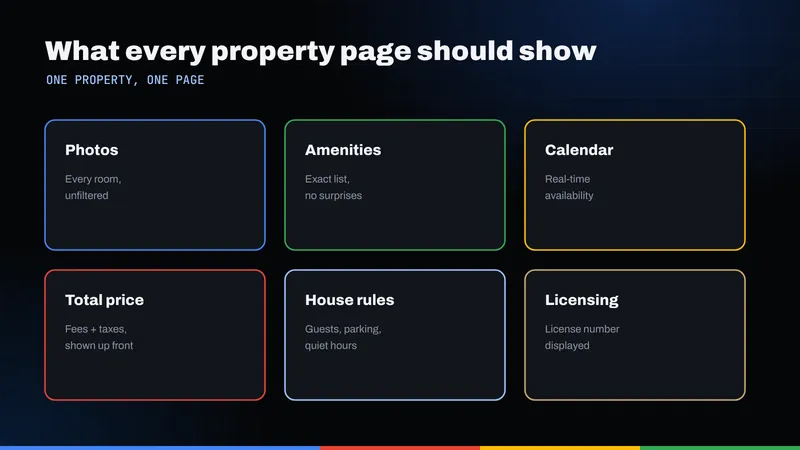
Instead, give each property its own URL. Saltgrass Hideaway, in our example, would have something like /stays/garden-cottage/ and /stays/bayview-two-bedroom/, each with:
- A plain, descriptive title. "Garden Cottage with Private Patio, North Miami Beach" beats a cute name nobody searches for. Keep the cute name; just put the useful words next to it.
- A short, honest summary up top. Bedrooms, bathrooms, how many guests it sleeps, parking, and the single best thing about the place.
- Live availability and a clear price path. Show the nightly rate, cleaning fee and taxes before the final screen. Surprise fees at checkout kill direct bookings faster than anything.
- A booking button that works on a phone. Plenty of guests plan on a laptop and book from the couch on mobile. Test the whole flow on a small screen.
Speed matters here too. A property page loaded with uncompressed photo galleries can crawl on a phone, and slow pages lose bookings. We cover the mechanics in how website speed affects revenue. If you're starting from scratch, our website design team builds direct booking sites around exactly this structure.
Getting into Google's vacation rental listings
There's a second door into Google beyond your organic pages. According to Google's Hotel Center help page on vacation rentals, rental listings can appear on Google Search, Google Maps and Google Travel, where travelers can filter by price, property type, occupancy, amenities and guest rating. Listings show approximate location, rates, availability and a link to book on the partner's own site. Google says partners can show their vacation rentals at no cost, with no fees for Google-generated referrals or bookings.
The catch is how you get in. Google's starter guide for vacation rental property managers says companies with fewer than 500 properties are steered toward an approved connectivity provider, while larger companies may qualify for direct integration. The same guide notes that individual homeowners aren't currently eligible for a Google Business Profile for their physical home. In practice, a small operator usually reaches these listings through the property management or channel software they already use, so ask your software provider whether it connects to Google.
So skip the weekend spent fighting for a Business Profile for the cottage. Make sure your software sends accurate photos, rates and availability, and put the rest of your energy into your own pages. Our guide to hotel SEO in North Miami Beach covers more of Google's lodging tools.
Check-in: honest photos, full amenity lists and house rules up front
Check-in is the moment of truth. The guest opens the door and compares the room with the photos they saw two months ago. If the "ocean view" turns out to be a sliver of blue between two parking garages, no welcome basket fixes the review. That moment is decided long before arrival, on your property page, and honest pages that answer real questions serve guests and search engines alike.
Photos that tell the truth
Shoot every room, in daylight, at eye level. Include the bathroom, the kitchen counter space and the view from the balcony as it actually is. Write descriptive file names and alt text ("garden-cottage-kitchen-island.jpg," "Kitchen with island seating for four") so images make sense to search engines and screen readers alike. If Google's vacation rental structured data applies to you (more on that below), note that Google's documentation lists a minimum of eight photos per listing.
Amenity lists guests can search
Guests filter by amenities, and they type them into search boxes: "vacation rental with washer," "pet friendly condo," "rental with parking." List amenities as plain text on the page, not only as icons. Group them so they're easy to scan:
- Sleeping: bed sizes per room, sofa beds, cribs on request.
- Kitchen and laundry: full kitchen or kitchenette, coffee maker, in-unit or shared laundry.
- Getting around: parking (how many cars, garage or surface), elevator, stairs.
- Work and play: Wi-Fi, a desk, pool access, beach gear.
House rules and your license, in plain sight
Post check-in and checkout times, occupancy limits, quiet hours, parking rules, pet policy and smoking policy on every property page, not hidden in a PDF. Guests who know the rules before they book are less likely to break them.
The same goes for licensing. In Florida, the DBPR Division of Hotels and Restaurants licenses vacation rentals under Chapter 509, Florida Statutes, with separate license types for condos and for dwellings. The division's guide says a license is generally required when you rent an entire unit more than three times in a calendar year for short stays, or advertise it as a place regularly rented to guests, and that you may still be subject to city, county or other local rules. Showing your license number on the property page is a simple, credible trust signal.
Check-in, behind the scenes: VacationRental structured data
Structured data is the label maker for your website. On schema.org, VacationRental is defined as "a kind of lodging business that focuses on renting single properties for limited time," and it sits under LodgingBusiness and LocalBusiness.
Google also publishes documentation for VacationRental structured data, which can help Google Search show a listing's name, description, images, location and rating in richer ways. Read the fine print, though: Google says these instructions are intended for sites that have already connected with a Google Technical Account Manager and have Hotel Center access, and that the feature is limited to sites meeting certain eligibility criteria. Required properties include a unique identifier, occupancy, precise latitude and longitude, a name and at least eight photos.
For most small hosts, the realistic takeaway is this: mark up your property pages accurately with the schema.org vocabulary, keep the details consistent with what's on the page, and don't expect a special search feature unless Google has invited you into the program. Our explainer on how schema helps search engines covers the basics.
The stay: neighborhood guide content guests actually use
Once guests settle in, the questions change. Where can we get outside? What's within a short drive? People type those same questions into Google weeks before they book, which makes a neighborhood guide one of the most useful things a host can publish.
Take one example that's easy to verify. Oleta River State Park sits at 3400 N.E. 163rd St. in North Miami Beach. A rental nearby has an honest hook for a guide page: say where the park is, point guests to the official state park page for current activities, hours and fees, and add tips only someone who's been there can give.
A few ground rules keep neighborhood content useful and safe:
- Only name places you've verified. Check the official site for hours, fees and addresses, and link to it. Don't guess drive times; describe them loosely or use a map link.
- Write from experience. One practical tip beats a paragraph of adjectives.
- Organize by trip type. A page for families, one for remote workers and one for outdoorsy guests will match different searches than a single "things to do" list.
- Keep it current. Review the guide each season. A closed restaurant on your list is a small but real trust leak.
- Link back to the stays. Every guide page should point to the property pages that suit that kind of trip.
If many guests book in another language, consider translated versions of your key pages. Our post on SEO for travel agencies in North Miami Beach touches on how trip planners search, which overlaps heavily with how renters research a destination.
Checkout: taxes, compliance and a clean final bill
Nobody likes a checkout surprise, including the tax collector. A clear, itemized total, with taxes handled correctly behind the scenes, is part of a trustworthy direct booking site. The Florida Department of Revenue's brochure on sales and use tax on rental of living or sleeping accommodations says Florida's 6% state sales tax, plus any applicable discretionary sales surtax, applies to rentals of six months or less, and that anyone renting transient accommodations must register with the Department to collect, report and remit tax. It adds that counties may impose local option taxes such as the tourist development tax, and that most counties self-administer it.
Miami-Dade is one of those. The county's Hotel and Restaurant Taxes page says owners of short-term rentals of six months or less must register with the Miami-Dade Office of the Tax Collector to collect, report and remit the county's tourist taxes, and that each rental accommodation is registered separately. The page lists a 3% Convention Development Tax, a 2% Tourist Development Room Tax and a 1% Professional Sports Franchise Facilities Tax, with exceptions for Surfside, Bal Harbour and Miami Beach.
| Item | Who handles it | Where to check |
|---|---|---|
| Vacation rental license (condo or dwelling) | Florida DBPR, Division of Hotels and Restaurants | DBPR vacation rental licensing guide |
| State sales tax and county surtax on transient rentals | Florida Department of Revenue | DOR brochure GT-800034 |
| Tourist development and convention development taxes | Miami-Dade Office of the Tax Collector | Miami-Dade Hotel and Restaurant Taxes page |
| City zoning, registration or short-term rental rules | Your city | Contact the city directly before you list |
On that last row: local short-term rental rules vary, so we won't guess at specifics. Check with the City of North Miami Beach and your condo or homeowners association before you list. This is a map of where to look, not legal or tax advice; a Florida accountant or attorney can confirm what applies to you.
The review: earning honest reviews without breaking the rules
Reviews are the guest's last word and the next guest's first impression. The rules are clear. Google's Maps user-generated content policy says incentivized or biased reviews aren't allowed and lists offering incentives such as payment, discounts, or free goods or services as prohibited. It also says businesses may not discourage negative reviews or selectively ask only happy customers.
So keep it simple:
- Ask every guest, the same way, a day or two after checkout.
- Don't offer a discount, late checkout or anything else in exchange.
- Reply to reviews, especially critical ones, with specifics and without arguing.
- Fix what the reviews keep mentioning, then update the property page so it stays accurate.
On your own site, quote real reviews with permission, but never write them yourself or polish them. For Saltgrass Hideaway, the right move would be linking to where guests actually reviewed the cottage.
The return visit: turning one stay into repeat direct bookings
The quietest win in vacation rental marketing is the guest who comes back and books direct. They already trust you and know the place.
Make the return trip easy:
- Collect emails with permission during the direct booking process, and send a short, useful note a few times a year: new availability, a seasonal neighborhood update, a new property.
- Build a returning-guest page that explains how to book direct and what's changed since their last stay.
- Keep the brand consistent. If a guest searches "Saltgrass Hideaway" by name, your website should be the first thing they find, with property pages, house rules and a booking button ready.
- Measure what matters. Track direct bookings, booking-page visits and where those visits came from, rather than chasing vanity traffic.
Managing several owners' properties? The structure scales: one page per property, shared neighborhood guides and a single brand guests can remember. Our post on property management SEO in North Miami Beach covers the owner-facing side of that business. For the local search groundwork, see our North Miami Beach SEO services or our broader SEO services.
If you'd like a second set of eyes on your rental site, we'll review your property pages, booking path and search visibility and tell you what we'd fix first. Request a free SEO audit and we'll take it from there.
Frequently asked questions
What is SEO for vacation rentals?
It's the work of getting your own rental website found in search for the trips your guests plan. That usually means one page per property, honest photos and amenity lists, neighborhood content, accurate structured data and a mobile-friendly direct booking path.
Can my vacation rental get its own Google Business Profile?
Usually not for the home itself. Google's vacation rental starter guide for property managers says individual homeowners aren't currently eligible for a Google Business Profile for their physical home. Your website and Google's vacation rental listings are the better routes.
How do vacation rentals show up in Google's lodging results?
Google says vacation rental listings can appear on Search, Maps and Google Travel through its vacation rentals partner program, at no cost. Companies with fewer than 500 properties are pointed toward an approved connectivity provider, so ask your property management or channel software whether it connects to Google.
Do I need a license to run a vacation rental in North Miami Beach?
Florida's DBPR Division of Hotels and Restaurants licenses vacation rentals under Chapter 509, Florida Statutes. Its guide says a license is generally required when you rent an entire unit more than three times a year or advertise it as regularly rented to guests. Local rules may also apply, so check with the city and your association too.
Should I use VacationRental schema on my property pages?
VacationRental is a valid schema.org type for lodging businesses that rent single properties for limited time, and accurate markup helps describe your pages. Google's special VacationRental search feature, however, is limited to eligible partners connected through Hotel Center, so treat the markup as good housekeeping rather than a guaranteed new result.