SEO for hotels in North Miami Beach comes down to being present and convincing at each step of a traveler's trip: discovery, comparison, booking, the stay itself and the review afterward. In practice that means a complete Google Business Profile with accurate hotel attributes, a fast mobile site with Hotel schema, a direct booking path that is easier than the OTA's, honest review practices and pages in the languages your guests actually speak.
Key takeaways
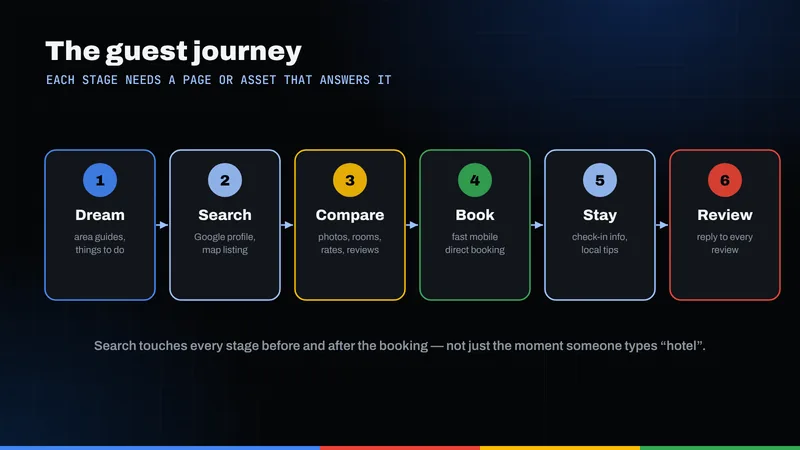
- Follow the guest's journey (discovery, comparison, booking, stay, review) and make sure a page or profile answers the question they ask at each stage.
- Your Google Business Profile and Google's free booking links put your rates next to the OTAs on Google, often before anyone reaches your website.
- Mark up your site with the most specific schema.org type that fits (Hotel, Motel, BedAndBreakfast or VacationRental, all under LodgingBusiness).
- Fake, paid or selectively solicited reviews break Google's policies, and the FTC's 2024 rule on consumer reviews makes several of these practices illegal.
- Separate, properly translated pages for international visitors and a fast mobile booking flow do more for direct bookings than a prettier homepage.
One family, one search: how a stay really begins
Picture a hypothetical family in Toronto in late January. The snow is gray and packed, the kids are restless, and one parent is on the couch typing "quiet hotel near the beach north of Miami." They don't know North Miami Beach from Sunny Isles Beach or Aventura yet. They want warm water, a pool, and a room that doesn't feel like a conference center.
Over the next week or so they'll scroll a map, open photo carousels, read reviews at midnight, compare your rate with the same room on a booking site, and finally tap "Book." Then they'll arrive, swim, sleep, and, if you ask nicely, write a few sentences that the next family will read.
That whole arc is what SEO for hotels is really about. It's not one ranking for one keyword; it's showing up, and making sense, at every point where a traveler is deciding. The rest of this article follows our imaginary family through each stage.
Why the North Miami Beach corridor is its own search market
To a guest, North Miami Beach, Sunny Isles Beach and Aventura blur into one stretch of coast, mall and marina. To Google, they're distinct places with distinct searches: "Sunny Isles hotel" and "hotel near Aventura Mall" may describe rooms a few minutes apart, but the words and results differ.
Be precise about names, too. North Miami Beach is its own city, separate from North Miami and from Miami Beach. Say plainly where you are so neither guests nor search engines have to guess.
Local color helps here, as long as it's accurate. Oleta River State Park, which Florida State Parks lists at 3400 N.E. 163rd St. in North Miami Beach and calls Florida's largest urban park, offers paddling, mountain biking, swimming and wildlife viewing. The Ancient Spanish Monastery, listed on the National Register of Historic Places at 16711 W. Dixie Hwy. in North Miami Beach, is the 12th-century cloister William Randolph Hearst brought over from Spain.
If you operate on more than one side of these city lines, it's worth reading how we approach SEO in Sunny Isles Beach and Aventura alongside our main North Miami Beach SEO page. Each has its own search vocabulary.
Discovery: your Google Business Profile is the front door
When our family first searches, they'll often see a map and a list of hotels before any website. That panel draws on Google Business Profiles, so your profile is the first impression for many guests. Everything we cover in our Google Business Profile guide for North Miami Beach applies, but hotels have a few rules of their own.
Google's help page on getting started with a Business Profile for your hotel spells out several of them:
- Amenities live in "Hotel details." If your hotel profile is verified, you can edit services and amenities there. Google notes that hotel attributes can't be updated through the bulk spreadsheet upload, so multi-property operators need the dashboard or the API.
- Hotels can't set business hours. Google treats hotels as open 24 hours to their guests, so don't waste time trying to add hours.
- Hotel class is assigned by Google. Google evaluates some hotels and assigns a class rating; if you believe yours is wrong or missing, the help page points you to support.
- Prices come from elsewhere. The rates and booking links shown on your profile come from Google Hotel Ads and free booking links, not from the profile itself.
Go through every amenity carefully. A family filters for a pool, a remote worker for Wi-Fi, a couple with a dog for pet policies. Missing or wrong attributes make it harder for those guests to find you. This is the hotel version of the work we do under Google Maps SEO, and the profile is the single asset most worth getting right.
Photos that answer questions
Our family isn't looking for a wide-angle lobby shot at dusk. They want to know how big the room really is, whether the pool has a shallow end, what a standard room's view looks like, and where they'll park. Shoot what guests ask about at the front desk, label room photos by room type so image and rate match, and replace photos when you renovate.
Comparison: putting your rate beside the OTAs
A few searches later, our family has narrowed it to three places and is comparing prices, often right on Google's results page.
Google's free booking links let a hotel's own booking site appear across Google with the room rate, and Google states that hotel partners pay no fee for them. According to that page, properties qualify when they have a bid in a hotel campaign, available rates and a landing page, and hotels without a Hotel Center account can often get set up through their reservation system or integration partner. Google also says ranking takes into account the historical accuracy of the prices you send. In plain terms: if the rate Google shows doesn't match the rate on your booking page, that hurts you.
Short-term rental operators follow a slightly different path. Google's Hotel Center help pages direct vacation rental managers toward a list of approved connectivity partners for getting rates and availability onto Google. If you run a handful of condos in Sunny Isles Beach through a property management system, ask your vendor whether they're one of those partners before you try anything else.
Direct booking vs. OTAs, honestly
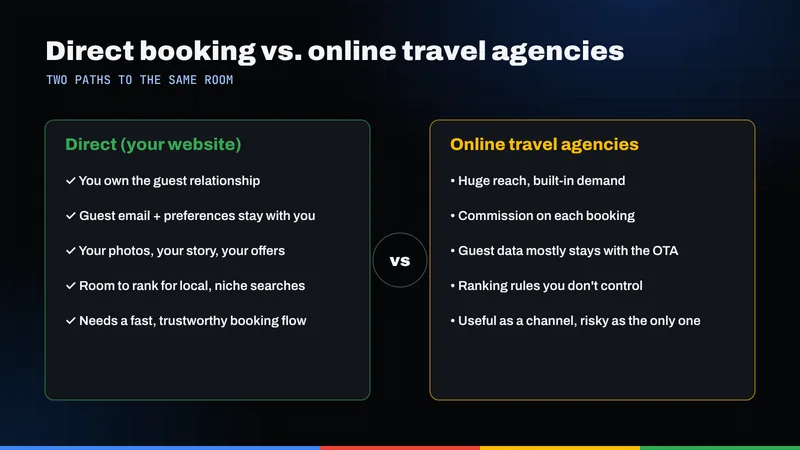
Online travel agencies reach travelers you'd never find alone, and many guests trust them. They also take a commission set by your contract, so check yours rather than trusting anyone's rule of thumb. The goal of hotel SEO isn't to abandon OTAs. It's to make your own site a real alternative, so that a guest who finds you on a booking site can come to yours and get the same or better deal with less friction.
Your website should do what the OTA listing can't:
- Show every room type with its own photos, square footage, bed setup and view.
- Offer something tangible for booking direct, such as flexible cancellation, a late checkout or parking, if your economics allow it.
- Answer the questions OTAs gloss over: resort fees, parking costs, beach access, distance to the nearest grocery store.
- Keep the booking engine on your domain or clearly connected to it, with no surprise redirects.
Booking: the mobile page that has to work at midnight
Our family books late at night, in bed, on a phone with a mediocre connection. This is where good hotels quietly lose guests: the booking engine crawls, the date picker breaks on a small screen, or a pop-up hides the "Continue" button.
Page speed on mobile isn't a technical nicety for hotels; it's the checkout line. Test your site on an actual phone, on cellular data, from the homepage all the way through to the payment screen. Compress images, lazy-load galleries below the fold, and cut unused third-party scripts. We've written about why website speed affects revenue. For hotels, every extra tap is a chance for the guest to retreat to the OTA app that already has their card saved.
Hotel schema: telling search engines what you are
Structured data helps search engines understand your property. On schema.org, Hotel sits under LodgingBusiness, which in turn sits under LocalBusiness. LodgingBusiness includes useful properties such as checkinTime, checkoutTime, amenityFeature, numberOfRooms, petsAllowed and availableLanguage. Google's own local business documentation recommends using the most specific LocalBusiness subtype possible, so a small inn might use BedAndBreakfast and a rental operator might use VacationRental rather than a generic type.
Keep the markup in sync with the page; schema that contradicts your pet policy confuses guests and machines alike. Our explainer on how schema helps search engines covers the basics if you're new to it.
What guests search for at each stage, and what answers it
Here's the journey in one place. For each row, ask whether you have the asset on the right, and whether it's good.
| Stage | What the guest is asking | Typical search | Page or asset that answers it |
|---|---|---|---|
| Discovery | Where should we even stay? | "hotels near Sunny Isles beach," "boutique hotel North Miami Beach" | Google Business Profile with full hotel details; area guide page on your site |
| Comparison | Is this place better or cheaper than the others? | "[hotel name] reviews," "[hotel name] parking" | Room-type pages, honest fees page, free booking links showing your direct rate |
| Booking | Can I book this quickly and trust it? | "[hotel name] book direct," "[hotel name] cancellation policy" | Fast mobile booking engine, clear policies page, Hotel schema |
| Stay | What do we do now that we're here? | "kayak rental near me," "things to do North Miami Beach" | Local guide pages, pre-arrival email, multilingual info pages |
| Review | Should I tell others about this place? | (No search; a request from you) | A polite, unconditional review request and thoughtful public replies |
The stay: local content and pages in your guests' languages
Once our family arrives, they search again, now for things to do nearby. A short guide to a morning paddle at Oleta River State Park, a rainy-day visit to the monastery, or getting to Aventura without a car serves guests on the property and future guests still planning.
Plenty of visitors to this coast don't search in English. If many of your guests come from Latin America, Brazil, Quebec or Europe, translated pages are worth it. Google's guidance on managing multilingual sites is specific:
- Use a different URL for each language version rather than switching language with cookies or browser settings.
- Don't automatically redirect visitors to a language version based on guesses; give them links to choose.
- Use hreflang annotations so Google can show the right language version in results.
- Translate the main content, not just the navigation. Google notes that translating only the boilerplate creates a poor experience.
We go deeper on this in our post on Spanish and multilingual SEO in North Miami Beach. For hotels, translate room types, policies, the booking flow and the area guide first.
The review: asking, answering, and staying on the right side of the rules
A week after checkout, our family gets a short email thanking them and linking to the review page. That's the whole request: no discount, no contest, no "only if you loved it."
Reviews matter, which is why the temptation to game them is real. Don't. Google's prohibited and restricted content policy says fake engagement isn't allowed and will be removed, and it specifically bars businesses from offering incentives such as payment, discounts or free services in exchange for reviews, from discouraging negative reviews, and from selectively soliciting positive ones. It also bars reviews based on a conflict of interest, which can include current or former employees.
The federal rules go further. In August 2024 the FTC announced its final rule banning fake reviews and testimonials. Among other things, it prohibits creating, buying or knowingly disseminating fake reviews, paying for reviews conditioned on a positive or negative sentiment, undisclosed reviews from company insiders, and suppressing negative reviews through baseless legal threats or intimidation. The FTC says it can seek civil penalties against knowing violators. For a hotel, that rules out "free breakfast for a five-star review," asking staff or relatives to post reviews without disclosure, and threatening a guest over a bad one.
How to reply like a good host
Replies are public and they're read by the next family, not just the reviewer. A few habits help:
- Reply to the specific stay. Thank the guest for the detail they mentioned, whether that was the pool, the staff or the view.
- Handle complaints briefly and without argument. Acknowledge the problem, say what you've changed if anything, and invite them to contact you directly.
- Never reveal private details. Room numbers, booking info and anything personal stay out of public replies.
- Answer questions future guests will have. If a review says parking was confusing, your reply can explain where to park. That reply now works like a tiny FAQ.
Putting it together: a practical plan for hotels and rentals
Whether you run a boutique inn, a mid-size hotel or a few rentals, here's a sensible order of work. It mirrors the way we approach local SEO and broader SEO in Miami for hospitality clients.
- Audit your Google Business Profile. Confirm category, address, phone, link and every hotel attribute; add real photos of each room type.
- Check your rates on Google. If your direct rate doesn't appear beside the OTAs, ask your booking engine or channel manager about free booking links.
- Fix the mobile booking flow. Test end to end on a phone over cellular data.
- Build one page per room type and one honest policies page. Cover fees, parking, check-in, pets and accessibility.
- Add accurate structured data. Most specific lodging type, consistent with the page.
- Write local guides that guests actually use. Specific to your neighborhood, not all of Miami.
- Translate the pages that convert. Separate URLs, hreflang, and real translation of the main content.
- Set up an honest review routine. Ask every guest the same way, reply to every review, and never offer anything in exchange.
None of this is glamorous. Local SEO in Miami rewards properties that do the basics well and keep them current. Request a free SEO audit and we'll walk through your profile, site and booking path the way a guest would.
Frequently asked questions
What is the most important part of SEO for hotels?
For most independent hotels, the Google Business Profile and the mobile booking path matter most. The profile is often the first thing a traveler sees, and the booking flow is where interest becomes a reservation.
Do free booking links cost anything?
Google states that hotel partners pay no fee for free booking links. To be eligible, a property needs available rates and a landing page, and many hotels connect through their reservation system or an integration partner rather than setting up Hotel Center on their own.
Which schema type should a boutique inn or vacation rental use?
Use the most specific type that fits. On schema.org, Hotel, Motel, BedAndBreakfast and VacationRental all fall under LodgingBusiness. Pick the one that matches how you operate.
Can we offer guests a discount for leaving a review?
No. Google's review policy prohibits offering incentives such as payment, discounts or free services in exchange for reviews, and the FTC's 2024 rule bans paying for reviews conditioned on a particular sentiment. Ask every guest the same way, with no reward attached.
Do we need translated pages for international guests?
If a meaningful share of your guests search in another language, translated pages help. Google recommends a separate URL for each language, hreflang annotations, and no automatic language redirects. Translate the main content, especially room types, policies and booking steps, not just the menu.