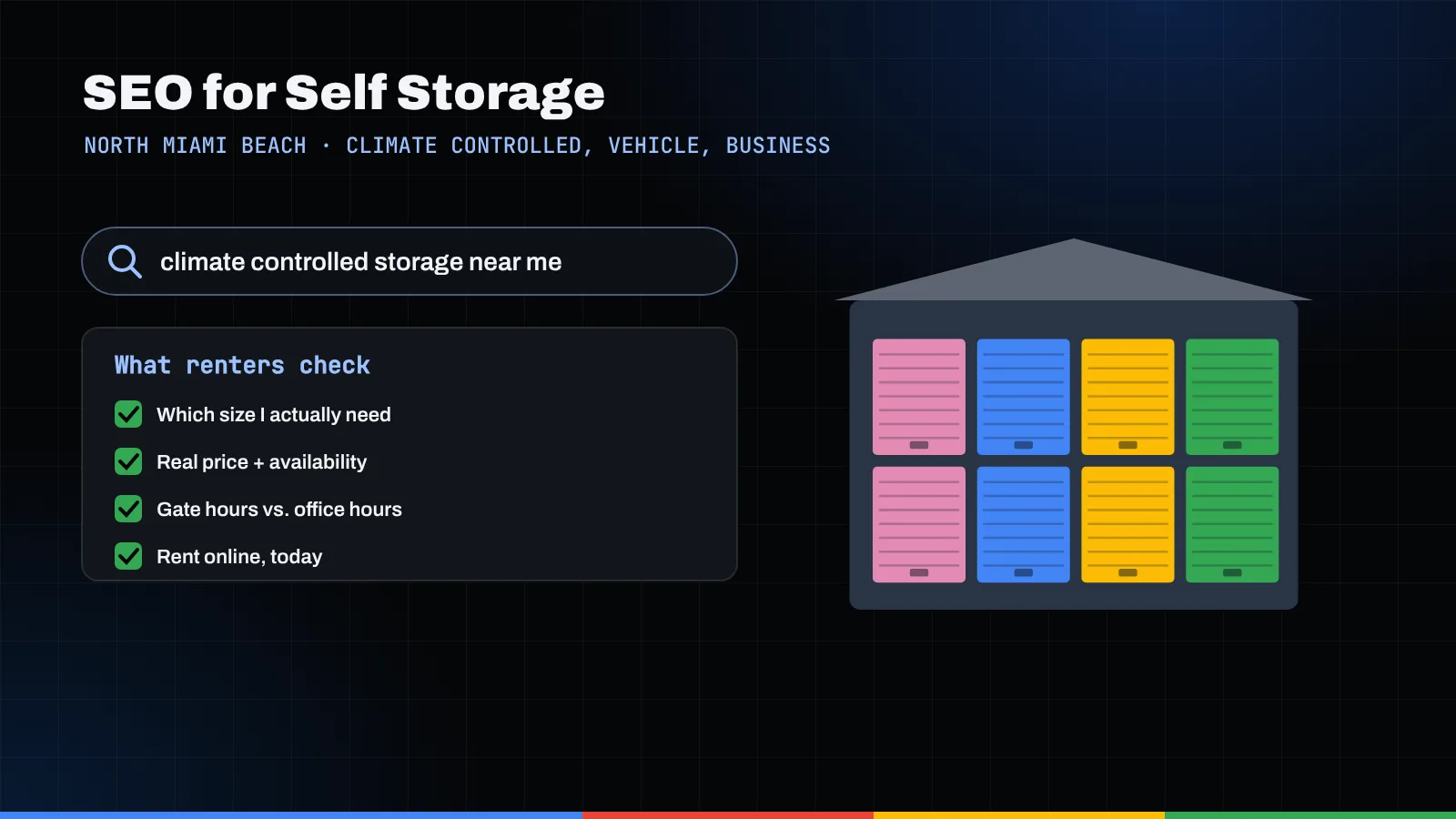
SEO for self storage works best when you treat the website like your rent roll: one row per unit type, one row per feature, and every row kept accurate. For a North Miami Beach facility, that means a page for each kind of storage people search for, a size guide built from your own units, live availability with online rental, Google Business Profile hours that match reality, transparent pricing, reviews earned the way Google allows, and SelfStorage structured data.
Key takeaways
- People search for storage at a life moment: a move, a renovation, a downsizing, a seasonal departure, a storm or a business that ran out of room. Build pages for each moment and each unit type.
- A size guide built from your actual units (measured, photographed, with door sizes) answers the question nearly every first-time renter has.
- Office hours and gate hours are different things. Decide which ones Google shows as regular hours and spell out both on your site.
- Show the full price picture, including fees and how promotions end, and keep availability synced so you never rent a unit you don't have.
- Florida's self-storage law (F.S. 83.801 to 83.809) sets specific rules for denying access and lien sales; if you explain them on your site, quote the statute and have your attorney review the page.
Move-in day: who is searching for storage, and why now?
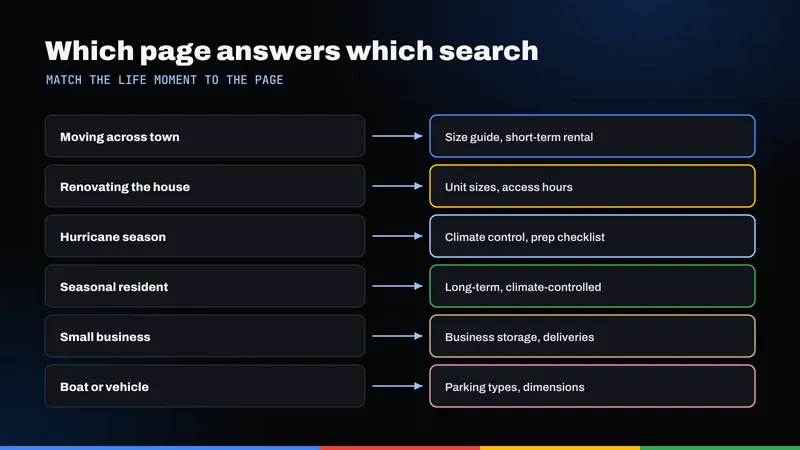
Nobody wants a storage unit for its own sake. They want one because something changed, and that change is the most useful fact in SEO for self storage, because it's what they type into Google. Around North Miami Beach, the searches tend to come from a handful of situations:
- The move. A lease ends before the next one starts, or a closing date slips. The search is often "storage near me" with a deadline attached.
- The renovation. A kitchen or flooring job means the furniture has to go somewhere for a few weeks.
- The downsizing. A move from a house to a condo, or a family sorting through a parent's home.
- The seasonal resident. Someone who spends part of the year in South Florida and wants their things kept somewhere dry and secure while they're away.
- Hurricane season. People looking to move valuables, documents or vehicles somewhere they feel is safer, often in a hurry.
- The small business. Inventory, files, equipment or seasonal stock that has outgrown a back room.
- The vehicle or boat owner. A car, motorcycle, trailer or boat that has no place at home or at the condo.
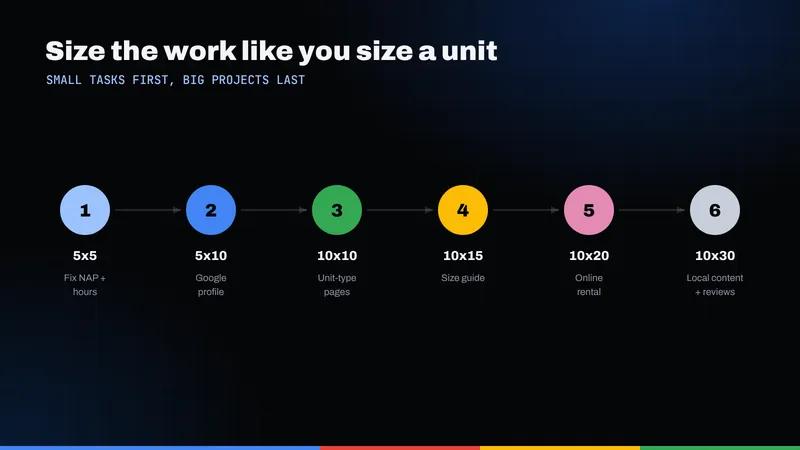
Each wants a different answer, even if they rent the same 10x10. Below, the work is sorted the way you'd walk a facility: unit by unit, smallest task to largest.
The 5x5: get your Google Business Profile hours right
The smallest unit, and the quickest fix. Storage has a quirk most local businesses don't: the office and the gate keep different schedules. If your profile shows only one, someone will drive over at the wrong time.
Google's guidelines for representing your business ask you to "provide your regular customer-facing hours of operation," to use special hours for holidays and closures, and, where Google offers additional "More hours" types, to set them as a subset of your primary hours. Here is the 5x5 checklist:
- Pick one set of regular hours on purpose. Decide whether the hours customers act on most are office hours or access hours, and keep that choice consistent with Google's rule that More hours sit inside the primary hours.
- Publish both schedules on your website. A clear "Office hours" and "Gate access hours" block on the home page and the contact page, in the same format.
- Use special hours before every holiday and any storm-related closure, so the profile doesn't promise an open office that isn't.
- Keep the business name your real-world name. Google doesn't allow taglines or keywords in the name field, so "climate controlled" belongs in your description and services, not your name.
- Choose the fewest, most specific categories that describe what the business is, which is the standard Google sets for categories.
For the rest of the profile, our Google Business Profile guide for North Miami Beach covers photos, services and posts in detail.
The 5x10: a size guide built from your own units
"What size storage unit do I need?" is the question almost every first-time renter has, and most facility websites answer it with a generic graphic. Your advantage is that you have the actual units. Measure them, photograph them, and build the guide from that.
The floor area below is simple arithmetic. Everything in the right-hand column comes from you, because what fits depends on ceiling height, door width and how a customer packs.
| Unit size | Floor area | What the size guide page should show |
|---|---|---|
| 5x5 | 25 sq ft | Photo with a reference object (a standard moving box or a person), ceiling height, whether it's a locker or walk-in, interior or drive-up |
| 5x10 | 50 sq ft | Door width and height, photo from the doorway, a short list of what your own staff have seen customers fit |
| 10x10 | 100 sq ft | Floor plan sketch, climate-controlled or not, distance from the elevator or loading area |
| 10x15 | 150 sq ft | Ceiling height, roll-up door size, whether a dolly or cart is available on site |
| 10x20 | 200 sq ft | Drive-up access, whether it's offered for business inventory, whether vehicle storage is allowed inside units (and under what rules) |
| 10x30 and larger | 300+ sq ft | Who typically uses it (businesses, whole-home moves), door clearance, any loading dock access |
Three rules keep the size guide honest:
- Don't promise what fits. Write "customers have used this size for…" only if your staff has actually seen it, and suggest a call when someone is unsure.
- Link each size to live availability so the guide doesn't end at a dead end.
The 10x10: one page per unit type and feature
This is the workhorse unit, and the bulk of the site. Google ranks pages, not facilities. If "climate-controlled storage," "boat storage" and "business storage" all live as bullet points on one services page, none of them has a page that can rank on its own for the search that matches it.
A clean map of which page answers which search looks like this:
| Search the customer types | Page that should answer it | What that page needs |
|---|---|---|
| climate controlled storage near me | /climate-controlled-storage/ | What "climate controlled" means at your facility (temperature range, humidity control or not, stated plainly), which sizes have it, interior access |
| self storage North Miami Beach | Home page | Address, both sets of hours, unit types, size guide link, rent-online button |
| boat storage / RV storage / car storage | /vehicle-storage/ (or separate pages if you offer all three) | Space lengths, covered or uncovered, paved or not, access rules, required registration and insurance documents |
| business storage / inventory storage | /business-storage/ | Delivery acceptance policy, loading area, larger units, invoicing options |
| what size storage unit do I need | /storage-unit-sizes/ | The size guide above |
| storage for moving | /moving-storage/ | Short-term options, truck access, packing supplies if sold on site |
| document storage / wine storage | Only if you actually offer it | The specific conditions you provide, with no implied guarantees |
Only build a page for a service you actually provide, and keep URLs plain and descriptive.
The move connection matters here. Storage customers often need a mover too, and movers' customers often need storage. If you're curious how the other side of that search works, our post on moving company SEO in North Miami Beach walks through it. The same goes for downsizing clients who need things hauled away before anything goes into a unit, which we covered in junk removal SEO.
The 10x15: real-time availability, online rental and honest pricing
Once someone finds the right page, the next question is simple: do you have one, what does it cost, and can I rent it now? Storage is one of the few local businesses where a visitor can finish the whole transaction online, so the website should let them.
Availability
- Connect the website to your management software so availability updates by itself. A manual "call for availability" page goes stale quickly.
- Show availability by size and feature, not just by size. "10x10, climate-controlled, interior, ground floor" is a different product from a drive-up 10x10.
- Offer a waitlist for sold-out sizes.
Online rental
- Keep the flow short: unit, move-in date, contact details, ID and payment, lease signature.
- Send a confirmation that repeats gate hours, office hours and how to get the gate code.
Pricing
Customers compare storage prices closely, so clarity is an advantage:
- Show the monthly rate for each unit, and if online rates differ from walk-in rates, say so.
- List every fee that applies at move-in, such as an administrative fee, a required lock or a protection or insurance requirement, before checkout.
- Explain promotions completely. If "first month discounted" applies only to certain sizes or ends after a set period, put that next to the offer, not in the lease.
- State how rate changes work in plain language, so a tenant isn't surprised later.
Tightening rental flows like this is what our conversion optimization work focuses on.
The 10x20: hurricane-season content that stays accurate
A bigger unit, because this is where storage sites often say too much. The National Weather Service states that the Atlantic hurricane season runs from June 1 to November 30, and storm-related storage searches tend to cluster around watches and warnings. A good hurricane page earns those visits without overpromising.
What to include:
- Your facility's storm procedures. Whether the office closes, whether gate access changes, how tenants will be notified and where updates will be posted. Then actually update your Google Business Profile with special hours when it happens.
- Construction facts you can document. If your buildings have specific features, describe them factually. Avoid words like "hurricane-proof" or "flood-proof" unless you have engineering documentation to back them up.
- Practical advice that points to official sources. The NWS hurricane preparedness page recommends reviewing your insurance policies to make sure you have adequate coverage for your home and personal property. That's a natural point to explain what protection your facility offers or requires, and what it does not cover.
- A link to local emergency information. Miami-Dade County's hurricane hub covers alerts, evacuation and preparedness, and it's the right place to send people for anything beyond storage.
Review this page every spring.
The 10x30: reviews, handled the way Google allows
A large, long-term unit. Reviews accumulate slowly and count for a long time, so the process matters more than any single push. Google's prohibited and restricted content policy says businesses may not offer incentives for reviews, may not discourage negative reviews or selectively solicit positive ones, and that content based on a conflict of interest, which can include current or former employment, isn't allowed.
A compliant review process for a storage facility:
- Ask everyone at the same two moments: a few days after move-in, and at move-out. Not only the tenants who seemed happy.
- No discounts, free months or gifts tied to leaving a review.
- Staff and family don't review the facility.
- Reply to every review, positive or negative, without sharing account details. Storage disputes often involve billing, so take specifics offline.
- Fix what reviews point to. Repeated gate-code complaints are an operations issue, not a marketing one.
Lien and access rules: say what the statute says, nothing more
Tenants search for what happens if they fall behind on rent. In Florida, self storage is governed by Part III of Chapter 83 of the Florida Statutes, which s. 83.801 says may be cited as the "Self-storage Facility Act" (sections 83.801 to 83.809). A few points the statute states directly:
- Under s. 83.8055, if a tenant fails to pay rent when due, the owner may, without notice, after 5 days from the date rent is due, deny the tenant access to the property.
- Under s. 83.806, before a lien sale the owner must send written notice (in person, by email, or by first-class mail with a certificate of mailing) that includes an itemized claim and a demand for payment within a period of not less than 14 days after delivery, among other requirements.
- The same section allows the sale to be advertised in a newspaper or conducted on a public website that customarily conducts personal property auctions, and it lets the tenant redeem the property before the sale by paying the amount due plus reasonable expenses.
- For motor vehicles and watercraft, s. 83.806 allows the owner, after rent has gone unpaid for 60 days, to sell the vehicle or watercraft under that section or have it towed.
On your site, keep this page short and factual: when rent is due, how to pay, how late fees work under your lease, and who to call. Link to the statute rather than paraphrasing it loosely, and have your attorney review the page. We're an SEO agency, not a law firm, and nothing here is legal advice.
The climate-controlled unit: SelfStorage structured data
Structured data is the climate control of a storage site: invisible, but it keeps things in order. Schema.org has a dedicated SelfStorage type, described simply as "a self-storage facility," which sits under LocalBusiness. That means it can carry the standard local business properties, including name, address, phone, opening hours (with openingHoursSpecification, which is useful for separating office and access schedules on the page) and priceRange.
Say a facility we'll call Tidecrate Storage (a made-up name for this example) wants to mark up its home page. The core would look like this, with real values swapped in:
{
  "@context": "https://schema.org",
  "@type": "SelfStorage",
  "name": "Tidecrate Storage",
  "url": "https://www.example.com/",
  "telephone": "+1-000-000-0000",
  "address": { "@type": "PostalAddress", "addressLocality": "North Miami Beach", "addressRegion": "FL" },
  "openingHoursSpecification": [ { "@type": "OpeningHoursSpecification", "dayOfWeek": "Monday", "opens": "09:00", "closes": "17:00" } ]
}
The markup must match what's visible on the page and on your Google profile. For more on why this helps, see how schema helps search engines.
The ledger: tracking what each page rents
Report on the website the way you track occupancy. Once a month, check:
- Rentals and reservations by landing page. Did the climate-controlled page produce climate-controlled rentals?
- Calls from the Google Business Profile and requests for directions.
- Search queries per page, to spot gaps such as boat searches landing on a general vehicle page.
- Waitlist sign-ups by size, which tell you what to promote and what to stop advertising.
- Review count and response time.
If you'd rather have a team build and maintain this, our local SEO and North Miami Beach SEO services cover the profile, the pages and the reporting. Start with a free audit and we'll walk your site unit by unit.
Frequently asked questions
What is the most important part of SEO for self storage?
Matching pages to searches. Each unit type and feature people search for, such as climate-controlled, vehicle or business storage, should have its own accurate page linked to live availability, alongside a correctly set up Google Business Profile.
Should my Google Business Profile show office hours or gate hours?
Google asks for your regular customer-facing hours and says any additional hours should be a subset of those primary hours. Choose deliberately, keep it consistent, and list both office and gate access hours clearly on your website.
Is there a schema.org type for storage facilities?
Yes. Schema.org has a SelfStorage type, a kind of LocalBusiness, so it supports properties such as address, telephone, opening hours and price range. The markup should match what is visible on your page.
Can I offer a discount for a Google review?
No. Google's policy prohibits incentives for reviews and selectively asking only happy customers. Ask every tenant the same way, at the same moments, without any reward attached.
Should a storage website explain Florida lien rules?
A short, factual page can help tenants, but it should link to the statute (F.S. 83.801 to 83.809) rather than paraphrase it loosely, and your attorney should review it before it goes live.