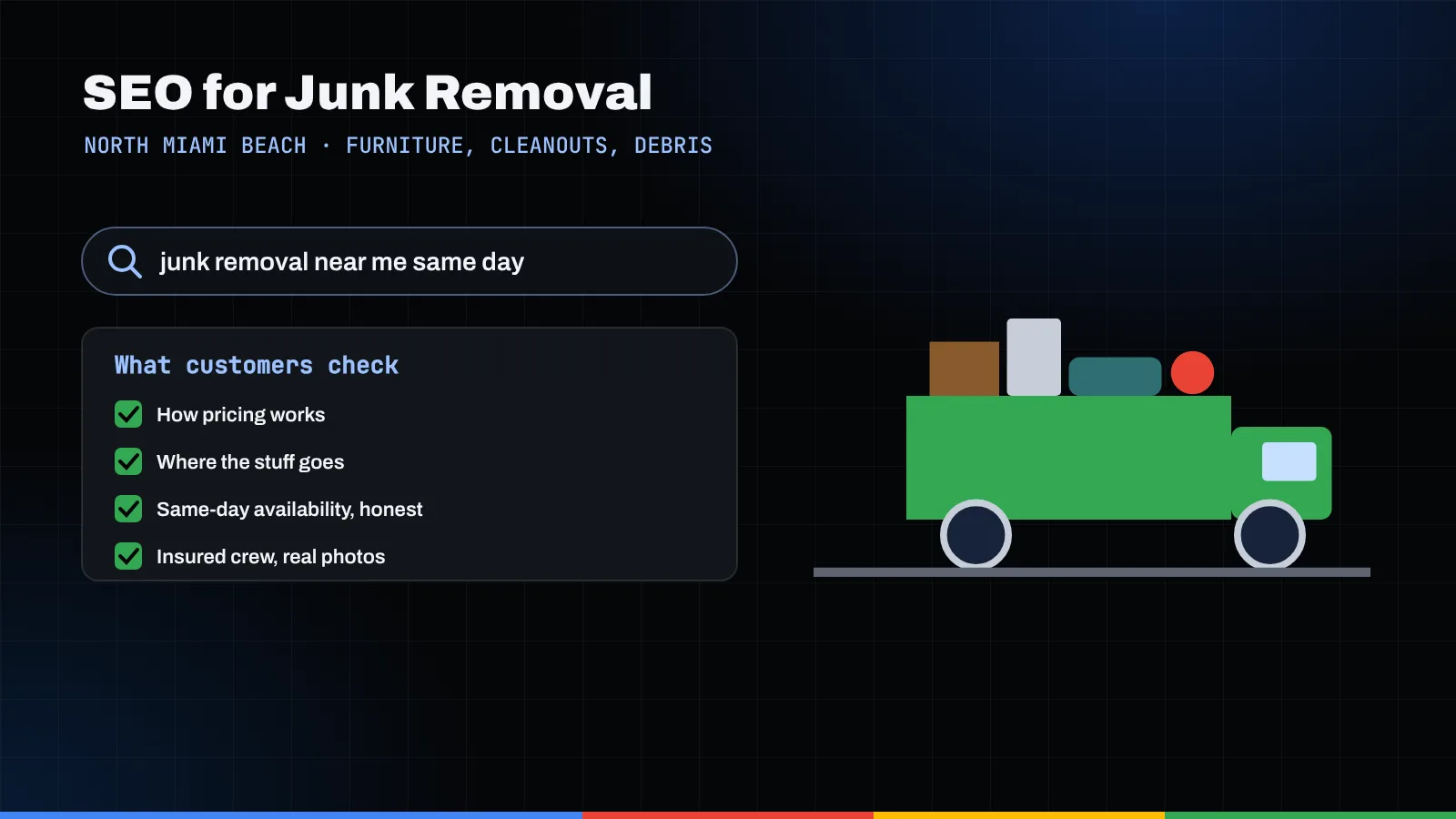
SEO for junk removal comes down to being easy to find and easy to trust at the moment someone stares at a broken couch or a garage full of a late parent's things. For a North Miami Beach hauler, that means a Google Business Profile set up correctly for a service-area business, one page per job type, a pricing page that explains how volume-based quotes work, honest information about where the stuff goes, and a steady flow of real reviews.
Key takeaways
- Junk removal is a service-area business on Google: hide a home address, keep the service area realistic and use your real-world business name.
- Build a page for each job customers actually search for, from appliance haul-away to condo move-outs to construction debris, instead of one long "services" list.
- Explain how pricing works (by truck volume, by item, minimums, what changes a quote) without publishing numbers you can't stand behind.
- Be specific about disposal: Miami-Dade requires a county hauler permit to transport solid waste over public streets, and refrigerators and window AC units need their refrigerant recovered before final disposal.
- Ask every customer for a review the same way, never pay or trade for one, and track calls and quote requests by page so you know which work the site is bringing in.
Walkthrough: who's actually searching for a junk hauler?
Every cleanout starts with a walkthrough: the crew lead looks around and decides what goes on the truck first. SEO for junk removal starts the same way, with a walk through the people who search for you, because they aren't one audience. Around North Miami Beach, they usually fall into a few situations:
- The one-item emergency. The new mattress arrives Thursday, so the old one has to go by Wednesday.
- The condo move-out. A closing date, a building with elevator rules, and a living room that's still full.
- The estate cleanout. A family member or executor needs a whole home emptied, often from out of state.
- The contractor. Drywall, cabinets and tile that need to leave the job site.
- The yard or the storm. Palm fronds, branches and fencing.
- The property manager. Repeat turnovers and abandoned items.
Each one searches differently and trusts different signals, which is why one homepage that says "we haul junk" doesn't win much. Junk removal SEO gives each walkthrough its own clear path.
To keep this concrete, imagine a company we'll call Haulbright Junk Co., a made-up two-truck outfit in North Miami Beach that does all of the above. Haulbright isn't real and isn't a client. It's the truck we'll load as we go.
Crew lead's note: if your phone log shows three types of calls, your website should have at least three types of pages. Start there.
Load the truck: how should a junk removal company set up its Google profile?
The Google Business Profile goes on the truck first, because it's what shows in the map pack for "junk removal near me." Most haulers have no storefront, which makes them service-area businesses under Google's Business Profile guidelines rules:
- Hide your address if customers don't come to you.
- Keep the service area realistic. Google says service areas generally shouldn't extend farther than about two hours of driving time from where the business is based.
- Use your real-world name. "Haulbright Junk Co." is fine. "Haulbright Junk Co. Cheap Same Day Junk Removal Miami" is the kind of stuffing the guidelines prohibit.
Then fill it out like you mean it: the most accurate primary category, services that match your site's pages, and photos of real trucks, crews and cleared-out rooms. A truck with your name on the door beats a stock photo of a stranger holding a box.
For a deeper walk through the profile itself, see our Google Business Profile guide for North Miami Beach businesses, and if you want help with the map side specifically, that's what our Google Maps SEO work covers.
Crew lead's note: the fastest way to lose a profile is to "fix" it with keywords in the name or a fake storefront address. Don't load what you'll have to unload later.
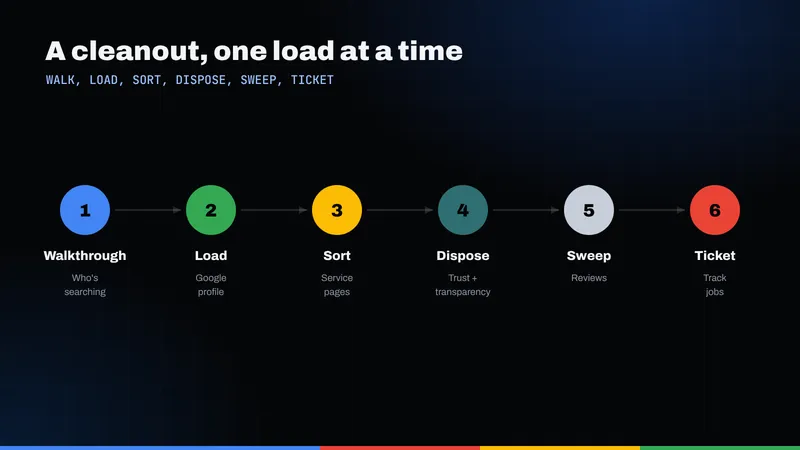
Sort: which service pages should a junk removal site have?
At the curb, the crew sorts the load. Your site needs the same sorting. Someone searching "appliance removal North Miami Beach" should land on an appliance removal page, not a homepage that mentions appliances once between hot tubs and pianos. Here's a starting sort for Haulbright:
| Job | What customers search | Page to build |
|---|---|---|
| Furniture haul-away | "couch removal," "furniture pickup near me," "old mattress removal" | Furniture & mattress removal page with what you take, how pickup works, and where items go |
| Appliance haul-away | "refrigerator removal," "washer and dryer haul away," "old appliance pickup" | Appliance removal page that explains refrigerant handling and recycling |
| Estate cleanout | "estate cleanout service," "clean out parent's house," "house cleanout after death" | Estate cleanout page written for families and executors, with a clear process and a private walkthrough option |
| Condo move-out | "condo cleanout," "move out junk removal," "apartment furniture removal" | Condo & apartment move-out page covering building rules, elevators and scheduling |
| Construction debris | "construction debris removal," "drywall removal," "remodel debris haul away" | Construction & renovation debris page for contractors and homeowners |
| Yard waste | "yard debris removal," "branch removal," "palm frond pickup" | Yard waste removal page with what counts as green waste |
| Hurricane debris | "storm debris removal," "hurricane cleanup hauling" | Storm debris page that's useful before and after a storm (more on this below) |
A few things make these pages work rather than just exist:
- Say what you don't take. Paint, chemicals and tires often have special rules; a short list saves phone time.
- Show the process in plain steps, with before-and-after photos from your own jobs.
- Add structured data. Schema.org's HomeAndConstructionBusiness type is a subtype of LocalBusiness. There's no junk-removal subtype, so use one of those and describe your services in the markup. Our post on how schema helps search engines explains what that does and doesn't do.
Add location pages only where you genuinely work and can say something specific. Pages that just swap city names don't help.
Quote at the curb: how should a pricing page explain junk removal costs?
"How much does junk removal cost" is the most natural question in this business, and a page that dodges it loses the visitor. You don't need a price list. You need to explain how pricing works:
- The pricing model. Junk removal is commonly priced by how much truck space the load takes (often in fractions of a truckload), by the item, or by the job. Say which you use.
- What moves the quote up or down. Volume, weight (concrete and tile are heavy), stairs and long carries, items that need special handling, and disposal fees for certain materials.
- How the quote happens. On-site estimate, photo quotes by text, or both. State whether the price you quote on site is the price you charge before loading.
- Minimums and extras. Say if there's a minimum, and list item categories that cost extra.
Don't post "starting at" prices you don't honor. If you publish prices, keep them current and true.
Crew lead's note: a pricing page that explains why a half truck costs more than a quarter truck builds more trust than a page that just says "affordable."
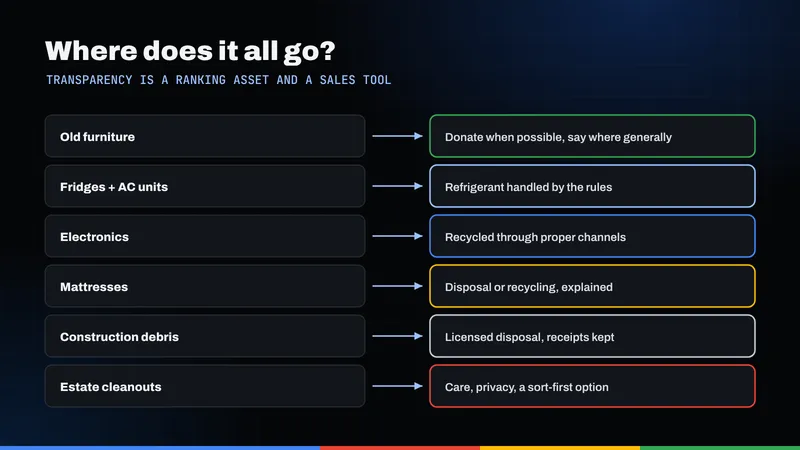
Donate, recycle, dispose: how does disposal transparency build trust?
Every load splits three ways: donate, recycle, dispose. Customers ask where their stuff goes, and a clear answer is one of the strongest trust signals a hauler has.
Permits and paperwork
Miami-Dade County's Department of Solid Waste Management states that a General Hauler Permit is required for anyone removing, collecting or transporting solid waste over public streets or rights-of-way in the county, including incorporated cities. The county also offers a Small Hauler Permit for one-vehicle hauling businesses. Permitted companies must keep company information affixed to their vehicles and carry required insurance. If Haulbright holds a county hauler permit, its website should say so, and the permit number on the truck door should match what's on the site.
That's less a ranking factor than a conversion factor: people pick the hauler that shows it's permitted and insured.
Appliances with refrigerant
Refrigerators, freezers and window air conditioners can still hold refrigerant when they're hauled away. The EPA's safe disposal requirements under 40 CFR Part 82, Subpart F, put responsibility on the final party in the disposal chain, such as a scrap recycler or landfill, to make sure refrigerant was recovered. That party either recovers it or gets a signed statement or contract verifying recovery, including who recovered it and when. The EPA notes that a sticker alone isn't accepted as proof.
On your appliance page, explain how you handle these units and claim only what you actually do.
Donation and recycling partners
Describe partners generally unless you have permission to name them: usable furniture to local charities when they'll accept it, metal to scrap recyclers, electronics to electronics recyclers. Don't promise "everything" gets donated or recycled.
Crew lead's note: "We donate what we can, recycle what we can, and dispose of the rest properly" is better copy than "100% eco-friendly," because it's true.
Storm duty: how should haulers handle hurricane debris content?
Storm debris searches arrive in bursts, so build the page months ahead and ground it in official guidance. Miami-Dade's hurricane waste disposal guidance tells residents not to begin tree pruning or cleanup, or put trash at the curb, once a tropical storm or hurricane watch or warning is issued, and to arrange bulky waste pickups before a storm threatens. It also points people whose waste service isn't provided by the county to their city for removal options.
That suggests a simple structure:
- Before the season: get yard waste, old furniture and loose items hauled early, while schedules are open.
- When a watch or warning is issued: don't put anything on the curb. Follow official instructions.
- After the storm: what you haul (fallen branches, damaged fencing, ruined furniture), how scheduling works when demand spikes, and a reminder to check with the city about municipal debris collection first.
Skip "same-day storm cleanup" promises you can't keep when every crew is booked.
Handle with care: how should an estate cleanout page sound?
Estate cleanouts are the most sensitive work a hauler does. The reader may be grieving or managing things from another state, so the page should read like it was written by someone who has stood in that kitchen. It helps to include:
- A calm process. Walkthrough, a hold-back list for anything the family wants to keep, sorting for donation, removal, and a final sweep.
- Respect for personal items. Say what your crew does when it finds photos, documents or anything that looks valuable. Setting it aside for the family is the answer people hope to read.
- Remote coordination. How you work with an executor or agent who isn't there, with photo updates.
- Plain language. No jokes or slogans on this page.
Estate work often overlaps with real estate and moving. If you partner with movers, our post on SEO for moving companies in North Miami Beach covers how that side of the industry is found online. If property managers are a big share of your calls, the property management SEO guide shows what those buyers look for.
Sweep up: how should junk removal companies get reviews?
The sweep-up is the last thing the customer sees, so the review request should follow it. The rules are strict.
Google's review content policy prohibits incentivized reviews, selectively asking only happy customers for reviews, and discouraging negative ones. The Federal Trade Commission's final rule on fake reviews, announced in August 2024, bans fake reviews, incentives tied to a positive or negative review, undisclosed reviews from insiders, and review suppression through threats or intimidation.
A clean system for a company like Haulbright:
- After every job, the crew lead or office sends the same short text with the review link to every customer.
- No discounts, gift cards or "$10 off your next haul" for reviews. Not even for honest ones.
- Reply to every review, including the critical ones, without sharing private details about the job.
Crew lead's note: customers who mention specifics, like "cleared my mom's condo in one visit" or "took the old fridge and the dryer," write the reviews that help most. You can't script them, but you can earn them.
Dump ticket: how do you track whether SEO is working?
The dump ticket proves the load went where it should. Your marketing needs the same receipt, or you can't tell whether the condo page brings in jobs or just visitors. Track:
- Calls and quote requests by source. Use call tracking and form tracking so you can see whether a lead came from the Google profile, a specific service page, or an ad.
- Profile actions. Calls, website clicks and direction requests from your Business Profile.
- Booked revenue by channel. Not just leads. A page that sends fewer but larger jobs might be your best page.
Paid search can sit alongside SEO. Google's Local Services Ads list "Junk removal services" as a supported category in the United States, and businesses that pass Google's screening can earn the Google Verified badge. For haulers who want calls while organic rankings build, that's worth a look. Our local SEO work and Google Ads management can be set up to report on the same leads, so you're comparing like with like.
Be patient with organic: a month-over-month trend in calls tells you more than any single week.
Where does a North Miami Beach SEO agency fit in?
Ribacoff Enterprises is based in North Miami Beach and does SEO, web design and AI-search optimization for service businesses. For a hauler, that usually means cleaning up the Google profile, building the service and pricing pages described above, setting up schema and tracking, and keeping the review process honest. You can see the kind of sites we build in our portfolio, or read more about our North Miami Beach SEO services. Covering more of the county? See our SEO Miami page; local SEO in Miami works best when each area you serve has real jobs behind it.
If you'd like a second set of eyes on your profile and pages, request a free audit and we'll walk through what's on the truck and what should come off.
Frequently asked questions
What is the most important part of SEO for junk removal?
For most haulers it's the Google Business Profile, set up correctly as a service-area business with a real name, a realistic service area and real photos. After that, separate service pages for each job type do the most work.
Should a junk removal company show prices on its website?
You should explain how pricing works, such as volume-based truckload pricing, per-item pricing, minimums and what changes a quote. Publish actual prices only if you keep them current and honor them.
Do junk haulers in Miami-Dade need a county permit?
Miami-Dade's Department of Solid Waste Management says a General Hauler Permit is required for anyone removing, collecting or transporting solid waste over public streets or rights-of-way in the county, and it offers a Small Hauler Permit for one-vehicle businesses. Check with the county for your situation.
What happens to refrigerators and air conditioners that get hauled away?
Under EPA rules, the refrigerant must be recovered before final disposal. The final processor, such as a scrap recycler, either recovers it or obtains a signed statement or contract verifying who recovered it and when.
Can I offer a discount for Google reviews?
No. Google's policy prohibits incentivized reviews, and the FTC's 2024 rule bans incentives conditioned on a review's sentiment. Ask every customer the same way and offer nothing in exchange.