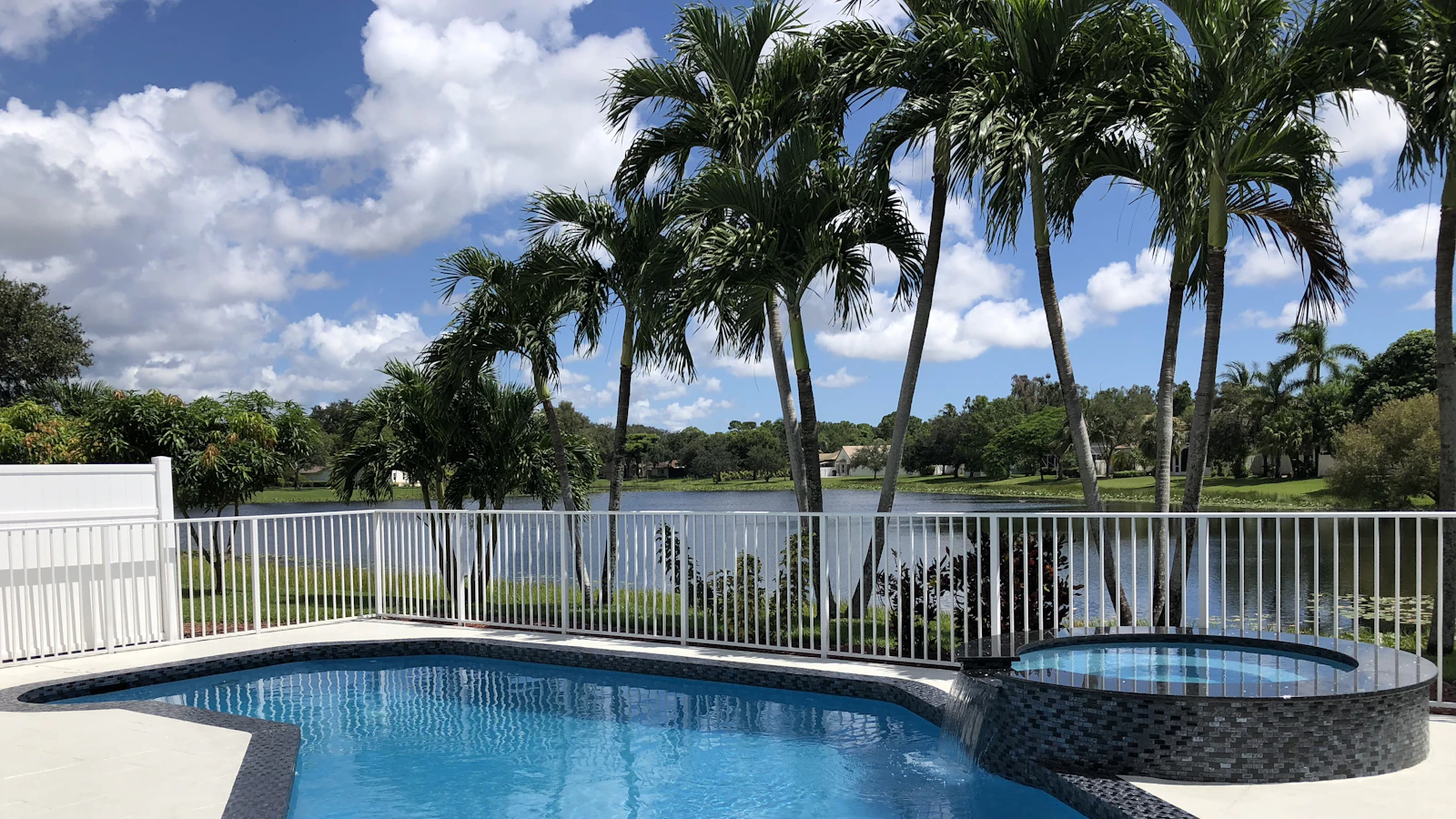
Pool company SEO in North Miami Beach comes down to being findable at the exact moment someone needs you: a complete Google Business Profile, a dedicated page for each service you offer (cleaning, green-pool recovery, repair, construction), separate pages for commercial and condo work, seasonal content that matches how South Florida actually uses its pools, a steady flow of honest reviews, and a fast site that turns a visit into a booked estimate. Like pool chemistry, it works when you test and adjust on a schedule, not once a year.
Key takeaways
- Most pool jobs start with a specific search, so every service you sell needs its own page and its own spot in your Google Business Profile.
- Florida law separates licensed pool/spa contracting from routine cleaning, so say clearly what you are licensed to do and keep your marketing inside that line.
- Commercial and condo work deserves its own pages, written for managers and boards rather than homeowners.
- Reviews, asked for at the right moment and never paid for, feed both your Maps visibility and your close rate.
- A slow or confusing estimate page can waste everything the rest of your SEO earned.
Before Monday: meet Marisol and her route
Marisol does not exist. Neither does Blue Ledger Pool Co., the small outfit she runs with one truck, one helper on busy days, and a clipboard she refuses to give up. We invented her so we could follow a pool service business through an ordinary week in North Miami Beach and notice, stop by stop, where customers actually come from.
Her route is a loop of single-family homes, a few townhouses and, lately, one condo building. She is good at the work. She is less sure about the part that happens before anyone calls her: the search.
Each day below brings one stop, and each stop carries one lesson about pool company SEO.
Monday: the neighbor who found someone else on Maps
Monday starts at a house Marisol has serviced for years. While she is checking the skimmer, the next-door neighbor leans over the hedge. Nice pool, he says. He wishes he had known about her sooner. Last month he searched "pool cleaning near me," tapped the first company in the map results, and signed a contract.
Marisol has a Google Business Profile. She set it up years ago and has not touched it since. Its newest photo shows the truck she sold.
Google is fairly open about how local results are chosen. Its own help page on improving your local ranking names three factors: relevance (how well a profile matches the search), distance (how far the business is from the searcher) and prominence (how well known the business is, influenced by things like links and reviews). Marisol cannot move her business closer to every neighbor. She can make her profile far more relevant and, over time, more prominent.
Monday's takeaway
- Pick the most specific primary category that describes what your business is, then add only the secondary categories that truly apply.
- Fill out services one by one. Weekly cleaning, green-pool cleanup, pump and filter repair, heater repair, resurfacing. Each is a phrase someone searches.
- Post real photos regularly: clean water, equipment pads, before-and-afters, the truck with your name on it.
- Set your service area honestly to the neighborhoods you actually drive.
We cover the full setup in our Google Business Profile guide for North Miami Beach, and if map visibility is the main problem, that is the core of our Google Maps SEO work. Think of the profile as your pool's free chlorine. If it drops to zero, nothing else you do downstream keeps the water clear.

Tuesday: the green-pool emergency
Tuesday's first call comes in before 8 a.m. A homeowner back from two weeks away opened the patio door to a pool the color of pea soup. She has guests arriving Saturday. She found Marisol by searching "green pool cleanup" and landing on a competitor's page first, then calling Marisol because the competitor's voicemail was full.
Luck, in other words. Marisol's website has one "Services" page with a bulleted list. Nothing on it says green pool, algae or emergency.
This is the most common gap we see with pool service SEO. A one-page list of services asks Google to guess. A dedicated page for each high-intent problem tells it plainly. Google's guidance on creating helpful, people-first content puts it in terms any pool tech would recognize: write for the person who arrives with a problem, not for a ranking.
What a good emergency or service page includes
- The problem in the customer's words ("my pool turned green," "pump is making a grinding noise").
- What you do about it, step by step, without overpromising timelines you cannot keep.
- Where you work, named naturally, and how to reach you right now.
- Photos from your own jobs, with honest captions.
A word on licensing before you write "repair"
Florida draws a real line here, and your service pages should respect it. Under section 489.105, Florida Statutes, the definition of a swimming pool/spa servicing contractor covers the repair and servicing of pools and spas, including the substantial or complete draining of a pool for repair or renovation. The same statute says a license is not required to clean a pool or spa in a way that does not affect the structural integrity of the pool or its equipment, and that water treatment which does not require installing, modifying or replacing permanently attached equipment does not require a license either.
Construction is a separate scope. The residential and commercial pool/spa contractor definitions in that same section cover construction, repair and servicing, and the DBPR Construction Industry Licensing Board lists the residential, commercial and servicing pool/spa license types. We are not lawyers, and this is not legal advice. The SEO point is simple: if your pages advertise equipment replacement or construction, make sure your license covers it and show the license number where customers can see it. If you are a cleaning-only route, say so with confidence. "Weekly cleaning and water chemistry" is a perfectly good thing to rank for.
Wednesday: the condo association manager
Wednesday is different. Marisol has a walkthrough at a condo building with a property manager collecting three quotes for the association pool. He wants to know about her insurance, how she documents chemical readings and whether she has worked with a board before.
He did not find her on Maps. A board member forwarded her name. But before he called, he searched her company and looked for anything about commercial or community pools. He found nothing, and he almost did not call.
Commercial buyers search differently from homeowners. They search phrases like "condo pool maintenance," "HOA pool service" and "commercial pool cleaning," and they judge you on process, not price. That is why SEO for pool companies that want condo and HOA accounts usually means separate commercial pages: who you serve, how you log readings, what your reporting looks like, how you communicate with management. The CDC's healthy swimming guidance, for example, suggests checking disinfectant and pH at least twice a day, more often with heavy use, which tells you how closely a careful manager watches the water between your visits. A page that explains how your service fits into that routine speaks his language.
Wednesday's takeaway
- Build one page for residential service and one for commercial, condo and HOA service. Do not make managers dig.
- Describe your documentation, communication and response process plainly.
- Link to the related work your buyers also hire for.
Property managers juggle pools alongside landscaping, fencing and everything else on a building. Our posts on SEO for property management companies and landscaper SEO in North Miami Beach show the other side of that same desk.
Thursday: the snowbird coming back for the season
Thursday brings a phone call from Connecticut. A couple who spend winters in a house on her route are flying down in three weeks. Their old service retired over the summer, and they would like the pool ready when they walk in. They found Marisol through a short article on her site she almost did not bother writing: a checklist for getting a seasonal home's pool ready after months away.
That is the quiet power of seasonal content. People search the problem they have this month: storms and debris in summer, returning owners in fall, heaters in winter. A pool company that publishes something useful for each moment shows up for searches its competitors ignore.
Keep it honest and specific to the work. A good seasonal article for pool cleaning marketing answers real questions:
- What should be checked before an owner returns after months away?
- What happens to equipment that sat idle through the summer?
- How far ahead should someone book a startup visit in busy months?
- What can a homeowner do between visits, and what should they leave to a pro?
Thursday is the water chemistry lesson in its plainest form: consistency beats correction. One article a year is a shock treatment. One useful piece a month, planned around the calendar, keeps the whole thing in balance.
Friday: the review request at the gate
Friday is the green pool from Tuesday, now clear enough to see the drain. The homeowner walks Marisol to the side gate and tells her she has saved the weekend. In the past, Marisol would have said thank you and driven off. This time she hands over a small card with a QR code and asks if she would mind sharing that on Google.
The moment matters. Google's own guidance on getting reviews says you can ask customers to visit a link or scan a QR code, and it prohibits offering incentives such as free or discounted service in exchange for reviews. So no "ten dollars off your next visit for five stars." Just ask, and make it easy.
Friday's takeaway
- Ask in person, right after a visible win: clear water, a fixed pump, a finished resurface.
- Keep a short review link and a QR code on a card or the back of your invoice.
- Reply to every review, good or bad, briefly and like a person.
- Never pay, discount or reward anyone for a review, and never ask only the customers you think will be happy.
On the same Google page about local ranking, Google notes that more reviews and positive ratings can help a business's local ranking, and that replying shows you value customer feedback.
Saturday: the estimate that converted
Saturday is supposed to be light. Marisol checks her phone between stops and finds a form submission from a homeowner who wants a quote on resurfacing and a new pump. He found Blue Ledger on his phone, read the service page, saw the license number, scrolled through photos, and filled out a four-field form while sitting by his own cloudy pool.
That only happened because her site loaded quickly on a phone and the form was short. Otherwise he would have tried the next result. Google's documentation on Core Web Vitals sets "good" targets of a Largest Contentful Paint within 2.5 seconds, Interaction to Next Paint under 200 milliseconds and Cumulative Layout Shift under 0.1, and says this aligns with what its core ranking systems seek to reward. More practically, a slow page loses people who already wanted to hire you.
Saturday's takeaway
- Make the call button and estimate form obvious on every service page, especially on mobile.
- Keep forms short. Name, phone, address or neighborhood, and what is wrong. Ask the rest on the call.
- Compress your photos. Pool shots are beautiful and often enormous.
- Show trust signals near the form: license number if you hold one, insurance, real reviews.
If your site looks fine but the phone stays quiet, our post on how website speed affects revenue is a good next read, and our website design team builds service-business sites around exactly this path from search to booked estimate.
One more Saturday note for pool builders. If your projects include new residential pools, your customers will ask about safety. Florida's Residential Swimming Pool Safety Act, Chapter 515, Florida Statutes, requires a new residential pool to meet at least one of several listed safety features (such as a qualifying barrier, an approved safety cover, exit alarms, self-closing and self-latching doors, or a certified pool alarm) to pass final inspection. A clear, accurate page explaining those options answers a question buyers already have, and it is a natural place to point to fence partners. Our fence company SEO post looks at that same customer from the other side of the barrier.
The week in one table
Here is Marisol's week, reduced to what the customer searched and which asset won the job. Notice that none of the wins came from a single trick.
| Day | The customer | What they searched (or did) | The asset that won it |
|---|---|---|---|
| Monday | Neighbor over the hedge | "pool cleaning near me" on Maps | Complete, active Google Business Profile |
| Tuesday | Homeowner back from vacation | "green pool cleanup" | Dedicated emergency/service page |
| Wednesday | Condo property manager | Company name plus "condo pool service" | Commercial and HOA service page |
| Thursday | Returning seasonal owners | Getting a pool ready after months away | Seasonal checklist article |
| Friday | The green-pool customer, now happy | Scanned a QR code at the gate | Simple, in-person review request |
| Saturday | Homeowner with a cloudy pool | "pool resurfacing" on his phone | Fast service page with a short form |
Each row is one reading on the test strip. Read together, week after week, they show you where the balance is off.
Sunday: keeping the whole system in balance
On Sunday Marisol reviews the clipboard: which pools needed extra chemicals, which equipment is wearing out. A pool business that treats its marketing the same way tends to do well. Check the profile. Add a page where calls are coming in without one. Publish the next seasonal piece. Ask for reviews at the gate. Look at which pages bring in estimates and which ones leak.
None of this is exotic. Local SEO in Miami and the cities around it rewards relevance, proximity, reputation and a site that works. The hard part is doing it every week while running a route. Our local SEO service handles the profile, pages, reviews process and reporting, and our North Miami Beach SEO work is built around businesses that serve North Miami Beach and the communities around it.
If you want a straight read on where your pool company stands right now, request a free SEO audit. We will look at your profile, your service pages and your site speed, and tell you which reading is furthest out of range.
Frequently asked questions
What is pool company SEO?
Pool company SEO is the work of helping a pool cleaning, repair or construction business show up when nearby customers search for those services on Google and Google Maps. It usually combines a complete Google Business Profile, a page for each service, location and commercial pages, reviews and a fast, easy-to-use website.
Do I need a license to advertise pool cleaning in Florida?
Section 489.105, Florida Statutes, says a license is not required to clean a pool or spa in a way that does not affect its structural integrity or equipment, and water treatment that does not involve installing, modifying or replacing permanently attached equipment does not require one. Repair, equipment replacement and construction fall under licensed pool/spa contractor categories. Check with the DBPR or an attorney about your specific services.
Should pool repair and pool cleaning have separate pages?
Yes. People search for each one differently, and a dedicated page for each service gives Google a clear match and gives the visitor the specific answer they came for. Commercial and condo pool service usually deserves its own page as well.
Can I offer a discount in exchange for a Google review?
No. Google's review guidance prohibits offering incentives such as free or discounted goods or services in exchange for reviews. You can make it easy by sharing a review link or QR code and asking in person after a job goes well.
How long does SEO take for a pool service company?
It depends on your starting point, your competition and how consistently the work is done. Fixes to a Google Business Profile and site speed can be made quickly, while service pages, seasonal content and reviews build value over months. Like water chemistry, steady weekly attention works better than occasional big corrections.