A landscaping company in North Miami Beach gets found by doing a few unglamorous things well and keeping them up all year: a Google Business Profile set up for a service-area business, one page for each job you actually do, a gallery of your own before-and-after photos, and reviews you earned honestly. Then tune the site to South Florida's two real seasons, wet and dry, because that's when what homeowners search for changes.
Key takeaways
- Most landscapers work at the customer's property, so set up your Google Business Profile as a service-area business with the home address hidden and a realistic service area.
- Give lawn maintenance, landscape design, irrigation, tree trimming and hardscaping each a page of their own. One "Services" page can't answer five different searches.
- Your own job photos, with plain descriptive alt text, are some of the strongest proof you can put on a page.
- Florida-specific credibility (Florida-Friendly Landscaping, the county's rainy-season fertilizer rules, the state fertilizer certification) separates a local pro from a generic listing, as long as every claim is accurate.
- Plan content around the wet season and the dry season, and ask every customer for a review the same way, with nothing attached.
Why does SEO for landscapers need its own playbook?
Landscaping sits in an odd spot. It's a home service like plumbing or roofing, but the work is visible, it grows, and it changes with the weather. A homeowner searching for a landscaper isn't usually in an emergency. They're comparing. They want to see what your yards look like a year later, whether you know which plants survive a South Florida summer, and whether you'll show up every other week without being chased.
That means SEO for landscapers leans harder on three things than most trades do: photos, local plant and water knowledge, and consistency over time. Our broader guide to SEO for contractors in North Miami Beach covers what all trades share, like licensing, permits and call tracking. This guide stays in the yard.
You don't get a hedge by buying one big plant. You get it by planting the right thing in the right spot, watering on schedule and pruning before it gets out of hand. Landscaping SEO works the same way.
How should a landscaper set up Google Business Profile?
For most local searches, your Google Business Profile is the first thing a customer sees, often before your website. Google's Business Profile guidelines are specific about service-area businesses, and most landscapers are exactly that: you drive to the customer.
- Hide your address if customers don't come to you. Google says service-area businesses should hide the business address from customers. If you run the company from home or a yard where clients don't visit, keep it hidden.
- Keep the service area honest. The guidelines say a service area generally shouldn't extend farther than about two hours of driving time from where you're based. List the cities and neighborhoods you'll really drive a mower trailer to every week, not every ZIP code in South Florida.
- Use your real business name. "Green Leaf Landscaping" is fine. "Green Leaf Landscaping Best Lawn Care Miami Sod Irrigation" isn't. Google doesn't permit unnecessary information in the name.
- One profile per business. Don't create a second listing for your irrigation crew or a fake office in the next town. Google says a service-area business can't list a virtual office unless it's staffed during business hours.
- A phone you control. The number should be under your direct control, and Google prefers a local number to a central call center line.
After the basics, fill in the parts many landscapers leave blank: your services list, your hours (including whether you take Saturday calls), a business description that names the work you do, and a steady stream of photos from real jobs. Our walkthrough on Google Business Profile in North Miami Beach goes field by field, and our Google Maps SEO service handles it for owners who'd rather be on the truck.
Why does each landscaping service need its own page?
Someone searching "irrigation repair" and someone searching "paver patio installation" want different things, and Google tries to show each of them the page that answers their question best. If your site has one Services page with five bullet points, neither search has a good page to land on.
Plant one page for each job you actually sell. For a typical North Miami Beach landscaping company, that might look like this:
- Lawn maintenance. Mowing frequency in the wet and dry seasons, edging, weed control, what a visit includes, and whether you work on contract or per visit.
- Landscape design and installation. How a design consult works, what you need from the homeowner, how you choose plants, and a few finished projects.
- Irrigation. New systems, repairs, zone adjustments, rain sensors, and the signs of a broken head or a leak that homeowners usually notice first.
- Tree trimming. What kinds of trees you work on, how you prune, cleanup and haul-away, and how you handle work near power lines or structures.
- Hardscaping. Pavers, walkways, retaining edges, patios and drainage, with photos showing the base prep as well as the finished surface.
Each page should answer the questions you hear on the phone: what's included, how long it takes, what affects the price (without making up a price you won't honor), and what happens after the job. Put a clear call to action near the top and again at the bottom. Our local SEO work usually starts here, because pages like these are what a profile links to and what Google uses to understand which searches you deserve to show up for.
How do before-and-after photos help landscaping SEO?
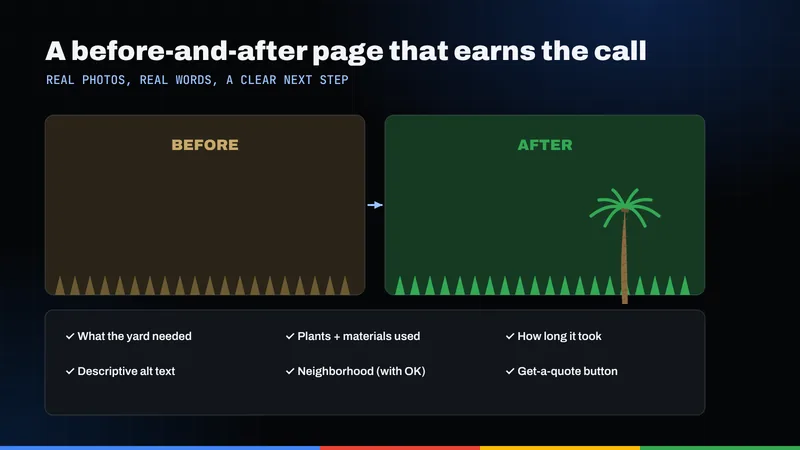
Photos are where landscapers have an advantage over almost every other trade. A finished patio or a rebuilt front bed tells a customer more than a paragraph can. They help search too, as long as they're your photos and Google can understand them.
- Use real job photos. Stock images of English gardens tell a North Miami Beach homeowner nothing. Shoot your own: the same angle before, during and after, in decent light.
- Name the files plainly. "front-yard-paver-walkway-after.jpg" says something. "IMG_4417.jpg" says nothing.
- Write alt text that describes the photo. "Paver walkway with new coontie and dwarf firebush beds along a front entry" is useful to a screen reader and to search. Don't stuff it with keywords.
- Put photos next to the text they belong with. Irrigation photos on the irrigation page, hardscape photos on the hardscape page, each with a sentence or two about the job.
- Keep file sizes reasonable. A gallery that takes forever to load on a phone loses people. Our post on how website speed affects revenue explains why that matters.
Ask permission before posting a customer's home, and leave out house numbers and anything that identifies the address. A good gallery is also a good habit: if the crew snaps photos on every job, you never run out of fresh images for the profile or the site.
What Florida-specific topics build trust with customers?
This is where a local landscaper can sound like a local landscaper. Customers here have watched lawns burn up in the dry months and drown in the wet ones. Showing that you know the rules and the conditions is both good content and good business, but only if it's accurate. Get a fact wrong about a county ordinance and you've lost the trust you were trying to earn.
Florida-Friendly Landscaping
UF/IFAS runs the Florida-Friendly Landscaping program, built on nine principles: right plant, right place; water efficiently; fertilize appropriately; mulch; attract wildlife; manage yard pests responsibly; recycle yard waste; reduce stormwater runoff; and protect the waterfront. If those principles shape how you design and maintain yards, say so on your design and maintenance pages and explain what it looks like in practice. Don't claim a certification or recognition you don't hold.
Miami-Dade's rainy-season fertilizer rules
In 2021, Miami-Dade County announced a fertilizer ordinance that bans fertilizer application during the rainy season, set from May 15 to October 31, and restricts phosphorus fertilizer year-round. The county's release says landscape companies are among those covered and that commercial applicators need training and a license in fertilizer best management practices. Some cities layer their own rules on top, so confirm what applies at each property before you publish a blanket statement. A short, accurate explainer page ("why we don't fertilize your lawn in summer") turns a rule many homeowners find confusing into a reason to trust you.
The state fertilizer certification
Under Section 482.1562 of the Florida Statutes, anyone applying commercial fertilizer to an urban landscape must hold the limited certification for urban landscape commercial fertilizer application, with an exemption for yard workers who use only the owner's fertilizer and equipment on an individual residential property. The certificate is good for four years, and renewal requires continuing education. If your crew holds it, say so on your lawn and fertilization pages. It's a concrete trust signal most competitors never mention.
How should a landscaper plan content around the wet and dry seasons?
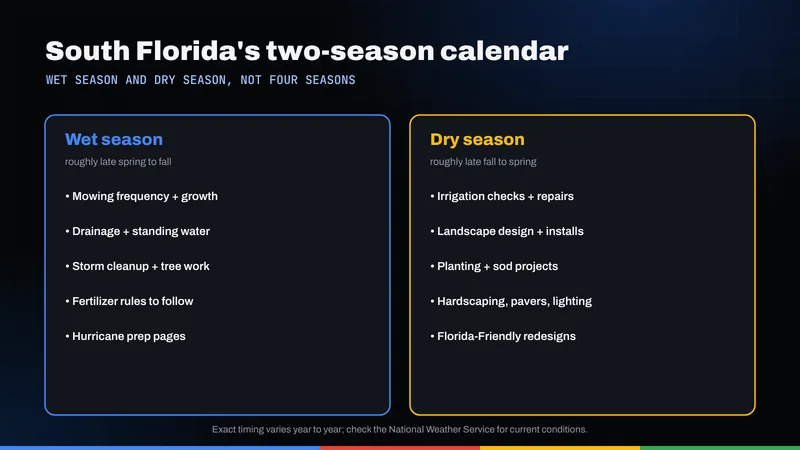
Most marketing calendars assume four seasons. South Florida has two that matter to a landscaper. The National Weather Service office in Miami describes the South Florida wet season as May 15 to October 15, the stretch when most of the year's rain falls. The rest of the year is the dry season. The county's fertilizer window runs a bit longer, to October 31, which is worth keeping straight on your pages.
Think of the calendar the way a gardener thinks about planting and pruning: you prepare a page before the season arrives, not after customers are already searching. Here's a simple way to map it.
| Season | What customers tend to search for | Page or content to update |
|---|---|---|
| Late dry season (spring) | Landscape design, new sod, planting, irrigation checkups before summer | Design and installation page; irrigation page with a pre-summer system check; fresh project photos |
| Start of the wet season (mid-May) | Mowing service, weed control, drainage problems, "why can't I fertilize" | Lawn maintenance page with wet-season mowing schedule; fertilizer explainer; drainage section on hardscaping page |
| Peak wet season and hurricane season | Tree trimming, storm cleanup, fallen branches, yard debris removal | Tree trimming page with how you prune and what cleanup includes; profile posts about scheduling |
| Early dry season (fall into winter) | Irrigation adjustments, lawn recovery, new beds, holiday curb appeal | Irrigation page with rain sensor and schedule adjustments; design page; seasonal gallery update |
| Mid dry season (winter) | Pavers, patios, walkways, outdoor living projects | Hardscaping page with recent projects, base prep photos and how quotes work |
The searches in the middle column are patterns, not measured numbers. Check them against your own phone calls and your Search Console data. If your inbox fills with irrigation complaints in a particular month, that's your cue to update the irrigation page a few weeks earlier next year.
What schema markup should a landscaping site use?
Structured data helps search engines read the facts on your pages: who you are, what you do, where you work and how to reach you. Here the honest answer is narrower than some guides suggest. Schema.org's HomeAndConstructionBusiness type lists subtypes like Electrician, GeneralContractor, HVACBusiness, HousePainter, Locksmith, MovingCompany, Plumber and RoofingContractor. There's no landscaping-specific type in that list.
So use HomeAndConstructionBusiness (a type of LocalBusiness) for the company, and fill it with the same facts that appear on the page and on your profile: business name, phone, hours, the areas you serve and your website. Keep the markup in step with the visible content. Markup that says one thing while the page says another doesn't help anyone. Our post on how schema helps search engines explains the basics if you're starting from zero.
Can landscapers use Google Local Services Ads?
Yes, in many places. Google's Local Services Ads help page lists landscaping services, lawn care services and tree services among the eligible U.S. categories. Irrigation isn't listed as its own category, so an irrigation-only company may not fit. Businesses that pass Google's screening show the Google Verified badge, and Google says providers without the badge appear below those who have it.
Local Services Ads sit at the top of some results and charge per lead rather than per click. They aren't a replacement for organic work, though. The profile, the reviews and the website still do the convincing once someone sees you. If you're weighing ads against organic, our Google Ads page covers how we think about the mix.
How should a landscaper collect reviews the right way?
Reviews are the harvest. You can't rush them, and you can't buy them without spoiling the crop. Google's contribution policy prohibits reviews posted because of an incentive, reviews that are paid for, discouraging negative reviews, selectively asking only happy customers, and reviews with a conflict of interest, such as from employees. The Federal Trade Commission's final rule on fake reviews, announced August 14, 2024, bans fake reviews, incentives tied to positive or negative sentiment, undisclosed insider reviews and review suppression.
A clean routine for a landscaping company looks like this:
- Finish the job or the first month of a maintenance contract.
- Send every customer the same short review request with a direct link. No discount, no free mowing, no "only if you're happy."
- Suggest they mention the actual work if they're comfortable, like the new irrigation zones or the paver patio. Specific reviews help the next customer more than "great job."
- Reply to every review, good or bad, briefly and professionally.
Where should a North Miami Beach landscaper start?
If you only do three things this season, do these. Clean up your Google Business Profile so it follows the service-area rules. Build or fix the one service page that brings in the most profitable work, with real photos. Then set up a review request that goes to every customer the same way.
After that, keep tending: a new project in the gallery each month, a seasonal update before the wet season and another before the dry season, and replies to every review. None of it is fast, and that's normal. Our post on how long SEO takes sets honest expectations. If you'd like help, our North Miami Beach SEO team builds service pages, profiles and review routines for local service companies. You can request a free audit and we'll show you what to plant first.
Frequently asked questions
Do I need a storefront to show up in Google Maps as a landscaper?
No. Google lets service-area businesses keep a Business Profile with the street address hidden. Set your service area to the places you really serve, generally within about two hours of driving from your base, and don't list a virtual office that isn't staffed during business hours.
Can I fertilize lawns in Miami-Dade during the summer?
Miami-Dade County's fertilizer ordinance, announced in 2021, bans fertilizer application during the rainy season from May 15 to October 31 and restricts phosphorus fertilizer year-round. Some cities add their own rules, so check what applies at each property before you schedule an application.
Does my crew need a certification to apply fertilizer?
Section 482.1562 of the Florida Statutes requires anyone applying commercial fertilizer to an urban landscape to hold the limited certification for urban landscape commercial fertilizer application, with an exemption for yard workers using only the owner's fertilizer and equipment on an individual residential property. The certificate lasts four years and renewal requires continuing education.
Is there a schema type made specifically for landscaping companies?
Schema.org doesn't list a landscaping-specific subtype under HomeAndConstructionBusiness. Its subtypes include Electrician, GeneralContractor, HVACBusiness, HousePainter, Locksmith, MovingCompany, Plumber and RoofingContractor, so a landscaper can use HomeAndConstructionBusiness itself with accurate name, phone, hours and service-area details.
Can landscapers and tree services run Local Services Ads?
Google's Local Services Ads help page lists landscaping services, lawn care services and tree services as eligible U.S. categories, though availability depends on location. Irrigation isn't listed as a separate category. Businesses that pass Google's screening show the Google Verified badge.