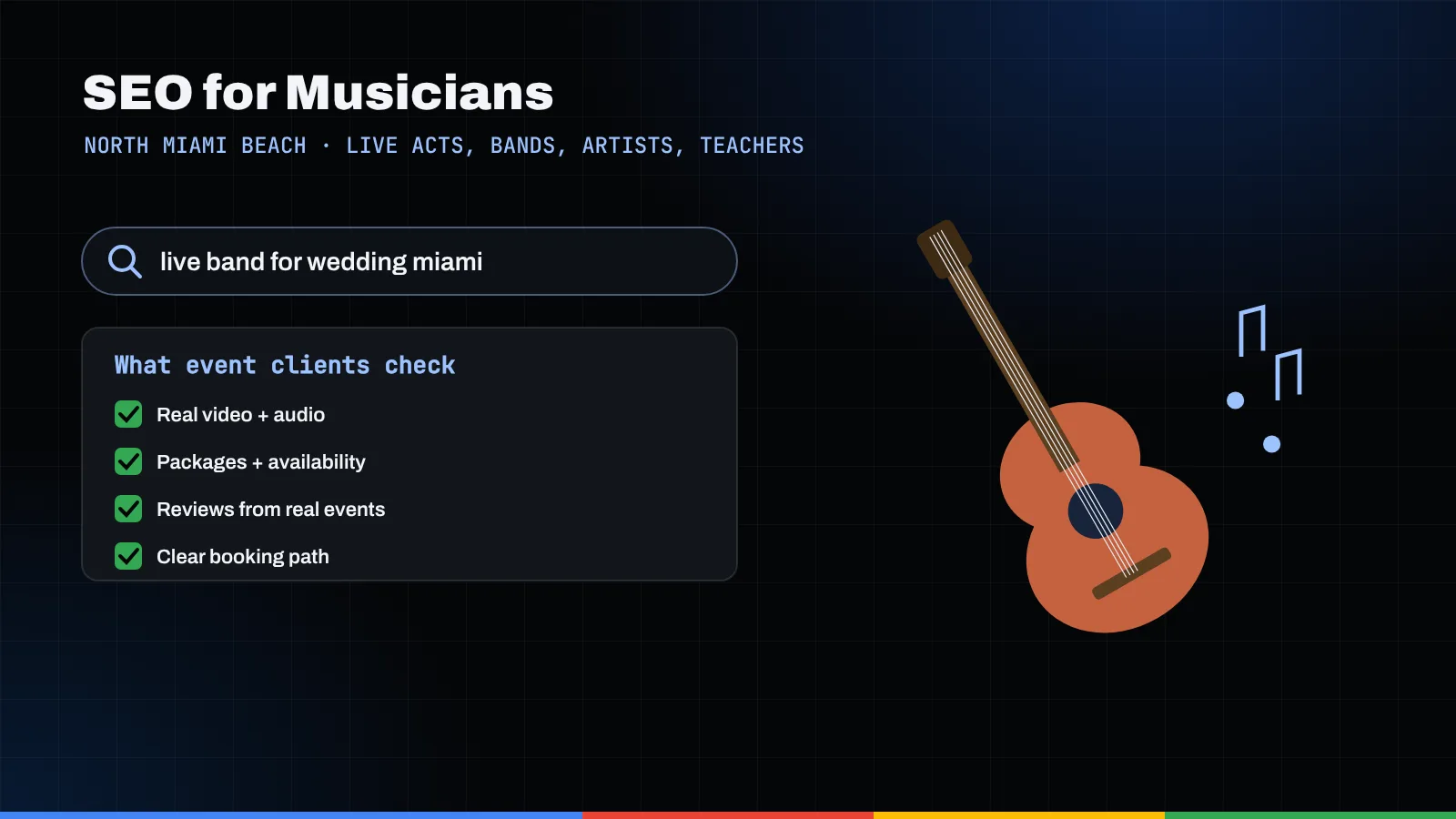
SEO for musicians comes down to two jobs: helping event clients book you and helping fans find, recognize and follow you. Working acts in North Miami Beach need clear booking pages, a Google Business Profile if they qualify, and honest reviews. Artists building an audience need a fast official website, consistent profiles everywhere they appear, and structured data that tells Google exactly who they are.
Key takeaways
- Split your audiences first: people hiring a band for a date search very differently from fans looking up a song.
- Give every service (wedding ceremony music, cocktail hour, private parties, lessons) its own page that explains how pricing works, even without publishing numbers.
- Acts that travel to clients may qualify for a service-area Business Profile; a band that only plays public shows and releases music usually leans on its website and Knowledge Panel instead.
- Use MusicGroup or Person markup on your site, and Event markup only for public, bookable shows, never private weddings.
- Ask every client for a review the same way, with nothing offered in return; Google's policy and the FTC's 2024 rule both draw hard lines here.
Soundcheck: who's searching for you?
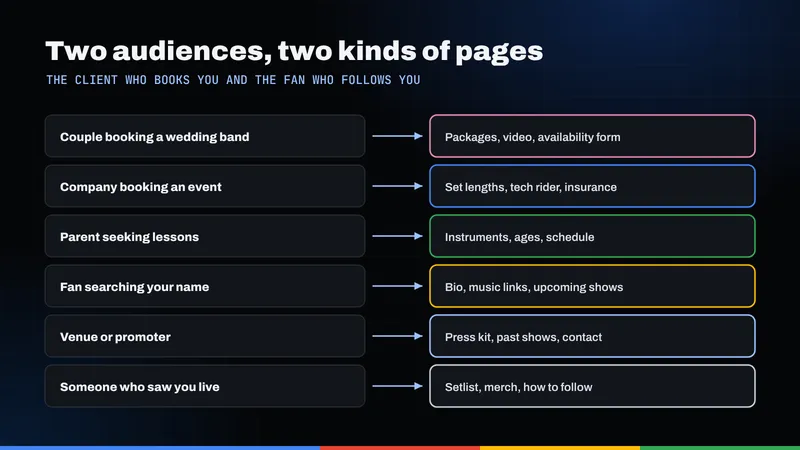
A musician's website usually has two crowds in the room, and they want different things.
Crowd one hires you. A couple planning a ceremony, a company booking a holiday party, a family planning a bar mitzvah, a parent looking for piano lessons. They search with a date and a budget in mind, they want to hear you, and they want to know you'll show up on time with the right gear.
Crowd two follows you. Someone heard your single on a playlist or caught your set at a public show and now types your name into Google. They want your music, your next date, your socials and maybe merch.
Plenty of acts serve both. To make that concrete, imagine a hypothetical five-piece we'll call The Mango Sevenths, based in North Miami Beach. (The name is invented for this article; it isn't a real band or a client.) Say they play weddings and private events most weekends, release original music a few times a year, and the keyboard player teaches lessons on weekdays. That one act needs a booking funnel, a fan hub and a lesson page, and each one answers a different search. That's the core of musician SEO: matching each kind of searcher to the page built for them.
| Client or fan need | What they search | Page to build |
|---|---|---|
| Ceremony music for a wedding | "string quartet for wedding ceremony Miami" | Ceremony music page with sample processional pieces and setup needs |
| Dance band for a reception | "wedding band North Miami Beach" | Reception package page with set lengths, lineups and videos |
| Background music for a corporate or private event | "jazz trio for corporate event" | Private and corporate events page |
| Lessons for a kid or adult | "piano lessons near me" | Lessons page with instruments, ages, format and location |
| Hearing the band before booking | "[band name] videos" | Media page with live clips, audio and a short song list |
| A fan looking for new music | "[artist name] new song" | Music page linking every streaming platform |
| A fan looking for shows | "[artist name] tour" or "[artist name] Miami" | Shows page with one entry per public date |
Roadie's note: if the same page tries to sell a wedding package and promote a single release, it does neither job well. Keep the two crowds on separate stages and link between them.
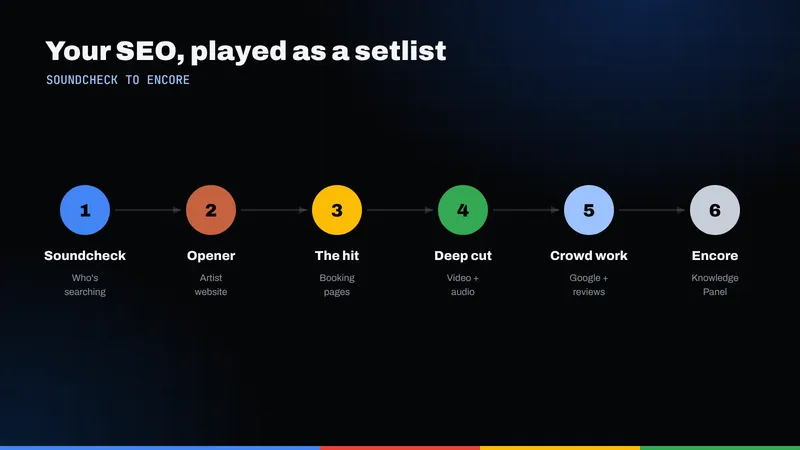
Opener: artist website basics
Streaming profiles and social accounts are rented stages. Your website is the one venue you own, and it needs a few essentials.
- A home page that says what you are in one line. "Five-piece wedding and event band based in North Miami Beach" beats a moody photo with no text.
- Separate pages for each job. Booking, music, shows, media, lessons, about and contact. One page per job gives Google something specific to match.
- Fast loading on phones. Compress images and skip autoplaying video.
- Consistent naming. Use the exact same act name everywhere: site, socials, streaming, YouTube, booking platforms. "The Mango Sevenths," "Mango 7ths" and "Mango Sevenths Band" look like three different acts to a machine.
- An about page with real facts. Who's in the band, what instruments, where you're based, what genres you cover, languages you perform in. If you sing in Spanish, Haitian Creole, Portuguese or Russian, say so plainly; a client planning a bilingual celebration is searching for exactly that.
If your current site is a single-page template from years ago, our website design team builds fast, crawlable sites, and the fundamentals in our on-page SEO guide apply to bands as much as to any business.
The hit: booking pages for event clients
For working musicians, booking pages carry most of the revenue, so most of the SEO for musicians effort should land here. A good booking page answers what a planner would otherwise email you about.
Packages
Give each package its own section or page: ceremony only, cocktail hour, full reception, ceremony plus reception, corporate background music, private party. For each one, list the lineup options (solo, duo, trio, full band), typical set lengths and break structure, and what's included, such as a sound system, an emcee or a DJ handoff between sets.
How pricing works
You don't have to publish a number to be useful. Explain what moves the price: number of musicians, hours of performance, travel distance, load-in difficulty, learn-a-song requests, overtime and date demand. Say whether you require a deposit and how the balance is handled.
Availability
Tell people how to check a date and how far ahead you typically book. A simple "Check your date" form with fields for event date, venue, guest count and event type gets you the information you need on the first message.
Tech rider and logistics
Venues and planners love a downloadable or on-page rider: stage footprint, power needs, load-in time, whether you need a green room, meals and parking. Put it on the page in plain text, with a PDF copy.
Proof
Short live clips filmed at real events, a sample song list by genre and a list of venues you've played (only ones you actually played) all help. If you play a lot of weddings, it's worth reading our posts on how wedding venues approach search and how wedding planners build their pages, since those are the people who refer you.
Roadie's note: a "Contact us for pricing" button with nothing above it is the musical equivalent of a ten-minute tuning break. People leave.
Deep cut: content, video and audio
Music is something people need to hear, so media pages are your strongest content.
YouTube basics you can verify
Use your act name and what the video shows in each title ("The Mango Sevenths, first dance live at a waterfront reception," for example), write a real description, and add chapters for longer performance videos. According to YouTube Help on video chapters, manual chapters need a first timestamp of 00:00, at least three timestamps in ascending order, and each chapter at least 10 seconds long.
Video on your own site
Embed your best clips on the matching booking page so a client can hear the reception band on the reception page. A dedicated page per showcase video, with its own title and description, gives Google more context than one long gallery.
Written content that helps clients
Short guides perform well because they answer real planning questions: how to choose processional music, how a band and a DJ split a night, what a ceremony needs for outdoor sound. Link each guide to the booking page it supports.
A licensing caution
Live performance licensing and posting recordings online are different questions. ASCAP explains that public performance licenses for venues and businesses that host music are the business owner's responsibility, not the musician's. Posting a video of your band playing someone else's song on your website is a separate matter with its own rights involved. If your media is mostly covers, get advice from a music-licensing attorney before building a big library of videos on your own site.
Crowd work: Google profile and reviews
A lot of local SEO Miami advice is written for plumbers and dentists, but the same rules apply to performers once you read them closely.
Can a musician have a Google Business Profile?
Google's Business Profile guidelines say a business qualifies if it has a physical location customers can visit or travels to customers where they are. A business that travels to customers without a storefront is allowed one service-area profile, with its address hidden and its service area kept within about two hours of driving from where it's based. The guidelines don't mention performers or entertainers specifically, so judge yourself by those general rules:
- Acts hired for private events (wedding bands, quartets, event performers) travel to the client, so the service-area model fits how they work.
- Music teachers with a studio where students come for lessons may list that address if the location is staffed during the stated hours; teachers who go to students' homes fit the service-area model.
- Artists who only release music and play public shows aren't serving customers at a location or in a service area, so a Business Profile usually isn't the right tool. That's where the Knowledge Panel comes in.
Set your primary category to the closest accurate option, write a description that says what you actually perform, add real photos and keep your name identical to your website. Our Google Business Profile guide for North Miami Beach walks through setup step by step.
Reviews, the honest way
Reviews from real clients are some of the most persuasive content you have. Google's prohibited and restricted content policy bars offering incentives such as payment, discounts or free services in exchange for reviews, and bars discouraging negative reviews or selectively asking only happy clients. It also prohibits content based on a conflict of interest, which can include employment and other professional or personal ties.
The FTC's final rule announced August 14, 2024 bans fake reviews and testimonials, compensation conditioned on positive (or negative) sentiment, undisclosed insider reviews, review suppression through threats or intimidation, and buying fake social media indicators like bot followers or views. For an act chasing streaming numbers, that last point matters.
The practical routine: send every client the same short thank-you message with your review link a few days after the event, whether the night was flawless or the generator hiccupped. Never write reviews for yourselves, and don't ask band members' relatives to post.
Roadie's note: a calm, specific reply to a mixed review ("Thanks for the feedback on the volume during dinner; we now confirm dinner levels with the planner before doors") does more for the next booking than five generic stars.
Encore: Knowledge Panel and entity SEO
For artists building a fan base, the goal is for Google to understand your act as a distinct entity: this band, these members, these songs, this website. That understanding feeds a Knowledge Panel.
Structured data on your site
Schema.org gives musicians specific vocabulary. MusicGroup is a type of PerformingGroup, itself a kind of Organization, with properties such as album, genre and track, plus member from Organization. A solo artist can use Person. Both inherit sameAs, which schema.org defines as the URL of a reference page that unambiguously indicates the item's identity, so it's the natural place to list your official streaming, YouTube and social profiles.
For shows, Google's Event structured data documentation requires name, startDate and location, and recommends performer, offers, eventStatus, image and description. The rules are firm: events must be bookable by the general public and take place at a physical location, and events that require an invitation are ineligible. A private wedding or corporate party doesn't qualify, so never mark those up as events. A public ticketed show at a club or festival does. If you're new to markup, our post on how schema helps search engines explains the basics.
Claiming a Knowledge Panel
Google's Get verified on Google page lays out the process. A panel has to exist for you first, and the claim button has to appear; Google notes that not all panels are claimable. You search for yourself, select "Claim this knowledge panel," review the details, and sign in to one of the official sites or profiles Google lists, which currently include YouTube, Search Console, Twitter and Facebook. If Google can't match you that way, it asks for more information. Once verified, you can suggest changes to the facts shown and add other managers. The same page points local businesses serving customers at a location or in a service area to a Business Profile instead.
You can't force a panel to appear. What you can do is make your identity easy to confirm: one consistent name, an official website that links to every profile, profiles that link back, and accurate markup. That entity work also overlaps with how AI assistants pick sources, which we cover on our AI search optimization page.
Roadie's note: if another act shares your name, add a distinguishing detail everywhere (city or genre) so Google doesn't blend you together.
Set order: what to do first
Most SEO Miami guidance assumes endless time. Musicians don't, so here's a running order:
- Lock your name. Pick one spelling and update every profile to match.
- Build or fix the booking pages. One per service, with packages, pricing factors, availability and a rider.
- Set up a Business Profile if you qualify. Service-area for traveling acts, address for staffed teaching studios.
- Start the review routine. Same message, every client, nothing offered in return.
- Publish your media properly. Titled, described, chaptered videos embedded on the right pages.
- Add markup. MusicGroup or Person site-wide with sameAs links; Event only for public shows.
- Try to claim your panel once one appears.
If you'd like help, our local SEO and North Miami Beach SEO services cover exactly this kind of work for performers and small businesses. Want to know where your site stands today? Request a free audit and we'll show you what's helping and what's holding you back.
Frequently asked questions
What is SEO for musicians?
It's the work of helping the right people find you in search: event clients looking to book a band or ensemble, students looking for lessons, and fans looking for your music and shows. It covers your website, booking pages, Google profile, reviews, video and structured data.
Can a wedding band or DJ-style live act get a Google Business Profile?
Google's guidelines say businesses that travel to customers can have one service-area profile with the address hidden. They don't name performers specifically, but acts hired for private events travel to the client, so that model fits how they work. Keep your service area within about two hours of driving from your base.
Should I use Event schema for weddings I play?
No. Google's Event structured data guidelines require events to be bookable by the general public, and invitation-only events are ineligible. Use Event markup only for public, ticketed or open shows.
How do I get a Google Knowledge Panel as a musician?
You can't request one directly. A panel appears when Google is confident about who you are. Once one appears with a claim button, you can verify by signing in to an official profile Google lists, such as YouTube. Consistent naming, an official site and sameAs links help.
Can I offer a discount for a five-star review?
No. Google's policy prohibits offering incentives for reviews, and the FTC's 2024 rule bans compensation conditioned on positive sentiment. Ask every client for honest feedback the same way, with nothing in return.