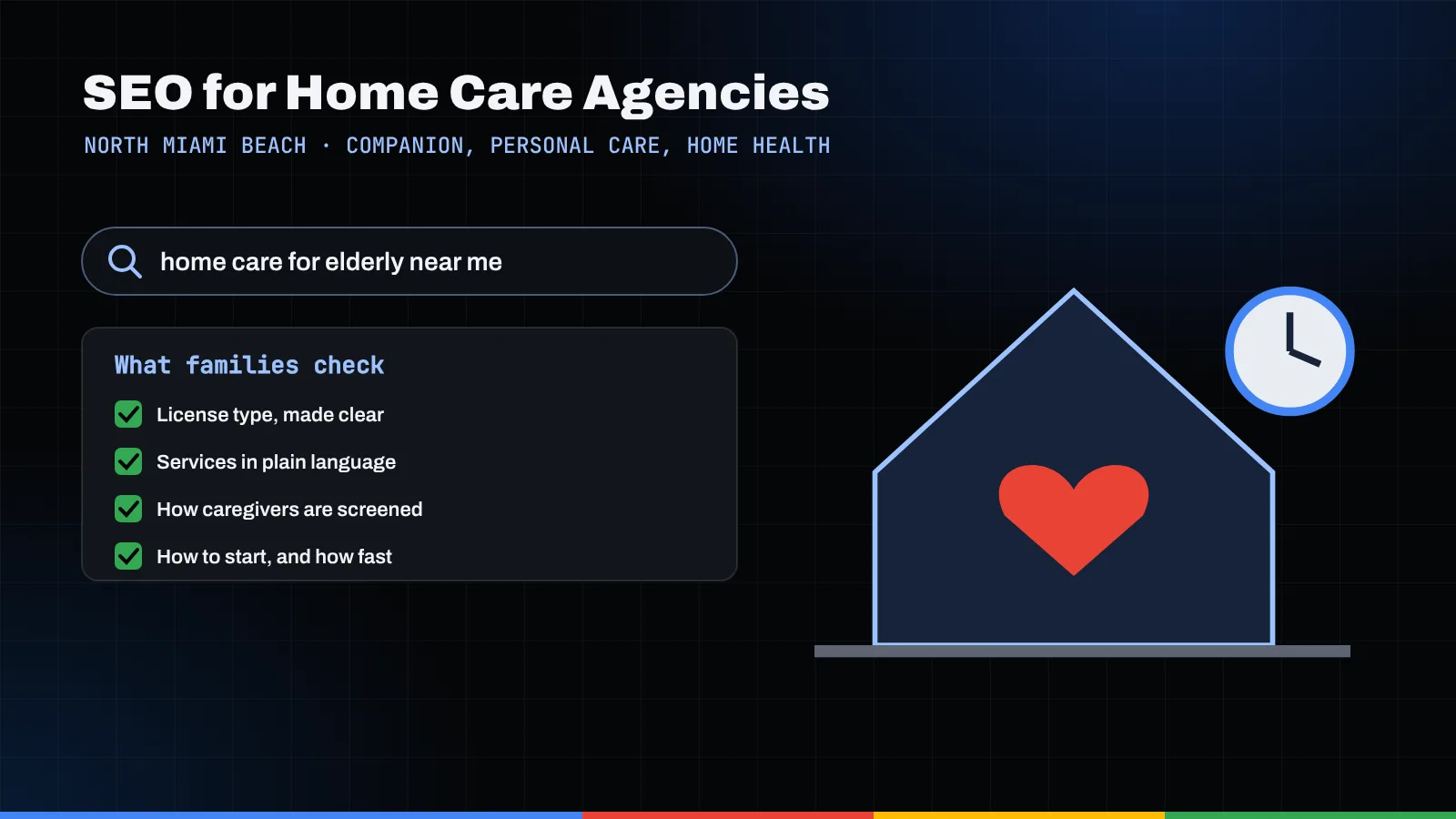
SEO for home care agencies starts with one honest fact: which Florida license or registration you hold, because that decides what you can advertise. From there, a North Miami Beach agency needs a service-area Google Business Profile, a page for each type of care and each everyday need families describe, plain payment information, and screening claims you can document. Search rewards the agency that answers a worried family's questions clearly.
Key takeaways
- Florida treats companion and homemaker services, nurse registries and home health agencies differently, and each one must put its AHCA license or registration number in its advertising.
- Under Florida's definitions, a companion or homemaker may not provide hands-on personal care, so your service pages must match the authorization you actually hold.
- Most agencies serve clients at home, which makes them service-area businesses on Google: hide the address if clients don't visit it, and list specific areas instead of a radius.
- Medicare covers part-time or intermittent skilled home health care for eligible homebound patients, not personal care when that is the only care needed. Say so plainly on your paying-for-care page.
- Caregiver recruitment is a second search audience with its own pages, and it should never compete with the pages built for families.
Assessment: who is searching, and what are they afraid of?
A good intake starts with listening. So should your search plan. The person typing into Google is rarely the client. It is usually an adult child or spouse, often searching late at night after a fall or a hospital discharge.
Imagine a family scenario, purely as an illustration. A daughter we'll call Renata lives in Broward. Her father lives alone in North Miami Beach and is coming home after a short hospital stay. The discharge planner said "home health," a friend said "a companion," and Renata has no idea whether those are the same thing or who pays. Within ten minutes she searches "home care near me," "does Medicare pay for a caregiver" and "overnight caregiver North Miami Beach."
Your pages should help her answer three questions fast:
- What kind of care does my parent actually need? Company and errands, hands-on help with bathing and dressing, or skilled nursing and therapy.
- Is this agency allowed to provide it? That depends on its Florida license or registration.
- How is it paid for, and how soon can it start?
That is what SEO for home care agencies really means: matching each type of care, and each license, to the words stressed families use.
Care coordinator note: If you also operate or partner with an assisted living or independent living community, keep that content separate. Residential communities are covered in our post on SEO for senior living communities in North Miami Beach; this one stays with care in a client's own home.
Assessment, part two: which Florida license or registration do you hold?
Before writing a service page, confirm your authorization with the Agency for Health Care Administration (AHCA). Florida's home care rules sit in Part III of Chapter 400 of the Florida Statutes.
- Home health agencies. Section 400.464 says a license or registration issued by AHCA is required to operate a home health agency in Florida, and that licenses issued on or after July 1, 2018 list the authorized services and whether they include skilled care. The statute's text on licensure and advertising also requires the license number in advertisements for licensed services and bars claiming a license you were not issued.
- Nurse registries. Under section 400.506, a nurse registry must hold its own license. It may refer nurses, certified nursing assistants, home health aides, companions and homemakers to clients, but those caregivers are deemed independent contractors, and the registry must tell the client at the time of contracting that it may not monitor, supervise, manage or train them. Advertising must include the registry's license number.
- Companion and homemaker services. Section 400.509 exempts providers of only companion or homemaker services from licensure, but they must register with AHCA, and anyone advertising those services must include the AHCA registration number in the advertisement.
The definitions in section 400.462 draw the line families care about most. A companion spends time with or cares for an elderly, disabled or convalescent person. A homemaker handles chores such as housekeeping, meal preparation and shopping. Neither may provide hands-on personal care, which the same section defines as help with activities of daily living such as dressing, bathing, eating or personal hygiene.
Care coordinator note: This is not legal advice. If you're unsure whether your authorization covers a task, ask AHCA or a health care attorney before publishing a page about it.
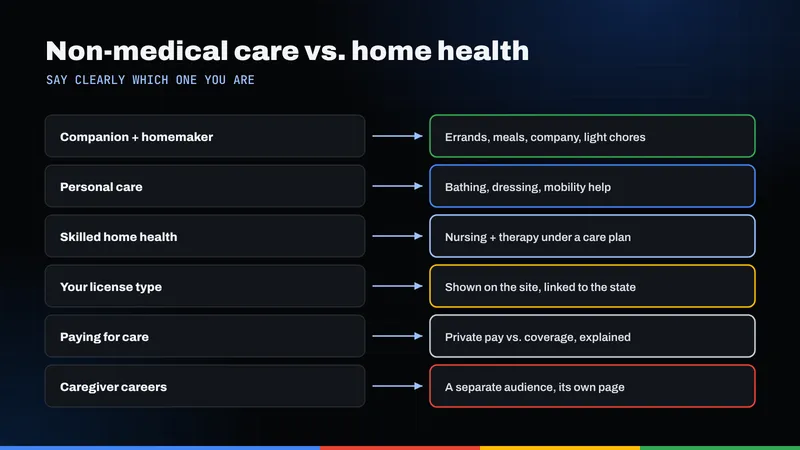
Care plan: make your license type obvious on every page
The care plan for your website is simple: state your status everywhere a family might land. Families compare agencies in browser tabs, and the clearest one earns the call.
Say a hypothetical agency called Biscayne Kindred Care holds a homemaker and companion registration and has no home health license. Its site should do the following:
- Show the AHCA registration number in the footer of every page and on any landing page tied to an ad.
- Use one short, plain sentence near the top of the home page, such as "We provide non-medical companion and homemaker services," with a link to a page explaining what that includes and what it doesn't.
- Avoid words that suggest licensed care it can't provide, like "nursing," "skilled care" or "bathing assistance," unless a licensed partner provides them and the page says so clearly.
A licensed home health agency writes the reverse version: name the license, list the authorized services shown on it, and explain how a physician's order or a hospital referral starts care. A nurse registry should explain the independent contractor model on a "How it works" page, since families hear about it at contracting anyway. Clarity helps search too: a page that plainly says "non-medical companion care" matches "companion for elderly mother" far better than one that hints at everything.
Schedule: a Google Business Profile built for a service-area agency
Many families meet you in the map results first. Because care happens in clients' homes, the profile needs a specific setup.
Google's service-area business guidelines say that if you don't serve customers at your business address, you should remove it from your profile and list only your service area. You can add up to 20 service areas. The overall area shouldn't extend more than about two hours of driving from where the business is based, and you can't set it as a radius around your office. For a North Miami Beach agency, name the cities your caregivers actually reach on a normal schedule, not every county you once staffed.
- Primary category: pick the one closest to your license type.
- Services: list only services your authorization covers, using the same names as your website pages.
- Hours: show real intake hours; explain overnight care in the description.
- Photos: use your office, your team with written permission, and branded vehicles. Never post client faces or homes.
Our Google Business Profile guide for North Miami Beach businesses goes deeper. Our local SEO service handles profile setup and ongoing management.
Caregiver match: service pages by care type and by everyday need
Build one page for each type of care you're authorized to provide, then pages around the everyday needs families describe. Condition-friendly pages are where agencies overreach. A memory-care companion page is fine if it describes routine, supervision, conversation, meals and respite for the family. It becomes a problem when it promises to slow decline or manage symptoms. Describe the help, not an outcome.
| Family need | What they search | Page to build |
|---|---|---|
| Parent lives alone and is lonely or forgetful | "companion care for elderly," "someone to check on mom" | Companion care page with visit lengths and what a visit includes |
| House, meals and errands are slipping | "homemaker services near me," "help with groceries for seniors" | Homemaker services page listing chores covered |
| Help with bathing, dressing and getting around | "personal care aide at home," "help bathing elderly parent" | Personal care page, only if your license covers hands-on care |
| Coming home from the hospital with a doctor's order | "home health after hospital," "home nurse visits" | Skilled home health page explaining referral and orders (licensed agencies only) |
| Family needs flexible caregivers or a private nurse | "nurse registry Miami," "private duty nurse at home" | Nurse registry "How it works" page with the independent contractor disclosure |
| Memory changes and daily routine | "dementia companion care," "Alzheimer's sitter" | Memory-friendly companion care page describing support, with no medical claims |
| Family caregiver is exhausted | "respite care at home," "overnight caregiver" | Respite and overnight care page with scheduling options |
| Need care in a language the parent speaks | "Spanish speaking caregiver," "Haitian Creole caregiver" | Language page listing languages your team truly speaks |
Each page should answer the intake questions in the same order: what's included, what isn't, who it suits, scheduling, how to start, and which license covers it. For language pages, our post on multilingual SEO in North Miami Beach explains how to build translations properly.
Care coordinator note: Don't create a page for every diagnosis. A few strong pages beat forty thin ones.
Caregiver match, part two: screening statements you can prove
The deciding question is often "Who is coming into my father's home?" Answer it only with statements you can document.
Section 400.512 says home health agencies, nurse registries and companion or homemaker services must require level 2 background screening for employees or contractors, under Chapter 435. AHCA manages the Care Provider Background Screening Clearinghouse that tracks those results. Section 400.509 also requires companion and homemaker registrants to obtain and verify the employment or contract history of anyone who will have contact with clients in their homes.
"Every caregiver we place has completed Florida Level 2 background screening" is fine if it is true for every caregiver and you have the records. Avoid these unless documented:
- "Bonded and insured," unless you hold the bond and policies.
- "Certified caregivers," unless you can say what certification and who issued it.
- "Hand-picked" or "top 1%," because these are claims you can't prove.
- Training hours or ratios, unless they reflect your actual written policy.
Nurse registries need extra care: since a registry may not supervise or train referred caregivers, "ongoing supervision by our nursing team" may describe something the model doesn't allow.
Check-ins: paying-for-care pages that tell the truth
Money is the question agencies most often dodge, which makes a clear paying-for-care page one of your most useful.
Medicare and home health
Medicare's own home health services page explains that coverage is for part-time or intermittent skilled services for people who are homebound, after a doctor or other provider sees them and orders care, delivered by a Medicare-certified home health agency. It lists what is not covered, including 24-hour care at home, homemaker services like shopping and cleaning unrelated to the care plan, and custodial or personal care like help bathing or dressing when that is the only care needed.
Families often misunderstand that last point, so explain it gently. A companion and homemaker agency should say plainly how its services are usually paid.
Private pay and long-term care insurance
Many families pay privately, and some have long-term care insurance. Policies vary, so don't promise reimbursement. Explain what documentation you can provide, such as care notes and invoices, and suggest families call their insurer before care begins. Name specific programs only if you have a current agreement.
Care coordinator note: Don't publish hourly rates you can't honor across schedules. If you prefer not to list prices, explain what affects cost, such as hours per week, overnight shifts and care needs, and invite a free assessment call.
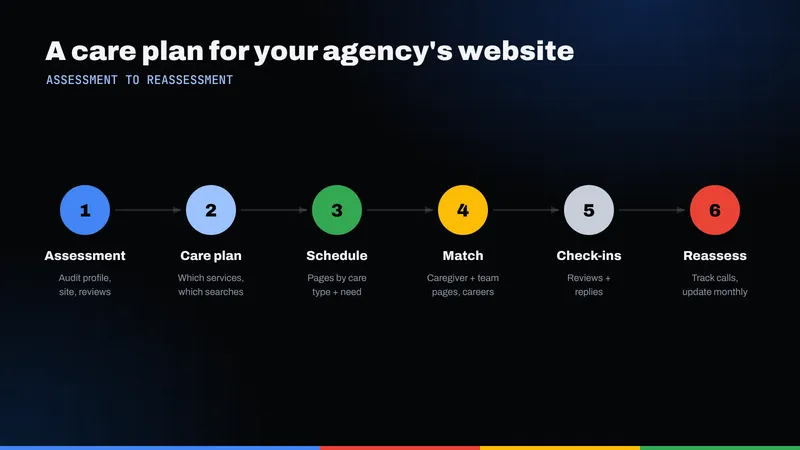
Check-ins: reviews and client privacy
Reviews matter because families are trusting strangers with someone they love, and a careless reply can reveal who receives care and where.
- Ask at natural moments, such as after a family thanks you at a reassessment. Never offer gifts or discounts for reviews.
- Reply without confirming details. Thank the reviewer warmly, but never repeat the client's name, condition, address or the caregiver's schedule. "Thank you for trusting our team" works for every review.
- Handle complaints offline. Respond briefly, invite a call with your care coordinator, and leave clinical or personnel details out of public view.
- Don't feature client stories without written permission. If you are a licensed home health agency, HIPAA may apply to client information. Non-medical agencies should still treat client details as confidential.
Never write reviews yourself, ask staff to post them, or publish testimonials you can't trace to a real client who agreed.
Reassessment: schema, measurement and what to adjust
Review your search plan every quarter, the way a care plan is reassessed.
Schema markup
Structured data helps search engines read your business details. Schema.org has no specific home care or home health type. MedicalBusiness is a subtype of LocalBusiness, and its own subtypes include Nursing and Geriatric. A licensed skilled home health agency might reasonably use MedicalBusiness. A non-medical companion and homemaker agency should generally stay with LocalBusiness, so its markup doesn't suggest medical services it doesn't provide. Either way, use the areaServed property to describe the cities you serve. Our post on how schema helps search engines covers the basics.
What to measure
- Calls and form submissions from family pages, tracked separately from job applications.
- Calls and website clicks from your Business Profile.
- Which care-type pages bring families who become clients.
- Questions families ask on intake calls that your site doesn't answer yet. Those are your next pages.
The second audience: caregivers looking for work
Home care agencies have a hiring audience searching phrases like "CNA jobs North Miami Beach" or "companion caregiver jobs." Give them a separate careers section with job pages, clear requirements, the screening process you actually use and an application form. Keep careers traffic out of family reports, and keep "hiring now, no experience needed" off care pages.
Putting the plan together for a North Miami Beach agency
None of this requires tricks, just writing down what you're licensed to do, where, and how families start and pay. Our North Miami Beach SEO team organizes structure, profiles and content, and our website design service rebuilds sites that are slow or confusing on a phone. When you're ready, request a free SEO audit and we'll review your profile, pages and license disclosures together.
Frequently asked questions
What is SEO for home care agencies?
It is the work of helping families find your agency in Google search and maps. For a home care agency, that means a service-area Google Business Profile, a page for each type of care you are authorized to provide, clear license or registration disclosures, honest payment information and careful handling of reviews.
Can a companion or homemaker agency in Florida offer personal care?
Florida's definitions in section 400.462 say a companion or homemaker may not provide hands-on personal care, such as help with dressing, bathing, eating or personal hygiene. If your website mentions personal care, confirm with AHCA or a health care attorney that your license covers it before publishing.
Do I have to put my license number in my ads?
Yes. Florida requires home health agencies and nurse registries to include their AHCA license number in advertisements, and companion and homemaker services to include their AHCA registration number. Putting it in your website footer and ad landing pages is a practical way to comply.
Should a home care agency show its office address on Google?
Only if clients are served at that address. Google's guidelines say a business that doesn't serve customers at its address should remove it and list a service area instead, with up to 20 areas and an overall area within about two hours of driving.
Does Medicare pay for non-medical home care?
Medicare says it doesn't cover homemaker services unrelated to the care plan, 24-hour care at home, or custodial or personal care when that is the only care needed. It covers part-time or intermittent skilled home health care for eligible homebound patients through a Medicare-certified agency.