A garage door company wins local search the same way a door works: every part has to carry its share of the load. Build a clean, policy-compliant Google Business Profile, give each job you actually do (springs, openers, new impact-rated doors, hurricane bracing) its own page, make booking easy on a phone, and back it all with honest reviews and real credentials. In a category crowded with lead-gen listings, being verifiably real is the advantage.
Key takeaways
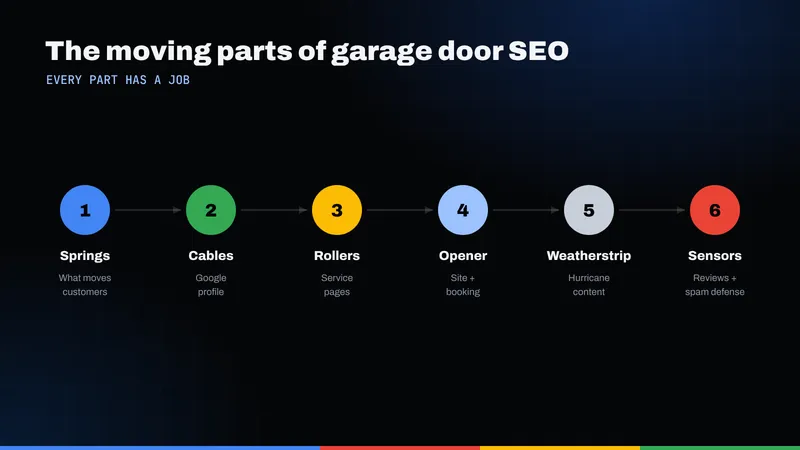
- Think of your marketing as a door system: springs (demand), cables (Google profile), rollers (service pages), opener (website and booking), weatherstripping (hurricane content) and safety sensors (reviews and spam defense).
- Service-area businesses should hide their address on Google Business Profile, keep the service area within roughly two hours of driving, and use their real business name with no keywords added.
- Garage door search has a fake-listing problem. Google has a Business Redressal Complaint Form for reporting misleading names, phone numbers and websites on Maps.
- Florida's Construction Industry Licensing Board has a certified "garage door installation specialty contractor" category. Show the credentials you actually hold and nothing you don't.
- Write hurricane and impact-door content from your real product approvals, never from made-up ratings, and claim 24-hour service only if someone truly answers at 3 a.m.
Why think about SEO like a garage door?
Because a garage door is a good honest machine. When one part fails, the whole thing sits crooked. A new opener can't lift a door with a snapped spring. Marketing works the same way. A gorgeous website won't get calls if your Google profile is suspended, and a perfect profile won't convert if the site behind it is slow and vague.
So this guide to SEO for garage door companies walks through the system part by part, from the springs that create demand to the safety sensors that keep your reputation from getting crushed.
To keep it concrete, imagine a hypothetical two-truck outfit called Bayfront Door & Opener, run out of the owner's home and serving North Miami Beach and nearby cities. It's made up for this article, with no reviews, results or clients. It's just a chassis to hang the parts on. For the bigger picture of how we approach this market, see our North Miami Beach SEO page.
Springs: what makes customers move?
Springs store the energy that lifts the door. In marketing, the stored energy is the homeowner's problem: the door won't open, the car is trapped inside, a cable is dangling, a storm is coming, or the old door finally looks as tired as it sounds.
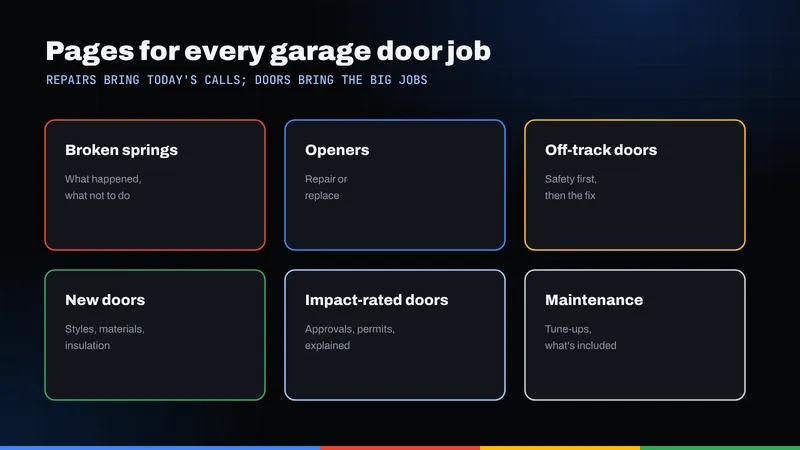
Good garage door SEO starts by matching each of those moments to a search and then to a page. Here's the map we'd sketch for Bayfront Door & Opener. The searches are the kinds of phrases homeowners type, not measured volumes.
| Problem or job | What homeowners search | Page to build |
|---|---|---|
| Loud bang, door won't lift | "broken garage door spring," "garage door spring replacement near me" | Spring repair and replacement |
| Cable snapped or door hanging crooked | "garage door cable came off," "garage door off track" | Cable and off-track repair |
| Opener hums but nothing moves, remote dead | "garage door opener not working," "new garage door opener installed" | Opener repair and replacement |
| Door reverses or won't close | "garage door won't close all the way," "garage door sensor problem" | Safety sensor troubleshooting and repair |
| Storm season, older non-rated door | "impact garage door," "hurricane garage door," "Miami-Dade approved garage door" | New impact-rated garage doors |
| Want protection without replacing the door | "garage door hurricane brace," "garage door bracing kit installed" | Hurricane bracing |
| Door works but looks dated | "new garage door installation," "modern garage door" | New doors and styles gallery |
Many of these searches are urgent, so the page has to answer fast on a phone. Others (impact doors, bracing) are research searches where people read, compare and come back later. Those pages need more depth.
Service tech's note: a spring with too little tension won't lift the door, and a spring with too much is dangerous. Pages work the same way. One thin "Garage Door Services" page can't lift seven different jobs, and a page stuffed with every city name in the county is wound too tight.
Cables: is your Google Business Profile connected right?
Cables tie the springs to the door. Your Google Business Profile ties your business to the map. For a mobile trade, the service-area rules matter most. Google's guidelines for representing your business say:
- Hide your address if customers don't come to you. If Bayfront works out of the owner's house, the address stays off the public profile and the service area does the work.
- Keep the service area realistic. Google says it generally shouldn't extend farther than about two hours of driving time from your base.
- Use your real name. No taglines, service descriptions or location words bolted onto the business name. "Bayfront Door & Opener" is fine. "Bayfront Door & Opener 24 Hour Garage Door Repair North Miami Beach" is not.
- No virtual offices. A rented mailbox or an unstaffed office isn't eligible.
- Phone numbers under your direct control. Google prefers a local number over a central call center where possible.
Beyond the rules, fill in what helps a stressed homeowner decide: accurate categories, real hours, a services list that mirrors your pages, and photos of your actual trucks, crew and installs. Our Google Business Profile guide for North Miami Beach covers setup in detail, and our Google Maps SEO service is where we handle it for clients.
Service tech's note: a frayed cable doesn't fail all at once. Neither does a profile. A keyword-stuffed name or a fake address can sit there for months and then snap, taking your calls with it.
Rollers: which service pages carry the load?
Rollers let the door glide along the track. Service pages let a visitor glide from "I have a problem" to "these people fix exactly that." Build one page per job from the table above, and make each one genuinely different. A useful service page for Bayfront's spring repair would include:
- The problem in plain words. What a broken spring sounds and looks like, and why homeowners shouldn't wind torsion springs themselves.
- What the visit includes. Inspection, the springs you work on, whether you check cables and rollers too.
- How pricing works. What affects the price and when you give a written quote. Don't publish numbers you won't honor.
- Proof and a next step. Real job photos, your license information, reviews, and a tap-to-call or booking button.
A word on emergency and 24-hour claims. "24/7" is tempting copy. Only use it if a person truly answers and a tech can be dispatched overnight. If you offer after-hours service only some nights or for some jobs, say exactly that, and make your Google hours match your website. Mismatches are how trust leaks out of a listing.
If you serve several cities, resist cloning a page per town with the name swapped. One strong page per service, plus an honest service-area page, beats a dozen thin copies.
Opener: does your website actually lift the door?
The opener is the motor. On your site, that means speed, clarity and a booking path that works with one thumb in a driveway. Check these on your own phone, not your office monitor:
- Call button visible without scrolling on every page.
- A short booking form: name, phone, ZIP, what's wrong, optional photo.
- Fast loading on a cellular connection. Heavy sliders and auto-playing video slow the motor.
- Real photos of your crew, trucks and installs, not stock models holding remotes.
Then add structured data. Schema.org doesn't have a garage-door-specific type. The closest fit is HomeAndConstructionBusiness, a subtype of LocalBusiness that inherits properties like areaServed and opening hours. Mark up your name, phone, URL, service area and hours, and keep every value identical to your profile. Our guide to how schema helps search engines shows the basics.
Weatherstripping: how should you write hurricane and impact-door content?
Weatherstripping seals the gaps. In South Florida, hurricane content is the seal, and it's where a garage door company can be useful instead of salesy. People searching "impact garage door" want to understand what they're buying.
Lead with product approvals, not adjectives
Miami-Dade County's Product Control Section reviews building-envelope products and issues Notices of Acceptance (NOAs). A sample Miami-Dade NOA for an impact-rated sectional garage door shows the details worth explaining: it says the product was designed to comply with the Florida Building Code including the High Velocity Hurricane Zone, lists a large and small missile impact rating, requires a permanent label showing design pressure ratings and the NOA number, and requires a copy to be available at the job site if the building official asks.
That same NOA includes a warning worth taking seriously: misusing it as an endorsement of a product, for sales or advertising, terminates the approval, and if any part of it is displayed, the whole thing must be shown. So on your website:
- Describe each door line you install and point to its current NOA rather than quoting fragments.
- Explain in plain words what design pressure and impact ratings mean, and that the right door depends on the house and the approval.
- Never invent ratings or wind speeds. If you don't have the approval in hand, don't write the number.
- Approvals expire, so update pages when a product's NOA changes.
Hurricane bracing pages
Bracing is a real search and a useful service for some homes. Explain who it may suit, what the install involves, and that you'll confirm with the local building department whether a permit or approval is required for that setup. Don't promise a brace makes an old door "hurricane-proof."
Roofers face the same questions about product approvals and storm claims, and we covered that ground in our roofer SEO guide for North Miami Beach. The principle carries over: content about storm protection should be accurate first and persuasive second.
What should you say about licensing and permits?
Credentials separate a real company from a listing that routes calls to whoever is free. Florida's Construction Industry Licensing Board rule on certified specialty contractors (Rule 61G4-15.100) includes a "garage door installation specialty contractor" category. In summary, the rule describes that contractor as able to install, adjust, repair and service all types of garage doors and their hardware and operating devices, including low-voltage safety wiring, with other electrical work subcontracted to a licensed electrical contractor.
What we'd tell Bayfront, or any real shop:
- Confirm your own licensing with the state board and the building departments where you work. Requirements can depend on scope and jurisdiction, and this isn't legal advice.
- Show the license you hold, exactly as issued, on your footer, service pages and estimates.
- Explain permits plainly. If a door replacement needs a permit where the customer lives, say you pull it and what inspection looks like.
- Don't claim credentials you don't have. "Licensed and insured" is a factual statement, so make sure it's true.
Safety sensors: how do honest reviews and spam defense protect you?
Safety sensors stop the door before it closes on something it shouldn't. Your sensors in local search are reviews you can stand behind and a willingness to report listings that cheat.
Reviews that hold up
Google's fake engagement policy prohibits offering incentives for reviews, discouraging negative reviews or selectively asking only happy customers, reviews based on a conflict of interest (employees, family, contractors), and paid reviews. On top of that, the FTC announced a final rule banning fake reviews and testimonials on August 14, 2024. It targets fake reviews (including AI-generated ones), incentives tied to a particular sentiment, undisclosed insider reviews, and review suppression through threats or intimidation.
A clean routine for a garage door crew is simple:
- Close the job and collect payment.
- Send every customer the same short review request by text or email. No discount attached.
- Let the review say whatever it says.
- Reply to every review, good or bad, calmly and specifically.
Over time, real reviews mention springs, openers, the tech's name and the city. Lead-gen listings can't fake that detail well.
Reporting misleading listings
Garage door repair, like locksmith work, is a category where some listings are lead-generation fronts: a generic name stuffed with keywords, an address that isn't really a shop, and a phone number that forwards to a call center. That runs against the guidelines covered above: no keyword-stuffed names, no unstaffed virtual offices, and phone numbers under the business's direct control. If you see listings like that in your service area, you have two tools:
- Suggest an edit on Maps. Any signed-in user can flag a listing that doesn't exist or is misleading through the listing's "Suggest an edit" option.
- File a Business Redressal Complaint. Google's Business Redressal Complaint Form is for misleading information or fraudulent activity on Maps involving a business's name, phone number or website. It asks for the Maps URLs, the type of content and a detailed explanation. Google notes it can't guarantee action and won't send status updates.
Report facts, not grudges. Document what you saw with screenshots, and keep your own profile spotless first. We dug into the same problem in our locksmith SEO guide.
Service tech's note: a sensor that's been taped over still looks like a sensor. Bought reviews look like reviews too, right up until they get filtered and the trust goes with them.
Should you run Local Services Ads?
Paid placement can be the extra torque during busy seasons. Google's Local Services Ads list garage door services as an eligible category, and businesses that pass Google's screening can earn the Google Verified badge. One detail matters for this trade: Google says pre-badge ads aren't available for garage door services, health care verticals and locksmiths.
Those ads lean on the same foundation as organic local SEO: accurate information, real licensing and honest reviews.
Where should a garage door company start this month?
Run the inspection in order: audit the profile against the guidelines, list every job that needs its own page, test the site and booking form on a phone, trace every impact-door claim back to a real approval, and start a same-for-everyone review routine.
That's the core of local SEO in Miami-area home services: real details, consistently presented, for people who need help now. Whether you're a single-truck shop or competing across the county for broader SEO in Miami, the parts are the same. If you'd like a second set of hands on the inspection, our local SEO team does this every day, and you can request a free audit to see where your system is sticking.
Frequently asked questions
What is the most important part of SEO for garage door companies?
A Google Business Profile that follows Google's rules, backed by a separate page for each service you offer. For a service-area business, that means hiding your home address, keeping a realistic service area, using your real business name and keeping hours accurate.
Can I add "24 hour garage door repair" to my Google business name?
No. Google's guidelines don't allow taglines, service descriptions or location details in the business name. Use your real name, and only describe 24-hour service on your site and profile if someone truly answers and can dispatch around the clock.
How do I report a fake garage door listing on Google Maps?
Use "Suggest an edit" on the listing to flag a place that doesn't exist or is misleading, or file Google's Business Redressal Complaint Form for fraudulent names, phone numbers or websites on Maps. Include the Maps URLs and a factual explanation. Google doesn't guarantee action or send status updates.
Can garage door companies run Google Local Services Ads?
Yes. Google lists garage door services as an eligible Local Services Ads category. Pre-badge ads aren't available for garage door services, so a business needs to pass Google's screening and earn the Google Verified badge before ads run.
Can I put impact ratings and Miami-Dade NOA numbers on my website?
You can describe the door lines you install and point to their current approvals, but don't invent ratings or quote fragments. A sample Miami-Dade NOA for a garage door says the number may appear in advertising literature, but if any portion is displayed it must be shown in its entirety, and misusing it as an endorsement terminates the approval.