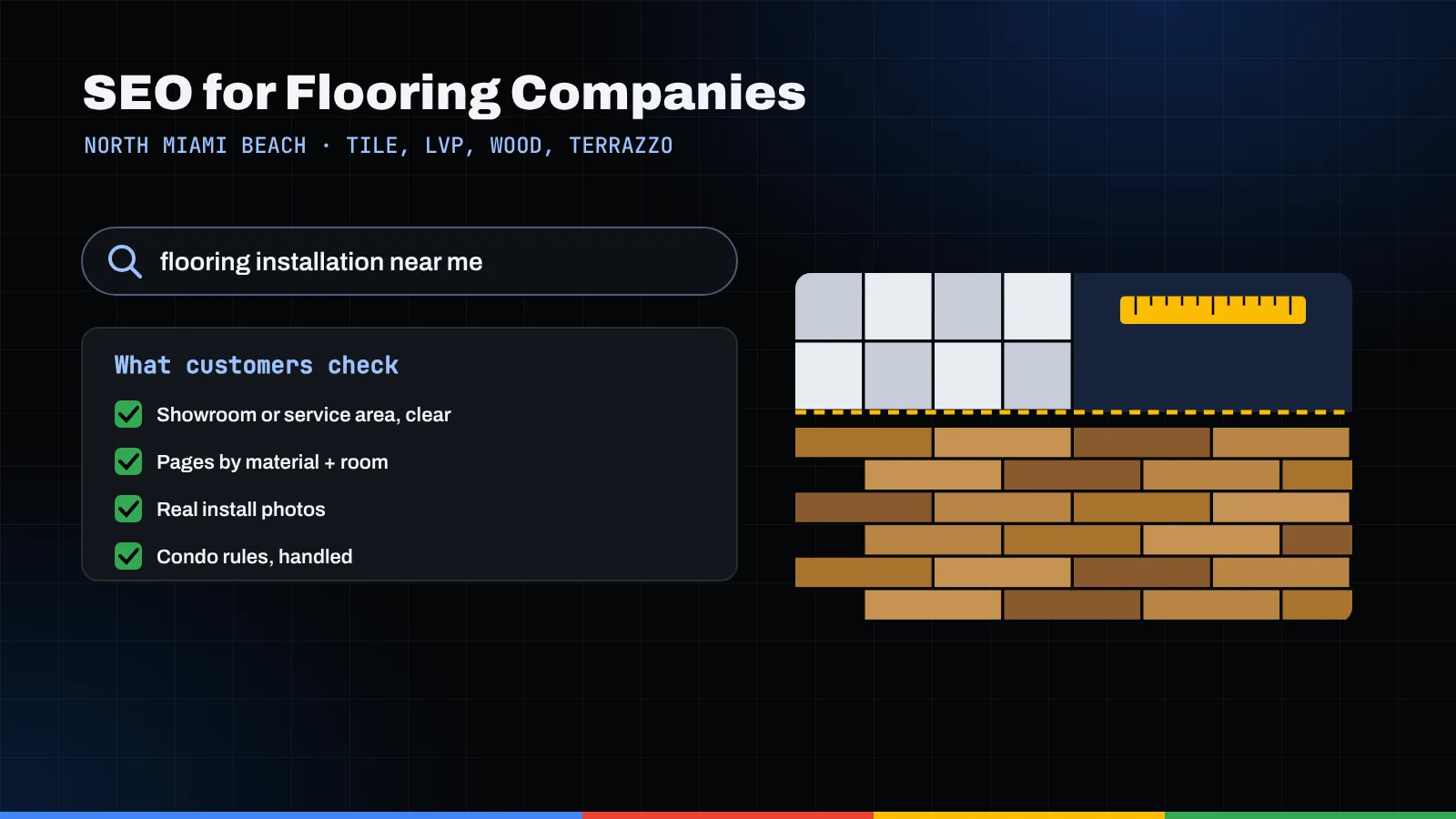
SEO for flooring companies in North Miami Beach works like a good install: measure what people actually search, get the site and Google Business Profile flat and level, then lay out a page for each material and room you really handle. Condo flooring pages, an easy way to book a showroom or sample visit, real job photos and honest reviews finish the job. Track calls and bookings so you know which pages are pulling their weight.
Key takeaways
- Set up your Google Business Profile to match how you really operate: a staffed showroom with signage, a service-area business with a hidden address, or a hybrid of the two.
- Build one page per material and per room (tile, porcelain, luxury vinyl plank, engineered wood, terrazzo restoration, condo flooring) instead of a single "services" list.
- Florida law lists flooring and tile, marble and terrazzo installation among job scopes local governments may not license, but you still need local business tax receipts, so show the credentials and insurance you actually hold.
- Condo buyers search for sound control. Explain that each association sets its own rules and tell owners to check their condo documents before they pick a floor.
- Ask every customer for an honest review, never pay or discount for one, and label your photos with descriptive file names and alt text.
Measure: who searches for flooring in North Miami Beach?
Every flooring job starts with a tape measure, and so does SEO for flooring companies. Before you write a word, figure out who is typing what. In and around North Miami Beach the searches usually fall into four groups:
- Condo owners looking for quiet, water-tolerant floors and an installer who knows how to deal with an association.
- Single-family homeowners comparing luxury vinyl plank, porcelain tile and engineered wood for a whole-house refresh.
- People with old terrazzo hiding under carpet or tile who want to know if it can be ground, polished and saved.
- Contractors, designers and property managers who need a reliable sub or supplier with stock on hand.
Each group uses different words. A condo owner types "soundproof flooring for condo." Someone who just pulled up a corner of carpet types "terrazzo floor restoration." Your site needs a page that answers each of those searches, and your Google profile needs services that match them.
Imagine a hypothetical company called Tidewater Plank & Tile, with a small showroom and two install crews. If its site has one page titled "Flooring Services," it's trying to cover four very different jobs with one board. The rest of this walk-through shows how a shop like that could lay things out.
Installer's note: Write down the questions customers ask you on the phone and in the showroom for two weeks. That list is better keyword research than any guess, and it tells you which pages to build first.
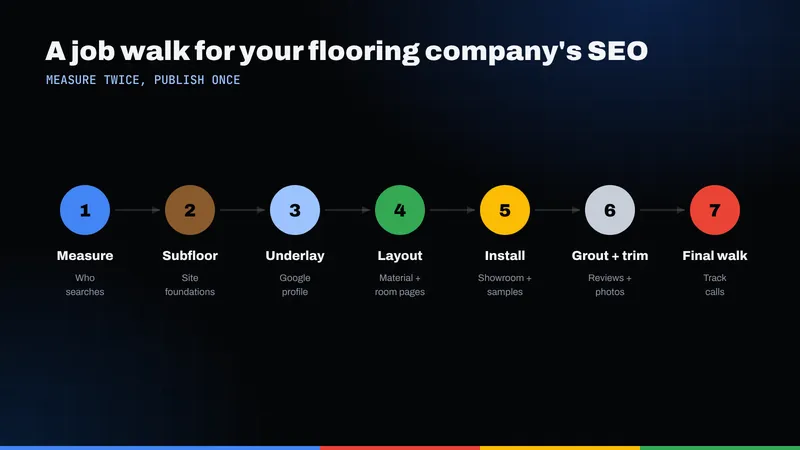
Subfloor: are your site foundations flat and level?
You wouldn't float a plank floor over a subfloor with a dip in it. The same goes for content on a weak website. Before you add pages, check the basics:
- Mobile first. Plenty of people browse flooring on a phone, sometimes standing in the room they want to redo. Buttons to call, text and book a visit should be easy to tap.
- Speed. Flooring sites are photo-heavy, so compress images and lazy-load galleries.
- Consistent business details. Your name, address, phone and hours should match on the site, your Google profile and every directory listing.
- One clear location page. If you're based in North Miami Beach, say so plainly, and list the neighborhoods and nearby cities you actually serve.
Licensing and insurance: what to show
Customers often ask whether a flooring installer needs a state license. Florida's statute on local contractor licensing, section 489.117, lists flooring, cabinetry and "decorative stone, tile, marble, granite, or terrazzo installation" among the job scopes for which a local government may not require a license. Interior remodeling is on that list only when the project doesn't include a task that needs a state license. So if a job turns into plumbing, electrical or structural work, the rules change, and that part needs the right licensed trade.
No license requirement doesn't mean no paperwork. Miami-Dade's tax collector says a business located within a municipality needs both a city and a county local business tax receipt. Put your real receipts, any state licenses you hold for other work, your general liability and workers' comp details, and manufacturer installer certifications on an "About" or "Credentials" page. Show only what you actually have, and keep it current. Homeowners and condo managers check this, and it gives searchers a concrete reason to trust you over a listing with nothing on it.
Installer's note: Many condo buildings ask for a certificate of insurance before a crew can enter. A short page explaining how you send one to building management answers a question that comes up on nearly every condo job.
Underlayment: how should you set up your Google Business Profile?
Underlayment is the layer nobody sees but everyone feels. In local SEO in Miami and everywhere else, your Google Business Profile plays that role under your Maps listing.
The first decision is what kind of business you are in Google's eyes. Google's Business Profile guidelines separate them like this:
- Showroom (storefront). If customers come to your address, the location needs permanent signage and should be staffed during the hours you list. Show the address.
- Service-area business. If you only travel to customers, Google says you should hide your address and set a service area. The guidelines say a service area shouldn't extend farther than about two hours of driving time from where you're based.
- Hybrid. If you have a showroom and also install in customers' homes, you can show the storefront address and set a service area.
Google also says a virtual office can't be listed unless it's staffed during business hours, and that your business name should be your real-world name, without added keywords, taglines or city names. "Tidewater Plank & Tile" is fine. "Tidewater Plank & Tile Best LVP Installer North Miami Beach" isn't.
Then fill in categories, a services list that mirrors your material pages, real hours, and photos of the showroom and finished jobs. If you're a contractor first and a store second, the post on SEO for contractors in North Miami Beach covers more of the service-area side. For hands-on help with the profile, see our local SEO services.
Layout: which material and room pages should you build?
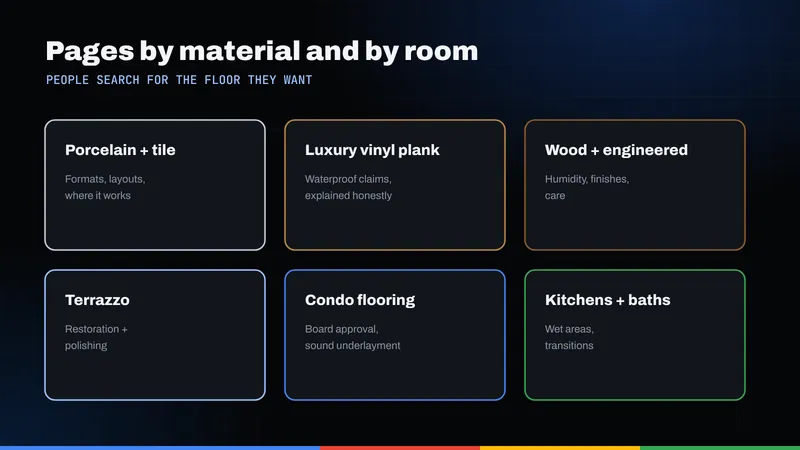
A good installer dry-lays the floor before glue or nails come out. Plan your pages the same way. Each page should match one clear search, explain the material honestly, show your own work and end with a way to book.
| Material or room | What customers search | Page to build |
|---|---|---|
| Luxury vinyl plank | "LVP installation," "waterproof vinyl plank flooring," "vinyl plank over tile" | Luxury vinyl plank installation, with a section on going over existing tile and when you'd remove it instead |
| Porcelain and ceramic tile | "porcelain tile installation," "large format tile installer," "wood look tile" | Porcelain tile installation, covering large-format work, layout and leveling |
| Hardwood and engineered wood | "engineered hardwood installation," "hardwood floors in Florida humidity" | Engineered wood flooring, explaining how you acclimate and install it in a humid climate |
| Terrazzo | "terrazzo floor restoration," "remove carpet from terrazzo," "terrazzo polishing" | Terrazzo restoration, with before-and-after photos from your own jobs |
| Condos | "condo flooring installation," "soundproof underlayment condo" | Condo flooring and sound control, with an association approval checklist |
| Showroom | "flooring store near me," "flooring showroom North Miami Beach" | Showroom page with address, hours, brands carried and a booking link |
Keep each page useful on its own: what the material is good for, where it struggles, how you prep the subfloor and what the customer does before the crew arrives. If you'd rather not quote prices online, explain what drives cost (square footage, demolition, leveling, pattern, trim) and invite a measure.
Flooring often overlaps with design work. If you partner with designers or sell to them, the interior designer SEO guide shows how that side of the trade thinks about search, which helps when you write trade pages or referral pages.
Condo flooring: how do you write about sound control without guessing?
North Miami Beach and the neighboring coast have a lot of condo buildings, and condo flooring has its own rules. Many associations require sound-control underlayment under hard floors, and many require board or management approval before work starts. The details vary from building to building.
That variation is exactly why a condo page is worth building, and why it has to be careful. Don't publish a single sound rating and imply it applies everywhere. Instead, write a page that helps owners through the process:
- Check your condo documents. The declaration, rules and any flooring policy say what's allowed under hard floors and whether you need approval.
- Ask management for the application. Many buildings have a form, a required product spec sheet and set work hours.
- Pick a floor and underlayment that meet the building's rule. You supply the manufacturer's documentation for the exact products.
- Send the certificate of insurance. Get it to management before the crew is scheduled.
- Schedule around building rules. Elevator reservations, loading hours and debris removal all go on the calendar.
A page like this answers real questions and gives owners a reason to call a specialist.
Installer's note: Keep spec sheets for every underlayment you stock in a folder you can email in minutes. Then mention on the page that you'll send them to the association on the owner's behalf.
Install: how do you turn searches into showroom and sample visits?
Flooring is hard to buy from a photo. People want to see the color in daylight and lay a plank next to their cabinets. So the goal of most flooring SEO isn't a form fill. It's a visit.
- Offer a showroom appointment. A simple booking widget or form with time slots works better than "call us." Say how long a visit usually takes and what to bring (photos, room measurements, a cabinet door if they have one).
- Offer take-home samples or an in-home sample visit. If you do it, say so on every material page and in your Google profile's services.
Your showroom page should list the address, hours, parking notes, languages spoken by staff, and the brands or product lines you carry. If you speak Spanish, Haitian Creole, Russian or another language with customers, say so. It's a practical detail people search for. Our website design team builds booking flows like this into flooring and home-improvement sites.
Grout and trim: how should you handle reviews and job photos?
Trim and grout are where customers judge the whole job. Reviews and photos are where searchers judge your business.
Honest reviews
Google's contribution policy says businesses may not offer incentives such as payment, discounts or free goods or services for reviews, and may not discourage negative reviews or selectively ask only happy customers. It also bars content based on a conflict of interest, such as reviews tied to employment. The FTC's final rule on fake reviews and testimonials, announced in August 2024, bans fake reviews, incentives conditioned on a positive or negative sentiment, undisclosed insider reviews and review suppression through threats or intimidation.
The fix is simple. Ask every customer at the final walk, with a short link and no discount attached. Reply to every review briefly and specifically, including the critical ones.
Job photos that search engines can read
Your own photos beat stock photos every time, and they can rank in image search. Google's image SEO best practices recommend descriptive alt text without keyword stuffing, short descriptive file names, placing images near related text and using standard HTML image elements rather than CSS backgrounds.
- Rename files before upload: herringbone-engineered-oak-condo-living-room.jpg, not IMG_4471.jpg.
- Write alt text that says what's in the photo: "Herringbone engineered oak floor in a condo living room with white baseboards."
- Put each photo on the matching material page, with a caption saying the material and room.
- Get the homeowner's permission and keep faces and house numbers out of the shot.
Installer's note: Shoot every job from the same corner before and after, in daylight. A matched pair is worth more than ten random angles.
Schema: how do you label the boxes for search engines?
Structured data is like the label on a carton of tile: it tells whoever picks it up exactly what's inside. Schema.org has a type called HomeAndConstructionBusiness, defined as a local business that provides services around homes and buildings. Its listed subtypes cover trades like electricians, plumbers, painters and roofers, but there's no flooring-specific type, so an install company can use HomeAndConstructionBusiness itself.
If you run a showroom where people buy product, HomeGoodsStore, a type of Store, may fit that part of the business. A hybrid company can describe both accurately as long as every detail matches what customers see on the page and on your Google profile:
- Real business name, address (if shown), phone and hours
- Area served, matching your service-area settings
- Services that match your material pages
Never mark up reviews you wrote yourself or ratings that don't appear on the page. Our post on how schema helps search engines goes deeper on implementation.
Final walk: how do you know your flooring SEO is working?
Every job ends with a walk-through. Do the same with your marketing each month.
- Calls and texts from the Google profile and the website, tracked separately.
- Showroom and sample bookings, tagged by the page they came from.
- Search queries in Google Search Console, so you see whether "terrazzo restoration" or "condo LVP" pages are earning impressions.
- Closed jobs by source, because a page that brings fewer but bigger condo jobs may beat a busy page full of tire-kickers.
Our guide to SEO KPIs for North Miami Beach businesses lays out a simple monthly report. If you'd like a team to handle measuring, building and tracking for you, see how we approach North Miami Beach SEO and broader SEO in Miami, or request a free audit and we'll walk your site and profile the way you'd walk a finished floor.
Frequently asked questions
Do flooring installers need a state license in Florida?
Florida's section 489.117 lists flooring and decorative stone, tile, marble, granite or terrazzo installation among the job scopes for which a local government may not require a license. Work that includes tasks needing a state license, such as plumbing or electrical, still needs the right licensed trade, and businesses still need local business tax receipts.
Should a flooring company with a showroom use a storefront or service-area Google profile?
If customers visit a staffed location with permanent signage, show the address. If you also install at customers' homes, Google's guidelines let you show the storefront address and set a service area. If you have no place customers visit, hide the address and use a service area.
What should a condo flooring page say about soundproofing?
Explain that many associations require sound-control underlayment and approval before work starts, and that each building sets its own rules. Tell owners to check their condo documents and ask management for the application, and offer to send product spec sheets and your certificate of insurance.
Can I give customers a discount for leaving a review?
No. Google's contribution policy prohibits incentives such as payment, discounts or free services for reviews, and the FTC's 2024 rule bans incentives tied to a positive or negative sentiment. Ask every customer for an honest review instead, with no conditions.
What schema type fits a flooring company?
Schema.org has no flooring-specific type, so an installer can use HomeAndConstructionBusiness, a local business that provides services around homes and buildings. A showroom selling product may also fit HomeGoodsStore, a type of Store. Keep every detail consistent with your page and Google profile.