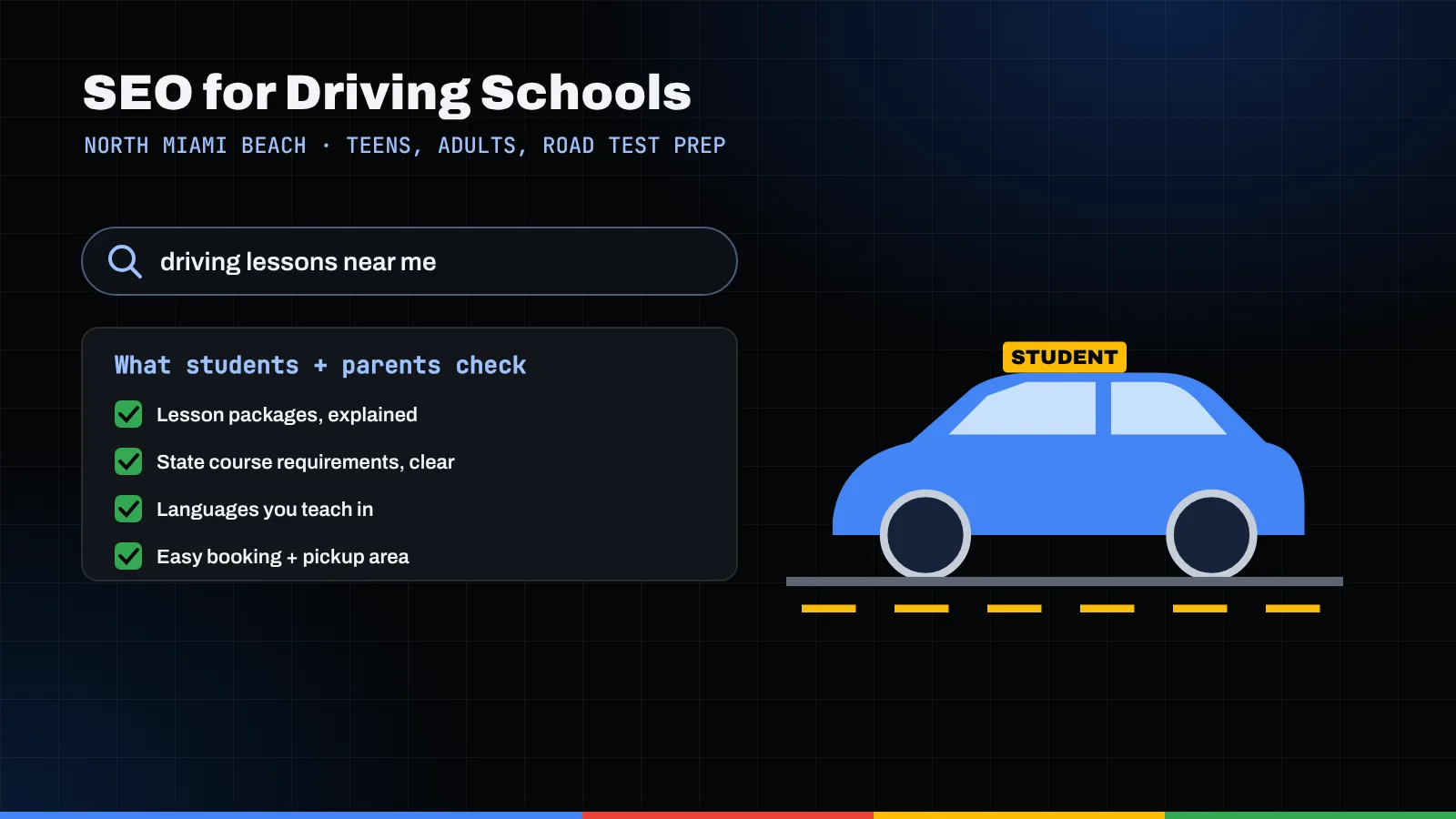
A driving school in North Miami Beach gets found by being the clearest answer to each student's first search: a nervous teen's parent, an adult who just moved to the US, or someone with a road test next week. That means an accurate Google Business Profile, a site where booking takes seconds, a separate page for every lesson and course you actually offer, Florida licensing steps explained with links to FLHSMV, honest reviews, and tracking that shows which pages produce bookings.
Key takeaways
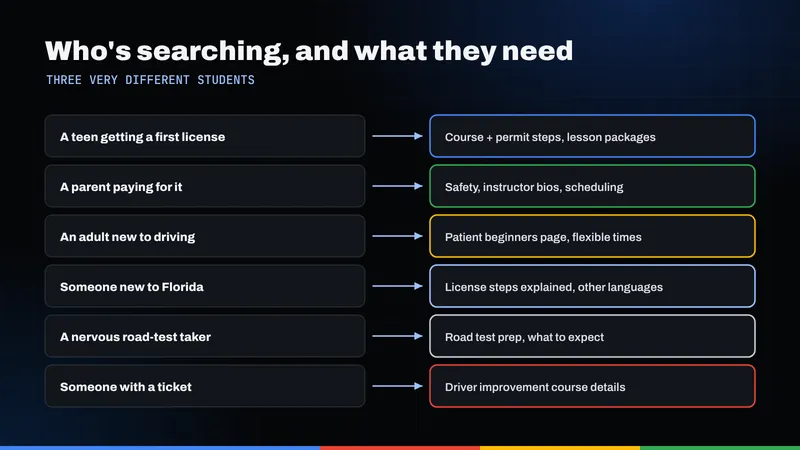
- Driving school SEO starts with knowing your three main students: teens (and the parents who pay), adult beginners, and adults new to the US who need a Florida license.
- If your instructors pick students up at home, set up your Google Business Profile as a service-area business and hide the address unless students actually come to you.
- Build one page per lesson type and course, and explain Florida's licensing steps in plain language with links to FLHSMV instead of paraphrasing rules from memory.
- Only say you give the Class E Knowledge Exam or the driving skills test if your school is an approved third party administrator.
- Ask every student for a review the same way, never trade discounts for reviews, and track bookings by page so you know what is working.
Mirrors: who is actually searching for a driving school?
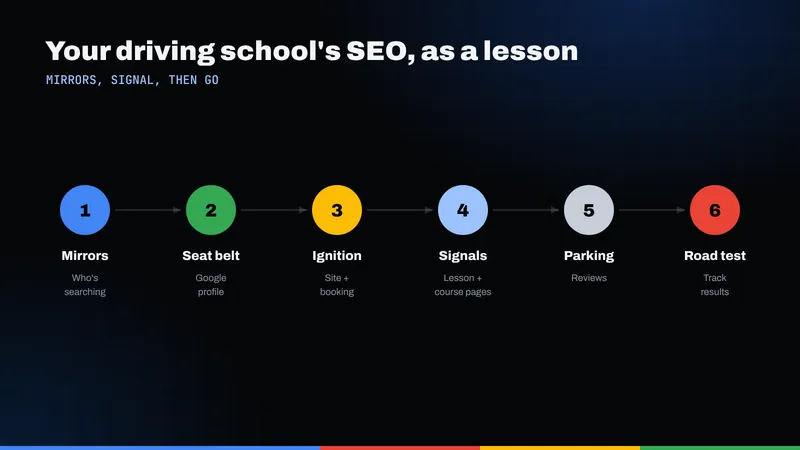
Every good lesson starts the same way. Before the engine turns over, you adjust your mirrors so you can see what's around you. SEO for driving schools starts there too, because the people searching for you are at least three different groups, and they type very different things.
- Teens and the parents who pay. A 15-year-old wants a learner's permit. The parent wants to know who will sit in the passenger seat, whether the car has an instructor brake, and how pickup works around the school day. Often the parent searches and the teen asks. Your pages need to answer both.
- Adult beginners. Plenty of adults never learned to drive, and they search with a little embarrassment built in: "driving lessons for adults," "nervous driver lessons." A page that says, in effect, "nobody here will rush you" does more work than any slogan.
- Adults new to the US. Many North Miami Beach families arrived from other countries and need a Florida license fast. They search for the steps in plain terms, often in Spanish, Haitian Creole or Portuguese, and want to know which requirements apply to someone who drove for years somewhere else.
Instructor's tip: before you write a single page, list the ten questions your front desk answers most often on the phone. That list is your keyword research, already written in your customers' own words.
Seat belt: get your Google Business Profile right first
The seat belt isn't exciting, but you don't move without it. Your Google Business Profile is the same. It's how you show up in the map results for "driving school near me," and it's the first thing many parents check.
The big decision is how your school serves students. Google's service-area business guidance says that if you don't serve customers at your business address, you should remove the address from your profile. A school whose instructors only pick students up at home or school is a service-area business. A school with a classroom students visit, plus instructors who also pick students up, is a hybrid: it keeps the address visible and adds service areas. Google allows up to 20 service areas and says the overall area shouldn't extend more than about two hours of driving from your base. List the places your instructors truly cover.
- Category and services: pick the closest driving school category, then list each service separately: teen lessons, adult lessons, road test prep, and any state courses you're approved to offer.
- Photos: your real training cars and classroom, and instructors who've agreed to be pictured. No students under 18 without written parent permission.
- Booking link: point it straight to your scheduler, not the home page.
For the rest of the settings, see our Google Business Profile guide for North Miami Beach.
Instructor's tip: if you have a classroom but most lessons start at the student's front door, keep the address visible. Hiding a real classroom confuses students who need to find it on course day.
Ignition: a site that turns a search into a booked lesson
Turning the key is the moment the car becomes useful. On your website, that moment is the booking. A visitor who liked your reviews and then got lost looking for a phone number is a stalled engine.
Imagine a hypothetical school we'll call Causeway Driving Academy. On a phone, its home page should do three things before any scrolling: say what it teaches and where, offer a button to book or check availability, and show a tap-to-call number.
- Booking that works on a phone. Test the scheduler on an older phone over a slow connection, because that's how many parents will see it.
- Pickup area stated plainly. "We pick up in North Miami Beach and nearby" beats "serving South Florida."
- What the first lesson looks like. Where the instructor meets the student, what to bring, how long it lasts, and whether the car is automatic or manual.
- Fast pages. If the site feels sluggish, our post on how website speed affects revenue covers what to check.
Instructor's tip: put your cancellation and rescheduling policy on the booking page in two or three plain sentences. It prevents a surprising number of awkward phone calls.
Turn signals: one page for every lesson and course
A turn signal tells everyone exactly where you're going. Your lesson and course pages should do the same for Google and for students. One page that tries to cover teen lessons, adult lessons, road test prep and three state courses signals nothing clearly. Separate pages, each built around one need, signal well.
| Student type and need | What they tend to search | Page to build |
|---|---|---|
| Teen getting a first permit | "how to get a learner's permit in Florida," "teen driving lessons" | Teen lessons page plus a plain-language permit steps guide that links to FLHSMV |
| Parent comparing schools | "driving school for teens near me," "driving lessons with pickup" | Teen page covering pickup area, car safety features and instructor background |
| Adult who has never driven | "driving lessons for adults," "nervous driver lessons" | Adult beginner page with a calm first-lesson walkthrough |
| Adult new to the US | "Florida driver license new resident," the same in Spanish, Haitian Creole or Portuguese | New-to-Florida guide plus translated pages, only in languages your instructors teach |
| First-time driver needing the state course | "TLSAE course," "drug and alcohol course Florida" | Course page explaining who needs it, linking to FLHSMV, and how you deliver it if you're an approved provider |
| Student with a road test coming up | "road test practice," "driving test prep" | Road test prep page and practice package |
| Driver with a traffic ticket | "basic driver improvement course" | Driver improvement page, if you're an approved provider |
Florida's licensing steps people search for
These rules change, so link to the state rather than restating everything. Here's what FLHSMV's own pages said when we checked in October 2026:
- The first-time driver course. FLHSMV's Traffic Law and Substance Abuse Education (TLSAE) page says drivers who have never held a license from another state, or don't have it with them, must complete a TLSAE course before applying for a Florida license. Many people just call it "the drug and alcohol course."
- A change for teens. FLHSMV's Driver Education Traffic Safety (DETS) page says that starting August 1, 2025, applicants under 18 who have never held a license must complete the 6-hour DETS course, with exceptions such as certain high school traffic safety classes and teens who finished the 4-hour TLSAE before that date. If your teen page still says every teen takes the TLSAE, it's out of date.
- The Class E Knowledge Exam. FLHSMV's knowledge exam and driving skills test page describes 50 multiple-choice questions on traffic laws, safe driving and traffic controls, with 40 correct (80 percent) needed to pass. Applicants under 18 can take it online with a parent proctoring form.
- Who gives the tests. The same page says the knowledge exam can be taken at a service center, through approved third party administrators, or through participating high school driver education classes. The driving skills test can be taken at a service center or with a driver license exam provider or third party administrator, once the applicant has held a learner's license for 12 months or is 18.
The honest-marketing point is simple: only say "take your permit test with us" or "road test here" if your school is an approved third party administrator. Otherwise, say you prepare students for the test and link to FLHSMV for where to take it. Likewise, FLHSMV's Education & Courses page covers basic driver improvement, including its use after a traffic citation. If you're an approved provider, a dedicated page for it reaches a different audience: experienced drivers who aren't shopping for lessons at all.
Instructor's tip: add a "last checked" date to any page that explains state requirements and recheck it a couple of times a year. Florida changed its teen course rules in 2025; it could happen again.
Lessons in more than one language
If your instructors teach in Spanish, Haitian Creole or Portuguese, that may be the biggest reason a North Miami Beach family picks you. It's also easy to bury. A small "se habla español" in the footer doesn't help anyone who searched in Spanish.
The better approach is a real translated page for each lesson type you offer in that language, written or reviewed by a fluent speaker, with its own URL and a language switcher linking the versions together. Our post on Spanish and multilingual SEO in North Miami Beach walks through the setup.
One firm rule: only promise lessons in a language when an instructor can actually teach in it. If only one instructor speaks Portuguese, say "available with select instructors" and let students request that person when they book.
Pricing and package pages without the guesswork
Parents and adult students want to know what lessons cost before they call. You don't need a giant rate card, but you do need a page that answers the question honestly.
- Explain how packages are built: single lessons, multi-lesson packages, road test prep, course fees, and what each includes (lesson length, pickup, use of a training car on test day if you offer it).
- Publish real prices if you can, and keep them current. Old prices are worse than none, because they start an argument on the first call.
- Separate your fees from state fees, and link to FLHSMV for the state's numbers instead of quoting them.
- Name your policies for cancellations, rescheduling and unused lessons.
Someone weighing three schools will go straight to the page that answers cost, and quietly leave the two that make them call to find out.
Parallel parking: earning reviews the honest way
Parallel parking takes patience and small corrections. Reviews are the same: they come one student at a time, and every shortcut eventually scrapes the curb.
Two sets of rules apply. Google's policy for user contributions treats reviews posted because of a business's incentive as fake engagement, and says businesses may not discourage negative reviews or selectively ask only happy customers. The FTC's final rule on fake reviews and testimonials, announced in August 2024, bans fake reviews, incentives conditioned on a review's sentiment, undisclosed insider reviews and tactics used to suppress negative ones.
- Never offer a discount on the next lesson for a review. Not to teens, not to parents, not to anyone. Teens especially will take that deal.
- Ask everyone the same way, with a short message after the last lesson or test day, whether things went perfectly or not.
- For minors, ask the parent. They booked, paid and watched the progress.
- No reviews from instructors, family or staff.
- Reply to every review, keep student details private, and answer complaints calmly. A thoughtful reply to a two-star review can reassure a nervous parent more than another five-star one.
Instructor's tip: ask right after test day, and ask the same way when a student doesn't pass. A fair review from someone who needed a second try often says more about your patience than a perfect one.
Dashboard lights: schema that tells Google what you are
Dashboard lights tell the driver what's going on without making them guess. Structured data does the same for search engines. If you're wondering whether schema.org has a DrivingSchool type, we checked: as of October 2026 it doesn't appear among the subtypes of LocalBusiness or EducationalOrganization.
So use the closest real types. Google's local business structured data documentation says to use the most specific LocalBusiness subtype possible, requires only a name and address, and allows multiple types as an array. For a driving school, that usually means ["LocalBusiness", "EducationalOrganization"] with your name, phone, URL, hours, and address or areaServed, matching your Google Business Profile exactly. Don't add ratings you didn't collect on your own site. Our post on how schema helps search engines covers the basics.
Road test: tracking what actually books lessons
The road test is where you find out whether the lessons worked. In driving school SEO, tracking plays that role. Without it, you're guessing which pages earn students.
- Count bookings, not just visits: completed bookings, calls from the site and form submissions.
- Tag your Google profile links with tracking parameters so you can see bookings that came from the map listing.
- Ask at booking, with one optional "How did you hear about us?" question.
- Compare by page. If the adult beginner page gets visits but few bookings, it needs work. If the new-to-Florida guide books lessons, write more like it.
- Compare seasons fairly. Teen demand often follows the school calendar, so compare each month to the same month last year.
For more on what to measure, see our guide to SEO KPIs for North Miami Beach businesses.
How Ribacoff Enterprises approaches SEO for driving schools
Ribacoff Enterprises is an SEO, web design and AI-search agency based in North Miami Beach. For a driving school, the work usually covers local SEO and Google Business Profile setup, lesson and course pages, multilingual pages, booking-focused website design, structured data and tracking. Start with our North Miami Beach SEO page or browse our work. Plenty of owners begin by searching for "seo miami" or "local seo miami" help and find they need something simpler than expected: a clean profile, clear pages and a booking button that works.
If you'd like a second set of eyes on yours, request a free audit and we'll tell you what we'd fix first.
Frequently asked questions
Should a driving school set up its Google Business Profile as a service-area business?
If instructors pick students up and no one comes to your address, yes. Google says to remove the address in that case and list the areas you serve. If students also come to a classroom or office, keep the address and add service areas as a hybrid business.
Do teens in Florida still take the TLSAE course?
FLHSMV says that starting August 1, 2025, applicants under 18 who have never held a license must complete the 6-hour Driver Education Traffic Safety (DETS) course, with some exceptions. FLHSMV's TLSAE page still applies to other first-time drivers. Check FLHSMV before publishing, because these rules change.
Can our driving school say we give the permit test or road test?
Only if your school is an approved third party administrator with FLHSMV. If it isn't, say that you prepare students for the Class E Knowledge Exam and driving skills test, and link to FLHSMV for where to take them.
Can we give students a discount for leaving a review?
No. Google's policy treats incentivized reviews as fake engagement, and the FTC's 2024 rule bans incentives conditioned on a review's sentiment. Ask every student or parent the same way, offer nothing in return, and reply to every review.
Is there a DrivingSchool type in schema.org?
Not as of October 2026. Use LocalBusiness and EducationalOrganization together as an array, with your name, address or service area, phone, hours and URL, and keep those details identical to your Google Business Profile.