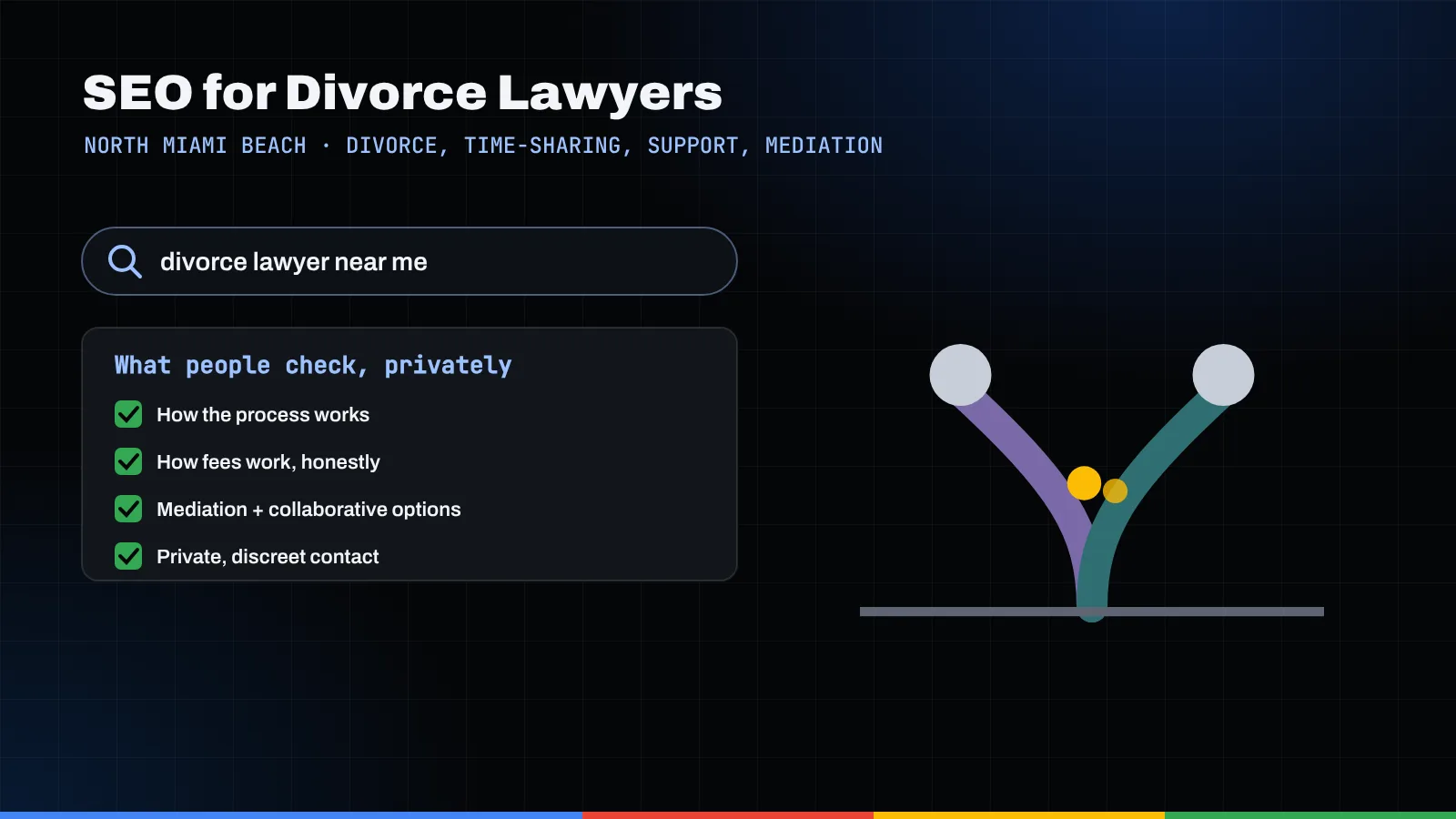
SEO for divorce lawyers works best when the website reads like a calm first meeting: it names the issues people are worried about in Florida's own legal terms, explains fees and process honestly, gives parents something useful, and offers a private way to reach out. For a North Miami Beach family law firm, that means one solid page per issue, a properly set up Google Business Profile, careful review replies, and advertising that respects both Google's sensitive-category rules and the Florida Bar's.
Key takeaways
- Many people research divorce quietly, late at night and on a shared phone or laptop. Discreet contact options and restrained ad targeting are part of good family law SEO, not an afterthought.
- Use Florida's vocabulary. The statutes speak of dissolution of marriage, parenting plans and time-sharing, and the 2023 alimony law changed which types of alimony a court may award.
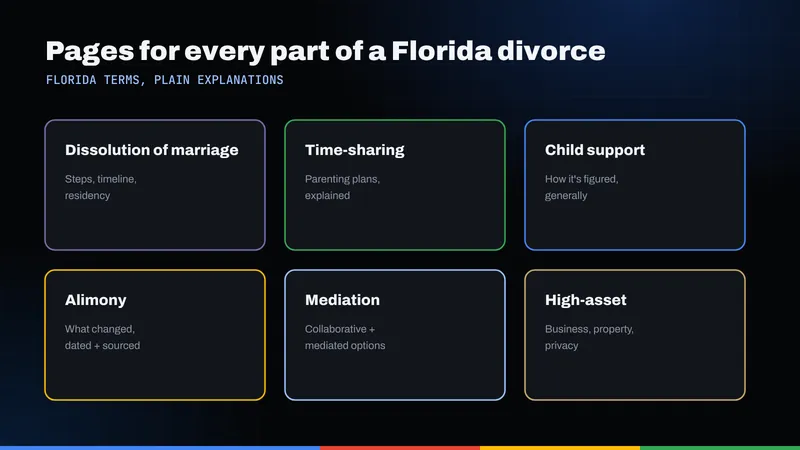
- Build a page for each real issue (time-sharing, child support, alimony, collaborative divorce, mediation, high-asset cases) rather than one long list.
- Google classifies divorce services as a "relationship hardships" sensitive category, which limits remarketing-style audiences for these ads.
- Florida Bar rules on guarantees and testimonials apply to your website, and confidentiality applies to how you answer reviews, including the unfair ones.
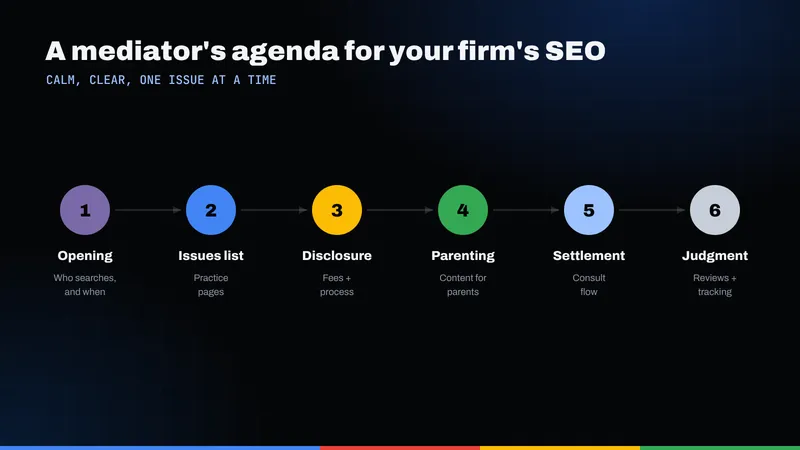
This post is general information about marketing a family law practice. It is not legal advice, and nothing here describes how any particular case will turn out. If you want the broader picture of law firm marketing in our area, including the Bar's advertising framework, start with our guide to law firm SEO in North Miami Beach. This one stays with family law, and it's organized the way a good mediator runs a session: an agenda, an issues list, honest disclosure, and a path toward settlement.
Opening statements: who is searching, and how?
Every mediation starts by letting each side say where they are, so start with the person on the other side of the search box. They might be the spouse who has decided, the one who just found out, or a parent who mostly wants to know what happens to the kids. Plenty of them search after the house goes quiet, on a phone someone else could pick up.
That shapes almost every decision below:
- Tone. War-room language ("we fight to win") can frighten someone hoping for an amicable outcome. Even-handed language reaches both readers.
- Privacy. People notice when a divorce ad follows them around. More on that below.
- Language. If many of your prospective clients speak another language at home, a family law page in that language may reach someone the English page never will. Our post on multilingual SEO in North Miami Beach covers how to do that without duplicate thin pages.
- Geography. Your local SEO work should reflect the communities you actually serve.
Mediator's note: write the first paragraph of every page as if the reader is tired, worried and reading on a phone. They need to know quickly that they're in the right place and that contacting you is safe.
Ground rules: speak Florida's legal language
The right words in Florida law aren't always the ones people type first, so a good page uses both: the everyday phrase to meet the searcher, and the statutory term to show you know the territory.
Dissolution of marriage
Florida's statutes frame divorce as dissolution of marriage. Your divorce page can say "divorce" in the headline and explain early on that the legal name for the process is dissolution of marriage. The residency rule is a good example of a plain fact worth stating carefully: under section 61.021, Florida Statutes, one of the parties must have lived in Florida for six months before the petition is filed. A short "Can I file in Florida?" section helps people who recently relocated.
Parenting plans and time-sharing
Parents often search for "custody" and "visitation." The Florida statute governing these issues, section 61.13, is built around a parenting plan, a time-sharing schedule and shared parental responsibility. A page titled something like "Time-Sharing and Parenting Plans (What Florida Calls Custody)" bridges both vocabularies honestly.
Alimony after the 2023 changes
Florida's 2023 dissolution of marriage bill, SB 1416, became Chapter 2023-315 and took effect July 1, 2023. The current version of section 61.08 lists the forms of alimony a court may award as temporary, bridge-the-gap, rehabilitative or durational. Permanent alimony is not on that list. The statute also sets presumptive marriage-length categories (under 10 years, 10 to 20 years, and 20 years or longer) and caps durational alimony at a percentage of the marriage's length for each.
If your alimony page still describes permanent alimony as an option for new cases, it's misinforming readers and signaling that nobody maintains the site. Put a "last reviewed" date on legal-explainer pages and have an attorney review them whenever the law changes.
Issues list: which practice-area pages should you build?
A mediator writes down every open issue before anyone negotiates. Your site should too. One "Family Law" page listing eight services can't rank well for any of them; a focused page per issue can.
Here is how situations translate into searches and pages. The search phrases are illustrations, not measured data.
| Situation | What people search | Page to build |
|---|---|---|
| Thinking about ending a marriage | "how to file for divorce in Florida," "divorce lawyer near me" | Dissolution of marriage overview: residency, contested vs. uncontested, what the process looks like |
| Worried about the children | "custody lawyer," "50/50 custody Florida," "parenting plan" | Time-sharing and parenting plans, written for parents |
| Money for the kids | "child support lawyer," "how is child support calculated" | Child support: what the court considers, modification, enforcement |
| Spousal support questions | "alimony lawyer," "is there permanent alimony in Florida" | Alimony after the 2023 changes, kept current |
| Hoping to stay out of court | "collaborative divorce," "uncontested divorce lawyer" | Collaborative divorce: how the process works and who it suits |
| Want a neutral process | "divorce mediation," "family mediator" | Mediation: your role as counsel or as mediator, what to bring, what happens |
| Business, real estate or complex assets | "high net worth divorce attorney," "dividing a business in divorce" | High-asset divorce: valuation, disclosure, privacy |
| Circumstances changed after the judgment | "modify parenting plan," "change child support" | Modifications, with links to the parenting and support pages |
For the collaborative page, there's a useful anchor in the statutes. Florida has a collaborative law part of Chapter 61, and its definitions (section 61.56) describe a collaborative law process as one intended to resolve a matter without intervention by a tribunal. Explaining that plainly, including what happens if no agreement is reached, earns trust.
Mediator's note: only build pages for work the firm actually wants and handles well. A high-asset page with nothing specific to say makes the stronger pages look generic too.
Disclosure: honest fee and process pages
Financial disclosure is where a mediation becomes real. The website equivalent is the page most firms avoid: how you charge and what happens next.
You don't need to publish prices, and many family firms can't predict them. You can still explain how billing works at your firm: whether you use retainers, whether some matters are handled on a flat fee, what drives cost up (litigation, experts, a contested parenting plan) and what tends to keep it contained (cooperation, mediation, organized documents). It answers a question people are often embarrassed to ask on the phone.
A good "What to expect" page usually covers:
- The first consultation: who they'll meet, how long it takes, whether it's in person, by phone or by video, and what's confidential.
- What to bring: a simple document checklist.
- The broad stages of a case, without promising timelines you can't control.
- What happens if both spouses want to settle, and what happens if they don't.
These pages also tend to help in AI-driven search, because assistants that summarize answers need a page that actually answers the question. A vague "call us to learn more" page gives them nothing to work with.
Parenting plan: content written for parents
Parents aren't only looking for a lawyer. They want orientation. A small library of parent-focused articles can bring them to your site and keep your firm in mind when they're ready to talk.
Topics that tend to serve parents well, written as general information:
- What a Florida parenting plan has to address, in plain English
- Time-sharing schedules for school-age children versus toddlers, framed as common approaches rather than recommendations
- Holidays, travel and school breaks in a parenting plan
- How to talk with children about a separation (often best written with input from a licensed counselor)
Say a hypothetical firm called Halyard & Wren Family Law, a name we made up for this example, wanted to reach parents in North Miami Beach. Rather than a blog full of "5 reasons you need a divorce lawyer," it might publish a calm series on parenting plans, each article linking to the main time-sharing page and ending with a quiet invitation to ask a question privately. Nothing in that series would promise an outcome. It would just help.
Privacy: discreet contact options and restrained ads
A person researching divorce may not want anyone else in the household to know. Your site and your ads should make that easy.
On the website
- Offer more than one way to reach you: a phone number, a short form, and if your firm supports it, a secure message option.
- On the form, ask how and when it's safe to contact them, and whether you may leave a voicemail.
- Keep confirmation emails and text messages neutral. A subject line that says "Your divorce consultation" can land on a shared screen.
In advertising
Google's personalized advertising policy treats this area as sensitive. Its page on relationship hardships in personalized advertising lists divorce services as an example and says advertiser-curated audiences, including Customer Match and "your data" segments, can't be used when promoting in sensitive interest categories. In practice, don't plan on following people around the web after they read your divorce pages.
We'd suggest going further than the policy requires: keep sensitive pages out of any retargeting setup on any platform, and be thoughtful about what your analytics and call tracking store. If you run paid search, build the campaign around what people type rather than who they are. Our Google Ads management work for legal clients starts from that principle.
Mediator's note: discretion is part of the service. A firm that markets discreetly is showing prospective clients how it will handle their case.
Settlement: a consultation flow that respects the decision
Settlement happens when both sides feel heard. Your consultation flow should leave people feeling that way, not pushed.
- A clear next step on every page, phrased gently: "Talk through your options" tends to fit better than "Start your case now."
- Phone answered by a person during business hours, and a realistic promise about when after-hours messages get a reply.
- A conflict check before details. Your intake should check for conflicts early, which also protects the caller if their spouse has already contacted the firm.
If you also serve clients across the wider Miami area, relevance in neighboring markets matters. Owners who search for "local SEO Miami" or "SEO Miami" help are asking the same question: how to show up for people nearby. Our Miami SEO and North Miami Beach SEO pages explain how we approach each market.
Final judgment: reviews, Google Business Profile and tracking
Google Business Profile for practitioners
Google's Business Profile guidelines include specific rules for practitioners such as lawyers. A practitioner in a public-facing role can have a profile, but shouldn't have several profiles for different specialties. If an attorney is the only public-facing practitioner at a branded firm's location, Google says it's best to share one profile, named in the "[brand]: [practitioner name]" format. Adding unnecessary information to the business name, such as "Best Divorce Lawyer North Miami Beach," isn't permitted and can lead to suspension. For more on profile setup, see our Google Business Profile guide for North Miami Beach.
Reviews and confidentiality
Family law clients often prefer not to leave reviews. Ask gently and accept slow growth. The harder part is replying.
The Florida Bar's Ethics Opinion 20-1 addresses responding to a former client's negative online review. It concludes that a lawyer may not disclose information relating to the representation in a reply unless an exception applies or the client consents, and that a general response, such as saying the post doesn't present a fair and accurate picture, is acceptable. That follows from the confidentiality rule, Rule 4-1.6, which continues after the representation ends. A positive review gets a short thank-you that confirms nothing about the matter.
Tracking
Track consultations booked, not just clicks. Use call tracking that tells you which page or channel produced a call, but set it up so recordings and notes don't become a store of sensitive detail you didn't need. Then look monthly at a short list: consultations by source, which issue pages they started on, and how many became clients.
Housekeeping: guarantees, testimonials and schema
This isn't a full overview of the Bar's advertising rules, just the parts that come up most on divorce pages.
- No guarantees. The Florida Bar's advertising handbook explains that under Rule 4-7.13, an advertisement can't include statements a consumer could reasonably read as a prediction or guarantee of success. "We'll get you primary time-sharing" or "protect your assets, guaranteed" are out.
- Testimonials have conditions. Per the same handbook, a testimonial must reflect the person's actual experience, be representative of what clients generally experience, not be written by the lawyer, and not be exchanged for anything of value. The person must also be qualified to evaluate the lawyer, and if a testimonial mentions results, the ad needs a clear disclaimer that prospective clients may not get the same or similar results.
- Past results. The handbook notes that past results must be factually verifiable and can't leave out facts that would make them misleading.
On structured data, schema.org's LegalService type describes a business that provides legal services, advice and representation, and schema.org marks the older Attorney type as deprecated in favor of LegalService. Mark up the firm's name, address, phone and hours accurately, and don't add review markup you aren't entitled to. Our post on how schema helps search engines explains the basics.
If you'd like a second set of eyes on your family law site, including terminology, privacy settings and profile setup, request an audit. We'll look at what's there and tell you plainly what we'd change.
Frequently asked questions
What is the most important page for SEO for divorce lawyers?
Usually the main dissolution of marriage page, followed closely by the time-sharing and parenting plan page. Those two answer the questions most people start with. Each should explain the process in plain language, use Florida's legal terms, and offer a discreet way to get in touch.
Should a family law firm use the word "custody" on its website?
Yes, as a bridge. Many people search for custody, while Florida's statute speaks of parenting plans, time-sharing and shared parental responsibility. Using the everyday word to meet the reader and the statutory terms to explain the law helps both people and search engines.
Can we use remarketing ads for divorce services?
Google lists divorce services as an example of its relationship hardships sensitive category, and its policy says advertiser-curated audiences such as Customer Match and your data segments can't be used when promoting in sensitive interest categories. Plan campaigns around search terms instead, and check Google's current policy before launching.
How should a family lawyer respond to a negative review?
Briefly and without details about the matter. Florida Bar Ethics Opinion 20-1 says a lawyer may not disclose information relating to a representation in response to a negative review unless an exception applies or the client consents. A short, general reply that the post doesn't present a fair and accurate picture is acceptable.
Do we need to update our alimony page after the 2023 law change?
If it was written before July 1, 2023, almost certainly. The current section 61.08 lists temporary, bridge-the-gap, rehabilitative and durational alimony, and permanent alimony is not among them. Have an attorney review the page, add a last-reviewed date, and keep it general information rather than advice.