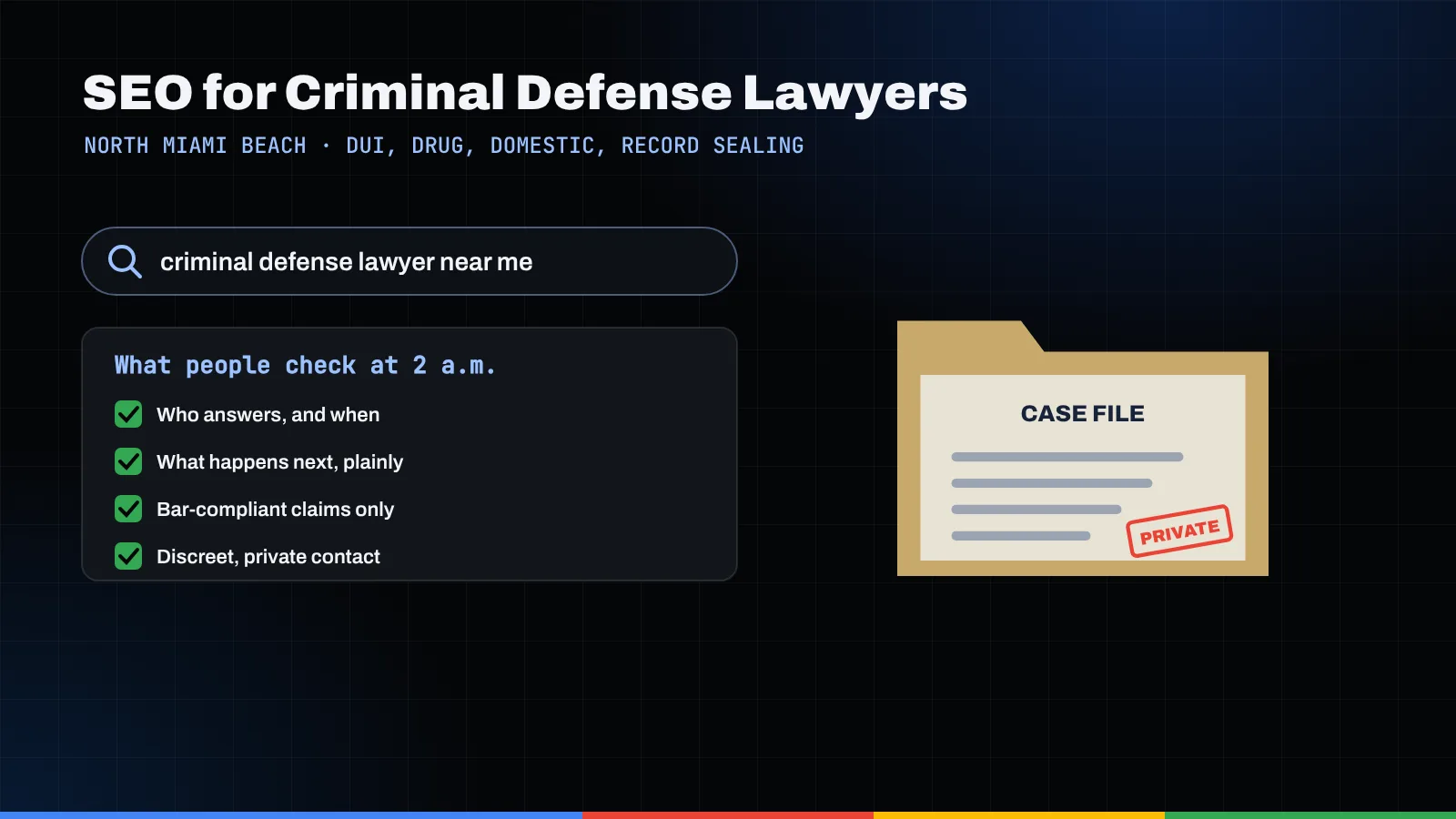
SEO for criminal defense lawyers in North Miami Beach is about being findable, accurate and reachable at the moment someone's life has just gone sideways: a Google Business Profile that follows Google's practitioner rules, one clear page per charge type, plain-English answers to the questions people ask in a panic, and reviews and results handled within the Florida Bar's advertising rules. This article is general information about marketing, not legal advice.
Key takeaways
- Many defense searches are made by a frightened family member late at night, on a phone. Speed, clarity and a working phone line matter more than clever copy.
- Build a separate page for each charge type you actually handle (DUI, drug charges, domestic violence, theft, juvenile, sealing and expungement, federal) instead of one long practice-area list.
- Defense content is held to the Bar's rules: no predictions of success, past results only if objectively verifiable, and testimonials only under specific conditions.
- Targeted mail, email, texts and targeted social posts to people with a pending matter fall under Rule 4-7.18, with labeling, disclosure and filing requirements.
- Review replies are a confidentiality question first. The safe default is a courteous reply that never confirms someone was a client.
Arrest: what does the 2 a.m. search look like?
Most criminal defense work starts with a call nobody planned to make. Someone is booked overnight, and a spouse or parent is typing into Google with shaking hands. They want to know three things: can this lawyer help with this kind of charge, can I reach a human right now, and do I trust them enough to call.
That is what SEO for criminal defense lawyers has to serve: show up in the map and organic results for charge-specific searches, then make the landing page calm, specific and easy to act on. If you have read our general guide to law firm SEO in North Miami Beach, you already know the Bar's broad advertising framework. This piece stays on what's different about defense work.
To keep it concrete, imagine a small practice we'll call Harbor Ledger Defense, two attorneys with an office in North Miami Beach. The firm is hypothetical; nothing below describes a real firm or result.
Counsel's note: The person searching is often not the client. Write pages that speak to the family member too: what typically happens next, what information the lawyer will need, and how to reach the office, all framed as general information.
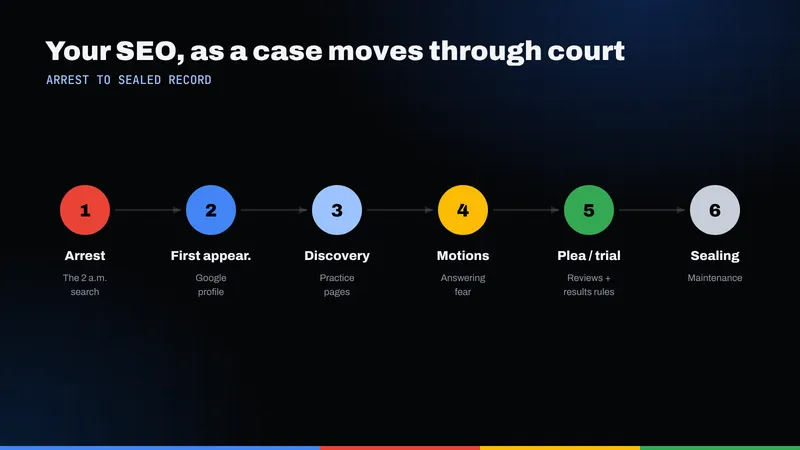
First appearance: is your Google Business Profile ready?
For many local searches, the first thing a prospective client sees is your Business Profile, not your website. Treat it like a first appearance: short, accurate, nothing you'll have to walk back.
Google's guidelines for representing your business set the ground rules for individual practitioners such as lawyers:
- A practitioner may have a dedicated profile if they work in a public-facing role and can be contacted directly at the verified location during stated hours.
- One practitioner should not have several profiles to cover different specializations.
- Where several practitioners share a location, the firm gets its own profile and each practitioner's profile uses only the practitioner's name.
- A solo attorney practicing under a firm brand should share one profile, named in the format "[brand/company]: [practitioner name]."
The same guidelines say unnecessary information in the business name isn't permitted and can lead to suspension. "Harbor Ledger Defense" is fine. "Harbor Ledger Defense DUI Lawyer 24/7 Miami" is not.
Hours, and the 24/7 question
Google asks for your regular customer-facing hours. Advertise around-the-clock availability only if a real person actually answers at 3 a.m. on a Sunday. The Bar's Handbook on Lawyer Advertising and Solicitation lists office and telephone service hours as presumptively valid content, and Rule 4-7.13 prohibits deceptive or misleading statements. A "24/7" claim that rolls to a full voicemail box invites trouble.
Our Google Business Profile guide covers categories and photos.
Discovery: which practice-area pages should you build?
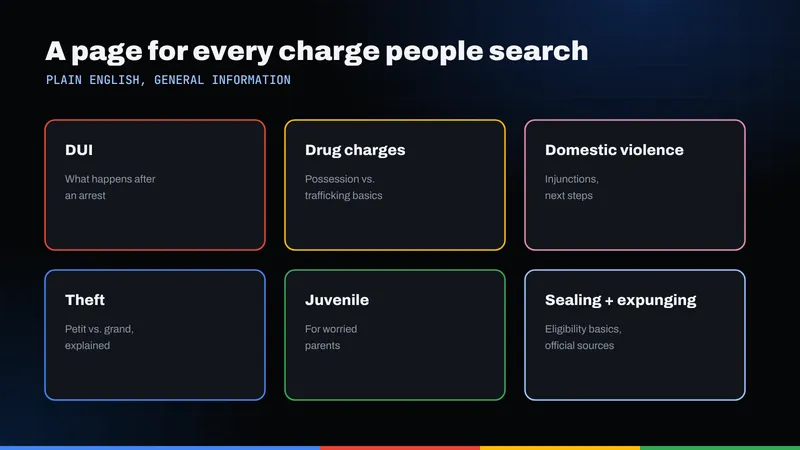
Discovery is where the facts get organized. On a defense site, that means a separate page for each charge or situation you actually handle. One "Criminal Defense" page listing a dozen offenses gives Google little to rank and a scared reader little reason to call.
The table below maps common situations to the way people tend to phrase their searches and the page that answers them. The search phrasings are illustrative examples, not measured data.
| Charge or situation | How people often search | Page to build |
|---|---|---|
| DUI arrest | "DUI lawyer near me," "what happens after a DUI arrest in Florida" | DUI defense page explaining, in plain language, what typically happens after an arrest |
| Drug charges | "drug possession lawyer," "charged with possession what now" | Drug charges page explaining possession versus more serious allegations, with no outcome promises |
| Domestic violence | "domestic violence charge lawyer," "injunction hearing lawyer" | Domestic violence defense page, plus a separate page on injunction hearings if you handle them |
| Theft or shoplifting | "shoplifting charge first offense," "petit theft lawyer" | Theft defense page that explains how the charge level depends on the facts |
| Juvenile arrest | "my son was arrested what do I do," "juvenile defense lawyer" | Juvenile defense page written for parents |
| Old record holding someone back | "how to seal my record Florida," "expunge arrest record" | Sealing and expungement page tied to FDLE's process |
| Federal investigation or charges | "federal criminal defense lawyer," "target letter what does it mean" | Federal defense page stating which federal courts the attorneys are admitted in, if any |
Each page should name the responsible attorney, link to their bio, explain the process in steps, and keep a tracked phone number within thumb's reach. If your intake team speaks Spanish, Haitian Creole or another language, say so plainly; see our guide to multilingual SEO in North Miami Beach.
Counsel's note: Resist twenty near-identical "DUI lawyer in [city]" pages. One strong DUI page is a sounder file.
Motions: how should content answer fear-driven questions?
Your blog and FAQ content works like a written motion: it takes the questions people ask when they're scared and answers them carefully. For example: Will I lose my job? Can I travel while the case is open? Will this show up on a background check? What does "no contest" mean?
Three ground rules keep this content useful and compliant:
- Explain process, never predict outcomes. Rule 4-7.13(b)(1) bars predictions of success. The Bar's handbook gives a pointed defense-flavored example of what not to say: "Come to me to get acquitted of the charges pending against you."
- Verify every legal statement against a primary source and have the responsible attorney review it before publishing.
- Say clearly that the page is general information, not legal advice.
A worked example: record sealing and expungement content
Sealing and expungement pages are a good illustration of why verification matters. The Florida Department of Law Enforcement's Seal and Expunge Process page says that applying for a Certificate of Eligibility is the first step, that FDLE determines whether the applicant is statutorily eligible to petition the court, and that a record doesn't receive relief until FDLE receives a certified court order. The same page says eligibility processing typically takes about 12 weeks and that FDLE does not expedite applications. It also notes that automatic sealing through FDLE does not seal records at the local level.
The eligibility conditions themselves are in the statutes. For court-ordered sealing, section 943.059, Florida Statutes, requires among other things that the person has never been adjudicated guilty of a criminal offense in Florida (with limited exceptions), was not adjudicated guilty of any charge arising from the arrest at issue, and has never secured a prior sealing or expunction.
A good sealing page summarizes the process, links to FDLE, and never tells a reader they qualify.
Plea or trial: what can you say about reviews and results?
The Bar's advertising rules apply to your website even though websites are exempt from filing. Here is how the key rules apply, based on the Bar's handbook. This is general information; confirm current requirements with the Rules Regulating The Florida Bar or the Bar's ethics staff.
Past results
Under Rule 4-7.13(b)(2), information about past results must be factually verifiable and can't omit facts that would make it misleading. "Charges dropped" with no context can mislead.
Testimonials and embedded reviews
Rule 4-7.13(b)(9) allows testimonials only under conditions the handbook spells out: the person must be qualified to evaluate the lawyer, the lawyer may not write or draft the testimonial, the person may receive nothing of value for it, and if results are mentioned, the ad must carry a clear and conspicuous disclaimer that prospective clients may not obtain the same or similar results. Pulling Google reviews into a widget on your site is using testimonials, so the same conditions apply.
"Expert," "best" and comparisons
Rule 4-7.14(a)(4) allows claims of specialization or expertise only when they can be objectively verified, and claims of board certification are limited to individual lawyers who actually hold it; a firm can't claim to be board certified. Separately, the handbook explains that ads may not characterize or compare lawyers' skills, experience, reputation or record unless the claim is objectively verifiable. "Best DUI Lawyer" in a title tag is still advertising.
Earning reviews under Google's policy
Google's prohibited and restricted content policy bars offering incentives for reviews, discouraging negative reviews and selectively soliciting positive ones. It also treats reviews from current or former employees as conflicts of interest. Many defense clients will never want a public link to their case; ask every concluded client the same neutral way and accept that many will decline.
Replying to reviews without breaching confidentiality
Rule 4-1.6 starts from a simple position: a lawyer must not reveal information relating to a client's representation except as the rule allows. The current rule includes a narrow exception, subdivision (c)(7), for responding to specific allegations published online by a former client that the lawyer engaged in criminal conduct, and its comment says the disclosure must be no greater than the lawyer reasonably believes necessary to refute those allegations.
Counsel's note: The safe default for any review is a short, courteous reply that does not confirm the person was a client, does not mention a charge, and invites them to contact the office directly. "Thank you for the feedback. We take every concern seriously; please call our office so we can talk privately" works for nearly everything.
Can you contact people who were just arrested?
Rule 4-7.18 governs direct contact with prospective clients. According to the Bar's handbook, a lawyer may not solicit in person or by telephone when pecuniary gain is a significant motive, with exceptions for family, current or former clients and people with a prior professional relationship.
Written outreach, including direct mail, email, texts and targeted social media, is permitted under conditions. The handbook describes these requirements:
- Each enclosure and the face of the envelope must be clearly and conspicuously marked "Advertisement," and emails, texts and targeted social posts must begin with that word.
- The communication must disclose how the lawyer obtained the information that prompted it and include a written statement of the lawyer's background, training and experience.
- The outside of a mailing must not reveal the nature of the recipient's legal problem, and ordinary postcards generally can't be used.
- Unsolicited direct mail, email, texts and targeted social media ads must be filed with the Bar for review at least 20 days before their planned use.
On timing: the 30-day waiting period in Rule 4-7.18(b)(1)(A), as the handbook describes it, applies to communications about personal injury, wrongful death, or an accident or disaster involving the recipient or a relative. We did not find a parallel 30-day rule for criminal arrests in the handbook. One restriction matters to domestic violence practices: under Rule 4-7.18(b)(1)(G), a lawyer may not send targeted mail, email, texts or social media to the respondent in an injunction petition if the lawyer knows or reasonably should know the respondent hasn't yet been served. Confirm the current text before you plan any campaign.
Paid search is advertising too
The handbook notes that paid or sponsored search results are subject to the lawyer advertising rules, and that internet advertisements other than lawyer and law firm websites must be filed for review unless the content is limited to presumptively valid information. If you run Google Ads, build Bar review into the launch timeline.
What structured data should a defense firm use?
Schema.org now marks the Attorney type as deprecated, noting that LegalService is "more inclusive and less ambiguous." LegalService is defined as a business that provides legally oriented services, advice and representation, and it sits under LocalBusiness.
Useful properties for a defense firm include areaServed for the communities you serve, knowsLanguage for languages your team genuinely speaks, and openingHoursSpecification that matches the hours on your Business Profile. The name, address and phone in your markup should match the profile and site footer exactly. Our post on how schema helps search engines covers implementation. And whatever the markup says, test the click-to-call button monthly from a real phone.
Sealing the record: how do you maintain it?
SEO doesn't end at launch. Quiet maintenance is where visibility compounds or decays.
- Quarterly legal review. Have the responsible attorney reread each charge page and sealing page for changes in statutes or procedure.
- Monthly profile check. Confirm hours, phone numbers and categories on every Business Profile.
- Call review. Listen to a sample of recorded intake calls, with appropriate notice and consent.
- Compliance log. Keep a record of which ads were filed with the Bar and when, and which website claims were reviewed by which attorney.
A firm like Harbor Ledger Defense would also watch broader local SEO Miami and SEO Miami searches; our Miami SEO page covers the wider metro.
Ribacoff Enterprises is headquartered in North Miami Beach. Our North Miami Beach SEO work for professional practices includes local SEO, charge-specific page writing for attorney review, Business Profile management and call tracking. If you want an outside read on where your defense practice stands, start with a free audit of your site and Business Profile.
Frequently asked questions
Is criminal defense attorney SEO different from general law firm SEO?
The foundations are the same, but defense searches are often urgent and made by family members, so after-hours intake and charge-specific pages matter more, and content must never predict outcomes.
Can our website say we are available 24/7?
Only if someone actually answers around the clock. An unsupported 24/7 claim risks being misleading, and your Google Business Profile hours should match what you advertise.
Is there a 30-day waiting period before mailing someone who was arrested?
The Bar's handbook describes the 30-day waiting period in Rule 4-7.18 as applying to personal injury, wrongful death, accident and disaster matters. Targeted mail to people with a criminal matter still has to meet the labeling, disclosure, envelope and filing requirements, and there is a separate restriction involving unserved respondents in injunction cases. This is general information, not legal advice.
How should we reply to a negative Google review from a former client?
Start from confidentiality. Rule 4-1.6 bars revealing information about a representation except as the rule allows, and its narrow online-review exception covers only specific allegations that the lawyer engaged in criminal conduct. A short, courteous reply that doesn't confirm the person was a client is the safer default.
Can we tell readers they qualify to seal or expunge their record?
No. Eligibility depends on the person's full history and the statutes, and FDLE determines statutory eligibility through its Certificate of Eligibility process before a court decides. Explain the process instead.