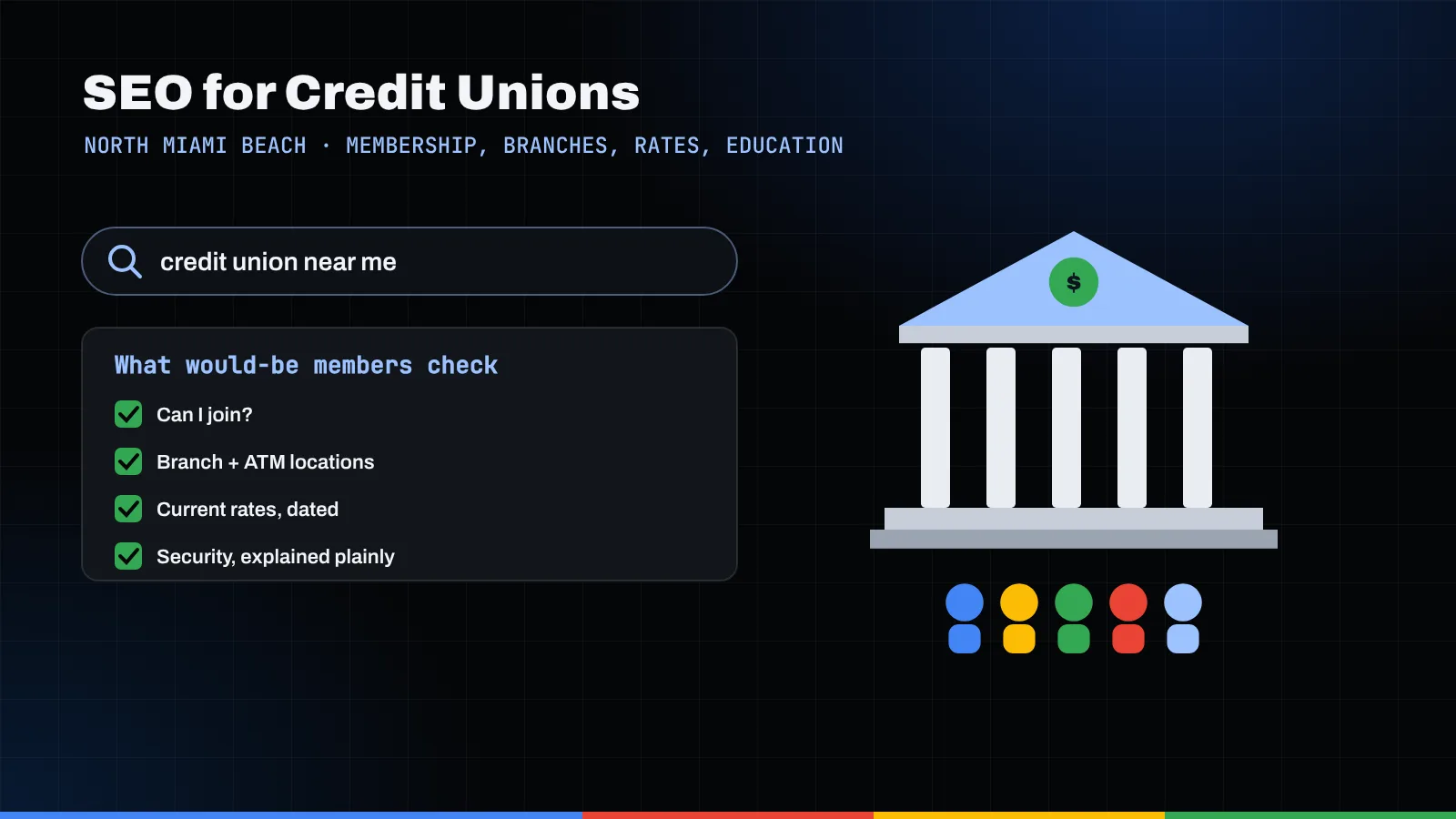
SEO for credit unions works best when the site answers the first question most searchers have, "can I join?", within seconds, then backs it up with accurate branch pages, current rates and genuinely useful financial education. Because money topics are held to a higher trust standard by Google, and because NCUA rules govern how insurance is described in advertising, every recommendation below is built to be compliance-friendly from the start.
Key takeaways
- A plain-language "who can join" page is the most important page on a credit union site, because eligibility is the question big banks never make people ask.
- Each branch deserves its own location page and its own Google Business Profile; an ATM attached to a branch may have a separate profile with its own hours.
- Rate pages should be treated like inventory: dated, owned by a named person and updated the same day rates change.
- Financial education content is "Your Money or Your Life" territory, so authorship, review and sourcing matter more than volume.
- Build the NCUA official advertising statement, accessibility and anti-phishing messaging into templates so nobody has to remember them page by page.
To the marketing committee: purpose of this memo
To: the marketing committee
Re: a search plan that plays to a credit union's strengths
This memo lays out how we would approach search visibility for a community credit union in North Miami Beach. To keep it concrete, we will use a hypothetical institution throughout. Imagine a small, member-owned cooperative called Mangrove Lantern Credit Union, with two branches and a handful of ATMs. It is an invented name used only for illustration; it is not a client, and nothing here describes its results.
The premise is simple. A national bank will outspend a credit union on almost every channel, but it cannot easily copy the membership model: local governance, a defined community and an institution owned by its users. Search lets that advantage show up the moment someone decides where to bank. The catch is that membership raises a question banks never face: am I even allowed in?
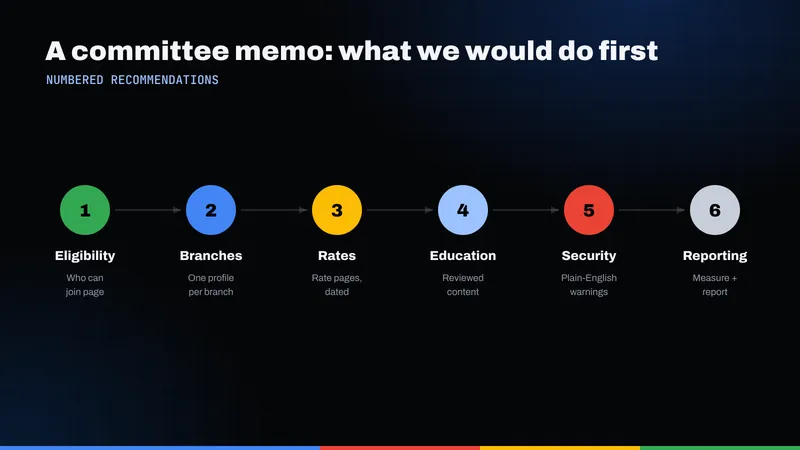
The seven recommendations are ordered by expected impact, followed by what we would avoid. This is general marketing guidance, not legal or compliance advice, and we would expect your compliance officer to review anything that touches account insurance, rates or disclosures.
Recommendation 1: make "who can join" answerable in one screen
A credit union's eligibility rules come from its charter. The NCUA explains that a credit union's field of membership "determines who is eligible to join", and that federal credit unions operate under one of three kinds of charters: single common bond, multiple common bond or community. A federal credit union also needs NCUA approval before changing its field of membership.
On many websites, eligibility is buried in a PDF or phrased in charter language, while the searcher on a phone wants a yes or a no. We would build a dedicated eligibility page that:
- Leads with a one-sentence answer. For a community charter, that might be "If you live, work, worship or attend school in [the defined area], you can join." Use the exact boundaries your charter allows, nothing broader.
- Lists every path in. Employer groups, family relationships, associations and geographic eligibility, each on its own line, in the order most members actually qualify.
- Shows what to bring. Identification, proof of address or employment and any opening deposit, stated the way your account opening team actually handles it.
- Ends with one action. Apply online, or visit a branch, with the branch links right there.
A short FAQ covering questions members ask at the counter, such as whether a relative's eligibility extends to them, matches how people phrase searches. If your structured data is still basic, our note on how schema helps search engines explains what markup can and cannot do here.
Recommendation 2: give every branch a real page and a real profile
Google's Business Profile guidelines are specific about financial locations: an ATM attached to a bank can have its own separate profile with its own hours, and banks are told to use lobby hours where possible, otherwise drive-through hours. The guidelines also prohibit creating more than one profile for the same location, and they ask multi-location businesses to keep the business name consistent across locations.
In practice, for our hypothetical Mangrove Lantern, that means:
- One Google Business Profile per branch, verified, with lobby hours, holiday hours and the correct primary category.
- A separate profile for an attached ATM only where its hours genuinely differ from the lobby, and only if your team can keep it accurate.
- A matching location page on the website for each branch: address, hours, services offered at that specific branch (notary, coin counting, safe deposit, drive-through), parking and transit notes, and the staff roles a member can expect to find there.
- Each profile linking to its own location page, not to the home page.
We would not invent pages for neighborhoods without a branch; a wider charter community belongs on the eligibility page. Our guide to SEO for multi-location businesses covers how to keep a set of location pages distinct rather than near-duplicates, and our local SEO service handles the profile work for institutions that prefer to hand it off.
Recommendation 3: treat rate pages like live inventory
Rate pages attract some of a credit union's highest-intent searches, and they are the pages most likely to go stale. An outdated rate table erodes trust at the moment of decision and may create a compliance problem. We would recommend:
- Pull rates from a single source of truth (a core system feed or one managed table) so the same number never appears in two versions on two pages.
- Show an "effective as of" date on every rate table.
- Assign a named owner in the finance or lending team who signs off on each change, and agree on a same-day update window.
- Keep required disclosures adjacent to the rates they qualify, as directed by your compliance team, rather than in a distant footer.
- Add a short paragraph explaining who each product suits and what affects the rate offered.
Lending pages overlap heavily with the mortgage space. If your credit union originates home loans, our post on mortgage broker SEO in North Miami Beach covers the local search patterns behind purchase and refinance queries.
Recommendation 4: publish financial education that earns trust, not just traffic
Financial education is the clearest place where a cooperative's mission and its search strategy line up. It is also where the standard is highest. Google's guidance on creating helpful, reliable, people-first content says its systems give more weight to experience, expertise, authoritativeness and trustworthiness on topics that could affect someone's health, financial stability or safety, which it calls "Your Money or Your Life" topics. The same page says trust is the most important of those aspects, and that E-E-A-T itself is not a specific ranking factor.
The page also suggests asking "who, how and why" about each piece of content. For a credit union, we would turn that into a short editorial standard:
- Who: a real byline, ideally a staff member with relevant experience (a lending officer, a financial counselor), with a short bio. Google specifically warns against fabricated author profiles.
- How: a visible "reviewed by" line and a review date, plus links to primary sources such as regulators.
- Why: topics chosen because members ask about them, such as building credit after moving to the United States, understanding a first auto loan, or recognizing a scam, rather than topics chosen because they seemed easy to rank for.
A small library of well-reviewed guides, refreshed on a schedule, beats a weekly post nobody checks. Our post on SEO for financial advisors in North Miami Beach covers a similar trust-first approach in a more heavily regulated advisory context.
Recommendation 5: build the NCUA advertising statement into templates
We would rather the website handle insurance language automatically than rely on memory. Under 12 CFR 740.5, each insured credit union must include the official advertising statement in all of its advertisements, including on its main internet page, unless an exemption applies. The rule permits the statement to read, in substance:
- "This credit union is federally insured by the National Credit Union Administration"
- "Federally insured by NCUA"
- "Insured by NCUA"
- or a reproduction of the official NCUA sign.
The statement must be clearly legible and no smaller than the smallest font used elsewhere in the ad to convey information to consumers. The rule then lists advertisements that do not need it. A few of the exemptions, summarized from the regulation:
| Situation | What 12 CFR 740.5 says |
|---|---|
| Main page of the website | The statement is required. |
| Ads that relate to member accounts | Required unless another exemption applies. |
| Ads that do not relate to member accounts, such as loan ads | Exempt. |
| Directory listings | Exempt. |
| Radio or television ads of 30 seconds or less (TV display ads excluded) | Exempt. |
| Ads that do not name the credit union | Exempt. |
| A non-English version of the statement | Allowed with prior approval of the translation by the NCUA Regional Director. |
Two practical points follow. First, putting the statement in the global footer satisfies the main-page requirement on every page without anyone having to think about it. Second, the line between a "loan ad" and a "member account ad" can blur on a single landing page that promotes both a certificate and an auto loan. Whether a particular blog post, social graphic or business listing counts as an advertisement is a question for your compliance officer, not your web team. The same section of the rule also restricts how non-NCUA excess share insurance may be described, so any mention of private coverage should go through review as well.
Recommendation 6: serve multilingual members and every ability level
North Miami Beach is a multilingual city. Census QuickFacts reports that 71.8% of residents age 5 and older speak a language other than English at home (2020–2024). For a community credit union, translation is basic service.
A few principles we would apply:
- Translate the pages that matter most first: eligibility, account opening, branch pages, the security notice and the most-used rate pages.
- Give each language its own URL and connect the versions with
hreflang. Google's documentation on localized versions of a page explains that each version should list itself and all alternates, and that untranslated main content can be treated as a duplicate. - Have fluent staff review translations of anything involving fees, rates or disclosures, and remember that a translated insurance statement needs Regional Director approval under 740.5.
Our post on Spanish and multilingual SEO in North Miami Beach goes deeper on structure and translation workflow.
Accessibility belongs in the same conversation. The Department of Justice's guidance on web accessibility under the ADA states its position that the ADA's requirements apply to all the goods and services businesses open to the public offer, including those offered on the web, and it points to the Web Content Accessibility Guidelines (WCAG) as helpful technical guidance. For a credit union, the forms are where this usually breaks: membership applications, loan applications and calculators that cannot be used with a keyboard or a screen reader. We would test those first.
Recommendation 7: make security messaging part of the site's voice
Financial institutions are a favorite disguise for scammers, and search can help or hurt here. The FTC's guidance on recognizing and avoiding phishing scams notes that phishing messages often look like they come from a bank or another company you trust, and advises contacting the company through a phone number or website you know is real rather than the details in the message. It also lists where to report phishing, including ReportFraud.ftc.gov.
We would recommend:
- A permanent, plain-language security page stating exactly what the credit union will and will not ask members for. Most institutions choose to state that they will never ask for an online banking password or a one-time passcode by phone, text or email. Write the commitments your operations team can actually keep.
- A short "think you were targeted?" section with the credit union's own verified phone number and the FTC reporting link.
- Consistent official contact details everywhere (site, Business Profiles, statements) so members can spot an impostor number.
- A brief alert banner pattern the team can turn on quickly when a known scam is circulating locally.
What we would not do
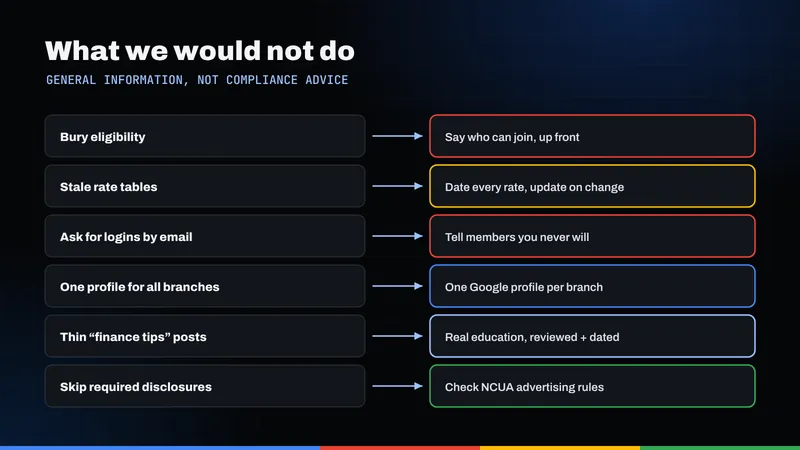
These are tactics we would advise the committee to decline, even if a vendor proposes them:
- Keyword-stuffed branch names. Google's guidelines say a profile name should reflect the real-world name and must not include location information or marketing taglines.
- Pages for places you do not serve. No city pages implying eligibility or branches that do not exist. Your charter defines your community; the website should not expand it.
- Unreviewed AI-written financial advice. Drafting help is fine; publishing money guidance without a qualified human reviewer and a named author is not.
- Rates in images or PDFs. They go stale invisibly, cannot be read by screen readers and cannot be indexed reliably.
- Incentivized reviews. No raffle entries or rate bumps in exchange for reviews.
- Login forms on marketing pages without clear security cues. Members should always know they are on the real domain before they enter credentials.
- Comparative claims we cannot document. "Lower fees than the big banks" needs a dated, specific basis or it should not be published.
How we would measure progress and next steps
We would report to the committee monthly on measures that connect to membership rather than vanity traffic: membership application starts and completions from organic search, calls and direction requests from each Business Profile, visits to the eligibility page and the share that continue to an application, and rate-page visits that lead to a loan application. Rankings are a supporting indicator, not the goal.
A sensible order of work for a credit union like our hypothetical Mangrove Lantern:
- Eligibility page and the global footer statement (weeks one to two).
- Business Profile cleanup and branch pages.
- Rate page data source and ownership.
- Security page and multilingual versions of the core pages.
- An accessibility review of the application forms.
- An editorial calendar for financial education, with a review workflow.
Ribacoff Enterprises is based in North Miami Beach and provides SEO for North Miami Beach organizations, local search and website work for institutions that need to stay inside the lines. If the committee would like an outside view of where your site stands today, you can request a free SEO audit and we will walk through findings with your marketing and compliance leads together.
Frequently asked questions
What is the most important page for credit union SEO?
The eligibility or "who can join" page. Searchers comparing a credit union with a bank need to know quickly whether they qualify. A page that answers in one sentence, lists every path to membership and links straight to the application usually does more than any other single change.
Does every page of a credit union website need "Federally insured by NCUA"?
12 CFR 740.5 requires the official advertising statement in advertisements, including the main internet page, with listed exemptions such as loan ads and directory listings. Many credit unions place it in the site footer so it appears everywhere. Your compliance officer should decide how it applies to specific pages and campaigns.
Should each credit union branch have its own Google Business Profile?
Yes. Each physical branch that serves members in person should have one verified profile linked to its own location page. Google's guidelines also allow an ATM attached to a bank to have a separate profile with its own hours, and they prohibit more than one profile for the same location.
Can a credit union publish financial education content written with AI?
Google's guidance focuses on whether content is helpful and trustworthy and suggests explaining how content was made. For money topics, we recommend that any draft, however it was produced, be reviewed by a qualified staff member and published under a real byline with a review date.
Can we translate the NCUA insurance statement into Spanish or Haitian Creole?
12 CFR 740.5 allows a non-English equivalent of the official advertising statement in any advertisement, but only if the NCUA Regional Director gives prior approval to the translation. Ask your compliance team to handle that request before publishing translated versions.