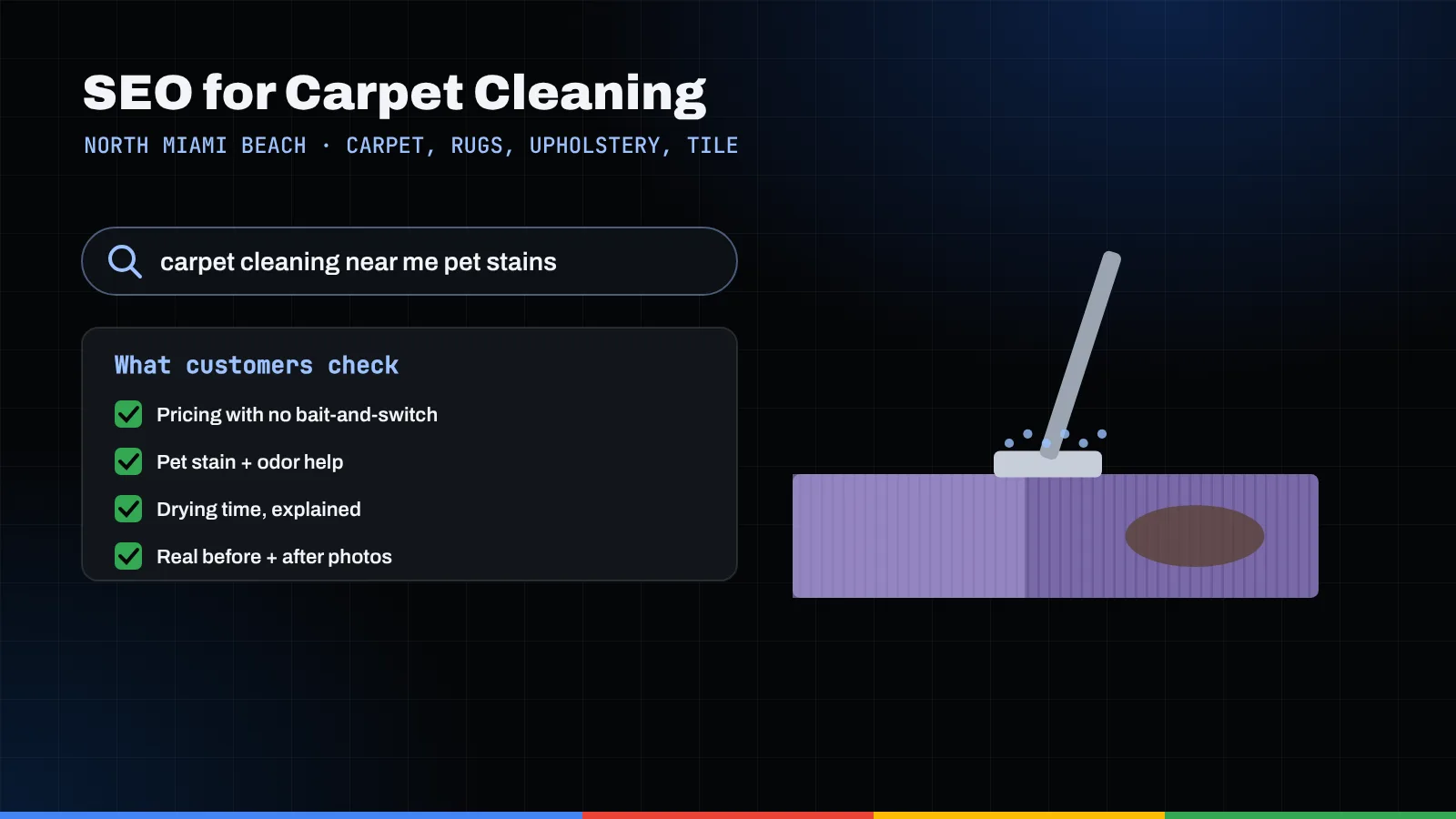
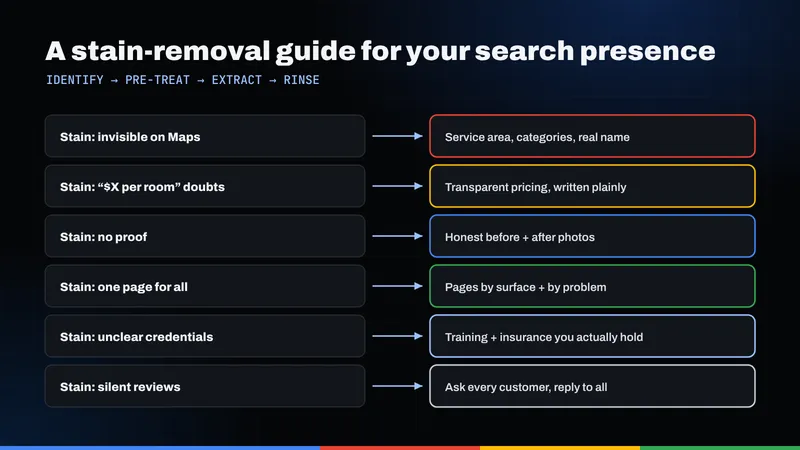
SEO for carpet cleaning works best when you treat each weak spot like a stain: identify it, pre-treat it, extract it and rinse so it doesn't come back. For a carpet, rug and upholstery cleaner in North Miami Beach, the stubborn ones are a weak service-area Google profile, one catch-all services page, vague "per room" pricing, unverifiable photos and credentials, and too few honest reviews. Fix those in order and you give both customers and Google a clear reason to pick you.
Key takeaways
- Set up your Google Business Profile as a service-area business: hide a home address, keep the service area realistic and use your real business name with no extra keywords.
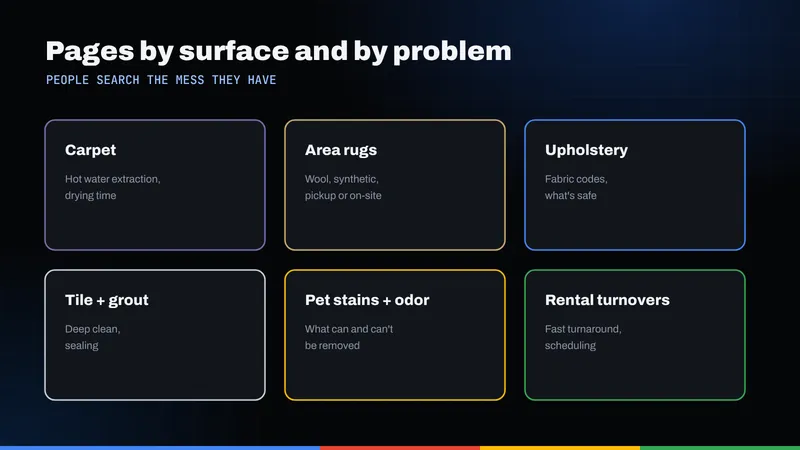
- Build pages by surface (carpet, area rugs, upholstery, tile and grout) and by problem (pet urine and odor, rental turnovers, commercial carpet). Searchers look for the problem, not your equipment.
- The FTC's Guides Against Bait Advertising describe the "insincere offer" that gives cheap per-room ads a bad name. Publish what a price includes and what costs extra.
- IICRC certification is a voluntary industry credential, not a state license. Florida's DBPR doesn't list carpet cleaning as a licensed profession, but Miami-Dade requires local business tax receipts.
- Ask every customer for a review the same way, with nothing attached. Google's policy and the FTC's 2024 rule both prohibit paid or gated reviews.
Why treat carpet cleaning SEO like a stain-removal guide?
Because the method is the same. A good technician identifies the stain, pre-treats it, extracts it and rinses so no sticky residue attracts dirt next week. Throwing money at ads when the real problem is a half-finished Google profile is like scrubbing red wine with a dry towel: lots of effort, same stain.
Carpet cleaning also deserves its own playbook, separate from general cleaning. We covered maid and janitorial services in our guide to SEO for cleaning companies. Those businesses sell recurring visits. A carpet and upholstery specialist sells a visible result on a specific surface, usually as a one-off job triggered by a problem: the dog had an accident, a tenant moved out, the sofa met a coffee cup. People search for the surface and the problem, and they want proof you've handled it before.
Throughout this guide we'll use a hypothetical company to keep things concrete. Imagine a two-van operation called Lagoonleaf Carpet & Rug Care, based in North Miami Beach and serving nearby condo towers, single-family homes and a few offices. It's made up, so no results, reviews or numbers are attached to it.
Technician's note: work the stains in order. Early ones decide whether you show up; later ones decide whether people call.
Stain: invisible on Google Maps
Identify. Search "carpet cleaning near me" from a phone in your neighborhood. If you're missing from the map, or your listing shows a home address or a keyword-stuffed name, you've found the stain.
Pre-treat. Most carpet cleaners go to the customer, which makes them a service-area business in Google's eyes. Google's guidelines for representing your business say a service-area business should hide its address from customers, and that the service area generally shouldn't extend farther than about two hours of driving time from where the business is based. You're allowed one service-area profile, not one per neighborhood you'd like to rank in.
Extract. Clean up the details that hold you back:
- Name: use your real-world business name. Google's guidelines say adding unnecessary information to the name isn't permitted, so "Lagoonleaf Carpet & Rug Care" stays exactly that, not "Lagoonleaf Best Carpet Cleaning North Miami Beach."
- Categories: pick the primary category that describes the core of the business and add secondary ones only for services you actually offer.
- Services and photos: list each surface and problem you handle, and add real job photos regularly.
- Hours: show the hours someone will actually answer the phone.
Rinse. Keep the profile active and consistent with your website. Our guide to how Google Maps rankings work explains why relevance, distance and prominence matter more than any trick, and our Google Maps SEO service is built around exactly this kind of cleanup.
Stain: one "Services" page doing all the work
Identify. If your site has a single Services page listing carpet, rugs, upholstery, tile, pet treatment and commercial work in bullet points, Google has very little to match against specific searches.
Pre-treat. Map pages to how people describe their problem. Some searches are about the surface (area rug cleaning, upholstery cleaning). Others are about the situation (pet odor, move-out, office carpet). Each deserves a page covering what you do, how long it takes to dry, what affects price and what you can't promise.
| Surface or problem | What customers tend to search | Page to build |
|---|---|---|
| Wall-to-wall residential carpet | carpet cleaning near me, steam carpet cleaning, carpet cleaning North Miami Beach | Residential carpet cleaning (your core page) |
| Area rugs, including wool and delicate rugs | area rug cleaning, wool rug cleaning, rug pickup and delivery | Area rug cleaning, explaining in-home vs. in-plant and what fibers you won't touch |
| Sofas, sectionals, dining chairs | upholstery cleaning, couch cleaning, sofa stain removal | Upholstery cleaning, with fabric-code and testing explained |
| Tile and grout | tile and grout cleaning, grout cleaning and sealing | Tile and grout cleaning (link to stone work only if you're trained for it) |
| Pet urine, stains and odor | pet urine carpet cleaning, dog smell in carpet, pet stain removal | Pet stain and odor treatment, honest about when padding or subfloor is the real problem |
| Condo and short-term rental turnovers | move-out carpet cleaning, Airbnb carpet cleaning, condo carpet cleaning | Rental and turnover cleaning, covering scheduling, building access and invoicing for owners or managers |
| Offices and commercial spaces | commercial carpet cleaning, office carpet cleaning | Commercial carpet cleaning, covering after-hours work and maintenance plans |
Extract. Write each page from real experience. On its pet odor page, Lagoonleaf might explain why surface cleaning can't fix a soaked pad and when replacement is the more honest answer. That builds more trust than any "100% odor removal" promise.
Rinse. Link the pages to each other where a customer's problem overlaps (pet odor to upholstery, rentals to tile and grout), and link each one back to a location page. If you also install or sell flooring, our post on flooring company SEO covers how to keep sales pages and service pages from competing with each other.
Technician's note: don't build dozens of near-identical city pages with the town name swapped. One strong page for North Miami Beach and a few genuinely different pages for the areas you actually serve beat a pile of copies. Our North Miami Beach SEO page explains how we approach local pages for businesses here.
Stain: the bait-and-switch pricing reputation
Identify. Carpet cleaning has a well-known reputation problem: the low "per room" ad that turns into a much bigger bill once the technician is inside, with add-ons for "pre-spray," "heavy soil" or a room that apparently counts as two. Even if you've never done it, customers arrive expecting it.
Pre-treat. Know where the legal line is. The FTC's Guides Against Bait Advertising (16 CFR Part 238) define bait advertising as "an alluring but insincere offer to sell a product or service" that the advertiser doesn't really intend to sell, with the purpose of switching customers to something that costs more. The guides also say the law is violated if the first contact is secured by deception, even if the real terms are disclosed later, and they list practices that discourage the purchase of the advertised offer, such as disparaging it or failing to have it available.
Extract. Turn transparency into a ranking and conversion asset:
- Publish a pricing page that explains how you price: by room, by square foot, by piece of furniture, or by job. Define what a "room" means to you, in writing.
- List what's included and what isn't. If moving furniture, pet treatment, stain protector or stairs cost extra, say so before anyone books.
- If you advertise a starting price, make sure a real customer can actually buy the job at that price, and that technicians aren't paid or pressured to upsell away from it.
- Give a written quote before work starts, and confirm any price change before doing it.
Rinse. Add a short "How pricing works" section to each service page and an FAQ that answers "Why did my quote change?" honestly. This isn't legal advice (talk to an attorney about your specific ads), but clarity is the cheapest reputation repair you'll ever buy, and it gives Google and AI tools something quotable instead of "call for pricing."
Technician's note: we're deliberately not quoting typical prices here. They vary by surface, soil level and access, and any number we printed would be a guess.
Stain: no proof of results
Identify. Stock photos of a smiling family on white carpet prove nothing. Customers want real jobs on surfaces like theirs.
Pre-treat. Set rules for your before-and-after photos so they stay honest:
- Shoot from the same angle, distance and lighting before and after. Changing the light is the oldest trick in the book.
- Photograph the carpet when it's dry if you can. Wet fibers can look cleaner, and the difference sometimes changes once it dries.
- Get the customer's permission and keep addresses, faces and anything personal out of frame.
Extract. Put the photos where they help: on the matching service page, in your Google Business Profile, and in short project notes that explain the job in plain language ("old pet stains in a rental, partial improvement, recommended pad replacement in one corner"). An imperfect result, honestly labeled, is more believable than a gallery of miracles.
Rinse. Use descriptive file names and alt text, and add new jobs regularly.
Stain: credentials nobody can check
Identify. "Certified," "licensed" and "insured" badges with no details are easy to ignore and risky if inaccurate.
Pre-treat. Get your facts straight before you print them:
- IICRC certification. The IICRC describes itself as a non-profit organization for the inspection, cleaning and restoration industries that develops standards and certifies professionals. Its cleaning division certifications include Carpet Cleaning Technician (CCT), Upholstery and Fabric Cleaning Technician (UFT), Rug Cleaning Technician (RCT), Commercial Carpet Maintenance Technician (CCMT) and Stone, Masonry and Ceramic Tile Cleaning Technician (SMT). It's a voluntary credential for individual technicians (there's also a separate certified firm program), not a government license.
- State licensing. The Florida DBPR's list of licensed professions and industries doesn't include carpet or general cleaning. It does include Mold-Related Services, so don't drift into mold assessment or remediation language unless you hold that license.
- Local tax receipts. The Miami-Dade Tax Collector requires local business tax receipts, and states that a business located within a municipality needs both a city receipt and a county receipt. County receipts run October 1 through September 30.
Extract. On a credentials page, list what you can back up: current certifications by technician, tax receipts and insurance. Don't imply the state licenses carpet cleaning. "IICRC-certified technicians, insured, Miami-Dade business tax receipt on file" is accurate and still reassuring.
Rinse. Check expiration dates yearly.
Stain: vague drying times and scary mold talk
Identify. "How long until I can walk on it?" is a constant question in this trade, and in humid South Florida it matters. If your site doesn't answer it, customers pick the competitor whose page does.
Pre-treat. Answer drying time from your own jobs, as a range with the factors that change it: carpet type, how much moisture your method uses, airflow and air conditioning.
Extract. Give practical aftercare steps (keep the AC running, use fans if you have them, stay off it in socks rather than shoes, put furniture back on blocks or tabs). Avoid health claims entirely. Don't promise that cleaning "kills allergens," "eliminates bacteria" or "prevents mold." Those claims need evidence, and mold work is a licensed category in Florida.
Rinse. If a customer has real water damage, a wet pad or a mold concern, refer them to a restoration company and say so on your site. That's honest, and it keeps you out of claims you can't support. Our post on water damage restoration SEO covers that neighboring trade.
Stain: a review drought and leaky paid leads
Identify. A handful of old reviews, or a burst of five-star reviews followed by silence, both look odd. And paid leads you can't trace to jobs are a slow drip of wasted money.
Pre-treat. Know the rules. Google's policy on fake engagement says businesses can't offer incentives such as payment, discounts or free services for reviews, and can't discourage negative reviews or selectively solicit positive ones. The FTC's 2024 final rule on fake reviews bans fake reviews and testimonials, compensation tied to a particular sentiment, undisclosed insider reviews and review suppression through threats or intimidation. So no "10% off your next cleaning for a 5-star review," and no reviews from your cousin.
Extract. Ask every customer the same way, a day or two after the job once the carpet is dry and they've lived with the result. A short text with a direct review link works. Reply to every review, including the critical ones, calmly and without sharing private details.
For paid leads, Google's Local Services Ads list "Carpet cleaning services" as a category, separate from "House cleaning services." So carpet specialists can advertise as what they are, not as maid services. Check availability for your area and expect Google's screening before ads run.
Rinse. Use call tracking, or at least a "How did you hear about us?" field, so ads and local SEO report against booked jobs, not just clicks.
Stain: search engines can't read your details
Identify. If your name, phone and service area differ between your site, Google profile and directories, or you have no structured data, search engines and AI assistants have to guess.
Pre-treat. Schema.org doesn't have a specific carpet cleaning type. Its HomeAndConstructionBusiness type, described as a LocalBusiness that provides services around homes and buildings, has subtypes for trades like plumbers, electricians, house painters and locksmiths, but nothing for cleaning. That leaves two reasonable choices: LocalBusiness, or HomeAndConstructionBusiness if you mainly work in homes and buildings.
Extract. Add markup with your business name, phone, website, hours, service area and the services you offer, matching your Google profile exactly. For a service-area business, describe the area you serve rather than publishing a home street address. Our explainer on how schema helps search engines walks through the basics.
Rinse. Test the markup after site changes and keep directory listings consistent. Whether you call it neighborhood search or local SEO Miami work, the same groundwork applies across the wider metro, and our SEO Miami page explains how we approach it beyond North Miami Beach.
Technician's note: none of this is a one-time spot treatment. Carpet cleaning SEO is maintenance: a little attention every month beats a deep clean once a year. If you'd like a second pair of eyes, request a free audit and we'll show you which stains we'd tackle first.
Frequently asked questions
How is SEO for carpet cleaning different from SEO for a maid service?
Maid services sell recurring visits, so their pages focus on cleaning types and schedules. Carpet, rug and upholstery cleaners sell results on specific surfaces, often triggered by a problem like pet odor or a move-out. Build pages by surface and by problem, and use Google's separate Local Services Ads category for carpet cleaning services.
Do carpet cleaners need a state license in Florida?
Florida DBPR's list of licensed professions and industries doesn't include carpet or general cleaning, though it does include Mold-Related Services. Carpet cleaners in Miami-Dade still need local business tax receipts, and a business inside a city needs both a city and a county receipt.
Is IICRC certification a license?
No. The IICRC is a non-profit that develops industry standards and certifies professionals, with credentials such as Carpet Cleaning Technician (CCT), Upholstery and Fabric Cleaning Technician (UFT) and Rug Cleaning Technician (RCT). It's a voluntary credential. List which technicians hold which certifications, and keep them current.
Should I advertise a per-room price?
Only if customers can actually buy the job at that price. The FTC's Guides Against Bait Advertising describe an alluring but insincere offer used to switch buyers to something pricier. Define what a room means, list what's included and what costs extra, and give a written quote before work starts.
Can I offer a discount for a five-star review?
No. Google's policy prohibits incentives such as payment, discounts or free services for reviews, and the FTC's 2024 rule bans compensation tied to a particular sentiment. Ask every customer for an honest review the same way, with nothing attached.