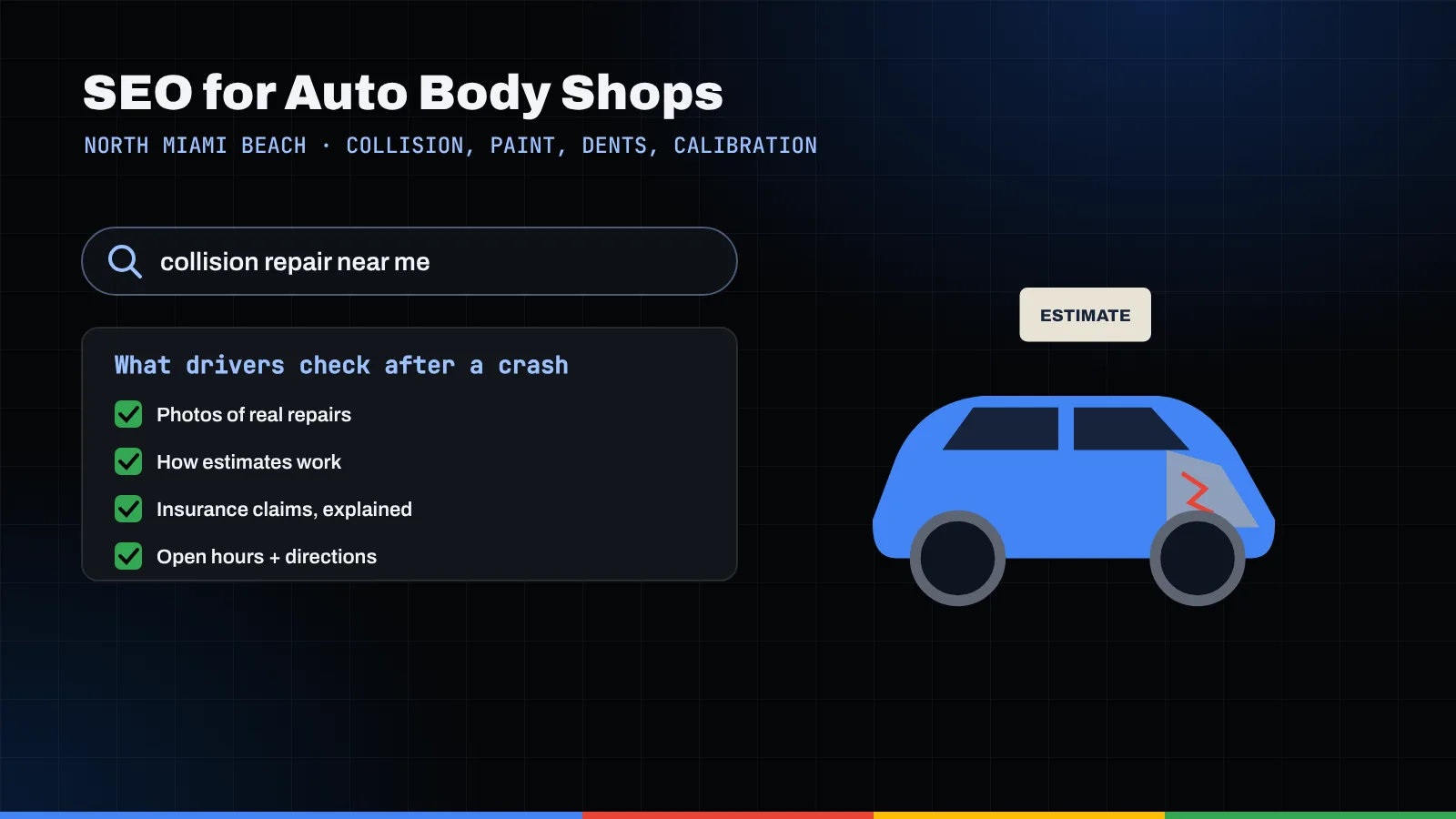
SEO for auto body shops works when your website and Google Business Profile answer the questions a rattled driver has right after a crash: can you fix this, will my insurance cover it, and what happens next. That means one page per repair type, a Business Profile built on the right category and real photos of your own work, and a plain explanation of how estimates and supplements work under Florida law. Get those three right and the rest is detail work.
Key takeaways
- People searching for a body shop are often stressed and holding a claim number. Write for that person, not for another shop owner.
- Give collision repair, paintless dent repair, paint matching, frame and structural work, ADAS calibration and insurance claims help their own pages.
- Lead your Google Business Profile with the most specific category that describes what you are, and fill it with photos of real cars in your real bays.
- Explain your estimate, teardown and supplement process honestly, and cite the Florida statutes instead of paraphrasing them loosely.
- If your customers speak Spanish, Haitian Creole or Portuguese at home, give each language its own real page, not a translate button.
Who is actually on the other end of the search?
Nobody browses for a body shop for fun. Your customer just got rear-ended at a red light, or backed into a pole at the grocery store, or found a fresh dent on the door after a night in a parking lot. They're annoyed. Sometimes they're shaken up. Often they have an adjuster's voicemail waiting and a claim number scribbled on a receipt.
So they pull out a phone and type "body shop near me." That moment decides whether your bays stay full.
Here's what that person wants to know, in order:
- Do you fix this kind of damage?
- Will you deal with my insurance company, or do I have to?
- How long will I be without my car?
- Are you legit, or will I get burned?
Good SEO for auto body shops means Google can find your answers to those four questions, in plain English and the other languages your customers speak. Below is how, organized the way a repair moves through the shop.
If you run a mechanical shop too, our guide to auto repair SEO in North Miami Beach covers the brake-and-A/C side. This one stays in the body department.
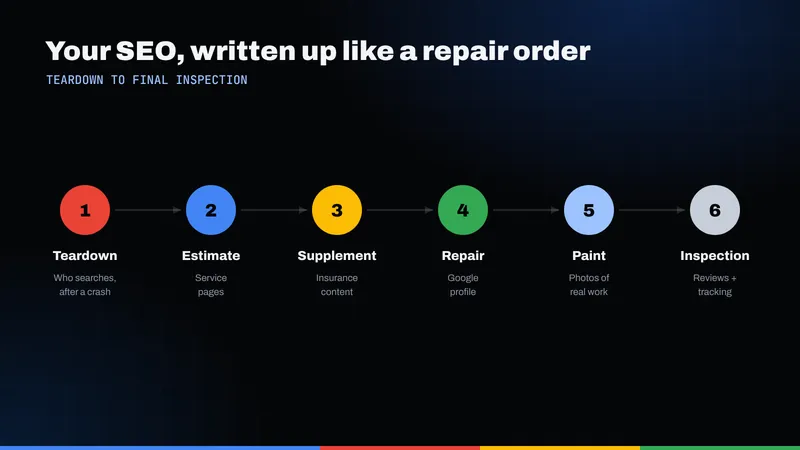
Teardown: what's really wrong with your current site?
You don't write an honest estimate off a photo from the customer's phone. You pull the bumper cover and look. Same with a website.
Most body shop sites we see have the same hidden damage once you take the cover off:
- One "Services" page that lists everything. Google has nothing specific to rank, and the customer has nothing specific to read.
- Stock photos. A shiny sports car that has never been near your shop. Customers can tell.
- No word about insurance. The biggest question a collision customer has, and the site is silent.
- A contact form with no photo upload and no field for the insurer or claim number.
- English only, in a market where that leaves a lot of customers out.
Write those down. That's your damage report. Now we price the fix.
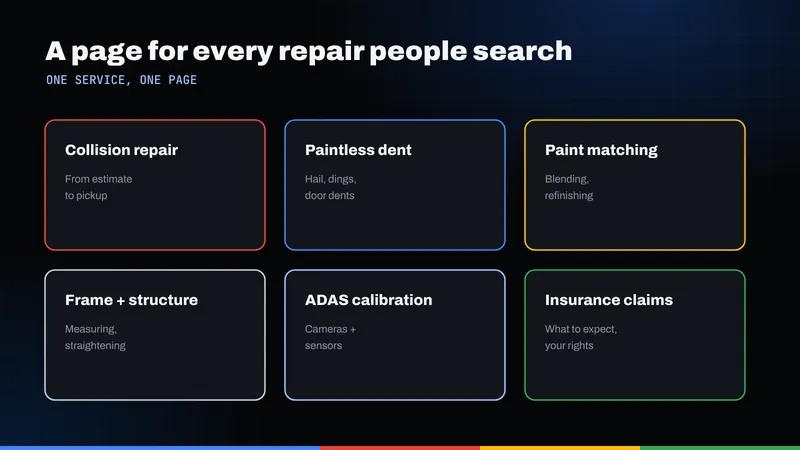
Line items: which pages does a body shop website need?
Every job on a repair order gets its own line. Your website should work the same way. One page per service you want more of, each with its own heading, its own photos and its own answers.
Here's the core estimate:
| Page | What the customer is asking | What the page should cover |
|---|---|---|
| Collision repair | "Can you fix my car after an accident?" | The collision work you do, how drop-off works, what to bring, and honest timing language. |
| Paintless dent repair | "Can this dent come out without repainting?" | When PDR works, when it doesn't (cracked paint, sharp creases), and a photo request. |
| Paint matching | "Will the new paint match?" | How you match and blend color, with before-and-after shots from your own booth. |
| Frame and structural | "Is my car safe to drive again?" | The structural work you do in-house, the equipment you own, and how you document it. |
| ADAS calibration | "Will my cameras and lane-assist work?" | Which calibrations you do yourself and which you sublet. Don't claim equipment you don't have. |
| Insurance claims help | "Do you work with my insurance company?" | How you coordinate with adjusters, how supplements work, and what Florida law says. |
A few shop rules for writing these pages:
- Lead with the answer. The first two sentences of the PDR page should tell someone whether PDR can probably fix their dent. Not your founding year.
- Put a call button and photo upload on every page. A customer who can send you three photos doesn't call the shop down the street.
- Skip the city-swap pages. Twenty copies of one page with the town name changed is filler.
How should a body shop set up its Google Business Profile?
When somebody types "body shop near me," the map results usually show up before your website does. That listing is your front counter. Treat it like one.
Pick the category that says what you are
Google's Business Profile guidelines say to use as few categories as possible to describe your core business, to choose the most specific one that fits, and not to use categories solely as keywords. For a collision shop, a body shop category leads. Add a mechanical category only if you genuinely run that operation too.
Keep the name honest
The same guidelines say your name should reflect your business's real-world name, and they list marketing taglines, service descriptions and location details as things that don't belong in it. "Pelican Ledger Collision" is a name. "Pelican Ledger Collision Best Body Shop North Miami Beach Insurance Approved" is a liability.
Photos of your work, not anyone else's
A stressed customer wants proof you can do the job, and a body shop produces that proof every day. Upload it. Shoot in good light, skip the filters, and show the place as it really is:
- The front of the building and the customer entrance, so a stressed driver can find you.
- Your paint booth, frame equipment and calibration area, if you have one.
- Before-and-after shots of real repairs, with license plates and anything personal blurred or cropped.
- The waiting area and the drop-off lane.
The rest of the profile (hours, services, the Q&A, posts) is covered in our Google Business Profile guide for North Miami Beach. And if you want to understand why one shop shows in the map pack and another doesn't, read how Google Maps rankings work.
How should you explain the estimate process on your site?
Most body shops hide the estimate process behind "Call for a free quote." Write a page that walks the customer through it instead. Plainly. And if you mention Florida law, cite it and stick to what it says.
What Florida's Motor Vehicle Repair Act says about written estimates
Florida's Motor Vehicle Repair Act sits in Part IX of Chapter 559 of the Florida Statutes, and its definition of motor vehicle repair expressly includes body work and painting. A few provisions are worth explaining to customers in your own words:
- The $150 threshold. Under section 559.905, when a customer requests repair work that will cost more than $150, the shop must prepare a written estimate before diagnostic or repair work begins. The customer can request the estimate, decline it as long as costs stay under a dollar amount they set, or decline it entirely, by signing a disclosure statement.
- Going over the estimate. Section 559.909 says that if actual charges will exceed the written estimate by more than $10 or 10 percent, whichever is greater, up to $50, the shop has to notify the customer, who can approve, change or cancel the work.
- Teardown charges. That section also says that if a customer cancels, the shop may charge for teardown and reassembly only if the customer was told about those possible costs in the estimate before diagnostic work began.
That last point matters in collision work, where you often can't see everything until the bumper cover comes off. Tell customers up front that teardown may be needed and what it can cost.
Registration is a trust signal
Under section 559.904, each motor vehicle repair shop must register with the Department of Agriculture and Consumer Services before doing business in Florida, and registration renews every two years. Put your registration number in the footer and on your estimate page. It costs you nothing and tells a nervous customer you're on the books.
A note from the foreman: this is a summary of statute text, not legal advice. Have your attorney read your estimate and insurance pages before they go live.
Supplement: how do you talk about insurance claims without overpromising?
Every body tech knows the word "supplement": you open the car up, find the bent bracket behind the bumper, and send the extra damage to the insurer. Customers have usually never heard it. Explain it.
A good insurance claims page answers, in order:
- What to bring. Claim number, adjuster's name and contact, policy info, photos from the scene if they have them.
- Who talks to whom. Say plainly what your shop handles with the adjuster and what the customer still has to do.
- What a supplement is. Hidden damage turns up after teardown. You document it and send it to the insurer. That can add time. Say so.
- What the law says. Quote it accurately, or don't quote it.
On that last point, be careful. Plenty of shop sites describe legal rights more broadly than the statute text does. Here's what Florida's claim-settlement statute for motor vehicle insurance, section 626.9743, does say:
- If an insurer specifically requires a particular repair shop for the repairs, the insurer must make sure the vehicle is restored to its pre-loss condition in performance and appearance, at no additional cost to the insured beyond what the policy states.
- If the insurer settles a partial loss based on a written estimate, it must give the insured a copy of that estimate.
- Replacement parts used in the estimate must be at least equal in kind and quality to the original parts in fit, appearance and performance.
Tell customers what the statute says, tell them you'll work with their insurer, and let them decide. Don't promise anything about their specific policy. You haven't read it, and neither have we.
Does structured data help a body shop?
Structured data is a bit of code that tells search engines, in their own format, what your business is and where it sits. It won't fix a weak site, but it removes guesswork.
Schema.org has a specific type for you: AutoBodyShop, which sits under AutomotiveBusiness and LocalBusiness. Google's local business structured data documentation says to use the most specific LocalBusiness subtype possible, and lists name and address as the required properties. So a body shop should mark up its homepage or contact page as AutoBodyShop, not a generic LocalBusiness.
Include the name exactly as it appears on your sign, plus street address, phone and hours, and keep all of it matched to your Business Profile. For the bigger picture on why this matters, see how schema helps search engines.
How do you reach customers who don't search in English?
Some of the drivers in North Miami Beach who'll need a bumper replaced this month will search in Spanish, Haitian Creole, Portuguese or Russian. If your site only speaks English, you're invisible to some of them and hard to trust for others.
Google's guidance on managing multilingual sites boils down to a few shop rules. (Our Spanish and multilingual SEO guide goes deeper.)
- One URL per language. Google recommends a separate address for each language version rather than switching languages with cookies or browser settings, because its crawler may never see the versions that only appear dynamically.
- Let people choose. Add a visible language switcher instead of redirecting people automatically.
- Translate the pages that matter first. Collision repair and insurance claims help are the two pages a stressed customer reads closest. Start there.
- Have a fluent person check it. One wrong word on an insurance page can mislead a customer.
- Match the phone. If the Spanish page says "Hablamos español," make sure someone who answers the phone actually does.
Final inspection: what should you check before calling it done?
No car leaves the shop without a final walkaround. Same with your site. Picture a hypothetical shop called Pelican Ledger Collision, on a busy stretch of NE 163rd Street, getting ready to relaunch its site. Here's the checklist we'd hand its owner:
- Every core service has its own page, with a call button and a photo-upload form.
- The estimate page explains the written estimate threshold, the over-estimate notice rule and teardown charges, with statute links.
- The insurance page sticks to the statute text.
- The FDACS registration number is in the footer.
- The Business Profile uses the real name, the most specific body shop category and photos of real work.
- AutoBodyShop markup matches the profile.
- Each language has its own URLs, checked by a fluent speaker.
- The site loads fast on a phone, because your customer is standing next to a dented car on a hot sidewalk.
Pelican Ledger is made up, by the way. The checklist isn't. Run it on your own site and see how many boxes you can actually tick.
When should a body shop bring in outside help?
Plenty of owners handle the Business Profile and photos themselves. Where shops get stuck is the site: real service pages, correct structured data, proper language versions and fast load times.
That's the work we do. Ribacoff Enterprises is based in North Miami Beach and handles local SEO, website design and the technical pieces in between for businesses here and nationwide. You can see the kind of sites we build on our portfolio page, and read more about how we approach the local market on our North Miami Beach SEO page.
If you'd rather have somebody do the teardown for you, request a free site audit. We'll write it up like an estimate: line items, what's urgent, what can wait, and no surprise supplements.
Frequently asked questions
What is SEO for auto body shops?
It's making your shop show up when drivers search for collision, dent or paint repair nearby, and making sure your site answers their questions. Mostly that means a solid Google Business Profile, a page per repair type, honest estimate and insurance explanations, and real photos of your work.
Which Google Business Profile category should a collision shop use?
Google's guidelines say to use as few categories as possible, pick the most specific one that describes what your business is, and not use categories as keywords. For a collision shop, a body shop category should lead. Only add a mechanical repair category if you genuinely run that kind of operation too.
Does Florida require body shops to give written estimates?
Florida's Motor Vehicle Repair Act covers body work and painting. Under section 559.905, a shop must prepare a written estimate when the customer requests repair work expected to cost more than $150, unless the customer waives it in writing. Section 559.909 requires the shop to notify the customer if charges will exceed the estimate by more than $10 or 10 percent, whichever is greater, up to $50.
What should a body shop website say about insurance and choosing a repair shop?
Stick to the statute text. Florida section 626.9743 says an insurer that specifically requires a particular repair shop must restore the vehicle to its pre-loss condition at no additional cost beyond the policy terms. Don't promise anything about a customer's specific policy, and have an attorney review the page.
Should a body shop use AutoBodyShop schema?
Yes. Schema.org has a specific AutoBodyShop type, and Google's documentation says to use the most specific LocalBusiness subtype possible, with name and address as required properties. Keep the markup matched to your Business Profile details.