SEO for car dealerships is mostly inventory management with a search engine watching. Set up your Google Business Profile the way Google's dealer rules allow (one for the store, more for sales, service and parts), give every vehicle a detail page worth landing on, write your own copy instead of pasting the manufacturer feed, and handle sold units cleanly. Then keep your reviews honest and your advertised prices real. For a North Miami Beach store, that's the whole playbook.
Key takeaways
- Google lets dealers run separate profiles for the dealership and for departments like sales, service and parts. New-car stores can add one per brand; used-car stores can't.
- Your vehicle detail pages (VDPs) are the money pages. Unique photos, the VIN, real price and a clear next step beat a recycled factory blurb every time.
- Google retired the vehicle listing rich result in 2025. Paid vehicle ads through Merchant Center are still available in the U.S. for eligible car and pickup inventory.
- A court vacated the FTC's CARS Rule in January 2025, but that didn't make misleading prices or fake reviews legal. The FTC's 2024 review rule is still on the books.
- Sold units need a plan: a proper status code or a useful redirect, never a blank "this vehicle is no longer available" page returning 200.
What does dealership SEO actually cover?
Picture the Monday morning lot walk. You check what's front line, what's aging, what's missing a key, what needs detailing. Good SEO for car dealerships is the same walk, just on your website and your Google listings.
The route: your Google profiles, then inventory and VDPs, model pages, service and finance, the sold line, and finally the paperwork (schema, speed, reviews and ad rules).
This applies whether you run a franchise store, an independent used lot on a busy corridor, a motorcycle shop or a boat dealer. The details shift (we'll flag where), but dealership SEO is the same walk everywhere. If you want the big-picture version for local businesses first, our North Miami Beach SEO page covers the foundation, and if you run rooftops across the county, our SEO Miami page covers the wider market.
How many Google Business Profiles can a dealership have?
More than most stores use. Google publishes specific guidelines for car dealerships, and they're more generous than the general rules.
What Google allows
- The dealership itself: every car dealer can have a profile for the store.
- Departments: dealers can add profiles for departments such as sales, parts or service. Name them with the dealership name plus the department name.
- Brands (new-car stores only): new-car dealerships can have a profile for each brand of new cars they sell.
- Used-car stores: no per-brand profiles. Google's reasoning is that used-car brands change too often.
Pick the right category for each one
Google recommends "Car dealer" for sales, "Car service" for maintenance and "Auto parts business" for parts. Don't stuff "Best Used Cars Miami" into a department name. The name should be your dealership's name and the department, period.
Dealer GBP checklist
- Separate phone numbers that ring the right desk for each department profile.
- Hours that match reality, including service hours that differ from sales.
- Each department profile links to its own page (service profile to the service page, not the homepage).
- Fresh photos of the actual building, service drive and lot. No stock shots.
Motorcycle and boat dealers: the department logic still applies if you genuinely run a separate service or parts operation. Just don't invent departments that are really one guy and a phone. The map pack is where local SEO in Miami gets decided for most dealers. For more on how it picks winners, see how Google Maps rankings work, and our local SEO service if you'd rather hand this off.
What makes a vehicle detail page rank and sell?
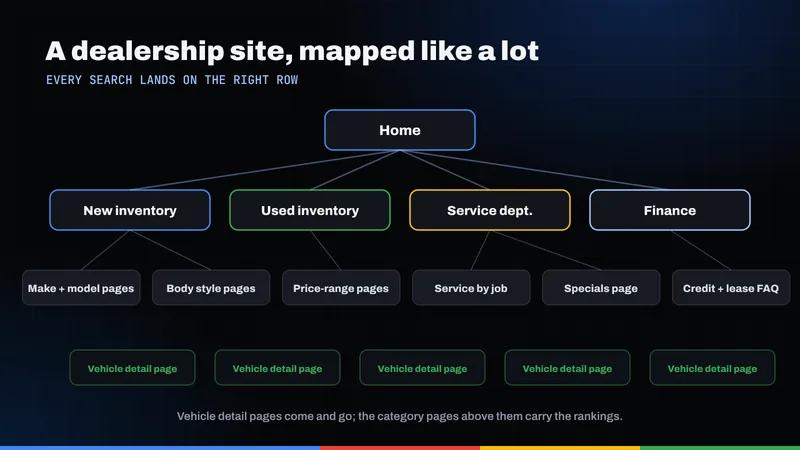
Your VDPs are where the shopper decides whether to call, text or bounce. They're also the pages most likely to look identical to every other dealer listing the same trim. That's the problem to solve.
The fix is specificity. A VDP should describe this exact unit, not the model in general. Here's how each page type on the lot should work:
| Page type | What the shopper wants | Must-have elements |
|---|---|---|
| Inventory search (SRP) | Browse and filter: "used SUVs under a budget," "certified trucks" | Working filters, crawlable category pages for real demand (make, body style), short intro copy, accurate counts |
| Vehicle detail page (VDP) | Decide on one unit and take the next step | Original photos, VIN, stock number, mileage, condition, price with fee disclosures near it, features, one clear call to action |
| Model page | Research before shopping: trims, differences, who it's for | Your own comparison copy, current inventory links, local test-drive info, FAQs |
| Service department | Book a repair or maintenance visit nearby | Services offered, makes serviced, hours, online scheduling, service-specific phone |
| Finance / credit | Understand options before talking to anyone | Plain-English process, what documents to bring, honest disclosures, secure application |
| Parts | Find and order a part | Parts counter hours, ordering method, parts-specific contact |
VDP checklist
- Real photos of the real unit. Walkaround, interior, odometer, any wear. Stock renderings on a used car are a credibility leak.
- A short dealer note. Two or three sentences only your team could write: one owner, new tires, just through your shop, whatever's true.
- The numbers that matter. VIN, stock number, mileage, price. If there are fees, say so right next to the price.
- One primary action. "Check availability" or "Schedule a test drive." Not six competing buttons.
Getting shoppers to the page is half the job. Getting them to act is the other half, which is why we pair this work with conversion optimization.
How do you avoid duplicate content from manufacturer feeds?
Every franchise store can pull the same OEM descriptions and spec sheets. If your model pages are just that feed, you're one of dozens of near-identical pages, and Google has no reason to pick yours.
Duplicate content usually isn't a penalty. It's a filter. Google picks one version to show and quietly ignores the rest. You don't get punished; you just don't get shown.
How to stand out from the feed
- Write the intro yourself. Who buys this model at your store? What do your salespeople get asked about it?
- Compare trims in your own words. A simple "which trim fits which driver" section beats a pasted spec dump.
- Use canonical tags on filter combinations. Sort orders and stacked filters can spin off thousands of near-duplicate inventory URLs. Point them at the main category page.
Bilingual shoppers are a real part of this market, so if your sales floor works in Spanish, your model and finance pages probably should too. Our guide to Spanish and multilingual SEO walks through doing it properly.
Why do service and finance pages deserve their own SEO?
Service is the steady business. Sales comes in waves. Service keeps the lights on. Yet plenty of dealer sites bury it under one "Schedule Service" form.
Give the service department real pages: one per major service you want more of (brakes, tires, A/C, scheduled maintenance), which makes you serve, and whether you take outside-brand vehicles. If you also want to see how an independent shop approaches this, our auto repair SEO guide covers service pages in depth.
Finance pages earn trust before the desk does. Shoppers with credit questions research quietly. A page that explains the process, what to bring and what happens next answers them without pressure. Keep every rate, payment and approval claim truthful and fully disclosed (more on the rules below).
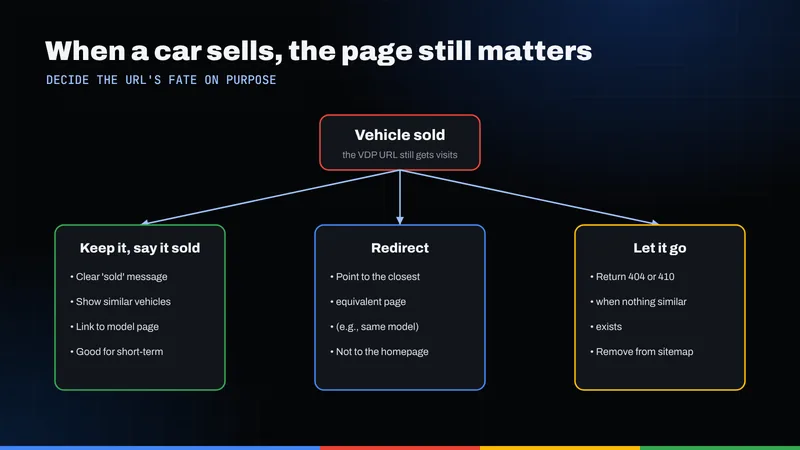
What should happen to a VDP after the car sells?
Here's where dealer sites leak. A unit sells, the VDP becomes a thin "no longer available" page, and the server still answers 200 OK. Multiply that by every unit you move.
Google's documentation on HTTP status codes and errors explains how this plays out:
- 404 and 410: Google treats 4xx errors (except 429) the same way. URLs already indexed that start returning 4xx get dropped over time, and Google crawls them less.
- Soft 404: a page that returns success but looks like an error or an empty page gets flagged in Search Console as a soft 404. That's exactly what a blank "vehicle sold" page tends to be.
A sold-unit playbook
- Truly gone, nothing similar: return a real 404 or 410.
- A close match in stock (same model, similar year): a redirect to that model's inventory page is reasonable, because it's what the shopper wanted.
- Want to keep the URL briefly? Then make it genuinely useful: mark it sold, show comparable units in stock, and set a rule for when it gets retired.
- Don't redirect everything to the homepage. That's a dead end with extra steps.
This is technical housekeeping. Automate it inside your inventory system so nobody has to remember.
Can your inventory show up directly in Google?
Yes, but the options changed, and plenty of advice online is out of date.
The free rich result is gone
Google used to support vehicle listing structured data for dealers. According to Google's Search Central updates log, vehicle listing was among the structured data features flagged for phase-out in June 2025, and in September 2025 Google removed the documentation, noting these types are no longer shown in Google Search results. If a vendor is still selling you "vehicle rich results" as a free organic feature, ask them to show you current Google docs.
Paid vehicle ads are live
Google's vehicle ads overview describes a paid format that shows the vehicle's image, make, model, price and mileage, and sends clicks to your VDP. The key points:
- Fully released in the United States (plus Australia, Canada and Japan).
- Requires the vehicle ads add-on in Merchant Center, a vehicle data feed, a linked Google Ads account and a linked Google Business Profile (or a store data source).
- New and used inventory both qualify from dealers, retailers, aggregators and manufacturers. Private sellers and brokers can't use it.
- Limited to non-commercial passenger vehicles like cars and pickups. Two-wheelers and commercial vehicles are excluded, so motorcycle and boat dealers shouldn't plan around it.
If you go this route, the same VDP quality rules apply, because that's where the paid click lands. Our Google Ads team handles feed setup and campaign management.
Schema still earns its keep
Structured data is still how you describe your business and inventory to machines, including AI assistants that summarize local options. Schema.org has an AutoDealer type under AutomotiveBusiness (there's also a MotorcycleDealer type). For units, the Car type sits under Vehicle and supports properties like vehicleIdentificationNumber, mileageFromOdometer, vehicleModelDate, bodyType, fuelType and itemCondition.
- Mark up the dealership and department pages with the right business type, address, phone and hours, and VDPs with Car plus an Offer matching the visible price.
- Never mark up anything the page doesn't show.
Just don't expect markup to produce a special search result by itself anymore. Its job now is clarity, not decoration.
How do you keep heavy photo galleries fast?
Shoppers want lots of photos per unit. The trick is loading them without making the page crawl on a phone.
- Load the first photo right away. The main image is usually the largest thing on the screen. Don't lazy-load it.
- Lazy-load the rest. Browser-level
loading="lazy"on gallery images below the fold defers them until the shopper scrolls or swipes. - Set width and height on every image. That reserves space so the page doesn't jump around as photos arrive.
- Resize at upload. A full-resolution camera file has no business in a thumbnail. Serve modern formats in sizes that match the screen.
- Audit third-party scripts. Chat, trade-in and payment widgets pile up. Each should earn its spot.
Speed decides whether the shopper sees the car before losing patience. More in how website speed affects revenue.
How should dealers get reviews without breaking rules?
Trust is the whole sale, so reviews matter. Two sets of rules apply.
Google's rules
Google's review policy says incentivized reviews aren't allowed. No payments, discounts or free services in exchange for a review. Businesses also can't discourage negative reviews or selectively ask only happy customers. That means "review gating" (screening for a good experience before sending the Google link) is out.
The FTC's 2024 rule
The FTC announced its final rule banning fake reviews and testimonials in August 2024. Among other things it prohibits:
- Fake reviews, including from people with no real experience with the business.
- Incentives conditioned on a review expressing a particular sentiment.
- Undisclosed reviews from insiders like managers and employees, and soliciting reviews from employees' relatives without disclosure.
- Suppressing negative reviews through threats or intimidation.
A clean review process for the store
- Ask every buyer and every service customer the same way, at delivery and after the RO closes.
- No spiffs to salespeople tied to star ratings. No "five stars and get a free oil change."
- Staff and family don't review the store.
- Respond to every review, especially the bad ones, with facts and a way to reach a manager.
Does the CARS Rule still apply to dealer advertising?
No, but don't take that as a green light. On January 27, 2025, the Fifth Circuit vacated the FTC's CARS Rule in a case brought by the National Automobile Dealers Association and the Texas Automobile Dealers Association. The court's reason was procedural: the FTC skipped the advance notice of proposed rulemaking its own rules require. The court didn't rule on the substance of the rule.
What that means for your website, in plain terms: the specific CARS Rule obligations aren't in force, but that decision was about how the rule was made. It didn't make deceptive advertising acceptable, and the review rule above is a separate rule. If you need a legal read on your ads, talk to your dealer counsel. From a marketing standpoint, here's how we set up dealer sites:
- The advertised price is a price someone can pay. If it requires a specific rebate, trade-in or financing, say so right next to the number.
- Fees are disclosed near the price, not three clicks deep in a disclaimer.
- "Available" means on the lot. Keep inventory feeds synced so sold units don't sit on the site as bait.
- Finance claims are specific and true. No "everyone's approved" unless everyone is.
- Fine print supports the headline; it doesn't reverse it.
If you're ready to have someone walk your site like it's Monday morning, start with a free SEO audit.
Frequently asked questions
Can a used-car dealer create a Google Business Profile for each brand it sells?
No. Google's dealer guidelines say only new-car dealerships can have a profile for each brand of new cars sold. Used-car dealers can still have a profile for the dealership and separate profiles for real departments such as sales, service or parts.
Does Google still show vehicle listing rich results from structured data?
No. Google flagged vehicle listing structured data for phase-out in June 2025 and removed its documentation in September 2025, saying those types are no longer shown in Search results. Paid vehicle ads through Merchant Center are a separate product and are available in the United States.
Should a sold car's page return a 404 or redirect?
If nothing similar is in stock, a real 404 or 410 is the clean choice, and Google drops those URLs over time. If you have a close match, redirecting to that model's inventory page is reasonable. Avoid thin "no longer available" pages that return 200, which Search Console can flag as soft 404s.
Is the FTC's CARS Rule in effect?
No. The Fifth Circuit vacated the CARS Rule on January 27, 2025, because the FTC skipped a required step in the rulemaking process. The ruling did not address the rule's substance, and it didn't make deceptive advertising acceptable, so dealers should still keep prices, fees and finance claims truthful and clearly disclosed.
Can motorcycle or boat dealers use Google vehicle ads?
Generally no. Google limits vehicle ads to non-commercial passenger vehicles such as cars and pickup trucks, and two-wheelers are excluded. Motorcycle and boat dealers should focus on their Google Business Profile, strong detail pages and standard search campaigns instead.