SEO for veterinarians comes down to being easy to find, easy to trust and honest at the moment a pet owner is worried. Keep your Google Business Profile accurate, especially your hours and whether you see urgent cases. Build a clear page for each service you offer, mark up your site with VeterinaryCare structured data, show credentials people can verify, and earn reviews the right way.
Key takeaways
- Your hours are the most important line on your profile. If you don't take emergencies after 6 p.m., say so plainly and point people to where they can go.
- Give wellness exams, vaccines, dental care, surgery and urgent care their own pages, written to inform and reassure, never to diagnose.
- Google only allows separate department profiles when a department is public-facing with its own name and category. A grooming or boarding service doesn't automatically qualify.
- Show credentials pet owners can check for themselves: a Florida veterinary license, AAHA accreditation or Fear Free certification, only if you actually hold them.
- Ask every client for a review the same way, offer nothing in return, and never mention a pet's diagnosis or treatment in a reply.
What does a worried pet owner see when they search at 9 p.m.?
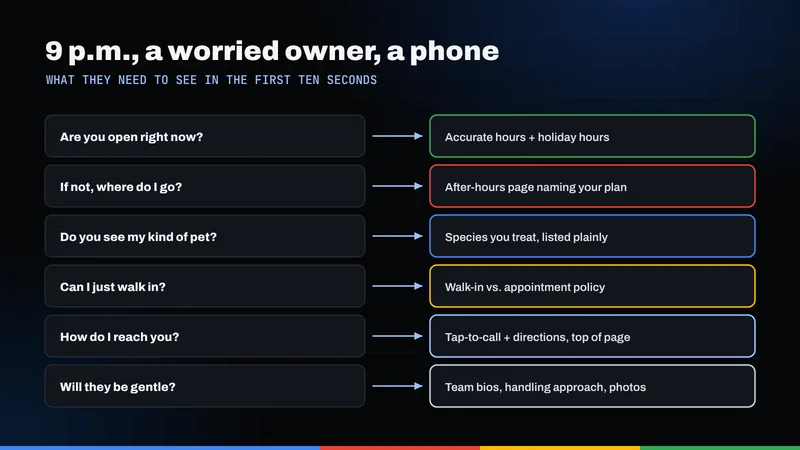
Imagine it's a Tuesday night in North Miami Beach. A woman's older Labrador has been restless since dinner, won't lie down and keeps pacing to the door. Her regular vet closed at six. She picks up her phone, types "vet open now near me," and starts scrolling with one hand while the other rests on her dog's back.
What she needs in the next two minutes is simple. Who is open right now? Do they see walk-ins, or do I need to call first? How far is it? Will someone pick up the phone?
Most of veterinary SEO isn't about tricks. It's about making sure that when someone is scared for an animal they love, what Google shows them about your clinic is true, current and kind. A profile that says "Open" when the doors are locked costs a frightened person time they didn't have.
The same habits also help the calmer searches: the new puppy owner looking for a first vaccine visit, or the family who just moved near Oleta River State Park and needs a regular vet.
How should a vet clinic set up its Google Business Profile?
For most clinics, the Google Business Profile is the first thing a pet owner reads and where the phone button lives. Google's guidelines for representing your business set the ground rules, and a few of them matter a lot for veterinary practices.
Use your real name
Google says your business name should reflect your real-world name, the way it appears on your sign, website and stationery. It specifically doesn't allow hours, phone numbers or location details in the name. So if your sign says "Example Animal Hospital," that's your name. "Example Animal Hospital 24/7 Emergency Vet North Miami Beach" is not, and stuffing a name like that puts your profile at risk.
Be completely honest about hours
This is the heart of it. Set your regular hours to match when a client can actually walk in and be seen. Then use the tools Google gives you for everything else:
- Special hours for holidays, hurricane closures and any day you close early. Set these before the day arrives, not after.
- More hours if different parts of your clinic keep different schedules, like a grooming desk that opens later than the exam rooms.
- Your description and website to explain what "urgent care" means at your clinic. Do you see same-day sick visits during business hours? Do you have a doctor on site overnight? If not, tell people where they can go.
If you're not an emergency hospital, don't let anything suggest it. A short, warm line works well: "We're not open overnight. If your pet needs help after hours, please contact the nearest emergency animal hospital." That sentence earns more trust than any keyword.
Departments: only when Google allows them
Many clinics ask whether grooming, boarding or an urgent care wing can have its own profile. Google allows separate profiles for departments within businesses, universities, hospitals and government institutions, but only when the department is public-facing and operates as a distinct entity with a name and category that differ from the main business. Google's own examples are "Walmart Vision Center" and "Sears Auto Center."
So a grooming service that shares your front desk, phone and name probably belongs on your main profile as a service, not a second listing. If you're unsure, keep it on one profile.
We go deeper into categories, photos and posts in our Google Business Profile guide for North Miami Beach.
Which service pages does a veterinary clinic need?
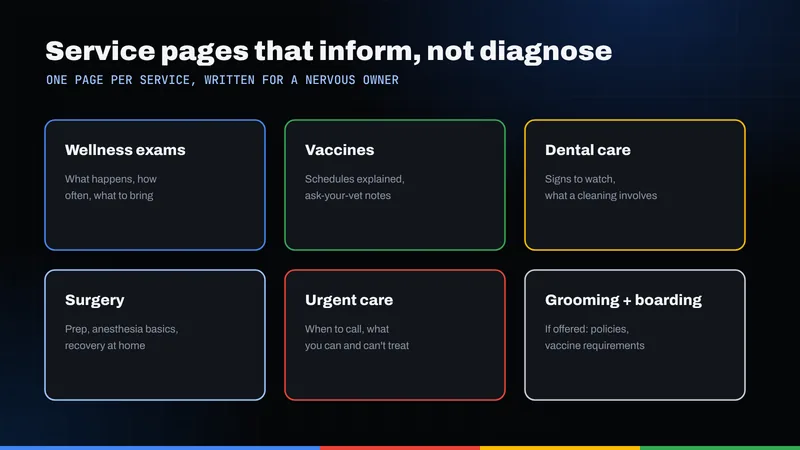
Pet owners don't search for "veterinary services." They search for the thing they're worried about or need to get done. Each deserves a page that answers it plainly, with a clear next step.
| Pet owner's question | Page that answers it | What the page should include |
|---|---|---|
| "Is anyone open right now?" | Hours & urgent care page | Exact hours, whether you see same-day sick visits, what to do after hours, a tap-to-call phone number |
| "Where do I take my new puppy or kitten?" | Wellness exams page | What a first visit looks like, what to bring, how to book, which species you see |
| "Which shots does my dog need?" | Vaccines page | That your vets recommend vaccines based on each pet's age, health and lifestyle, plus how to schedule |
| "My cat's breath is bad. Should I worry?" | Dental care page | What a dental exam and cleaning involve, why anesthesia may be used, why an exam comes first |
| "What happens if my dog needs surgery?" | Surgery page | Types of procedures you perform, pre-surgery steps, drop-off and pickup, how you communicate during the day |
| "Can you groom or board my pet too?" | Grooming and boarding pages | What's included, vaccination requirements, how to reserve |
| "Is this a real, licensed clinic?" | About / meet the team page | Each veterinarian's name and credentials, how to verify a license, any accreditation you hold |
If you list prices, keep them current. If you don't, say costs depend on an exam and invite people to call.
For the mechanics of titles, headings and internal links on each page, our on-page SEO guide walks through it step by step.
How do you write medical pages that help without diagnosing online?
Pet owners want answers. Your veterinarians know an answer without an exam is often a guess. Good service pages respect both.
Write to explain, not to decide. A dental page can describe what happens during a cleaning. It shouldn't tell a reader their pet "probably has" a particular disease. An urgent care page can explain when to call, while making clear that only a veterinarian who examines the animal can say what's wrong.
A few habits that help:
- Lead with reassurance and a next step. "If you're worried, call us. We'll help you decide whether your pet needs to be seen today."
- Describe the visit, not the diagnosis. What happens when they arrive, who they'll meet, how long it usually takes at your clinic.
- Have a veterinarian review every medical page. Put their name on it. It's honest, and it shows real expertise behind the words.
This is the same balance we describe for human healthcare in our post on dental and medical SEO in North Miami Beach.
Should you use VeterinaryCare schema?
Yes, and it takes one small block of code. Schema.org has a type called VeterinaryCare, described simply as "a vet's office." It sits under MedicalOrganization, which gives you properties like isAcceptingNewPatients and medicalSpecialty.
There's one wrinkle worth knowing. On schema.org, VeterinaryCare is not listed as a type of LocalBusiness, and properties like opening hours belong to LocalBusiness. Google's local business documentation says to use the most specific type you can and allows more than one type as an array. So many clinics list both:
{
  "@context": "https://schema.org",
  "@type": ["VeterinaryCare", "LocalBusiness"],
  "name": "Your Clinic Name",
  "url": "https://www.example.com/",
  "telephone": "+1-305-000-0000",
  "address": {
    "@type": "PostalAddress",
    "streetAddress": "Your street address",
    "addressLocality": "North Miami Beach",
    "addressRegion": "FL",
    "postalCode": "Your ZIP"
  },
  "isAcceptingNewPatients": true,
  "openingHoursSpecification": [{
    "@type": "OpeningHoursSpecification",
    "dayOfWeek": ["Monday","Tuesday","Wednesday","Thursday","Friday"],
    "opens": "08:00",
    "closes": "18:00"
  }]
}
The values above are placeholders. Use your real details, and make the hours match your Google profile and website exactly. Schema doesn't guarantee anything special in results, but it helps search engines connect your facts without guessing. Our post on how schema helps search engines explains why consistency matters more than volume.
Which credentials can you show, and how do pet owners check them?
People are handing you a member of their family. Credentials help, but only when they're real and easy to verify.
Florida veterinary license
In Florida, the Board of Veterinary Medicine is responsible for licensing and regulating veterinarians. The Board's page on the DBPR website explains that anyone can search DBPR records and verify a license by name or license number. Add a line to your team page inviting clients to do exactly that.
Florida's advertising rule
Florida law is direct about this. Section 474.214(1)(e), Florida Statutes, lists as grounds for discipline "advertising goods or services in a manner which is fraudulent, false, deceptive, or misleading in form or content." The Board also has its own rules on advertising. When in doubt about a claim, ask your attorney. In practice: no "best vet in Miami" claims you can't support, no implying you're an emergency hospital if you aren't, and no specialty titles your doctors don't hold.
AAHA accreditation
If your hospital is accredited by the American Animal Hospital Association, say so. AAHA explains that accreditation is voluntary and that accredited hospitals must meet or exceed hundreds of standards covering veterinary care and business, with re-evaluations every few years. AAHA also offers a search tool so pet owners can find accredited hospitals. If you're not accredited, don't imply that you are.
Fear Free certification
Fear Free offers certification programs aimed at reducing fear, anxiety and stress in pets. Individual veterinary professionals, groomers and boarding staff can be certified, and practices can certify at the facility level by meeting a set of standards and passing a virtual visit. Fear Free keeps a public directory on its website. If you're certified, mention it on grooming and boarding pages too.
What local content helps North Miami Beach pet owners?
South Florida pets live with heat, humidity and storms for much of the year. That gives you a natural, genuinely helpful topic list, as long as you stick to reputable sources and don't invent numbers.
Heat safety is the obvious place to start. The AVMA's warm-weather pet safety guidance advises never leaving pets in a parked car, even with windows cracked, avoiding hot surfaces like asphalt that can burn paws, providing fresh water and shade, and taking extra care with flat-faced breeds and overweight pets. It also lists warning signs of heat stress, like heavy panting, drooling, unsteadiness and collapse, and says to seek emergency veterinary care if you see them.
A local heat-safety page can add what only you know: your after-hours instructions and a clear phone number. Other ideas that fit the area:
- A hurricane-prep checklist for pets: records, medications, carrier, and how to reach your clinic if you're closed for a storm.
- Pages in Spanish or another language your team speaks, if your clients use it. Our post on multilingual SEO in North Miami Beach covers how to do that properly.
How should a vet clinic ask for reviews?
Reviews answer the question your website can't: "Will they be kind to my animal?" That makes it tempting to cut corners. Don't.
Google's review content policy prohibits offering incentives, such as payment, discounts or free services, in exchange for reviews. It also prohibits discouraging negative reviews or selectively asking only happy clients, and it doesn't allow reviews from people with a conflict of interest, such as current or former employees.
Federal rules point the same way. The FTC's final rule on fake reviews, announced August 14, 2024, bans fake reviews (including AI-generated ones), incentives tied to positive or negative sentiment, undisclosed insider reviews, and suppressing reviews through threats or intimidation.
A simple, honest process works best:
- Ask every client the same way, for example with a short text or email after each visit.
- Offer nothing in return. No discount on the next nail trim.
- Don't ask staff, their relatives or friends of the practice to leave reviews.
- Make it easy with a direct link to your Google profile.
How do you respond to a negative review without sharing patient details?
Few reviews hurt more than one about a pet who didn't make it. The owner is grieving, and your team may feel the review is unfair. Every future client who scrolls past will read your reply.
Replies appear under your business name, so treat each one like a note to a neighbor. As a general best practice:
- Never confirm that the reviewer was a client, and never mention a pet's name, diagnosis, treatment, test results or bill. Even if they shared those details, you shouldn't repeat or add to them.
- Lead with compassion. "We're so sorry to read this. We take every concern seriously and would like to talk with you directly."
- Move the conversation offline. "Please call our practice manager at our main number so we can talk this through privately."
- Keep it short and calm. Don't argue facts in public, and have one person approve sensitive replies.
If you believe a review breaks Google's policies, you can report it through your profile. Simply disagreeing with a review usually isn't enough, so put your energy into a reply that future clients will respect.
Where should a North Miami Beach vet clinic start?
If you only have an afternoon, do these in order:
- Check your Google Business Profile hours against reality. Add special hours for the next holiday.
- Write one honest sentence about after-hours care and put it on your profile description and your site.
- Build or improve your urgent care and wellness pages first, since those match the most anxious and the most common searches.
- Add VeterinaryCare schema with hours that match your profile.
- Add license verification and any real credentials to your team page.
- Start a simple, same-for-everyone review request after each visit.
Map visibility depends on more than any one of these steps, which our post on how Google Maps rankings work explains. Our local SEO services cover profile cleanup, service pages, schema and review processes for clinics that would rather hand this off, and you can see how we approach the city itself on our North Miami Beach SEO page. If you'd like a second set of eyes on your clinic's profile and site, request a free audit and we'll tell you what we'd fix first.
Frequently asked questions
What is SEO for veterinarians?
It's the work of helping pet owners find and trust your clinic in Google search and Maps. For most vet clinics, that means an accurate Google Business Profile, clear pages for each service, structured data that matches your real details, verifiable credentials and an honest review process.
Can my grooming or boarding service have its own Google Business Profile?
Only if it qualifies as a department under Google's guidelines, meaning it's public-facing and operates as a distinct entity with a name and category that differ from the main business. A grooming service that shares your name, desk and phone usually belongs on your main profile.
Should my clinic say it offers emergency care?
Only if it truly does, and only during the hours it does. Under Florida law, advertising veterinary services in a fraudulent, false, deceptive or misleading way is grounds for discipline. If you don't see emergencies after hours, say so clearly and tell pet owners where they can go.
Can I offer clients a discount for leaving a review?
No. Google prohibits offering incentives such as payment, discounts or free services for reviews, and the FTC's 2024 rule bans incentives tied to positive or negative sentiment. Ask every client the same way, with nothing attached.
How should we reply to a review about a pet's treatment?
Don't confirm the person was a client and don't mention the pet's name, diagnosis, treatment or bill. Express sympathy, invite them to call the practice privately and keep the reply short and calm.