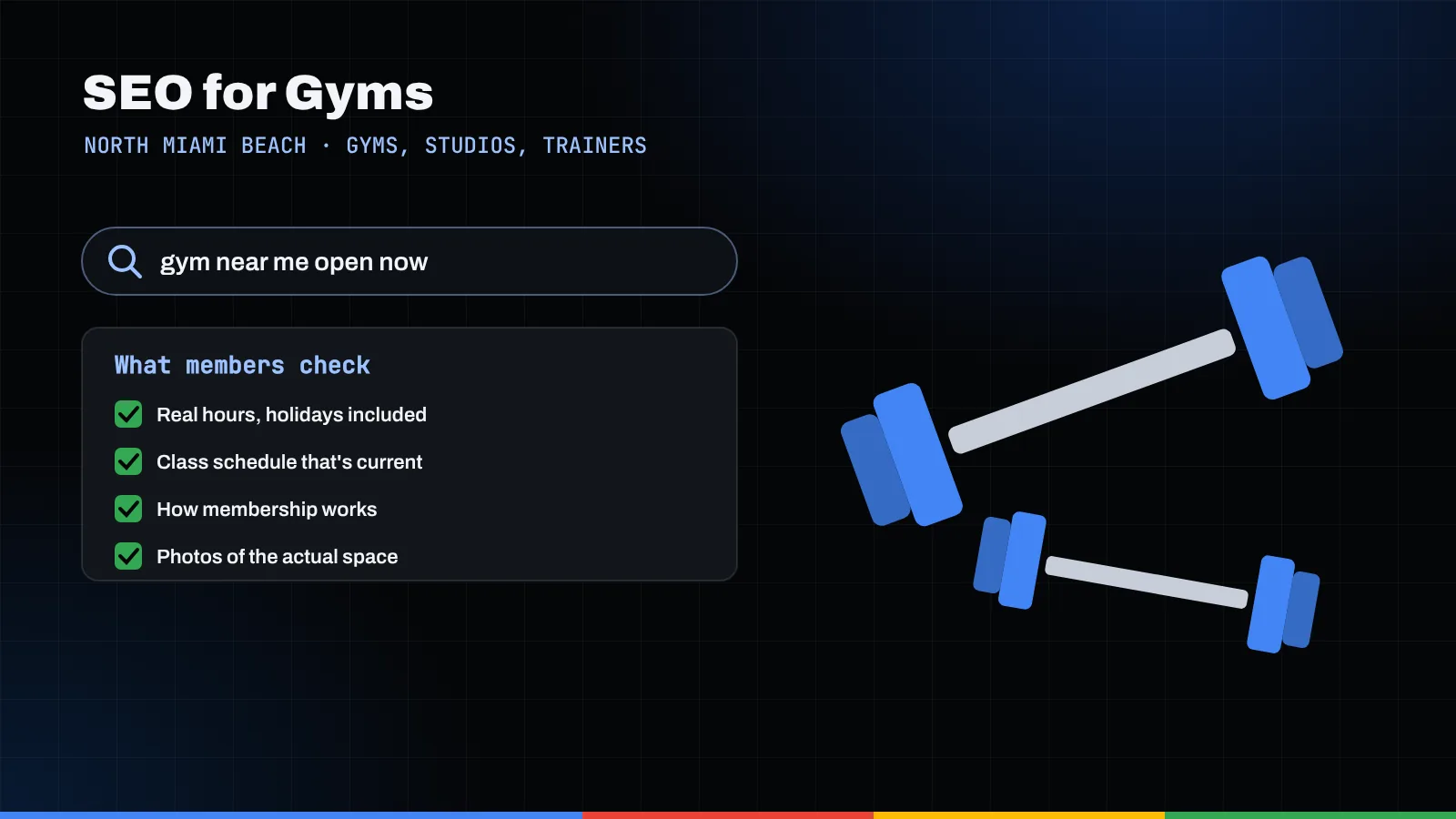
SEO for gyms is a training block, not a single workout. Lock down your Google Business Profile, give every program, class schedule, price and trainer its own clear page, mark up the business with schema that tells the truth, show the real space, and earn reviews the honest way. In Florida, your pricing and membership pages also have to line up with the state's health studio law.
Key takeaways
- Your Google Business Profile is the warm-up everyone skips. Pick the most specific category, keep regular and holiday hours current, and fill in the attributes you control.
- Recurring members-only classes generally don't qualify for Google's Event rich results. Public, ticketed workshops on their own page can.
ExerciseGymis a real schema.org type underSportsActivityLocationandLocalBusiness. Use it to describe the business, not to fake rich results.- Trainer bios should list the exact certification and who issued it. "Certified" on its own proves nothing to a member or to Google.
- Florida regulates health studios under sections 501.012 through 501.019. Registration numbers, cancellation rights and honest contract terms belong on the site, and before-and-after photos carry federal rules of their own.
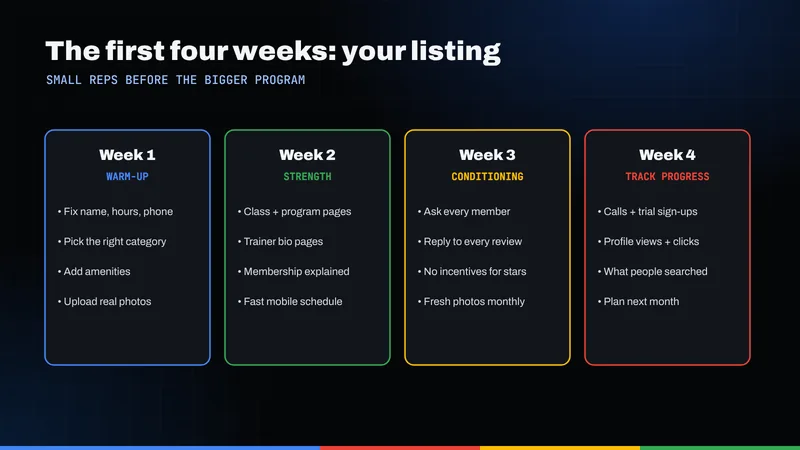
Week 1, warm-up: is your Google Business Profile ready to lift?
Nine weeks, one focus per week, a short set of reps each time. Week 1 is the profile, because most local searchers see it in Maps or the local pack before they ever see your website. It's the foundation of local SEO.
Reps
- Primary category: be specific. Google's own guidance is to choose the category that best describes what your business is and to use a specific one when it exists (its example is "Nail salon" over "Salon"). If Google's list has a category that fits a yoga, pilates or boxing studio or a personal trainer better than plain "Gym," and that's what you are, use it. Add extra categories only for real departments, not every class name.
- Regular hours: match the door. If the front desk opens at 5:30 a.m., say 5:30.
- Special hours: every holiday. Google lets you set special hours so your regular schedule doesn't change, and it recommends confirming your hours for official holidays even when they match. Thanksgiving, Christmas Eve, New Year's Day: fill them in.
- Attributes: fill what you control. Under Edit profile, then More, you can mark yes or no on attributes that describe your amenities and services.
Our longer Google Business Profile guide for North Miami Beach covers verification, photos and posts in more depth.
Week 2, strength: which pages does your site actually need?
The uncomfortable truth about fitness SEO: most gym websites are a pretty homepage, a "Join now" button and a schedule widget Google can barely read. That's a one-exercise program. Every question a member asks deserves a page or a clear section.
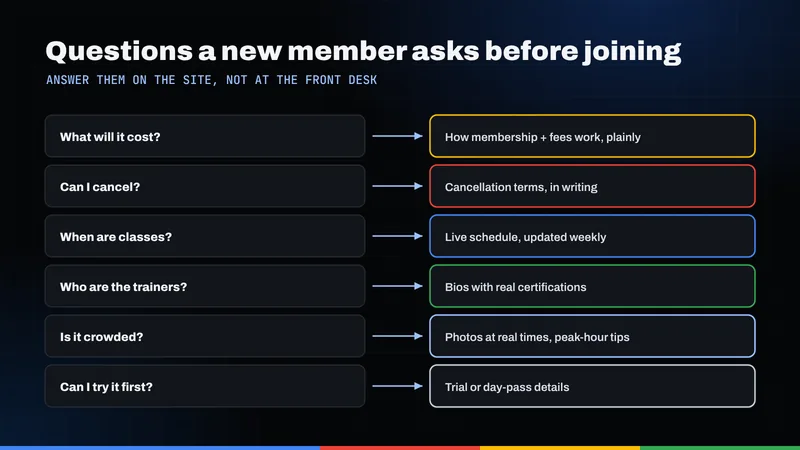
| Member question | Page that answers it |
|---|---|
| "Is there a class tonight after work?" | Class schedule page, crawlable text, not only an embedded widget |
| "Do you do reformer pilates / boxing / small-group strength?" | One program page per discipline, with who it's for and what a session looks like |
| "How much is it, really?" | Pricing and membership page with every tier, fee and term spelled out |
| "Can I cancel if I move?" | Membership terms and FAQ page that reflects your contract and Florida law |
| "Who's going to coach me, and are they qualified?" | Individual trainer bio pages with exact credentials |
| "I'm a beginner. Where do I start?" | New member or intro page: what to bring, what the first visit looks like |
| "Is there parking? Showers? Lockers?" | Visit or amenities page with real photos of the space |
| "Are you open on the holiday?" | Google Business Profile special hours, plus a notice on the schedule page |
Reps
- List every program you coach. Each one with real demand gets its own page and a heading that names it plainly, like "Boxing classes in North Miami Beach."
- Cover format, intensity, class length and who should start elsewhere.
- Link each program page to the schedule, the pricing page and the coaches who teach it.
A site that looks great but buries this is a common problem (see why beautiful websites fail to convert), and fixing it is the core of our website design work.
Week 3, mobility: can you mark up classes as events?
This is where gym SEO advice overreaches. Owners try to mark up every 6 a.m. spin class as an event. Read the rules before you load the bar.
Google's Event structured data guidelines say events must take place in a physical location, each event needs its own unique URL with markup on that page, and the page should focus on a single event. Most important for gyms: events that require a membership or an invitation before attending are ineligible. Google also says not to mark business hours as events, not to promote non-event products or services, and not to mark up short-term discounts, coupons or vouchers.
The honest read:
- Your recurring members-only class schedule generally doesn't fit. It lists many sessions and usually requires membership.
- A "first class free" promotion doesn't fit either. That's a discount, not an event.
- A public, one-off workshop (say, a Saturday mobility clinic anyone can buy a ticket for, or a charity boxing session open to the community) can fit, if it has its own page with the date, time, location and ticket details. If a series has separate ticketed sessions on different days, Google's guidance is to add a separate Event for each one.
Your schedule page still matters for regular search. Make sure the class names, days and times exist as text in the HTML, not only inside an iframe from your booking software. If your booking tool won't allow it, add a text summary above the widget.
Week 4, power: what schema should a gym use?
On schema.org, ExerciseGym is a defined type that sits under SportsActivityLocation, which itself sits under LocalBusiness. Its other subtypes include HealthClub and SportsClub. There isn't a dedicated yoga or pilates studio type, so most boutique studios pick ExerciseGym or the broader SportsActivityLocation and describe the specifics in plain text.
Reps
- Mark up the business on the homepage or contact page with name, address, phone, URL,
openingHoursSpecification,geoandsameAslinks to your real social profiles. - Keep every value identical to your Business Profile and footer. Mismatched hours are a self-inflicted injury.
- Skip review markup for testimonials on your own site. Google's review snippet guidelines say that when a business controls the reviews about itself, pages using
LocalBusinessor otherOrganizationmarkup aren't eligible for star review results.
Schema won't lift a weak page on its own; it labels what's already true. Our explainer on how schema helps search engines goes deeper.
Week 5, endurance: what makes a trainer bio page credible?
People don't hire a gym. They hire a coach. Competitors usually phone this page in with one headshot and the word "certified." Give each coach a real page:
- The exact credential name and the organization that issued it.
- Accreditation, if it applies. Many fitness certifications advertise accreditation from the National Commission for Certifying Agencies (NCCA), which the Institute for Credentialing Excellence offers for certification programs that show they meet its accreditation standards. If you say a coach holds a "nationally accredited certification," confirm with the issuing organization that the specific program is NCCA accredited.
- Only current credentials. Lapsed means off the page.
- What they actually coach. Beginner strength, reformer, youth boxing: specifics match the right member to the right coach.
- Classes they teach and a real photo taken in your space.
And a fitness credential isn't a medical license, so no bio should promise to diagnose or treat injuries.
Week 6, core: how transparent should pricing be, and what does Florida require?
"Call for pricing" feels safe. To a searcher comparing three gyms on their phone, it reads like a sales ambush. Publish tiers, enrollment and annual fees, freeze policy and cancellation terms in plain English. It also gives Google real text to match when people search for membership costs.
In Florida, pricing pages also live next to state law. Florida regulates health studios under sections 501.012 through 501.019 of the Florida Statutes, administered by the Florida Department of Agriculture and Consumer Services. The statute's definition of a health studio covers businesses that sell instruction, training or assistance in a program of physical exercise, or the right to use exercise equipment or facilities. It specifically excludes an individual acting as a personal trainer. Talk to a Florida attorney about how it applies to you; here's what the statutes say.
- Registration. Under section 501.015, a covered studio registers each business location with the department, pays an annual $300 registration fee per location, posts the registration certificate at the front or registration desk, and includes its registration number in all printed advertisements, contracts and publications.
- Security. Section 501.016 generally requires a $25,000 bond (or a letter of credit or CD-secured guaranty) per location, with exemptions, including for studios that only collect monthly payments and for studios with five years of continuous same ownership and a clean record.
- Exemptions. Section 501.013 lists narrow exemptions, granted after filing an affidavit, such as bona fide nonprofits and programs used solely for dance, aerobic exercise or martial arts that use no physical exercise equipment. A reformer studio has equipment. Don't assume you're exempt.
- Cancellation rights. Under section 501.017, the buyer can cancel within three days, excluding weekends and holidays, by written notice. The studio may keep a prorated amount for days already elapsed and must refund the rest within 30 days. Contracts can also be canceled if the buyer dies or becomes physically unable to use a substantial portion of the services, or if the studio closes or moves more than five driving miles away without providing an equal facility within that distance within 30 days. Initial contracts can't exceed 36 months, renewals are annual, and a studio can't describe a contract as "lifetime" or "perpetual."
Put a short, accurate summary of cancellation rights on your membership page, link to the full terms, and make sure the site says exactly what the contract says.
Week 7, peaking: how do you prepare for the January rush?
Resolutions hit and the phone, inbox and front desk all speed up. Rather than trust a made-up percentage, compare December through February with the rest of your year in Business Profile Performance and Search Console, and plan from your own numbers.
Reps, done by early December
- Refresh the new member page. Clear first-visit steps, what to bring, how intro sessions work, and honest terms for any trial offer.
- Update the schedule. If you're adding January classes, publish them before people start searching, not the week they start.
- Set holiday special hours in your profile for every date between Thanksgiving and New Year's Day.
- Test the join flow on a phone.
Fall work is what shows up in January. For realistic timelines, see how long SEO takes.
Week 8, conditioning: what photos and video should a gym show?
Stock models doing crunches in a white void tell a searcher nothing. Show the real place.
- The entrance and parking, so first-timers recognize the building and know where to leave the car.
- The training floor at a normal hour, not just empty at dawn.
- Locker rooms and showers, clean and well lit.
- A class in progress, with written consent from every recognizable member in the shot.
- A short walkthrough video on the visit page and your profile.
Upload photos to your Business Profile regularly, give site images descriptive filenames and alt text ("reformer pilates room with eight reformers" beats "IMG_4417") and compress them.
Week 9, recovery: how do you get reviews and testimonials the right way?
Reviews are the rep everyone wants to cheat on. Don't. Google's policy on fake engagement prohibits offering incentives such as payments, discounts or free goods and services in exchange for reviews, selectively soliciting only positive reviews, discouraging negative ones, and reviews from people with a conflict of interest, which includes current or former employment. It also says businesses shouldn't require or pressure people to leave reviews while on the premises. So: no free smoothie for stars, no trainers reviewing their own gym, no coach hovering over a front-desk tablet.
The FTC's final rule on fake reviews and testimonials, announced August 14, 2024, bans fake reviews (including AI-generated ones), incentives conditioned on positive or negative sentiment, undisclosed reviews from company insiders, and suppressing negative reviews through threats or intimidation.
Before-and-after photos
Transformation posts are the fitness industry's favorite testimonial and its biggest compliance trap. The FTC's Endorsement Guides at 16 CFR 255.2 say a consumer endorsement will likely be read as representing what people generally achieve. If you can't substantiate that the result is typical, you need to clearly and conspicuously disclose the generally expected results. The FTC's own weight-loss example says a vague, very wide range doesn't count as an adequate disclosure. Get written consent, describe what the member actually did, and don't imply everyone gets the same result.
Reps
- Ask every new member the same way, at the same point (for example, a follow-up text after their third visit), with nothing attached.
- Reply to every review calmly, without revealing anything private.
- Feature testimonials on program pages with the member's permission, and keep the wording as they gave it.
Cooldown: when should you bring in a spotter?
You can run this program yourself. If you'd rather coach than fight schedule widgets, that's what we do at Ribacoff Enterprises: SEO for North Miami Beach businesses and local SEO across Miami and South Florida, profile work through our Google Maps SEO service, and websites built so the pages in the table above actually exist and load fast. You can see the kind of sites we build in our portfolio.
Want a starting point? Request a free SEO audit and we'll show you where your profile, pages and markup stand, what to fix first, and what can wait.
Frequently asked questions
Can I use Event structured data for my weekly class schedule?
Usually not. Google says events that require a membership or invitation are ineligible, each event needs its own page focused on that single event, and business hours shouldn't be marked up as events. A public, ticketed workshop on its own page can qualify; a recurring members-only class schedule generally can't.
What schema type should a gym or fitness studio use?
ExerciseGym is a schema.org type under SportsActivityLocation, which sits under LocalBusiness. Boutique studios without a dedicated type often use ExerciseGym or SportsActivityLocation, with details that match the Google Business Profile exactly.
Does Florida require gyms to register with the state?
Florida regulates health studios under sections 501.012 through 501.019 of the Florida Statutes. A covered studio registers each location with the Florida Department of Agriculture and Consumer Services, pays a $300 annual fee per location, posts its certificate and puts its registration number on printed ads, contracts and publications. There are narrow exemptions, and the definition excludes an individual acting as a personal trainer, so confirm your status with a Florida attorney.
Can members cancel a gym contract in Florida?
Under section 501.017, a buyer can cancel within three days, excluding weekends and holidays, by written notice; the studio may keep a prorated amount for elapsed days and must refund the rest within 30 days. Contracts can also be canceled for death or disability, or if the studio closes or moves more than five driving miles away without providing an equal facility nearby within 30 days.
Can I give members a free class for leaving a Google review?
No. Google prohibits incentives such as discounts or free services in exchange for reviews, and the FTC's 2024 rule bans incentives conditioned on positive or negative sentiment. Ask every member the same way, with nothing attached.