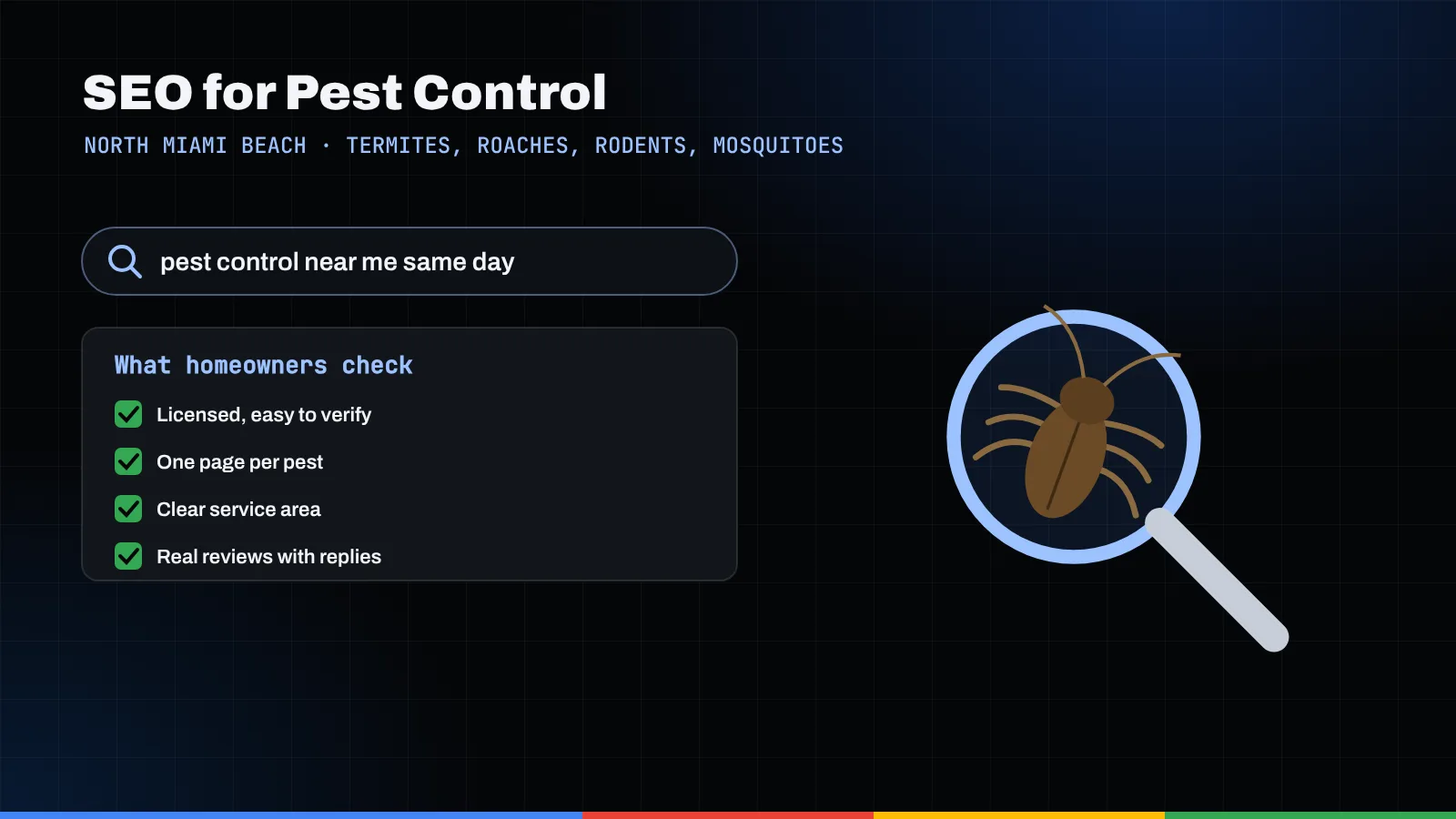
Good SEO for pest control in North Miami Beach comes down to matching each pest to the page a worried homeowner hopes to find: a service-area Google Business Profile, a separate page for termites, roaches, rodents, mosquitoes, ants and lawn pests, and your Florida license shown where people can see it. Keep every claim on those pages accurate, from swarm timing to how "safe" a treatment is, and collect reviews honestly.
Key takeaways
- Pest searches are urgent and specific. Someone with roaches in the kitchen is not looking for a "Services" page that lists eight pests in one paragraph.
- Set up your Google Business Profile as a service-area business: address hidden, a realistic service area and a phone number you control.
- Florida licenses pest control by category under chapter 482, and misleading advertising is grounds for discipline. Your pages should match the categories you're certified for.
- Seasonal content works when it's sourced. UF/IFAS gives Formosan subterranean termite swarm timing you can cite; don't invent seasons for other pests.
- Avoid "safe," "non-toxic" and "all natural" claims about pesticides, and never buy or filter reviews.
How to read this field guide to pest control SEO
Every good field guide has the same structure. You get the animal's habitat, its behavior, and some notes on how to manage it. We're borrowing that format here, except the creature under study is your customer, and the thing you're managing is what they find when they search.
Pest control SEO has its own quirks. The searcher just saw something with too many legs and wants it gone, but they also need to trust whoever comes inside with chemicals. Urgency plus trust shapes almost every decision below.
If you've read our guide to SEO for contractors in North Miami Beach, you'll recognize some shared ground: licensing, service areas, call tracking. And if you also handle lawn and ornamental work, the landscaper SEO guide covers the yard side of that business, including the separate state fertilizer certification. This guide stays with the bugs, the rodents and the paperwork that comes with them.
Specimen 1: the Google Business Profile
Habitat: the map results and the local panel, which is often the first thing a customer sees for a "near me" search, before they ever open your website.
Behavior: the customer scans the name, the rating, the hours and whether you serve their area. Then they call or move on. There isn't much reading involved.
Control: follow Google's Business Profile guidelines closely, because pest companies are the kind of business those rules were written for. Most of you drive to the customer, so:
- Hide your address if you run the business from a home or a yard customers don't visit. Google's own example is a plumber working from home.
- Set a service area you can actually cover. Google says it shouldn't extend farther than about two hours of driving from your base.
- Don't list a virtual office unless it's staffed during business hours. A rented mailing address you don't work from isn't eligible.
- Use your real-world business name. Adding service or location words ("Termite & Roach Control North Miami Beach") isn't permitted and can lead to suspension.
- Use a phone number under your direct control, and Google prefers a local number over a central call-center line.
- Keep one profile per business. Separate profiles are allowed only where you have separate locations with their own staff.
Pick a primary category that reflects your core work, and add your own photos of trucks and technicians so customers can see who is coming to the door. Our longer guide to Google Business Profile in North Miami Beach walks through the setup screen by screen, and our Google Maps SEO service handles the ongoing upkeep.
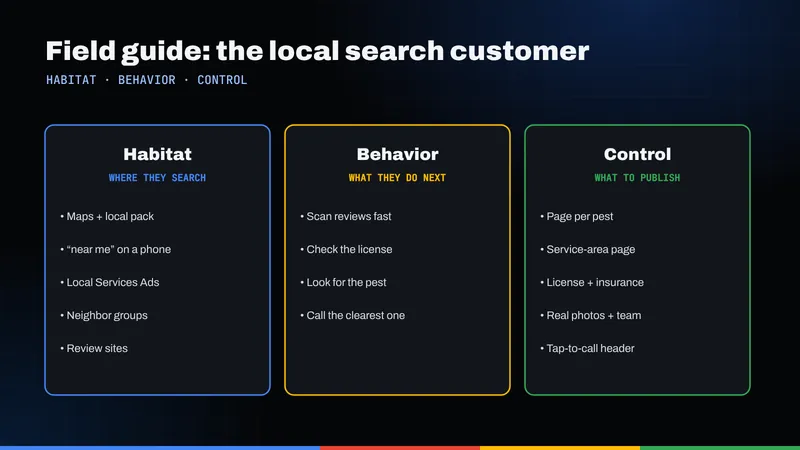
Specimen 2: the pest-specific service page
Habitat: the organic results under the map pack, and increasingly the AI-generated summaries that pull from pages written plainly and specifically.
Behavior: a customer searching for German cockroach treatment wants a page about German cockroaches. They read the first screen, look for a phone number and a sign that you've handled this before, and decide.
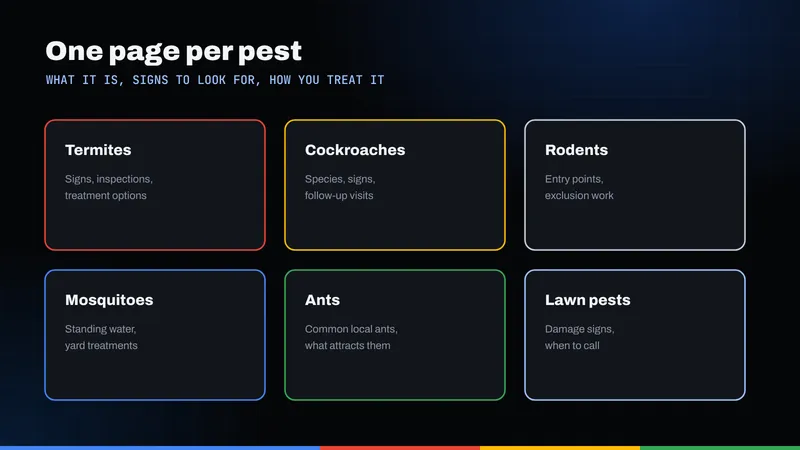
Control: give every pest you treat its own page. A single "Pest Control Services" page that mentions termites, roaches, rats, mosquitoes and ants in one breath can't fully answer any of those searches. Each page should cover the signs a homeowner notices, how you inspect, what treatment involves, what the customer does before and after, and how to book.
Here's how we'd map the main species to pages. The search phrasing is illustrative, the sort of thing people type, not data from any tool.
| Pest | What customers search (examples) | Page to build |
|---|---|---|
| Subterranean termites | "termite swarmers in house," "termite treatment near me," "mud tubes on wall" | Subterranean termite inspection and treatment, with a swarm-season section |
| Drywood termites | "termite droppings," "tent fumigation cost," "do I need to tent my house" | Drywood termites and fumigation, including how to prepare the home |
| German cockroaches | "roaches in kitchen," "German roach exterminator," "roaches in apartment" | German cockroach treatment, with a separate section for condos and multifamily buildings |
| Rodents | "rats in attic," "noises in ceiling at night," "rodent exclusion" | Rodent control and exclusion: inspection, sealing entry points, follow-up visits |
| Mosquitoes | "mosquito control for yard," "mosquito treatment for party" | Mosquito service for yards and one-time event treatments |
| Ants | "ants in kitchen," "fire ants in yard," "ants coming from outlet" | Ant control, split into indoor ants and lawn or fire ants |
| Lawn pests | "brown patches in lawn bugs," "grass dying in sections" | Lawn and ornamental pest control (only if you hold that certification) |
| Real estate paperwork | "WDO inspection," "termite inspection for home sale" | WDO inspection reports for buyers, sellers and agents |
Write each title for the pest, not your brand, and put the phone number above the fold. Use your own job photos with plain alt text, and answer the questions your office fields daily: do I need to leave the house, will I need a second visit. Our local SEO work builds out exactly this kind of page structure for service businesses.
Specimen 3: seasonal content (termite swarms, sourced)
Habitat: the spring evening when a homeowner sees winged insects around a porch light and grabs their phone.
Behavior: panic-search first, compare companies second. They want to know whether what they're seeing is termites, and whether it's an emergency.
Control: publish seasonal content before the season, and back the timing with a real source. For Formosan subterranean termites, University of Florida entomologists give you one. The UF/IFAS Featured Creatures profile of the Formosan subterranean termite says the species typically swarms between early April and late June, shortly after sunset, with the peak in May, and that it's found throughout Florida, mainly in densely populated urban areas.
That gives you a practical calendar. Get your Formosan termite page updated in early spring, add a short "what to do if you see swarmers" section, and link it from your homepage while the season is on. Cite the UF/IFAS page on your own site.
What not to do: don't invent seasons. If you can't find an authoritative source for when a pest peaks in South Florida, write about signs and treatment instead of dates.
Specimen 4: the Florida license, displayed and matched
Habitat: your footer, your About page, every service page, and the moment of doubt before a customer lets a stranger spray inside their home.
Behavior: careful customers, property managers in particular, look for a license number. Some will check it.
Control: Florida regulates this industry under chapter 482 of the Florida Statutes, administered by the Florida Department of Agriculture and Consumer Services (FDACS). A few points matter for your website:
- Certification is by category. Under section 482.111, FDACS issues pest control operator certificates in categories including fumigation, general household pest control, lawn and ornamental pest control, and termites and other wood-destroying organisms. Operators may not do work in another category's scope without that category's certificate, unless the chapter provides otherwise.
- Each location needs a certified operator in charge certified for the category of pest control done at that location.
- Certificates are renewed yearly and renewal involves continuing education, including hours on legislation, safety and pesticide labeling.
The SEO lesson is simple: your service pages should line up with your certifications. Section 482.161 lists the grounds for discipline, and they include "fraudulent or misleading advertising relative to pest control or advertising in an unauthorized category of pest control," as well as knowingly misrepresenting the effects of materials or methods. A company without the fumigation or termite category shouldn't have a page that reads as if it does tent fumigations or termite treatments itself. If you refer that work out, say so.
Show your business license number in the footer and on the About page. It costs nothing, and it answers the trust question before anyone has to ask it.
Specimen 5: the WDO inspection page
Habitat: real estate transactions. Buyers, sellers, agents and lenders all end up needing the same document.
Behavior: these searchers are often not homeowners with a bug problem. They're agents on a deadline, and they want to know turnaround time, cost and whether you'll send the report directly to them.
Control: if your company holds the right certification and does real estate inspections, give this its own page. Florida uses a standard Wood-Destroying Organisms Inspection Report, FDACS Form 13645, issued under Rule 5E-14.142 of the Florida Administrative Code. The current form (Rev. 05/21) has five sections: general information, inspection findings, obstructions and inaccessible areas, notice of inspection and treatment information, and comments and financial disclosure. It records the inspection company's business license number and the inspector's name and ID card number.
Walk agents through what they'll receive, what "inaccessible areas" means in practice, and how fast you deliver. Section 482.226 of the statutes also sets financial-responsibility requirements (insurance, a bond or a minimum net worth) for companies that do these inspections, so it's worth saying plainly that you meet them, if you do. A page like this can also earn links from local real estate agents, which is one of the cleaner ways a pest company picks up links from other local businesses.
Specimen 6: the safety claim (handle with gloves)
Habitat: homepage headlines, ad copy, and the FAQ about pets and kids.
Behavior: parents and pet owners ask whether treatment is safe. It's a fair question, and the tempting answer is a one-word "yes."
Control: don't give it. The U.S. Environmental Protection Agency's Label Review Manual chapter on labeling claims treats safety claims such as "safe," "nonpoisonous," "noninjurious," "harmless" or "nontoxic to humans and pets" as unacceptable on pesticide labeling, even with a qualifier like "when used as directed." It also says EPA does not permit "natural" or "naturally" in the labeling of registered products, and that advertising claims must not substantially differ from what's on the label.
That manual is written for product registrants rather than service companies, but the direction is clear, and Florida's own ban on misleading pest control advertising applies to you directly. So write the honest version:
- Explain what you apply and where, in plain language.
- Say what the customer should do: how long to stay off treated areas, what to do with pets, food and fish tanks.
- Describe lower-chemical options, such as exclusion, sanitation advice and baiting, as methods, not as safety guarantees.
A careful, specific answer reads as more trustworthy than "100% safe" ever will.
Specimen 7: Local Services Ads and the Google Verified badge
Habitat: the very top of the results page, above the map, for many service searches.
Behavior: a customer taps a provider with a badge and calls. You pay per lead, not per click.
Control: Google's Local Services Ads eligibility page lists pest control services as an eligible category in the United States. Businesses that pass Google's screening get the Google Verified badge. Google also allows pre-badge ads for some categories, pest control among them, once preliminary checks are done, including a license or business registration, reviews, billing and a budget. Those pre-badge listings appear below providers who have completed onboarding and earned the badge.
These ads pair well with organic work, since the same reviews and license details feed both. Weighing them against standard search ads is part of our Google Ads service.
Specimen 8: the honest review
Habitat: your profile, your Local Services Ads listing and the minds of everyone comparing you to the next company.
Behavior: customers read the recent reviews, especially the middling ones, to see how you handle a callback.
Control: ask every customer the same way, after every completed job, and attach nothing to the request. Google's review policy prohibits offering incentives for reviews, discouraging negative reviews or selectively asking only happy customers, and reviews from people with a conflict of interest, such as current or former employees. The Federal Trade Commission's final rule on fake reviews, announced August 14, 2024, bans fake reviews, incentives conditioned on positive or negative sentiment, undisclosed insider reviews and review suppression through threats or intimidation.
Pest control has a built-in advantage here: follow-up visits. A short text after the second visit, when the problem is actually solved, catches customers at the right moment. Reply to every review with specifics, not a template.
Specimen 9: structured data (a classification problem)
Habitat: the code behind your pages.
Behavior: crawlers read it to confirm who you are, where you work and what you do.
Control: here's the taxonomist's surprise. Schema.org doesn't currently define a pest control business type. Its HomeAndConstructionBusiness type has eight more specific subtypes: Electrician, GeneralContractor, HVACBusiness, HousePainter, Locksmith, MovingCompany, Plumber and RoofingContractor. None of them fits, so use HomeAndConstructionBusiness (or LocalBusiness) with your real name, phone, hours, service area and license details, and describe each treatment with Service markup on its own page. Our explainer on how schema helps search engines covers the mechanics.
If you're working through all nine specimens at once, start with the profile and the termite and roach pages, then layer in the rest. That's the order we usually follow for North Miami Beach SEO clients in home services, and the same groundwork carries over to broader local SEO in Miami if you serve the wider county. Want a second pair of eyes first? Request a free audit and we'll tell you which pages are missing and which claims need a closer look.
Frequently asked questions
Do pest control companies need a storefront to show up on Google Maps?
No. Google lets service-area businesses hide their address and set a service area instead. Keep that area within roughly two hours of driving from your base, use your real business name, and don't list a virtual office unless it's staffed during business hours.
When do Formosan subterranean termites swarm in Florida?
According to the University of Florida's Featured Creatures profile, Formosan subterranean termites typically swarm between early April and late June, shortly after sunset, with the peak in May. That makes early spring a good time to update termite pages.
Can I advertise termite or fumigation services if I only hold a general household certificate?
Florida issues pest control operator certificates by category, and operators may not work in another category's scope without that certificate unless chapter 482 provides otherwise. Section 482.161 also lists advertising in an unauthorized category of pest control as grounds for discipline, so only advertise work your company is certified to do.
Can I say our pest treatments are safe for kids and pets?
Avoid it. EPA's Label Review Manual treats claims like safe, harmless or nontoxic to humans and pets as unacceptable on pesticide labeling, even with "when used as directed," and Florida bans misleading pest control advertising. Explain what you apply and what precautions to take instead.
Can pest control companies run Google Local Services Ads?
Yes. Google lists pest control services as an eligible Local Services Ads category in the United States. Providers that pass Google's screening show the Google Verified badge, and pre-badge listings appear below badged providers.