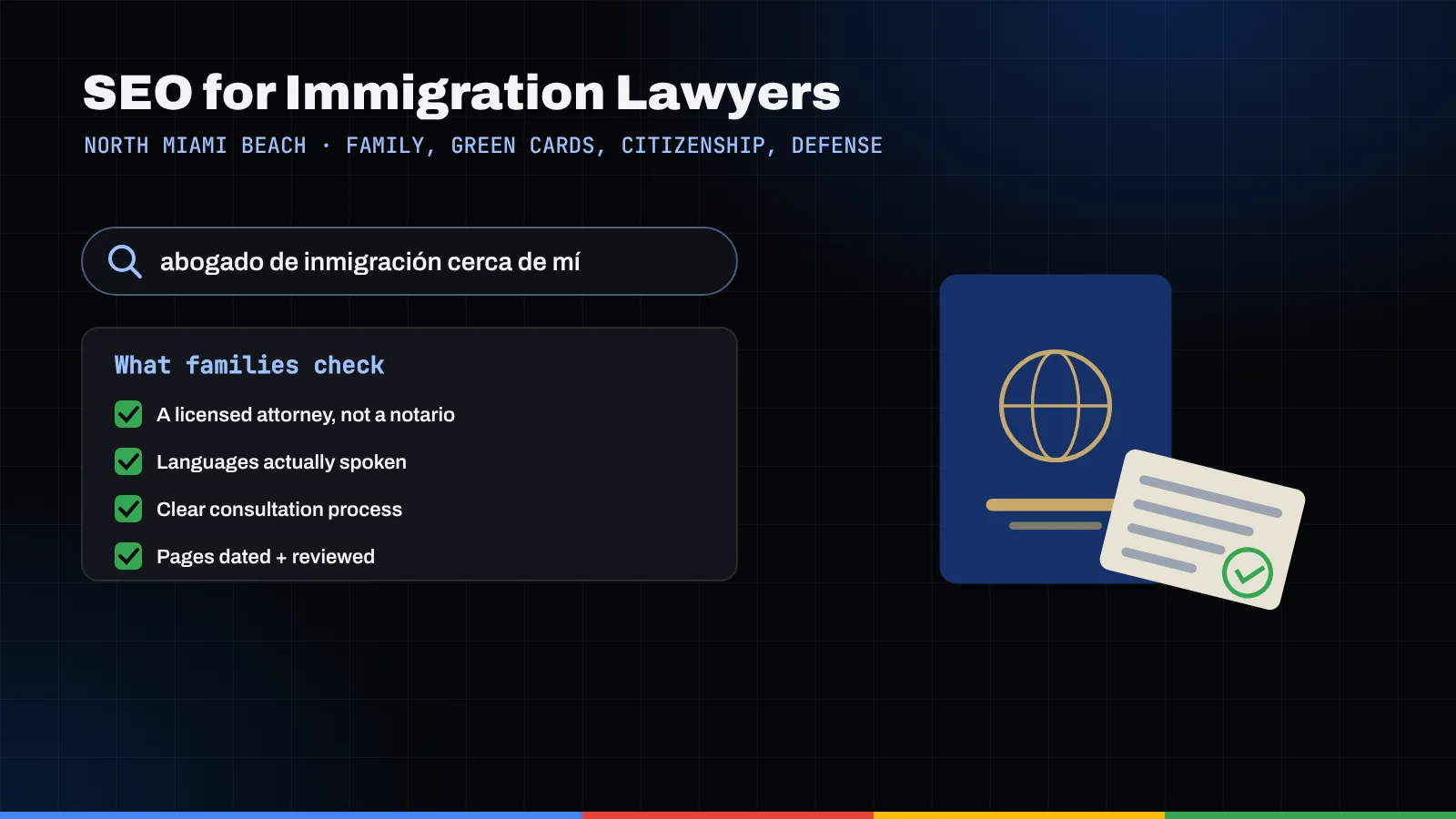
SEO for immigration lawyers comes down to three jobs: building a clear page for each case type in the languages your clients use, proving you are a licensed attorney and not a notario, and keeping time-sensitive pages dated and reviewed. In North Miami Beach, it also means a Google Business Profile that follows Google's practitioner rules and a consultation flow that works for a family reading on a phone in Spanish or Haitian Creole.
Key takeaways
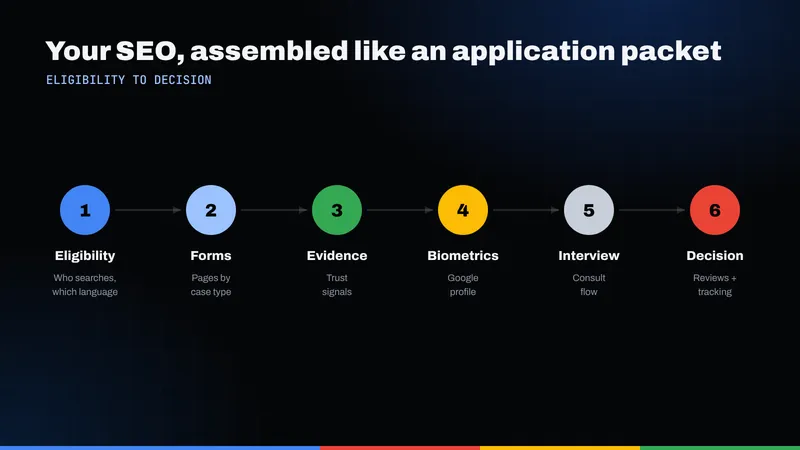
- Treat the site like an application packet: eligibility (audience and languages), forms (one page per case type), evidence (trust signals), then profile, consultation and tracking.
- Notario fraud is why trust signals matter so much in this practice. Make your license and who-does-what impossible to miss.
- Under Florida Bar Rule 4-7.12(c), required disclosures in a Spanish or Creole ad must appear in that same language.
- Link to official sources like the USCIS processing times tool instead of restating numbers that change, and date every TPS and asylum page.
- Never confirm a client relationship or case detail in a review reply.
This post is general information about marketing a law practice. It is not legal advice, and nothing here is advice about anyone's immigration case.
Eligibility: who is searching, and in which languages?
Every immigration case starts by asking whether the person qualifies. Good immigration attorney SEO starts the same way: who is actually searching for you, what do they call their problem, and what language do they type it in?
In North Miami Beach, the answer is several groups in several languages. A U.S. citizen petitioning for a spouse may search in English while her mother-in-law, the one worried about the interview, searches in Spanish. A Haitian family following TPS news may search in Creole, French or a mix with English. A local employer sponsoring a new hire searches in the language of HR departments.
For each group, note who searches (applicant, relative, petitioner or employer), the language they type in when stressed, how urgent their situation is, and what they fear. Many people looking for immigration help are worried about being cheated. That fear shapes every section below.
Paralegal's note: Have the front desk keep a one-month tally of each new caller's language and case type. It costs nothing and tells you which pages to build first.
The mechanics of translated pages, hreflang and language switchers are covered in our guide to multilingual SEO in North Miami Beach, so this post stays on what is specific to immigration.
Why does the notario problem shape your whole website?
In many Latin American countries, a notario público is a lawyer. In Florida, a notary public is not. The Florida Bar's consumer pamphlet on notaries, immigration and the law explains that Florida notaries cannot give legal advice or prepare immigration forms, and cannot use titles like notario público to imply they can practice law. It also notes that Florida law requires notaries advertising in a language other than English to include a disclaimer that they are not licensed attorneys.
The Federal Trade Commission's alert on scams that target immigrants says notarios are not licensed attorneys and cannot give legal advice, that official USCIS forms are free, and that some specialized lawyers and accredited representatives can help with immigration.
That second group is defined by federal rules. The Justice Department's Recognition and Accreditation Program page explains that non-attorney "accredited representatives" may represent people before DHS and the immigration courts, but only through "recognized organizations," which must be non-profit, federally tax-exempt entities.
For SEO, this means your pages must answer the question visitors are silently asking: is this a real lawyer? Explain the difference between an attorney, an accredited representative and a notary in calm, factual terms, link to the Bar and FTC resources, and don't name or attack other businesses.
Forms: how should you structure the site by case type?
USCIS sorts its work by form. Your clients sort their lives by problem. Strong SEO for immigration lawyers gives each case type its own page, written around the problem, with form numbers as supporting detail. One "Immigration Services" page listing everything will not compete with focused pages.
The search phrases below are illustrative examples, including Spanish and Haitian Creole examples, not measured search data. Your call logs and Search Console queries should replace them over time.
| Case type | What people search (examples) | Page to build |
|---|---|---|
| Family-based petitions | "petition for my wife green card"; Spanish example: "pedir a mi esposo residencia" | Family petitions page with sections for spouses, parents, children and siblings |
| Green cards | "green card through marriage"; Creole example: "kat vèt" | Green card page explaining adjustment of status and consular processing in plain language |
| Naturalization | "citizenship lawyer near me"; Spanish example: "abogado para ciudadanía" | Naturalization page covering the process and interview preparation |
| Asylum | "asylum lawyer"; Spanish example: "abogado de asilo político" | Asylum page, dated and reviewed, focused on how a consultation works |
| TPS | "TPS Haiti renewal"; Creole example: "renouvle TPS" | One dated page per country you serve, linking to the official USCIS TPS page |
| Removal defense | "deportation lawyer"; Spanish example: "abogado de deportación" | Removal defense page with a clear "if you have a hearing date" path |
| Employment visas | "work visa lawyer for employer" | Employer-facing page, separate in tone from family pages |
Keep one topic per URL (asylum and TPS are different programs), mirror each page in every language you serve with a translation reviewed by a fluent attorney or staff member, and link pages along the path many clients follow: family petition to green card to naturalization.
General practice-area structure and attorney bio pages are covered in our guide to SEO for lawyers in North Miami Beach. Immigration differs in the number of languages and how fast the rules under your pages change.
How do you write helpful content without giving legal advice?
Immigration pages tempt writers to answer every question. That leads to content that drifts into advice for situations you have never reviewed, and content that goes stale when a rule, fee or deadline changes. Explain the process in general terms and point to official sources for anything that moves:
- Processing times. Don't publish your own estimate. Link to the USCIS Check Case Processing Times tool, which shows estimates by form and office.
- Forms and fees. Mention the form number and send readers to the forms page on uscis.gov for the current edition. Say in every language that official USCIS forms are free.
- Program status. For TPS and other programs whose designations and dates change, link to the official USCIS page rather than summarizing dates yourself.
Date every page
Put a visible "Last reviewed by [attorney name] on [date]" line on every case-type page, especially TPS and asylum, and review them on a schedule. A confident page from three years ago can hurt someone.
Paralegal's note: Keep a spreadsheet of every page URL, its language, the reviewing attorney and the review date. When a policy changes, you can find every affected page in every language in minutes.
End each case-type page with a plain statement in that page's language: this is general information, not legal advice, and reading it does not create an attorney-client relationship.
Supporting evidence: which trust signals actually matter?
A petition without evidence goes nowhere. For an immigration practice, the evidence that matters separates a licensed attorney from everyone else offering "immigration help."
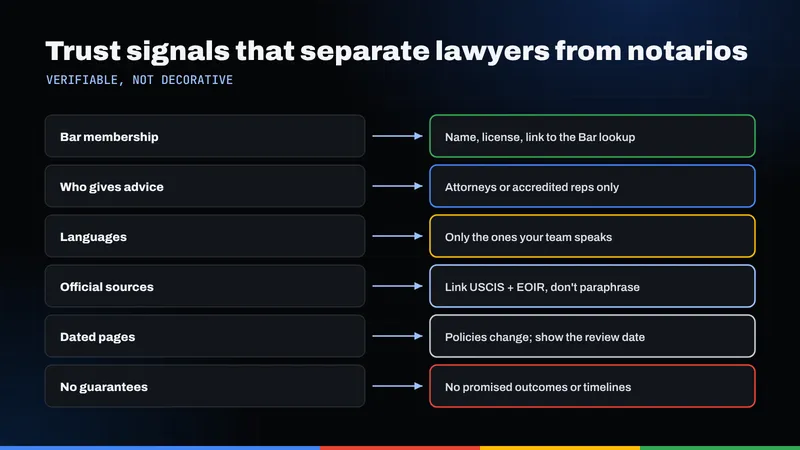
- Licensing, stated clearly. Each attorney bio should name their Bar admission and point to the Florida Bar's member lookup, which the Bar's pamphlet tells consumers to use.
- Who does what. If your team includes paralegals, interpreters or an accredited representative, say what each role does and does not do.
- Languages, by person. Say which attorney or staff member speaks which language, so a Creole-speaking client knows who will be in the room.
- A real address and real photos of the office, entrance and consultation room.
- No guarantees, in any language. More on the Bar rules below.
Imagine a hypothetical North Miami Beach practice called Lanternbridge Immigration Law (a made-up name, not a real firm). Its most useful page might be a plain "Who we are and how to verify us" page in English, Spanish and Creole, listing each attorney's Bar admission, each team member's role and languages, and why the firm will never charge anyone for a USCIS form.
What do the Florida Bar's rules say about ads in other languages?
The Bar's checklist for websites, social media and video sharing cites Rule 4-7.12(c): if an advertisement appears in a language other than English, the required disclosures must appear in that same language. That includes disclosures tied to testimonials and fee or cost statements. The same checklist flags:
- Content that "can reasonably be interpreted as a prediction or guaranty of success or specific results" (Rule 4-7.13(b)(1)).
- References to past results that are not objectively verifiable (Rules 4-7.13(a)(2) and (b)(2), and 4-7.14(a)(2)).
- Testimonials that don't meet Rule 4-7.13(b)(9), including those missing a disclaimer that prospective clients may not get similar results.
The checklist notes that websites generally do not need to be filed with the Bar unless posts or videos are sponsored. That is not an exemption from the content rules.
The practical risk is translation drift. "We will review your options" in English can become something closer to "we will solve your case" in a rushed Spanish draft. Have a fluent attorney check every translation against the original before it goes live. This is a marketing summary, not ethics advice; the firm's own reading of the rules or the Bar's ethics hotline should settle close calls.
Biometrics: how should your Google profile be set up?
Biometrics confirm identity. Your Google Business Profile does the same for local search, and for local SEO Miami searches with "near me" intent it is often the first thing a prospective client sees. Google's Business Profile guidelines set rules for individual practitioners, including lawyers:
- A public-facing attorney who can be contacted directly at the verified location during stated hours may have their own profile. Support staff should not.
- No separate profiles per specialty, such as one for asylum and one for naturalization.
- With several practitioners at one location, the firm gets its own profile and each practitioner's profile uses only their name.
- A solo attorney at a branded firm shares one profile named "[brand]: [practitioner name]."
- The name must match the firm's real-world name, without added services or locations.
Within those rules, state your team's languages in the description, add office and signage photos, and post short, dated updates pointing to reviewed pages when an official announcement changes something. Our Google Business Profile guide for North Miami Beach covers setup.
Interview: what should the consultation flow look like?
The interview tests an application. Your consultation flow tests your SEO. Ranking for seo miami or any case-type query means little if a visitor can't figure out how to reach you.
- Language first. The first form field, or first phone-menu option, should be preferred language.
- A short form. Name, phone, language, case type and whether there is a hearing or deadline. Don't ask for an A-number, status, passport details or the story of their case on a public web form; collect sensitive details later through a secure channel.
- What happens next. Who will call, in what language, roughly when, and whether the consultation is in person, by phone or by video.
- An urgent path for people with a hearing date, prominent on removal defense pages.
- A consistent fee message in every language, so no one is surprised.
Paralegal's note: Test your form on a phone in Spanish and in Creole. If error messages or the thank-you page fall back to English, fix them.
If requests lag behind traffic, our conversion optimization work focuses on exactly these steps.
Decision: how do you handle reviews and measure what works?
Reviews
Immigration clients may be reluctant to review a firm under their real name. Ask gently, in their language, and never offer anything of value for a review.
The bigger risk is the reply. In Ethics Opinion 20-1, the Florida Bar said a lawyer may not disclose information relating to a client's representation in response to a negative online review, and that confidentiality continues after the representation ends. The opinion approves a short, general response over a point-by-point rebuttal. In this practice, a reply that confirms someone was a client or mentions a case type, status, country or court can reveal far more than intended. Thank people without confirming details, keep negative-review replies brief and general, and reply in the reviewer's language when you can.
Tracking
Measure by case type and language, not just total traffic. Each month, ask which pages bring consultation requests in which languages, which Spanish or Creole queries are new in Search Console, which pages are overdue for review, and how many calls come from the Google profile versus the site.
Structured data helps search engines read this correctly. On schema.org, LegalService is a LocalBusiness type for businesses providing legal services, advice and representation; the older Attorney type is marked deprecated in favor of it. The knowsLanguage property, which takes IETF BCP 47 codes, applies to Person and Organization, so each attorney's bio can mark up their languages. See how schema helps search engines for the basics.
Where does an SEO partner fit in?
Most immigration attorneys would rather spend their time on cases than on title tags. A good partner handles structure, multilingual setup, the Google profile and reporting, while the firm keeps control of legal substance and every translation review.
Ribacoff Enterprises is headquartered in North Miami Beach and offers local SEO, website design, conversion work and AI search optimization. See how we approach the local market on our North Miami Beach SEO page, or request a free audit or call 516-510-5964 for a no-pressure look at where your site stands.
Frequently asked questions
What makes SEO for immigration lawyers different from other law firm SEO?
Immigration clients often search in more than one language, many are wary of notario fraud, and the rules behind programs like TPS and asylum change often. That means more translated pages, stronger proof of licensing, and dated pages reviewed on a schedule.
Do Florida Bar advertising rules apply to our Spanish and Creole pages?
Yes. The Florida Bar's website checklist cites Rule 4-7.12(c), which requires that required disclosures in an advertisement in a language other than English appear in that same language. The rules against misleading claims and guarantees apply in every language.
Should our website publish USCIS processing times?
It is safer to link to the official USCIS Check Case Processing Times tool than to publish your own numbers, because processing times change and the tool shows them by form and office.
How should we reply to a negative Google review from a former client?
Keep it short and general. Florida Bar Ethics Opinion 20-1 says a lawyer may not disclose information relating to a client's representation in response to a negative online review, so do not confirm case details, status or outcomes.
Which schema type should an immigration law firm use?
LegalService is the schema.org type for businesses that provide legal services, advice and representation. The Attorney type is marked as deprecated in favor of LegalService. The knowsLanguage property can be used on Person and Organization to show the languages your attorneys speak.