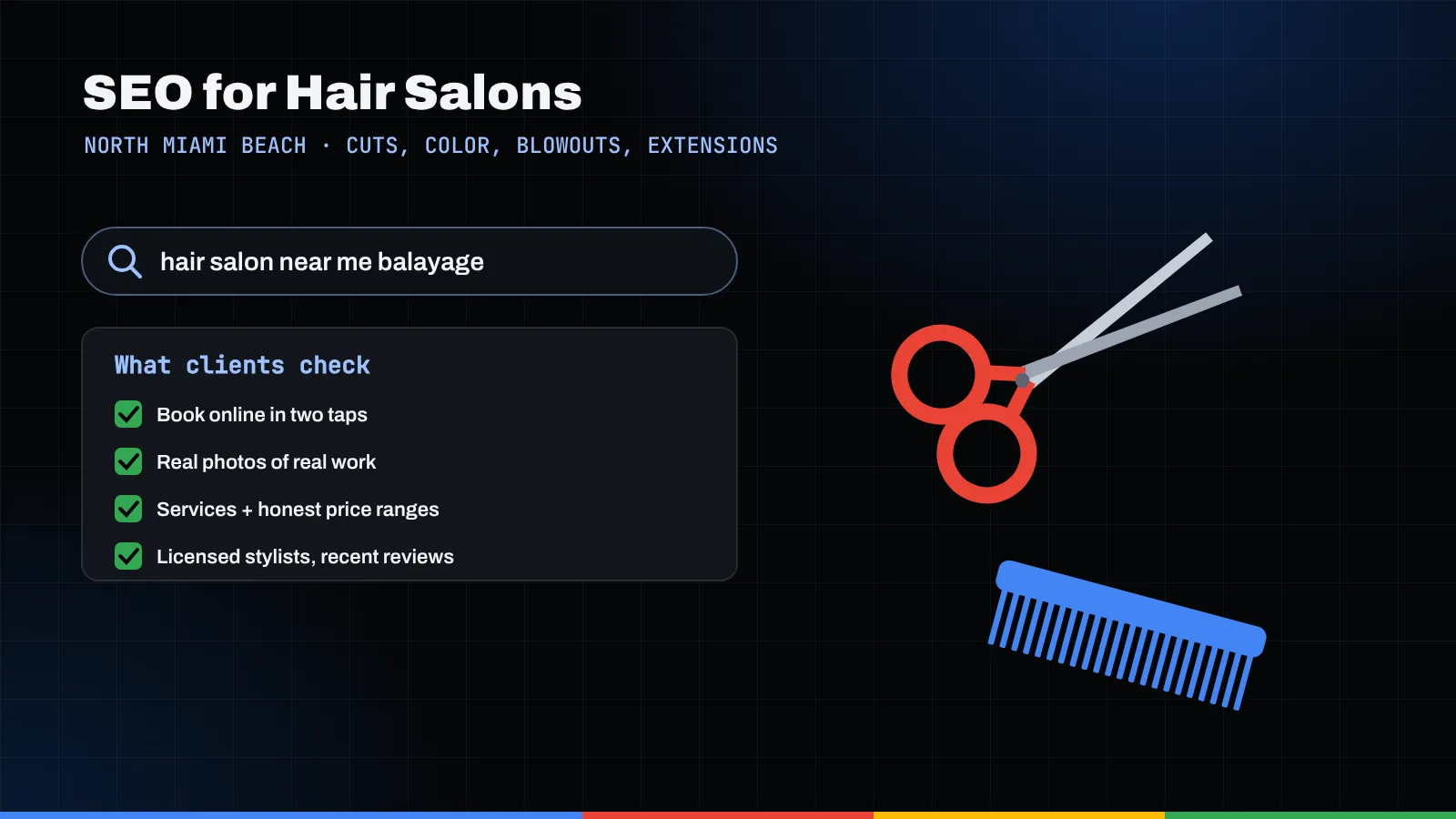
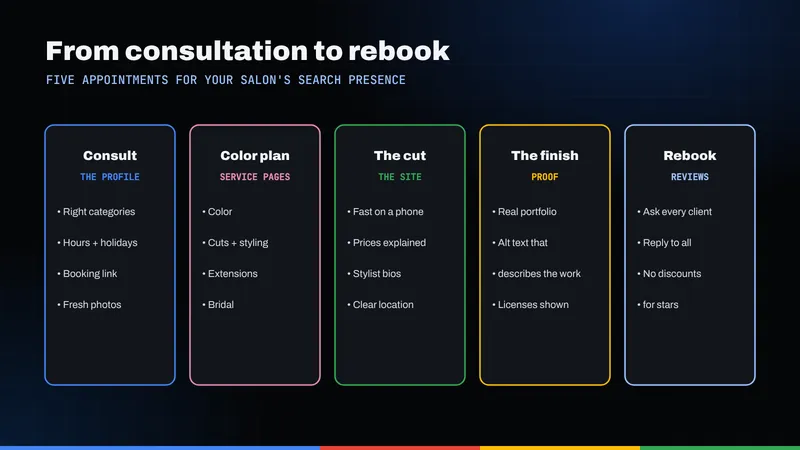
SEO for hair salons in North Miami Beach comes down to five steps you already know from the chair: a consultation (what clients actually search), a color plan (one page per service, with honest prices), the cut (fast mobile booking), the finish (real portfolio photos, licenses and honest reviews) and the rebook (keeping your profile and pages fresh). Start with your Google Business Profile, because that's what clients see first on a "near me" search.
Key takeaways
- Set up one Google Business Profile for the salon, pick the most specific category, add a booking link and fill in services. Booth-renting stylists who serve their own clients may qualify for their own profiles under Google's practitioner rules.
- Build a page for each core service (color, cuts, blowouts, extensions, smoothing, bridal) and show real price ranges or honest "starting at" prices, never numbers you can't honor.
- Florida requires a salon license under section 477.025 of the Florida Statutes, and anyone performing cosmetology services needs an active license. Put your license numbers on the site so clients and search engines can see them.
- Use your own work in galleries with descriptive alt text, and keep booking fast on a phone.
- Ask every client for an honest review, with no discounts, gating or staff writing reviews. Google's policy and the FTC's 2024 rule both draw that line.
The consultation: what are your clients actually searching?
Every good appointment starts with a consultation, and so does every good search strategy. Before you touch your website, sit down and listen to how clients describe what they want. Nobody types "full-service beauty establishment." They type "balayage near me," "keratin treatment North Miami Beach," "bridal hair trial," "silk press," "tape-in extensions," or simply "hair salon open now."
Those searches fall into three rough groups, and your plan should cover all three:
- Map searches. "Hair salon near me" and "blowout near me" are answered mostly by the Google map pack, which means your Google Maps presence carries most of the weight.
- Service searches. "Balayage North Miami Beach" or "Brazilian blowout cost" are answered by pages that are clearly about one service. A single "Services" page with forty bullets rarely wins these.
- Moment searches. Bridal, prom, quinceañera and event styling are planned weeks out, often by someone comparing three or four salons side by side. These clients read galleries, policies and reviews closely.
That's the whole idea behind seo for hair salons: match each kind of search to the right surface, either your profile or a specific page, and make both easy to book from.
Stylist's tip: Keep a running note at the front desk of the exact words new clients use when they call or DM. Those phrases make better page headings than anything a keyword tool suggests.
How should a salon set up its Google Business Profile?
Your Business Profile is the chair clients sit in before they've met you. A few settings matter most.
Name and category
Google's guidelines for representing your business say your profile name should match the real-world name on your storefront, with no extra keywords, taglines or locations added. Say your salon is called Studio Luxe: that's your profile name, not "Studio Luxe Best Balayage Keratin North Miami Beach."
For category, Google's advice is to choose the most specific primary category that fits and to skip adding a category for every service you offer. A full-service hair salon should lead with a hair-specific category rather than something generic. An independently run nail or lash business inside your space generally needs its own profile rather than your categories.
Booking links and Reserve with Google
Salons live and die by the "Book" button. Google lets businesses set up bookings through a provider: you pick a supported scheduling provider available in your country, and Google says the provider usually appears on your profile within about a week. Booking performance can then be checked through Reserve with Google. If your software isn't a partner, you can still add your own booking link. Test the button on your own phone, and check your contract, since Google notes some providers charge for bookings made through Google.
Services, products and photos
The Services section lets you list each service and add a description and price. Use your real service names (Google rejects custom services that include prices or phone numbers in the name), and keep the price field honest, which we'll come back to in the color plan. Products work for retail you actually stock. Photos should be recent, well lit and yours: the front door, the stations, the shampoo bowls, and plenty of finished work. Our Google Business Profile guide for North Miami Beach businesses walks through the rest of the fields.
Chair renters vs. the salon profile: who gets a listing?
Google's guidelines define an individual practitioner as "a public-facing professional, typically with their own customer base." The listed examples are doctors, lawyers, financial planners and agents, not stylists, so this is an interpretation, but a booth renter who builds and books their own clientele fits the definition better than a commissioned employee working the salon's book. Here's how the rules play out:
- The salon gets its own profile. When several practitioners work at one location, Google says the organization should create a profile for the location, separate from the practitioners.
- A stylist's profile uses only their own name. The guidelines say a practitioner's profile title should include only the practitioner's name, not the organization's. So "[Stylist name] Hair," not "[Stylist name] at Studio Luxe."
- No duplicates per specialty. A practitioner shouldn't have multiple profiles for different specializations. One stylist, one profile, even if she does color, cuts and extensions.
- Support staff don't qualify. Assistants, front-desk staff and apprentices shouldn't create their own profiles.
- Solo practitioner at a brand. If one practitioner is the only public-facing professional at a branded location, Google says to share a single profile named "[brand]: [practitioner name]."
Stylist's tip: Put renter arrangements in writing, including who owns the profile, the photos and the reviews if a stylist leaves. Clear rules now save an ugly breakup later.
The color plan: which service pages should you build?
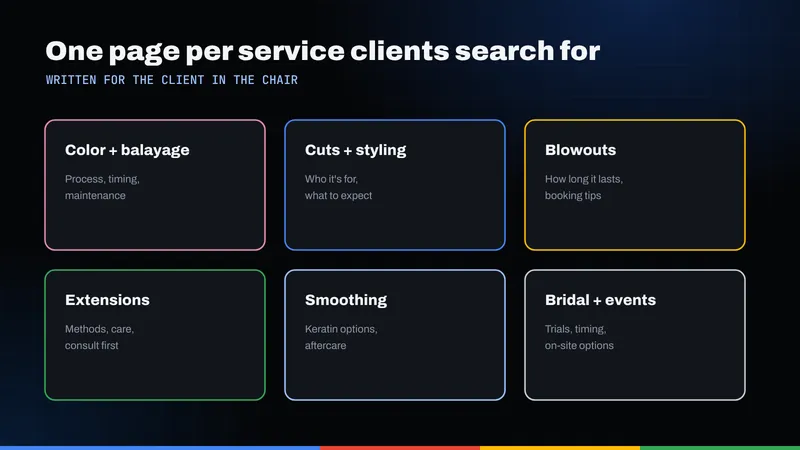
A color plan maps out every step before the first foil goes in. Your site needs the same thing: a page for every service that clients search for by name, each one answering what it is, who it suits, how long it takes, how to prepare, and what it costs.
| Service | What clients search | Page to build |
|---|---|---|
| Haircuts and styling | "women's haircut near me," "men's haircut North Miami Beach," "curly cut" | Cuts page with sections for women's, men's, kids' and curly hair, plus who specializes in each |
| Hair color | "balayage near me," "highlights," "gray coverage," "color correction" | A color hub with child pages for balayage, highlights, all-over color and color correction (consultation required) |
| Blowouts | "blowout near me," "silk press," "blow dry bar" | Blowout page with length-based options, add-ons and a note on how long results last for your clients |
| Extensions | "tape-in extensions," "hand-tied extensions," "extension maintenance" | Extensions page by method, with consultation, move-ups and care |
| Keratin and smoothing | "keratin treatment North Miami Beach," "Brazilian blowout," "frizz treatment" | Smoothing page naming the systems you use and the aftercare |
| Bridal and events | "bridal hair North Miami Beach," "wedding hair trial," "on-site bridal hair" | Bridal page with the trial process, party pricing approach, travel policy and a booking inquiry form |
Prices: real ranges or honest "starting at"
Clients want a ballpark before they book, and a page with no price information leaves them guessing. You don't have to publish a rigid menu, but whatever you show must be true:
- Show a real range when it genuinely varies by length, density or stylist level, and explain what moves the price.
- Use "starting at" honestly. If almost every balayage client ends up paying far above the starting price, say so and explain why ("most long-hair balayage appointments land toward the top of this range").
- Keep every surface in sync. The price on your site, your booking software and your Google services list should match. A client who sees one price online and another at checkout has a fair complaint.
Stylist's tip: Add a short "Is this right for me?" section to each service page. It answers the questions your stylists repeat all day, in the plain language clients actually use.
The cut: is your booking flow fast enough on a phone?
The cut is where precision matters, and for a salon website, precision means the path from "found you" to "booked" is short. Plenty of clients search on a phone, often between other things. Count the taps it takes on your site to get from the homepage to a confirmed appointment. If it's more than a handful, trim.
- Put "Book now" everywhere it makes sense: the header, every service page and the bottom of every gallery.
- Deep-link to the right service. If someone is reading your keratin page, the button should open your booking software on keratin, not the generic menu.
- Watch embedded widgets. Some booking embeds load slowly. If yours drags the page down, link out to the booking page instead of embedding it.
- Compress the gallery. Oversized photos are a common reason salon sites feel slow. Serve properly sized, modern image formats.
We cover the business case in how website speed affects revenue, and our website design work starts from the booking flow, not from the logo.
How do you build a portfolio gallery that ranks and converts?
Your portfolio is your best salesperson, but only if it's real and readable by search engines.
- Use your own work only. No stock photos, no brand-supplied campaign images presented as your results, and no reposting another salon's photos. Get written permission from clients before you post their photos.
- Group by service. Put balayage photos on the balayage page and bridal looks on the bridal page, not just in one giant gallery.
- Write descriptive alt text. Describe what's in the photo: "Shoulder-length dark brown hair with soft caramel balayage and face-framing layers." Google's image SEO guidance calls alt text the most important attribute for image metadata and warns against stuffing it with keywords.
- Name files clearly. "caramel-balayage-shoulder-length.webp" beats "IMG_4821.jpg."
What does Florida law say about salon and stylist licenses?
Licensing is also a trust signal, especially for chemical services. Here's what we verified in chapter 477 of the Florida Statutes and on the state licensing site. This is general information, not legal advice, so confirm your situation with the state.
- Salons need a license. Section 477.025 says no cosmetology salon or specialty salon may operate without a license issued by the department, with a narrow exception for certain licensed residential care facilities.
- Practitioners need active licenses. Section 477.0265 prohibits practicing cosmetology or a specialty without an active license, and it prohibits operating a salon where unlicensed people are permitted to perform cosmetology or specialty services.
- Who regulates it. The Florida Board of Cosmetology, part of the Department of Business and Professional Regulation, licenses salons (including mobile salons) and cosmetologists. The board's page says salon licenses expire November 30 of even-numbered years and that cosmetologists complete continuing education to renew.
How to use that in your SEO, honestly:
- List your salon license number in the site footer or on your About page, and list each stylist's license on their bio.
- Clients can confirm licenses through the state's DBPR license search, so make sure the names and numbers you publish match state records exactly.
- Call brand trainings what they are: brand education, not state licenses.
Stylist's tip: Put renewal dates on the salon calendar alongside your marketing calendar. An expired license on a bio page is worse than none at all.
The finish: how should a salon get reviews the right way?
Reviews are the mirror moment, when the client turns around and sees the result. You want plenty of them, and you want every one to be real.
Google's prohibited and restricted content policy is clear: businesses may not offer rewards, including discounts or free services, in exchange for reviews; may not selectively ask only happy clients; may not pressure clients to review while they're on the premises; and may not discourage negative reviews. The FTC's 2024 final rule on fake reviews and testimonials adds federal teeth. It bans fake reviews, incentives conditioned on a positive or negative sentiment, undisclosed insider reviews and reviews from officers or managers, and using threats or intimidation to suppress negative reviews.
What that looks like at the front desk:
- Send every client the same short follow-up after checkout with a direct link to your Google review form.
- Don't ask for "five stars." Ask how the appointment went.
- No "10% off your next color for a review," no raffle entries and no free deep-conditioning add-ons tied to reviews.
- Reply to every review, kind or critical, the way you'd talk to the client in person.
Should you add HairSalon schema to your site?
Yes. Schema.org has a dedicated HairSalon type, which sits under HealthAndBeautyBusiness and LocalBusiness. Marking up your site with it helps search engines and AI tools connect your name, address, phone, hours and services with confidence.
Useful properties to fill with real data:
- name, address, telephone and url, matching your Google profile exactly.
- openingHoursSpecification for your real hours, including late nights.
- priceRange, only if it reflects your menu.
- hasOfferCatalog or makesOffer to describe your services, pointing to the service pages above.
Don't mark up reviews you copied from Google onto your site, and don't invent ratings. For the bigger picture on why structured data matters, see how schema helps search engines.
The rebook: what should you keep doing every month?
The best salons don't let a client walk out without the next appointment on the books. Treat your salon seo the same way, with a short routine you repeat:
- Weekly: add a few new portfolio photos to Google and to the matching service page, and reply to new reviews.
- Monthly: check that hours, holiday closures, prices and booking links are correct everywhere. Post a Google update about something real: a new stylist, a new service or seasonal hours.
- Quarterly: review which service pages get traffic and bookings, and improve the weakest one. Update stylist bios and license details.
If your salon sits next to spa-style services, our med spa SEO post covers the medical side. Medical treatments come with their own rules, and they belong on separate pages from hair services.
Ribacoff Enterprises is based in North Miami Beach, and this is the kind of local SEO work we do every day: profiles, service pages, schema and the site itself. For a broader look at the market, visit our North Miami Beach SEO page, or if you're comparing options for local seo miami or general seo miami help, request a free audit and we'll show you what's working and what to fix first.
Frequently asked questions
Can booth-renting stylists have their own Google Business Profiles?
Possibly. Google allows profiles for individual practitioners, which it defines as public-facing professionals with their own customer base, who can be reached at the verified location during stated hours. The salon keeps its own separate profile, the stylist's profile uses only their name, and support staff shouldn't have profiles.
Does a hair salon in Florida need a license?
Yes. Section 477.025 of the Florida Statutes says no cosmetology or specialty salon may operate without a license from the Department of Business and Professional Regulation, with a narrow exception for certain licensed care facilities. Section 477.0265 also prohibits letting unlicensed people perform cosmetology services in a salon.
Should a salon publish its prices online?
Showing real price ranges or honest starting-at prices usually helps clients decide, but only publish numbers you'll honor. Explain what changes the price, such as hair length or stylist level, and keep your website, booking software and Google services list consistent.
Can I give clients a discount for leaving a Google review?
No. Google's policy prohibits offering rewards such as discounts or free services for reviews, and it bans asking only happy clients. The FTC's 2024 rule bans incentives tied to positive or negative sentiment. Ask every client for an honest review with no strings attached.
What schema type should a hair salon use?
Use HairSalon from schema.org, which sits under HealthAndBeautyBusiness and LocalBusiness. Fill in your real name, address, phone, hours and services, and make sure they match your Google Business Profile exactly.