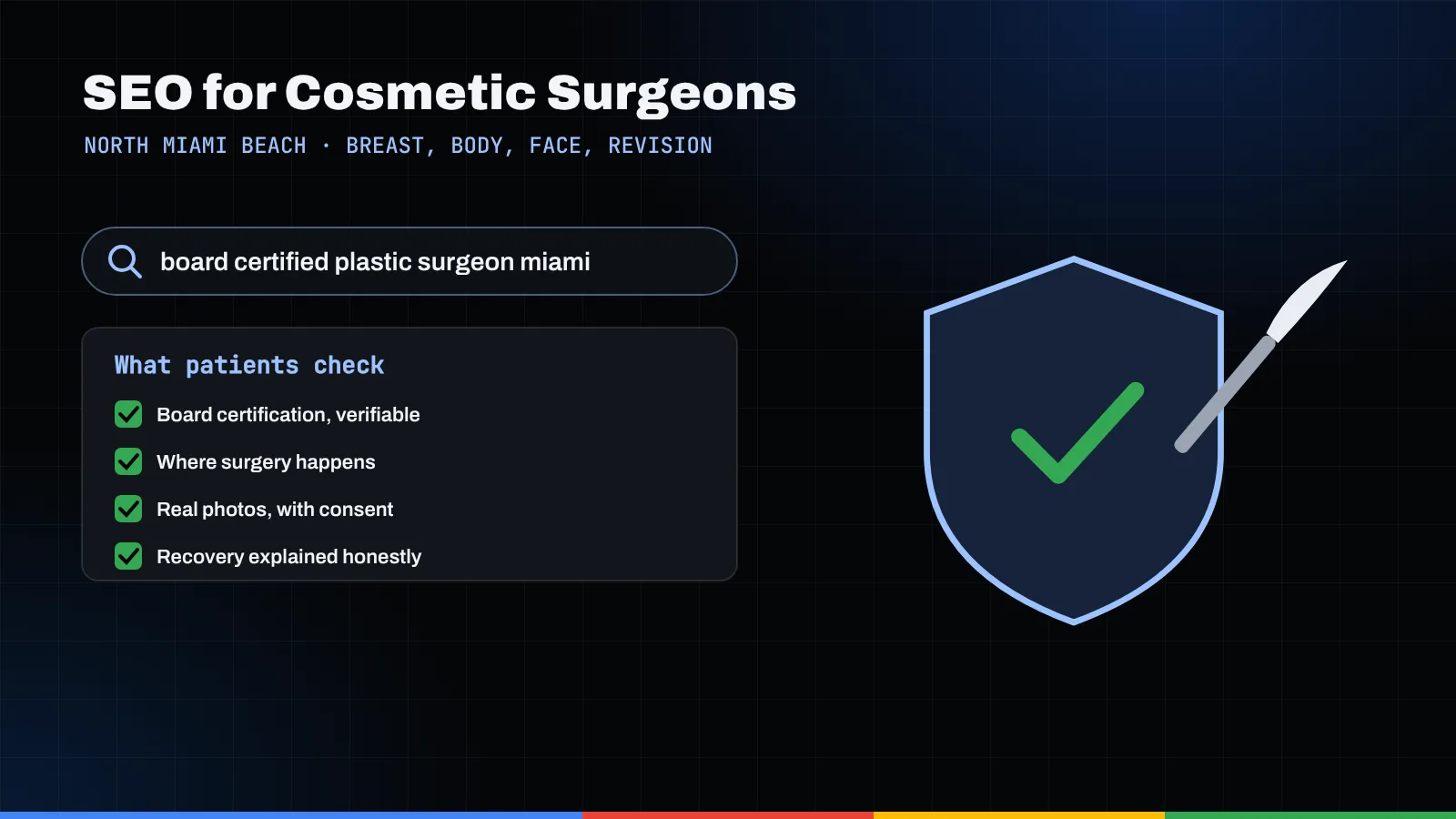
SEO for cosmetic surgeons works when the website answers the questions a careful patient asks before booking a consultation: who the surgeon is and how to verify their credentials, where the surgery happens, what each procedure and its recovery involve, and how to get a consult. For a North Miami Beach practice, that means credential pages that match Florida's advertising rules, one page per procedure, galleries built on written patient authorization, and honest review practices.
Key takeaways
- Cosmetic surgery is a "Your Money or Your Life" topic, so Google's guidance puts extra weight on trust signals like named surgeons, real credentials and accurate authorship.
- In Florida, a physician may only advertise as a board-certified specialist with formal recognition from an ABMS specialty board or another agency approved by the Board of Medicine. Give patients a way to verify it.
- Florida requires registration of offices where certain surgeries happen, and its office surgery statute sets specific standards for gluteal fat grafting. Describe your setting accurately and only claim what is true.
- Before and after photos used in marketing generally require the patient's written HIPAA authorization, and FTC rules cover testimonials, typical results and fake or incentivized reviews.
- Keep surgical pages separate from nonsurgical med spa treatments. Patients searching for each are in different places, and blending them muddies both.
Consultation: who's searching, and what worries them?
A good surgical consultation starts with listening: what the patient hopes to change, what they fear and what they've already read. SEO for cosmetic surgeons should start the same way, because the person typing "rhinoplasty surgeon near me" at 11 p.m. is comparing surgeons, worrying about safety and deciding which websites to trust.
Most searches for a plastic surgery practice fall into a few groups:
- Early researchers looking up a procedure, recovery time or what "revision" means.
- Credential checkers searching a surgeon's name plus "board certified," "reviews" or "complaints."
- Local comparers searching phrases like "breast augmentation North Miami Beach" or "plastic surgeon near me" and scanning the map results.
- Revision patients who had surgery elsewhere and are understandably cautious this time.
Each group wants evidence that this surgeon is qualified and that the practice will tell them the truth. Good plastic surgeon SEO gives them that evidence.
One scoping note. This guide is about surgical practices: breast, body contouring, facial procedures, rhinoplasty and revision surgery. If most of your revenue comes from injectables, lasers and other nonsurgical treatments, read our guide to med spa SEO in North Miami Beach instead. Surgery and med spa treatments differ in risk, recovery and the decision process, and your pages should say so plainly rather than listing a facelift next to a facial.
Surgeon's note: This article is general marketing information, not medical or legal advice. Have your compliance counsel review anything involving advertising claims, patient photos or facility disclosures.
Credentials review: why E-E-A-T matters more for surgeons
Google's guidance on creating helpful, reliable content describes how its systems look for experience, expertise, authoritativeness and trustworthiness (E-E-A-T), and says that of these, trust is most important. It also says content with strong E-E-A-T gets extra weight on topics that could significantly affect people's health, financial stability or safety. Elective surgery checks all three boxes.
The same page encourages accurate authorship information, like bylines, where readers would expect it, and treats fabricated creator profiles as a mark of low quality. For a surgical practice, that translates into a short list:
- A real surgeon bio page for each surgeon: training, board certification, hospital privileges if you choose to list them, and the procedures they actually perform.
- A named medical reviewer on every procedure page, with a "last reviewed" date that reflects a genuine review.
- A verification path so patients can confirm credentials without taking your word for it.
Getting board certification claims right in Florida
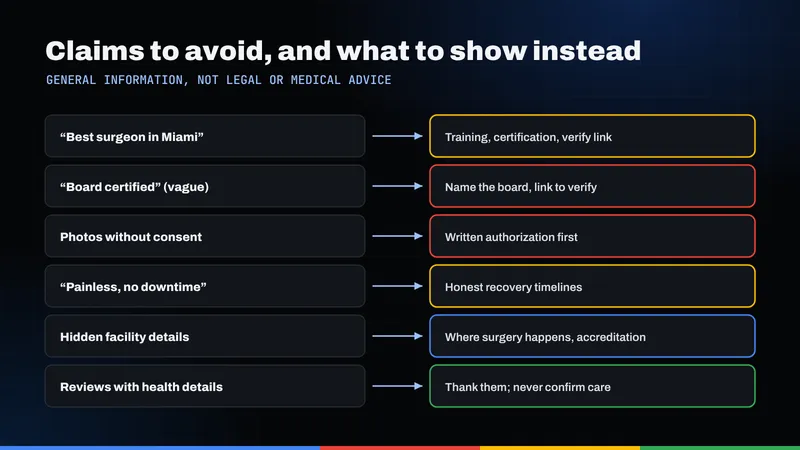
This is where cosmetic surgery marketing most often goes wrong. Florida's section 458.3312 says a physician licensed under chapter 458 may not hold themselves out as a board-certified specialist unless they've received formal recognition as a specialist from a specialty board of the American Board of Medical Specialties (ABMS) or another recognizing agency approved by the Board of Medicine. The statute also lets physicians describe the services they offer and say their practice is limited to certain services, as long as that's accurate.
In practice, that means every "board-certified" claim on your homepage, ads, social bios and directory listings should name the specific board and be true for every surgeon it covers. The American Board of Plastic Surgery, an ABMS member board, offers a public search to verify whether a surgeon is certified. ABMS also runs its own free lookup, Certification Matters, for any of its member boards. Linking to the right tool from each bio is a small, concrete trust signal.
Surgeon's note: "Cosmetic surgeon" and "plastic surgeon" are not interchangeable terms to many patients, and certifying boards differ. Describe each surgeon's training exactly as it is, and let counsel decide how to phrase anything you're unsure about.
Facility and safety facts patients look for
After "Is my surgeon qualified?" patients usually ask "Where will this happen?"
Under Florida's office surgery statute, section 458.328, an office where a physician performs liposuction removing more than 1,000 cubic centimeters of supernatant fat, or any Level II or Level III office surgery, must register with the Department of Health, unless it's a facility licensed under chapter 390 or 395. Registered offices are inspected unless accredited by a board-approved agency, and each must designate a responsible physician.
The same section sets standards for gluteal fat grafting, the procedure often marketed as a Brazilian butt lift. As of the current statute, which lists amendments in 2023 and 2024 in its history, the physician must examine the patient in person no later than the day before the procedure, fat extraction and gluteal fat injection must be performed by the physician, injection is limited to the subcutaneous space (intramuscular and submuscular injections are prohibited), ultrasound or an approved equivalent must guide the cannula during injection, and the office must keep a one-physician-to-one-patient ratio throughout the procedure.
For SEO, that doesn't mean pasting statute text onto a sales page. It means:
- If your office is registered or accredited, say so in plain words on a "Where your surgery happens" page, and keep the claim current.
- If you perform gluteal fat grafting, your procedure page can explain, in patient-friendly language, how your practice follows Florida's standards. Only describe what you actually do.
- If some procedures happen at a hospital or surgery center, say so.
Pre-op instructions: building procedure pages
A pre-op packet answers questions before the patient asks. Procedure pages should too, and each major procedure deserves its own page, because the patient searching "tummy tuck after pregnancy" has different questions than one searching "liposuction recovery."
Here's how procedures and concerns typically map to search behavior and the pages worth building:
| Procedure or concern | What patients search | Page to build |
|---|---|---|
| Breast augmentation | "breast augmentation North Miami Beach," "implant types," "breast augmentation recovery" | Breast augmentation page covering implant options, the consultation, the setting and recovery |
| Breast lift or reduction | "breast lift vs augmentation," "breast reduction surgeon near me" | Separate lift and reduction pages, plus a comparison page linking to both |
| Body contouring | "tummy tuck," "liposuction," "mommy makeover" | One page per procedure, with a combination-procedures page that links to each |
| Gluteal fat grafting | "BBL surgeon," "Brazilian butt lift safety" | A dedicated page with an accurate safety and setting section |
| Facial procedures | "facelift," "eyelid surgery," "neck lift" | Individual procedure pages; link to nonsurgical options only where clearly labeled as different |
| Rhinoplasty | "rhinoplasty surgeon," "nose job recovery," "functional vs cosmetic rhinoplasty" | Rhinoplasty page plus a recovery timeline page reviewed by the surgeon |
| Revision surgery | "breast revision surgeon," "revision rhinoplasty" | A revision page that explains the consult process for patients who had surgery elsewhere |
| Credentials | "[surgeon name] board certified," "[surgeon name] reviews" | Surgeon bio pages with verification links and real reviews |
Every procedure page should cover the same essentials in plain language:
- Who the procedure is generally for.
- What happens at the consultation.
- The setting and type of anesthesia your practice uses, described accurately.
- A general recovery overview, reviewed by the surgeon, with a clear note that individual recovery varies.
- Risks, stated honestly, with a link to your consent and safety information.
- A clear next step: request a consultation.
Avoid outcome promises, "risk-free" language and invented statistics. Our SEO services start with this page architecture because everything else depends on it.
Surgeon's note: Write recovery content as general information and send readers to the consultation for anything specific to them. A page that sounds like personal medical advice helps no one.
The procedure: your site, map listing and booking flow
Local search in North Miami Beach and beyond
Your Google Business Profile, accurate address and phone everywhere, and a location page that describes where the office is and how to get there are the basics of local search. Patients often compare surgeons across a wider area than they would a dentist, so a North Miami Beach practice may compete with offices across Miami-Dade and Broward. Good local SEO Miami strategy for a single office means a clear home base and honest coverage pages, not dozens of thin city pages. Our North Miami Beach SEO and Miami SEO pages explain our approach, built on the same local SEO fundamentals.
Booking and the consultation request
- Put "Request a consultation" on every procedure page, not just the contact page.
- Keep forms short and avoid asking for detailed medical history on an open web form. Collect it later through your secure intake process.
- Tell patients what happens after they submit: who will contact them and roughly when.
- Make the phone number tappable on mobile.
Our conversion optimization work focuses on exactly these friction points.
Financing pages without invented prices
Patients search for cost and financing, and a financing page can earn those visits. But don't publish prices you can't stand behind, and don't post an "average cost" you made up. A useful financing page explains how pricing is set at the consultation, which factors affect it (procedure, anesthesia, facility and so on), the payment and financing options you actually accept, and any terms the lender requires you to disclose. If you name a financing company, make sure your description matches their current terms.
If you run paid search, remember that Google Ads has its own healthcare and personalized advertising policies that can affect what you say and how you target. Review them before launching, or let a Google Ads specialist check your setup.
Recovery: before and after galleries done right
The gallery is often the most-visited and most sensitive part of a plastic surgery website.
HHS guidance on marketing under the HIPAA Privacy Rule says the rule requires an individual's written authorization before their protected health information is used or disclosed for marketing, with limited exceptions. Treat that as the starting point for every gallery photo.
Imagine a hypothetical practice we'll call Corallis Plastic Surgery building its first gallery. A careful process would look like this:
- Written authorization first. A signed authorization that specifies where the photos may appear (website, social media, ads) before any image is published.
- Consistent, unretouched photos. Same lighting, angles and framing before and after, with no editing that changes the result.
- Context for each case. The procedure performed and the surgeon, without identifying details the patient didn't agree to share.
- Honest framing. Avoid implying everyone gets the same result. The FTC's guides on consumer endorsements say a disclaimer like "results not typical" isn't enough on its own; if a result isn't what patients can generally expect, the ad needs to say what is.
- A revocation plan. If a patient revokes authorization, remove their photos from every place you control, promptly.
For search, organize galleries by procedure, link each from its procedure page and add descriptive text to each case.
Surgeon's note: Never feature a photo just because it's dramatic. A gallery that represents your typical work builds more trust than one that only shows outliers.
Follow-up: reviews, testimonials and tracking
Reviews and the FTC
The FTC's Endorsement Guides (16 CFR Part 255) say endorsements must reflect the endorser's honest opinions and experience, that advertisers shouldn't procure, suppress, boost or edit reviews in ways that distort what consumers think, and that material connections, like payment or free services, must be disclosed clearly and conspicuously.
In 2024 the FTC also announced a final rule banning fake reviews and testimonials. Among other things, it covers fake reviews (including AI-generated ones), incentives conditioned on positive or negative sentiment, undisclosed insider reviews, and using threats or intimidation to suppress negative reviews.
For a surgical practice, a clean review program looks like this:
- Ask every patient the same way, at a consistent point in their follow-up care, regardless of how you think they'll respond.
- Never offer discounts or gifts for positive reviews.
- Don't let staff or their families post reviews without clear disclosure.
- Reply to reviews without confirming the reviewer is a patient or mentioning any procedure. Thank them and invite them to call the office.
What to track
Measure consultation requests by procedure page, calls from your Google Business Profile, rankings for your main procedures and the pages patients view before booking. Keep tracking tools away from any form fields that collect health information, and review that setup with your compliance team.
Schema markup for a plastic surgery practice
Schema.org defines PlasticSurgery both as a type of medical business and as a value in its MedicalSpecialty list. That gives you a few useful building blocks:
- MedicalClinic or PlasticSurgery for the practice itself, with name, address, phone, hours and a medicalSpecialty of PlasticSurgery.
- Physician for each surgeon, which supports properties like medicalSpecialty, hospitalAffiliation, availableService and usNPI.
- availableService on the practice or physician, pointing to the procedures you perform.
Mark up only what's visible and true on the page. Our post on how schema helps search engines covers the basics, and the dermatologist SEO guide shows how a related medical specialty handles physician markup.
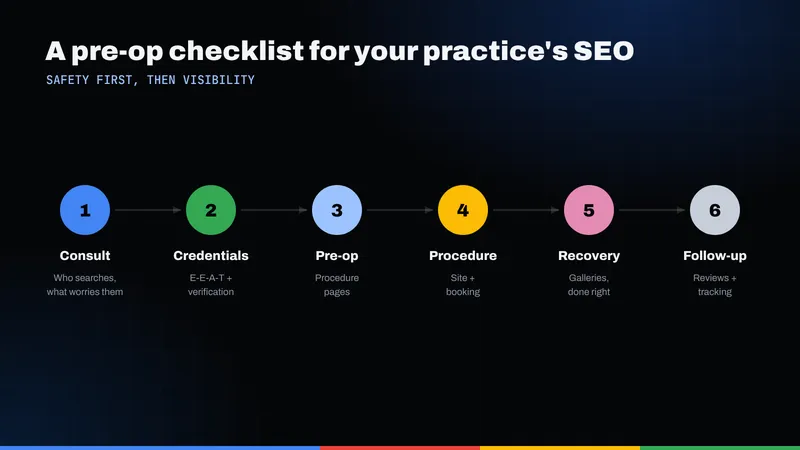
A pre-op checklist for your website
Before you invest in more content or ads, confirm these:
- Every surgeon bio names the specific certifying board and links to verify it.
- Your setting is described accurately, including registration or accreditation.
- Each major procedure has its own reviewed page, separate from nonsurgical services.
- Every gallery photo has a written authorization on file.
- Reviews follow FTC rules, financing pages carry no invented prices, and consultation requests are tracked by page.
Want a second set of eyes? Request a free SEO audit and we'll review your site against this checklist.
Frequently asked questions
What is the most important part of SEO for cosmetic surgeons?
Trust. Google's guidance gives extra weight to trust signals on health topics, so accurate surgeon bios, verifiable board certification, honest procedure pages and a clear consultation path matter more than volume of content.
Can our website say our surgeons are "board-certified"?
Only if it's accurate for each surgeon the claim covers. Florida's section 458.3312 says a physician may not hold out as a board-certified specialist without formal recognition from an ABMS specialty board or another agency approved by the Board of Medicine. Name the board and link to its public verification tool.
Do we need patient permission to post before and after photos?
Generally, yes. HHS guidance says the HIPAA Privacy Rule requires a patient's written authorization, with limited exceptions, before their protected health information is used for marketing. Get a signed authorization covering each use, and remove photos promptly if it's revoked.
Should we list prices on our website?
Only prices you can stand behind. Many practices explain how pricing is set at the consultation, which factors affect it, and which payment and financing options they accept. Never publish invented averages or prices that may not apply.
Should our med spa services be on the same pages as surgery?
No. Give surgical procedures and nonsurgical treatments separate pages. They differ in risk, recovery and decision process, and patients searching for each expect different information. Link between them only where clearly labeled.