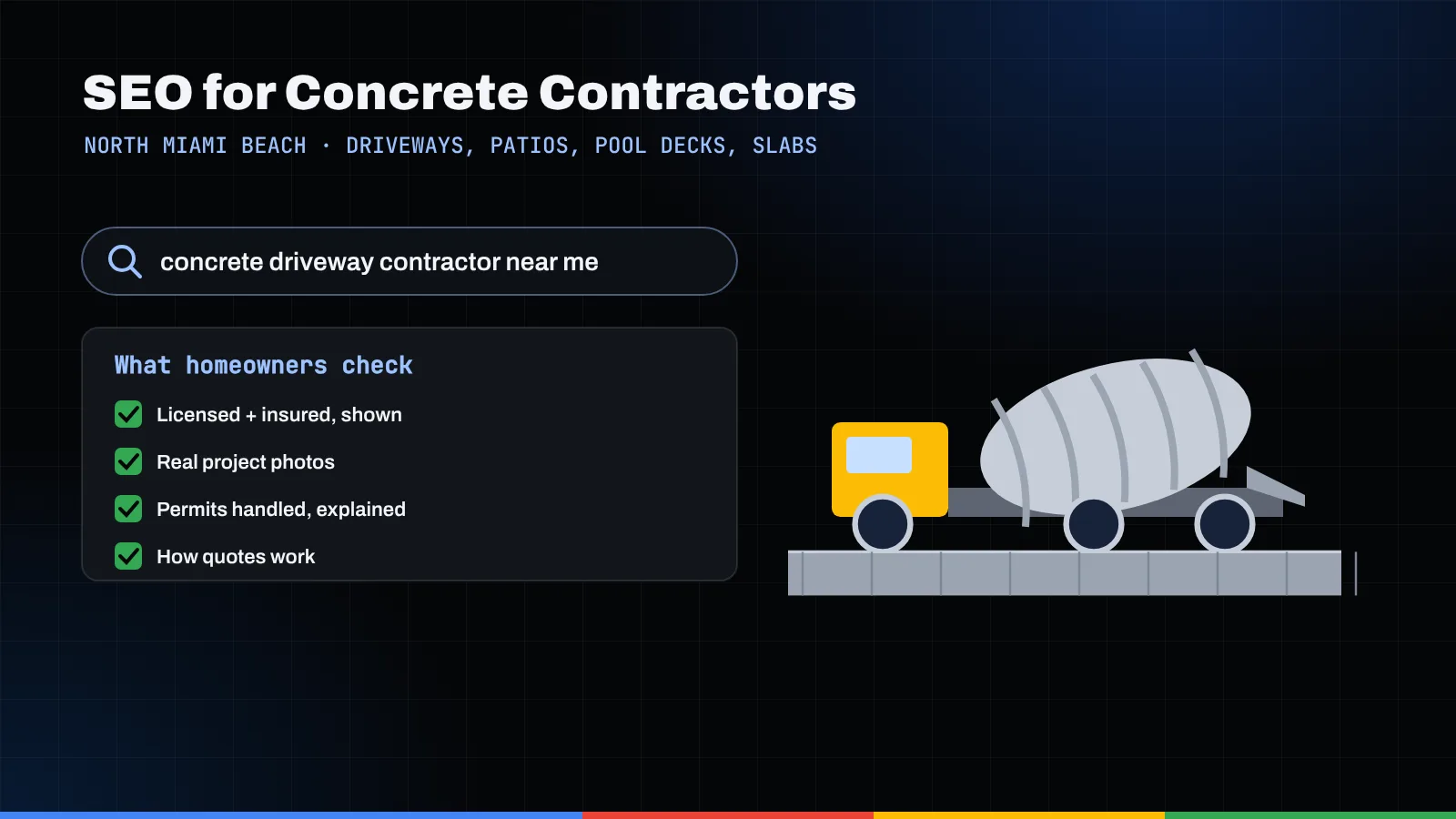
Concrete work is won locally, so SEO for a concrete contractor comes down to a few solid layers poured in the right order: know what homeowners search, give every job type its own page, run a Google Business Profile that follows the rules, show real photos of real slabs, and let honest reviews build up over time. Skip a layer and the whole thing cracks, usually right where a customer was about to call.
Key takeaways
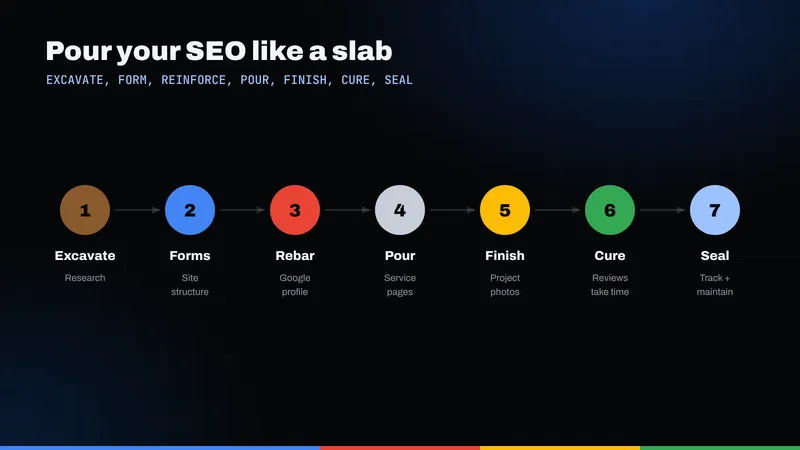
- Treat marketing like a pour: excavate (research), set forms (site structure), tie rebar (Google profile), pour (service pages), finish (photos), cure (reviews) and seal (tracking).
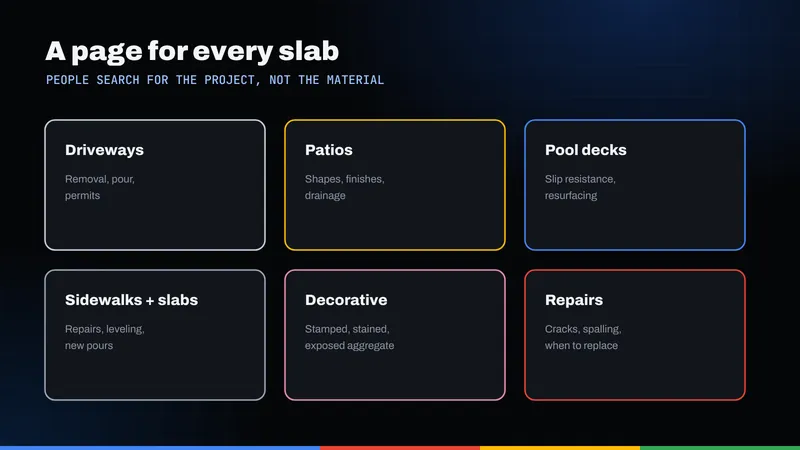
- Build separate pages for driveways, patios, pool decks, slabs, sidewalks, decorative and stamped concrete, and repairs. One "Services" page can't rank for all of them.
- Service-area contractors should hide a home address on Google Business Profile, keep the service area within about two hours of driving, and use their real business name with nothing added.
- Florida licensing for concrete depends on the job. Driveway installation is listed among scopes local governments can't license, while structural concrete falls under a state specialty category. In North Miami Beach, driveway and right-of-way permits run through the city's Public Works engineering staff.
- Reviews take time to cure. Ask every customer, never pay for praise, and never filter out the unhappy ones.
Why treat SEO like a concrete pour?
Because concrete is unforgiving about sequence, and so is search. You can't finish a slab you haven't poured, and you can't pour into forms you never set. Plenty of contractors skip straight to the shiny part (a new website, a burst of ads) on ground nobody compacted, then wonder why the phone stays quiet.
This guide to SEO for concrete contractors follows the order of a real job. To keep it practical, picture a hypothetical crew called Ironwake Concrete Co. that pours driveways, patios and pool decks around North Miami Beach. Ironwake is made up for this article. It has no clients, no reviews and no results. It just gives us somewhere to stand.
If you run a broader trade business, our general guide to SEO for contractors in North Miami Beach covers the shared basics. This one stays on concrete. For how we approach the city as a market, see our North Miami Beach SEO page.
Excavate: what do customers actually search for?
Every pour starts by digging out to stable ground. In SEO, stable ground is the real language customers use. A homeowner with a cracked driveway does not search "flatwork solutions." They search "driveway repair near me" or "concrete driveway cracked what to do."
Concrete demand splits cleanly by job, which is good news: each job is its own search, its own buyer and its own page. Here's the map we'd sketch for Ironwake. The phrases are typical of how people search, not measured volumes.
| Job | What customers search | Page to build |
|---|---|---|
| New or replacement driveway | "concrete driveway installation," "driveway replacement near me" | Concrete driveways |
| Backyard patio | "concrete patio contractor," "patio slab cost" | Concrete patios |
| Pool deck resurfacing or new deck | "pool deck resurfacing," "cool deck pool deck" | Pool decks |
| Shed, AC pad or addition base | "concrete slab for shed," "slab contractor" | Concrete slabs |
| Walkway or front sidewalk | "sidewalk repair," "concrete walkway installation" | Sidewalks and walkways |
| Choosing a material | "pavers vs concrete driveway," "are pavers better than concrete" | Pavers vs. concrete guide |
| Patterned or colored surface | "stamped concrete patio," "decorative concrete near me" | Stamped and decorative concrete |
| Cracks, sinking, spalling | "concrete crack repair," "sunken driveway repair" | Concrete repair |
Two things jump out. First, "pavers vs concrete" is a research search, not a hire-me search. It deserves an honest guide that explains the trade-offs, whether or not you lay pavers yourself.
Second, geography sits inside many of these searches, typed or implied. That's where local SEO Miami work matters, since Google weighs proximity and relevance for "near me" searches. Our keyword research guide walks through building a list like this.
Foreman's note: if you don't do a job, leave it off the map. A page for stamped concrete you've never stamped is a callback waiting to happen.
Forms: how should the website be structured?
Forms decide the shape of the slab before a single yard of concrete shows up. Site structure does the same job. Get it wrong and pages bleed into each other until Google can't tell which one to rank.
A simple, sturdy layout for a concrete contractor:
- Home page: who you are, the area you serve, your main services, a phone number that works, and a few of your best project photos.
- One page per service from the table above, each with its own title, heading and photos.
- A projects section with individual write-ups (more on that under Finish).
- An about page with the owner's name, how long you've been pouring, and the licenses and insurance you actually hold.
- A contact page with a short quote form that asks for the job type, the rough size, and photos of the area.
Keep URLs plain: /concrete-driveways/, /pool-decks/, /stamped-concrete/. Make sure the site loads quickly on a phone, because plenty of homeowners will look you up while standing on their cracked driveway. If the build itself needs work, that's what our website design team handles.
Foreman's note: don't build fifty city pages that say the same thing with the town name swapped. That's a cold joint in content form, and it shows.
Rebar: how do you set up a Google Business Profile?
Rebar is the part nobody sees that holds everything together. Your Google Business Profile plays that role, and for many local searches the map listing is where the call happens.
Most concrete contractors are service-area businesses. You go to the customer; they don't come to you. Google's guidelines for representing your business spell out the rules that matter most here:
- Hide your address if customers don't visit it. A crew running out of the owner's house or a yard customers never see should not show that address publicly.
- Keep the service area realistic. Google says a service area generally shouldn't extend farther than about two hours of driving time from where the business is based.
- Use your real name. The business name has to match how you're known in the real world. No added taglines, service words or locations. "Ironwake Concrete Co." is fine. "Ironwake Concrete Co. Best Driveways North Miami Beach" is not.
Then fill the profile in completely: the most accurate primary category, the services you offer, a plain description, and real photos of your crew and work. For the ranking side, see how Google Maps rankings work.
What about Local Services Ads?
Google's Local Services Ads put a "Google Verified" badge next to a contractor's ad. When we checked Google's list of eligible business categories for the US, we didn't find a dedicated concrete or paving category. Nearby options such as general contractor, foundations services and pool contractor do appear. Only sign up under one that honestly fits your work, and check the current list, because categories change.
What should you say about licensing and permits?
This is where concrete gets more complicated than most trades, so be careful with your copy.
Florida Statutes section 489.117(4) says that work which doesn't substantially correspond to a state contractor category doesn't require state registration, and that local governments can't require a license for it. Its list of example job scopes includes driveway or tennis court installation. The statute doesn't name concrete, patios or sidewalks specifically, and the list is examples rather than a complete one.
Structural concrete is a different story. Florida's Construction Industry Licensing Board rule on certified specialty contractors (61G4-15.100) includes a structural masonry specialty contractor category whose scope covers forming, placing and finishing concrete, including foundations, slabs and footers. So a decorative patio and a structural slab for an addition can sit under very different rules.
Permits are a separate question from licensing. In North Miami Beach, the city's Public Works department says it administers engineering permits, including driveway, paving and right-of-way permits. Some roads are maintained by the county rather than the city, so if a job touches the swale or the sidewalk out front, ask who has jurisdiction before you pour.
What this means for your website:
- List the licenses and insurance you actually hold, with license numbers where they apply.
- Don't imply that "no license required" means "no permit required."
- Say plainly that you pull permits when the job calls for them.
- When in doubt about a specific job, check with the building department. We aren't your lawyer, and neither is your website.
Pour: what goes on a concrete service page?
This is the main event. Each service page should answer the questions a homeowner has before they'll pick up the phone. A good driveway page for Ironwake might cover:
- What the job involves: tear-out, base prep, forms, reinforcement, pour, finish and cure time before the car goes back on it. Use your own process and your own timelines, not numbers from somebody else's blog.
- Finish options: broom finish, exposed aggregate, stamped, colored. Show photos of each that you poured.
- Florida conditions: heat, heavy rain and drainage affect how you schedule and slope a slab. Explain how you handle them, in your own words.
- Permits and licensing: a short, accurate line, as covered above.
- Where you work: North Miami Beach and the nearby cities you genuinely serve.
- How to get a quote: one clear call to action, a phone number and a short form.
- A few FAQs from real customer questions.
Each page also needs a specific title tag and heading. "Concrete Driveways in North Miami Beach | Ironwake Concrete Co." beats "Services | Home." Our on-page SEO guide covers the details.
The repair page deserves special care. Repair searches come from people with a specific worry: a trip hazard, a sunken section, a flaking pool deck. Explain when repair makes sense and when replacement is the honest answer. A contractor who will say "this one needs to come out" earns trust a sales page never will.
Foreman's note: nobody reads a page that's all adjectives. "Premium, top-quality, unmatched concrete solutions" tells a homeowner nothing about their driveway.
Finish: how should you use photos and project write-ups?
Concrete is a visual sale. Nobody hires a stamped-concrete contractor without seeing stamped concrete. Your photos are the finish coat.
A few rules for project galleries:
- Use your own photos. Stock images of somebody else's pool deck are misleading, and customers can usually tell.
- Show the process, not just the result. Forms set, rebar or mesh in place, the pour, the finished slab. It proves you do the work.
- Take before-and-after shots from the same angle. A cracked, heaved driveway next to the clean replacement says more than a paragraph.
- Name the files and write alt text that describes what's in the photo, like "stamped concrete patio with ashlar slate pattern."
- Get permission before you show a customer's home, and leave out house numbers and faces.
Then turn your best jobs into short project write-ups: what the customer needed, the general area (not the address), what you poured, the finish, and a handful of photos. Imagine Ironwake writing up a pool deck resurfacing, from the old surface to the finish chosen and why. That page can rank for specific searches and gives your service pages something real to link to.
Cure: why do reviews take time?
Concrete gains strength slowly, and rushing the cure ruins the slab. Reviews work the same way: a steady trickle from real customers beats a sudden flood that looks suspicious.
Ask every customer, not just the happy ones. Google's policy on fake engagement doesn't allow businesses to pay for reviews, offer discounts in exchange for them, post reviews from owners or employees, discourage negative reviews, or selectively ask only satisfied customers. You can absolutely encourage reviews. You just can't rig them.
Federal rules point the same direction. The FTC's final rule on fake reviews and testimonials, announced in 2024, bans fake reviews, incentives conditioned on positive or negative sentiment, undisclosed insider reviews and review suppression through threats or intimidation.
A practical routine for a concrete crew:
- Text the customer a direct review link once the slab has cured and they've used it for a bit.
- Ask them to mention what you did, like "pool deck" or "driveway." Don't script the words.
- Reply to every review, good or bad, briefly and politely.
- When a review is negative, answer with facts and an offer to make it right. Never with threats.
Foreman's note: the customer with the hairline crack is going to post about it either way. A calm, specific reply helps you more than a perfect record ever could.
How long all this takes varies by market and starting point. Our post on how long SEO takes explains what to expect.
Seal: how do you protect and maintain the work?
A sealed slab lasts longer. In SEO, sealing means structured data, upkeep and measurement.
Schema markup
Schema.org has a GeneralContractor type, which sits under HomeAndConstructionBusiness, which in turn sits under LocalBusiness. There isn't a concrete-specific type, so most concrete contractors would use one of those two. Fill in your real name, phone, hours, website and the areaServed property for the cities you cover. For a service-area business that hides its address publicly, keep the markup consistent with what your profile shows. Our explainer on how schema helps search engines goes deeper.
Tracking and upkeep
- Track calls and form fills by page, so you know whether the pool deck page or the driveway page is bringing in work.
- Watch Google Business Profile insights for calls, website clicks and direction requests.
- Use Google Search Console to see which searches your pages appear for.
- Refresh pages when your services, finishes or service area change, and add new project write-ups as you finish good jobs.
- Keep your name, phone and website consistent everywhere they appear online.
That last one is boring. It's also one of the easiest ways to keep concrete contractor SEO from crumbling at the edges.
Where should a concrete contractor start?
If you only have time for three things this month, do them in order: clean up your Google Business Profile, build one strong page for your most profitable job with your own photos, and start asking every finished customer for a review.
Then keep pouring, one page at a time. The SEO Miami contractors win with isn't flashy. It's specific, accurate and consistent, which is exactly what customers want from whoever pours their driveway.
Ribacoff Enterprises handles local SEO, Google profile work and websites for service businesses. If you'd like a second set of eyes on where your foundation is weak, request a free audit and we'll tell you what we'd fix first.
Frequently asked questions
What is the first step in SEO for concrete contractors?
Start with a Google Business Profile that follows Google's rules and a separate website page for each concrete service you offer. For a service-area business, that means hiding a home address, keeping the service area realistic and using your real business name with nothing added.
Should driveways, patios and pool decks each have their own page?
Yes. Each is a different search from a different customer. A dedicated page with its own title, photos and FAQs gives Google a clear match and gives homeowners the details they want before calling.
Do I need a license to pour concrete driveways in Florida?
It depends on the job. Florida Statutes 489.117(4) lists driveway installation among job scopes that don't require state registration and that local governments can't license, while structural concrete work falls under a state specialty contractor category. Permits are a separate matter, so check with the local building department or public works office before each job.
Can concrete contractors use Google Local Services Ads?
When we checked Google's US category list, there was no dedicated concrete or paving category. Related categories such as general contractor and foundations services do exist. Only sign up under a category that honestly matches your work, and check the current list because it changes.
Can I give customers a discount for leaving a review?
No. Google's policies don't allow paying for reviews or offering discounts in exchange for them, and the FTC's 2024 rule bans incentives conditioned on positive or negative sentiment. Ask every customer for an honest review and reply to all of them.